62 companies
RevolutFeatured
Wealth🇱🇹 Lithuania
Nik Storonsky grew up moving between Russia and France before landing in London as a derivatives trader. Vlad Yatsenko was a software engineer who'd spent years building financial systems. In 2015 they sat down and asked a question that should have occurred to banks years earlier: why does spending money abroad still cost so much?
The answer they built was Revolut — initially a prepaid card with no foreign exchange fees, then a multi-currency account, then a trading platform, then an insurance product, then a business banking offering, then something that's increasingly hard to describe as anything other than a full financial operating system. Revolut didn't unbundle banking so much as rebuild it from scratch for people who found the existing version frustrating and expensive.
The numbers now are genuinely striking for a company that started with two people and a card. Revenue reached £4.5 billion in 2025, up 46% year on year, with net profit of £1.3 billion. The customer base grew to 68.3 million retail users — one in five working-age adults in Europe — plus 767,000 businesses. The company employs 12,200 people across more than 25 countries and was valued at $75 billion in a November 2025 secondary share sale, making it Europe's most valuable private technology company.
The milestone that mattered most, though, arrived in March 2026: a full UK banking licence from the Prudential Regulation Authority, ending a three-year application process that had become the most-watched regulatory saga in European fintech. The licence means Revolut can now protect UK deposits up to £120,000, offer authorised consumer credit, and compete directly with high street banks for mortgage and lending business. It's the piece that transforms Revolut from a very successful payments app into a regulated bank.
The company has also applied for a US banking charter and is expanding aggressively into Latin America, having opened its first bank outside Europe in Mexico. The original thesis — that banking could be cheaper, faster, and simpler — hasn't changed. The scale at which it's now being tested has.
MonzoFeatured
Wealth🇬🇧 United Kingdom
The founding team that built Monzo had all worked together before — at Starling Bank, another challenger bank startup that didn't survive its internal conflicts. Tom Blomfield, Gary Dolman, Jonas Huckestein, Jason Bates, and Paul Rippon left Starling together in 2015 and started again. The product they built was initially a prepaid card — a coral-coloured piece of plastic that became one of the most recognisable objects in British fintech — before becoming a fully licensed current account in 2017.
The early user community was unusual for a bank. Monzo ran community forums, published public blog posts about its engineering decisions, and invited customers into beta programmes for new features. When it broke the world record for the fastest crowdfunding raise in 2016 — £1 million in 96 seconds — it wasn't just raising money; it was building an identity. People felt ownership of the product in a way that no high street bank had ever managed to create. That emotional connection became a genuine competitive advantage.
The product has matured considerably since then. Monzo now offers current accounts, joint accounts, savings pots, personal loans, overdrafts, and investment products, all wrapped in the real-time notification experience and transaction categorisation that made its early reputation. Revenue reached £1.23 billion in 2024, up 40% year on year, with net income of £95 million — the second consecutive year of profitability after years of growth-first losses. The customer base reached 12.1 million by end of 2024, making Monzo the UK's largest digital bank by customer count. Customer deposits stood at £16.6 billion.
The business is still private — the much-discussed IPO has not yet happened, and internal disagreements about where to list (the former CEO TS Anil favoured the US, the board preferred London) contributed to Anil's departure in October 2025. Diana Layfield took over as CEO with a mandate focused on international expansion before any public listing. The company is valued at approximately $5.9 billion following a 2024 secondary sale backed by Alphabet's GIC and StepStone.
In December 2025 Monzo announced it had agreed to acquire Habito, the digital mortgage broker, pending regulatory approval — a move that extends the product into one of the last major financial products it didn't yet offer. With 3,821 employees and a loan book growing rapidly, Monzo has evolved from a prepaid card experiment into a bank with genuine scale and a growing claim on being the primary financial account for a generation of UK consumers.
Artemundi
Wealth🇩🇪 Germany
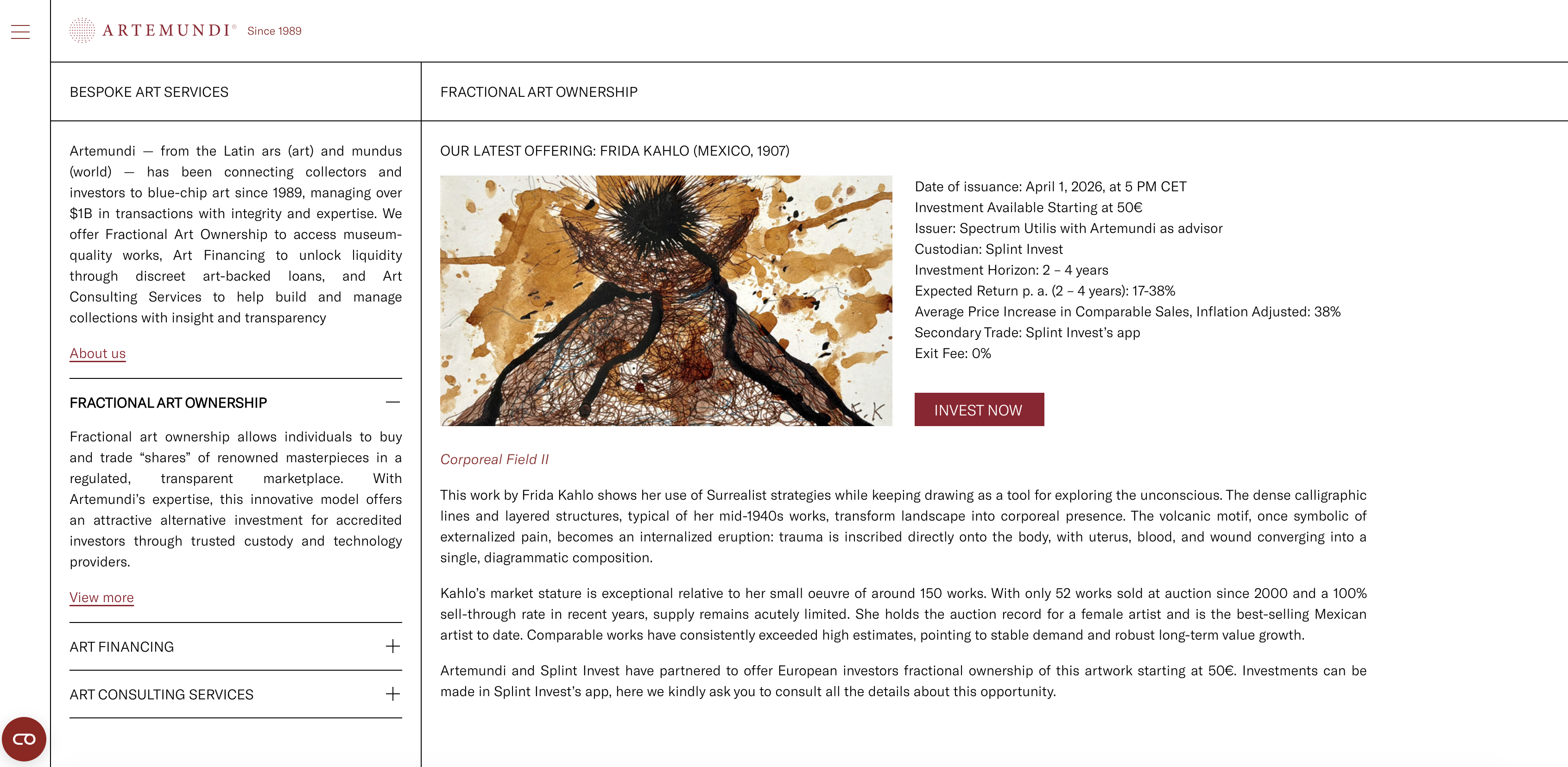
Artemundi is an alternative asset manager built for the modern wealth ecosystem. Rather than chasing traditional markets, the firm specializes in emerging market debt, private equity, and distressed assets—seeking returns where conventional investors see opacity. It's positioned at the intersection of hedge fund sophistication and institutional rigor, attracting wealth managers and sophisticated investors who understand that real returns often live outside the mainstream.
The company runs multiple investment vehicles targeting different risk appetites and timeframes, each managed with the discipline of a tier-one institutional shop. Their approach combines deep emerging market expertise with operational rigor, allowing them to navigate complexity that smaller competitors cannot. This isn't retail wealth management repackaged; it's institutional-grade alternative investing for those who can access it.
In the European wealth tech landscape, Artemundi represents the alternative asset class gatekeepers—firms that manage substantial capital across non-traditional strategies. While the fintech world obsesses over fractional shares and gamified trading, Artemundi operates in the space where serious capital allocation happens. They cater to family offices, pension funds, and institutional investors who view alternative assets as core portfolio components rather than exotic bets.
The firm embodies a particular European investment philosophy: skepticism of index-heavy approaches, appetite for frontier markets, and belief that skilled managers can exploit inefficiencies where passive strategies cannot. In an era of wealth fragmentation and advisor tech disruption, Artemundi remains a destination for institutional-grade alternative returns.
Partasio
Wealth🇨🇭 Switzerland
Most people think of art as something you hang on a wall, not something you add to a portfolio. That’s exactly the gap Partasio is trying to close.
Based in Switzerland, Partasio sits at the intersection of finance and culture, turning blue-chip art into a structured investment product. Instead of buying a single painting for millions, investors can access curated portfolios of museum-grade works—fractionalized, packaged, and managed like a financial asset.
At its core, the model is simple but powerful. Partasio builds portfolios of 4–6 high-end artworks from globally established artists, typically sourced off-market through private networks. Each portfolio is placed into a single-purpose vehicle, and investors buy into it through bankable certificates—complete with a Swiss ISIN—making it look and behave more like a traditional financial instrument than an art purchase.
The pitch isn’t just about access—it’s about diversification. Blue-chip art has historically shown low correlation with traditional asset classes like equities or real estate, making it attractive for investors looking to balance risk. But until recently, that market was largely reserved for ultra-wealthy collectors. Partasio lowers that barrier, with minimum investments starting around CHF 30,000.
What makes the platform stand out is how it blends private equity logic with the art world. Portfolios are actively managed over a multi-year horizon, with returns realized when the artworks are sold—typically within three to seven years. The company’s incentives are aligned with investors, earning performance fees only when profits are generated.
It’s part of a broader shift in fintech toward alternative assets—where everything from real estate to art is becoming more accessible, structured, and digital. But Partasio leans into something slightly different. It doesn’t try to reinvent art. It simply builds a financial layer around it.
In a market that’s historically opaque and exclusive, that alone is enough to make it stand out.
Nordnet
Wealth🇸🇪 Sweden
Pan-Nordic retail investing requires more than translating a Swedish product into Norwegian, Danish, and Finnish. Each Nordic market has its own pension system, tax-advantaged investment accounts, regulatory framework, and consumer expectations — complexity that has kept many investment platforms confined to a single national market. Nordnet was founded in Stockholm in 1996 with the explicit ambition to build a genuinely Pan-Nordic investment platform, and has spent nearly three decades doing it. Its platform serves customers across Sweden, Norway, Denmark, and Finland, offering stocks, funds, ETFs, pensions, and savings products tailored to each market's specific tax-advantaged account structures. The cross-border depth is genuinely unusual — most Nordic financial services companies that operate internationally do so through separate national entities with separate products, rather than the integrated platform approach that Nordnet has built. The company is publicly listed on the Stockholm Stock Exchange and competes directly with Avanza in the Swedish market while occupying dominant positions in several other Nordic countries. In the European retail investment landscape, Nordnet's combination of cross-border integration and decades of operational depth makes it one of the most credible regional brokers in any European market — a model that the rest of Europe has been slower to replicate.
Anaxago
Embedded Finance🇫🇷 France
Anaxago is a European investment platform that democratizes access to private market deals, letting retail investors back startups and SMEs that would normally require deep pockets and insider connections. The platform sidesteps the gatekeeping that has long defined venture capital, offering curated equity stakes in growth-stage companies across tech, real estate, and other sectors. Founded in 2014, it operates across multiple European markets and has processed hundreds of millions in investments, positioning itself as a bridge between ambitious entrepreneurs and everyday investors seeking portfolio diversification beyond public markets. What sets Anaxago apart is its focus on transparency and accessibility. Rather than opaque fund structures or minimum investment requirements that exclude ordinary savers, it lets users invest from relatively modest amounts while maintaining rigorous due diligence on every deal. The platform handles the mechanics of investment management, shareholder rights, and secondary market liquidity—functions that typically require armies of lawyers and compliance teams. It's part of a broader shift toward democratized finance, where technology makes previously exclusive opportunities available to anyone with capital and appetite for risk. In the European fintech landscape, where crowdfunding and alternative investment platforms have proliferated, Anaxago has carved out credibility through regulatory compliance, deal flow quality, and a genuine commitment to investor protection. It represents how fintech can unbundle traditional wealth management, making private market exposure a normal part of retail investing rather than a privilege reserved for the wealthy.
SeedBlink
Financial Infrastructure🇷🇴 Romania
SeedBlink enables investors to access European startup investment opportunities.
Primary Bid
Wealth🇬🇧 United Kingdom
Primary Bid sits at the intersection of investment access and market fairness. For years, retail investors have watched from the sidelines while institutional players get first crack at hot IPO allocations. Primary Bid flips that script, letting everyday people invest in initial public offerings directly, cutting out the traditional gatekeepers that have hoarded these opportunities.
The platform operates as a digital intermediary between retail investors and companies going public, democratizing access to what was once a VIP-only event. It's not just about fairness—it's about giving ordinary Europeans the chance to participate in wealth creation at the most exciting moment in a company's lifecycle.
Unlike traditional investment banks that cherry-pick their favored clients, Primary Bid opens the IPO window to anyone with a UK brokerage account. This challenges the old model where your wealth determined your access. The company essentially rebuilds the IPO process for the internet age, stripping away exclusivity and replacing it with transparency and scale.
In the broader fintech landscape, Primary Bid represents a quiet but powerful shift toward democratized capital markets—proving that retail investors aren't just traders chasing memes, but serious participants worthy of institutional-quality opportunities.
Raisin
Wealth🇩🇪 Germany
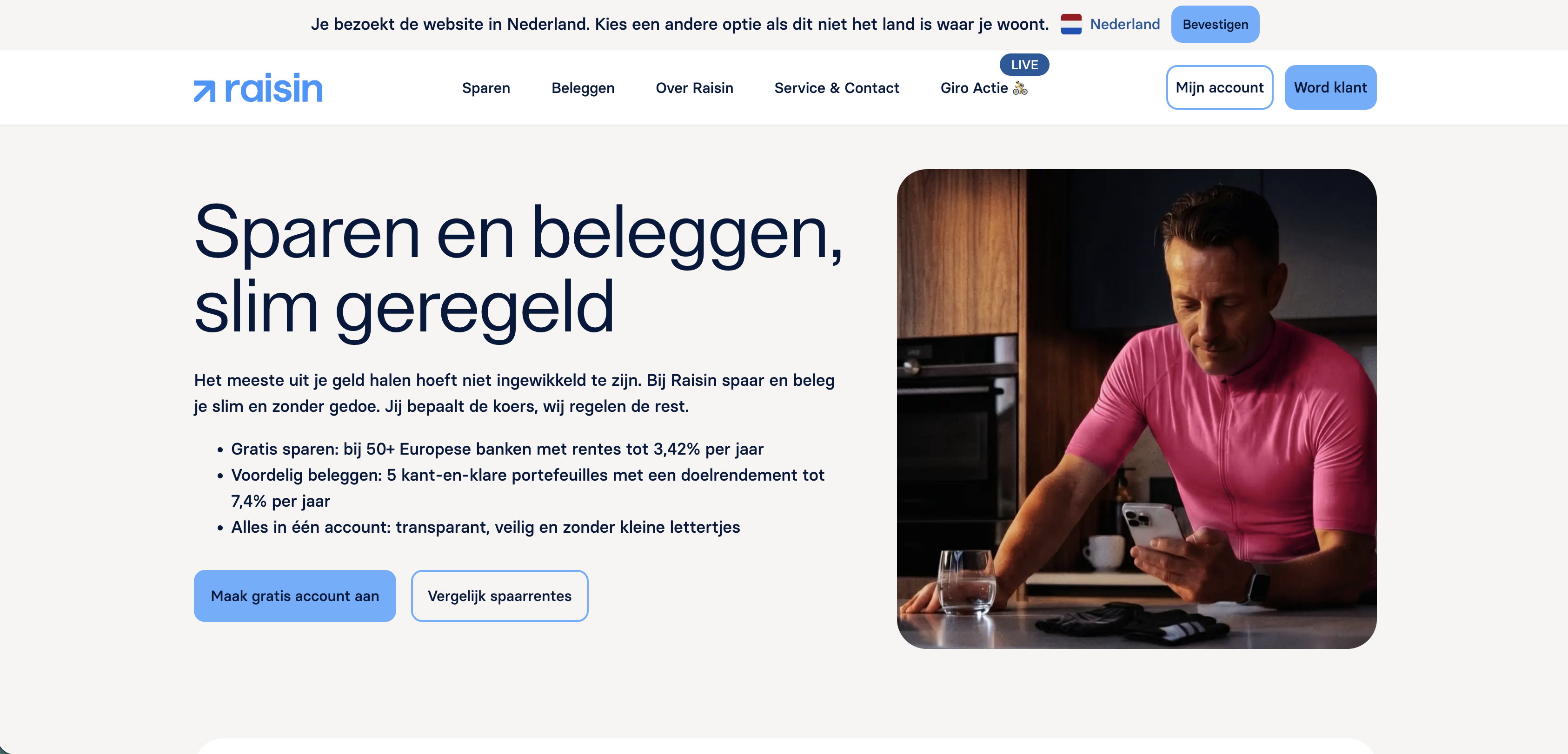
Raisin operates as Europe's leading savings marketplace, connecting millions of savers with competitive deposit and investment products across a fragmented banking landscape. Rather than building its own bank, Raisin has assembled a platform that lets customers shop for the best rates on savings accounts, fixed-rate deposits, and bonds from hundreds of partner institutions—cutting through the friction that keeps most European savers stuck with their hometown banks paying near-zero interest. The core insight is deceptively simple: most people never comparison shop for savings because it's tedious, so they leave money on the table. Raisin automated that tedium and standardized the onboarding, making it easy to move cash between institutions in search of yield. This positions it somewhere between a broker, a marketplace operator, and a fintech enabler. The platform operates across multiple European markets—Germany, Austria, Spain, France, and the UK—and has scaled to manage billions in deposits through its partner banks. By aggregating demand and making switching painless, Raisin has built a defensible moat in an industry where incumbents have historically relied on customer inertia. Unlike neobanks chasing transaction volume or fintechs building products for the already-engaged, Raisin targets the vast middle: ordinary savers who want better returns without complexity. Its expansion into investment products shows ambition to become the default platform for European retail savings and wealth building, operating as infrastructure for the continent's distributed banking system.
Alpian
Wealth🇨🇭 Switzerland
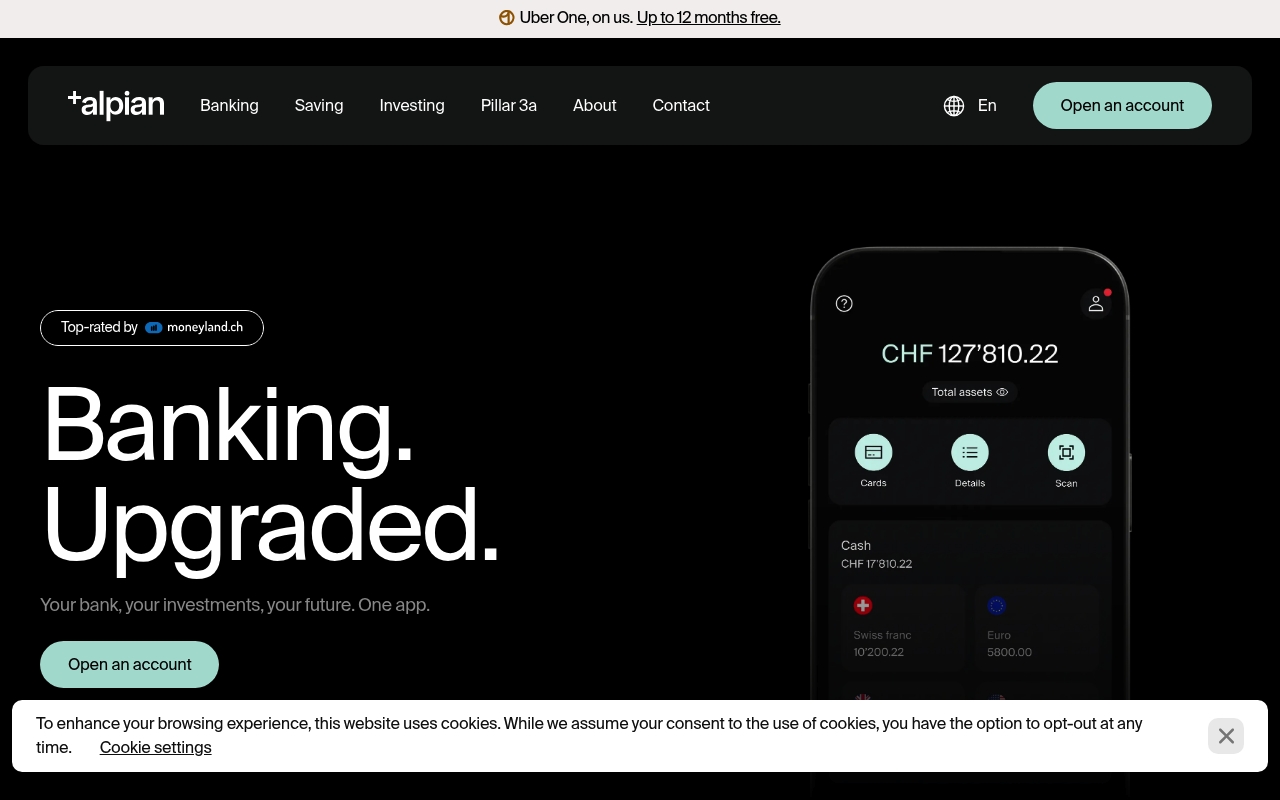
Alpian is a Swiss digital private bank combining wealth management and everyday banking.