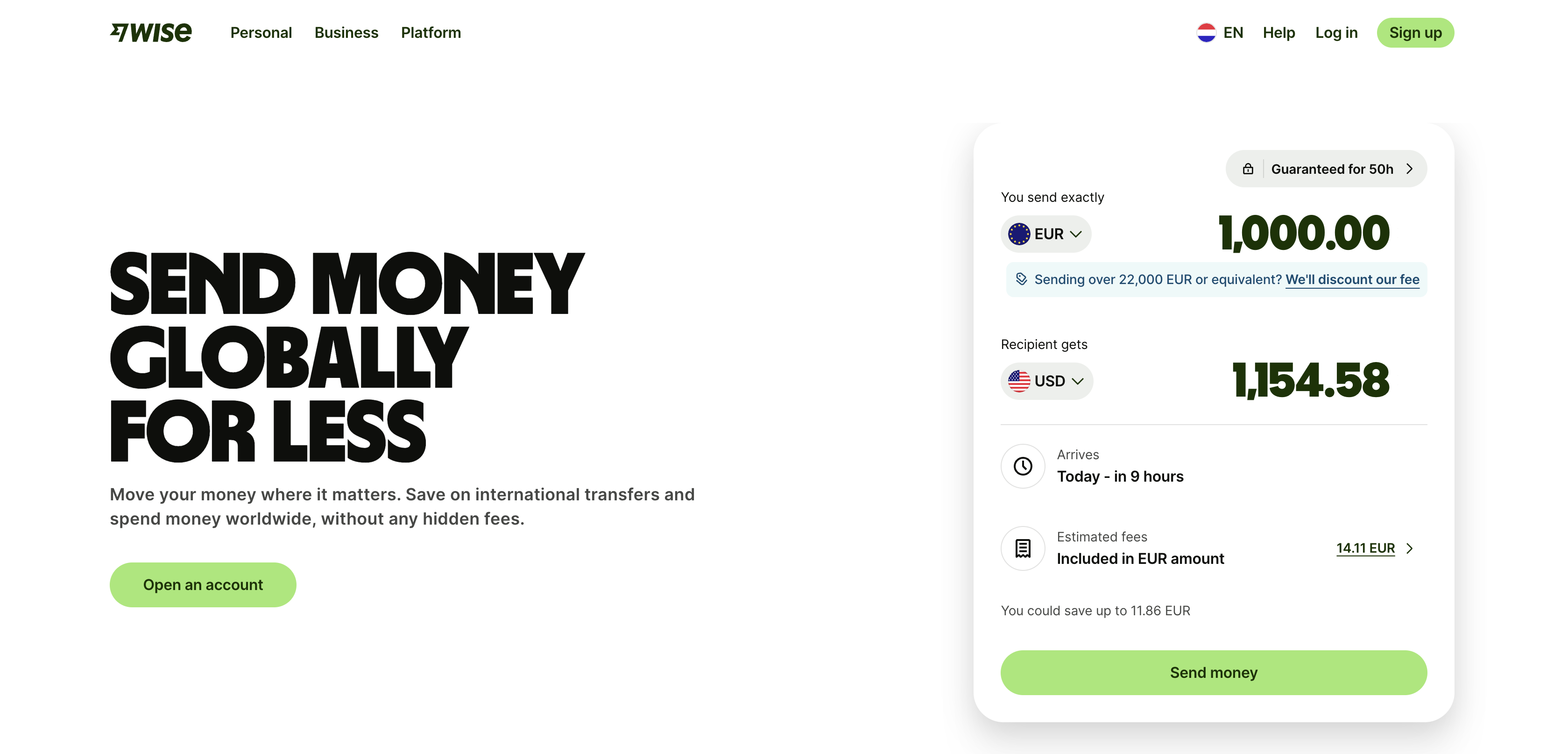
Kristo Käärmann and Taavet Hinrikus were two Estonians living in London with the same annoying problem in opposite directions — one paid in pounds needing euros, the other the reverse — and the same discovery that their banks were charging them for the privilege while quoting an exchange rate that wasn't the real one. Their fix was a private arrangement between themselves. Formalised as TransferWise in 2011, it became one of the most genuinely useful ideas in European fintech: don't send money across borders at all. Hold accounts in each country, match inbound and outbound flows domestically, and charge a transparent fee for the matching. No SWIFT chain, no correspondent banks, no hidden spread. The company built its brand on publishing the true cost of the alternative, and for over a decade that transparency was the product.
The business it became is substantial. Wise moves tens of billions of pounds across borders annually for consumers and businesses, has been consistently profitable, and operates Wise Platform — infrastructure sold to banks and fintechs that want cross-border capability without building it. In May 2026 the company moved its primary listing from the London Stock Exchange to Nasdaq under the ticker WSE, a decision that drew a great deal of comment in the UK about the attractiveness of London as a venue for technology companies.
Then 2026 turned difficult, and the honest version of that story is heavier than the headlines suggested. In June, the Brussels Public Prosecutor's Office was reported to be investigating Wise Europe — the Belgian subsidiary through which the group runs its European Economic Area operations — over roughly €500 million in suspicious transactions, with alleged links to fraud, corruption, and drug trafficking. Prosecutors had reportedly noticed Wise accounts appearing in hundreds of cross-border judicial assistance requests from more than 30 European countries. Shares fell sharply. In July, the US Office of the Comptroller of the Currency denied Wise's application for a national trust bank charter, and the language of the decision was unusually direct: the application presented "significant supervisory and compliance concerns," and proposed management and directors had demonstrated a "persistent inability" to manage money-laundering and terrorist-financing risk. The OCC's letter also cited state regulatory actions against Wise — a July 2025 multi-state consent order requiring Wise's US arm to pay $4.2 million and overhaul its Bank Secrecy Act and AML programmes. A proposed securities class action followed in the Southern District of New York at the end of July.
Wise denies wrongdoing, says it is cooperating with the authorities, and told the market its compliance programmes have evolved significantly since the original application was filed. It intends to submit a new charter application under the GENIUS Act framework. All of that is fair to state, and none of the allegations has been established: an investigation is not a finding, and securities class actions follow share price falls as a matter of routine. But two things are already true regardless of outcome. The denial was a rare public rejection from a regulator that had spent the preceding months approving trust charters for Circle, Ripple, Paxos, Coinbase, and others — meaning it was a judgement about Wise specifically rather than a closed door in general. And the charter's absence has a concrete cost: without it, Wise has no direct Federal Reserve access and continues routing US dollar flows through partner banks, which is exactly the dependency and margin leakage the application was meant to remove.
The honest read is uncomfortable for a company whose entire brand is built on being the straightforward one. Wise remains a profitable, well-run business with genuinely better economics than the incumbents it disrupted, and its consumer proposition is unaffected. But the compliance findings now recur across multiple entities, jurisdictions, and regulators — the same control domains each time, over several years — and the OCC has escalated what could have been read as a subsidiary problem to an enterprise-level one. For every European fintech queuing behind Wise for a US charter, Revolut included, the bar just became visible and it is higher than expected.