8 companies
Enable Banking
Financial Infrastructure🇫🇮 Finland
Most open banking aggregators want your data. That is the business model: connect to the banks, pull the transactions, store them, enrich them, and sell the enriched product back. Enable Banking built the opposite. The company describes itself as the postman of your data — it moves financial information from the bank to the customer's application and does not retain, process, or build models on what passes through. For a fintech that considers its transaction data a competitive asset, or a customer with strict data residency requirements, that neutrality is the entire pitch.
Joonas Tomperi and Fedor Tyurin founded the company in Espoo in 2019, at the point where PSD2 had legally opened European bank APIs but had not made them usable. Each bank interpreted the standard differently, each shipped its own authentication quirks, and each updated on its own schedule. The regulation created the right; someone still had to build the plumbing. Enable Banking started with Finland and the Nordics and expanded outward, and now connects to more than 2,700 banks across 30 European countries through a single PSD2-compliant API — account information from all of them, and payment initiation from over 1,500.
What makes the company genuinely unusual is its scale relative to that coverage. Enable Banking has raised roughly €600,000 in total, in a single seed round in 2022 led by Wellstreet and Forward VC, and employs somewhere between fourteen and seventeen people distributed across seven countries. Tink sold to Visa for €1.8 billion with 500 employees. TrueLayer has raised hundreds of millions. Enable Banking is covering comparable European ground with a team that would fit around one table, which says something about how much of open banking infrastructure is disciplined engineering rather than capital.
The company holds its own Account Information Service Provider registration, supervised by Finland's FIN-FSA — which means other companies can build on top of its licence rather than obtaining their own. That is the model behind open-banking.io, the Danish developer tool that resells Enable Banking access at €3 per month without customers needing eIDAS certificates. It is also why Enable Banking's no-data-retention architecture matters structurally: because the platform never holds readable customer data, the companies building on it can make stronger privacy guarantees than they otherwise could.
Two smaller details are revealing about who this is built for. Enable Banking runs a balanced split between business and consumer accounts — roughly half of its ten million monthly API calls come from each, where most early open banking providers targeted consumer accounts only and treated corporate banking as an afterthought. And it offers a live production environment for testing without requiring a contract, which is a small thing that tells you the company expects developers to evaluate it by using it rather than by booking a call. Tomperi now chairs the board of Fintech Finland, the national industry association.
Narvi
Embedded Finance🇫🇮 Finland
Narvi is a European fintech that simplifies embedded lending for e-commerce and marketplace platforms. Rather than forcing merchants to build lending infrastructure from scratch, Narvi handles the entire loan lifecycle—from origination through servicing—as a white-label API that integrates directly into checkout flows.
The company targets online retailers and marketplace operators who want to offer buy-now-pay-later and installment credit without the operational overhead of underwriting, collections, or compliance. Narvi handles credit decisions using proprietary scoring models and manages all regulatory requirements, while merchants simply embed a widget and capture incremental revenue.
In a market crowded with point-solution BNPL providers, Narvi positions itself as a full-stack lending partner rather than a payment mode. The company serves merchants across Europe and has built integrations with major e-commerce platforms, making it simpler for smaller retailers to compete with well-funded rivals on financing offerings.
Narvi represents a growing class of embedded finance infrastructure plays—companies enabling non-financial businesses to offer financial products without becoming financial institutions themselves. Its role is to abstract complexity and regulatory burden, letting merchants focus on customer experience and growth.
Tieto
Financial Infrastructure🇫🇮 Finland
Tieto operates in the murky middle ground between traditional IT services and fintech infrastructure, building the unsexy-but-essential systems that European financial institutions actually run on. The company provides core banking platforms, payment systems, and digital banking solutions to banks and financial services firms across the Nordic and European markets. Where most fintech captures headlines with consumer apps, Tieto stays disciplined in the B2B infrastructure game—modernizing legacy systems, managing complex regulatory requirements, and keeping payments flowing. Its positioning reflects a particular Nordic pragmatism: less about disruption, more about making banking systems reliable, scalable, and compliant. In a landscape crowded with flashy consumer fintechs, Tieto represents the unglamorous but critical plumbing layer that enables everyone else to operate. The company remains one of Europe's largest fintech infrastructure players, though its parent company structure and steady-handed approach means it rarely commands the venture attention of younger competitors.
Ferratum
Digital Banking🇫🇮 Finland
Mobile-first consumer lending was a genuinely novel concept in 2005, the year that Ferratum was founded in Helsinki. The company built one of Europe's earliest digital consumer credit businesses, offering small short-term loans through SMS and later through mobile apps — long before smartphone banking became universal. Its initial product targeted the gap between bank credit and informal lending, providing small loans quickly to consumers who needed flexibility that banks didn't offer. Ferratum expanded across more than 20 markets, received a Maltese banking licence, and rebranded to Multitude as it broadened from short-term consumer lending into a more diversified consumer banking business including a digital mobile bank. The transition from short-term lender to licensed bank reflects the broader maturation of European consumer fintech — companies that started with specific lending products evolving toward fuller-service banks as their licences and customer relationships justified the broader product range. Multitude is publicly listed on the Frankfurt Stock Exchange, making it one of the few publicly traded pan-European consumer fintechs. In the European consumer credit landscape, the company's two-decade trajectory illustrates both the original opportunity in mobile-first lending and the strategic logic of evolving toward a licensed banking model as the regulatory environment for short-term credit has tightened.
Paytrail
Payments🇫🇮 Finland
Paytrail is a Finnish payment service provider that sits squarely in the Scandinavian tradition of making financial infrastructure boring in the best way possible. What started as a straightforward payment gateway has evolved into a comprehensive solution for handling everything from card transactions to instant payments and merchant acquiring across the Nordic region and beyond. The platform serves retailers, e-commerce platforms, and subscription services by bundling payment processing, settlement, and reporting into a single dashboard that doesn't require a PhD in fintech to operate. Where many payment providers layer complexity on complexity, Paytrail prioritizes simplicity without sacrificing the kind of robust compliance and security features that Nordic banks and regulators demand. The company powers transactions across sectors from retail to SaaS, and increasingly sits at the intersection of merchant acquiring and embedded finance, enabling businesses to integrate payment logic directly into their own customer experiences. Its positioning in a market crowded with specialist providers is straightforward: it's the reliable, locally-trusted alternative to global payment behemoths, with the regional expertise and customer service that matters when you're processing millions in daily transactions. In the broader Nordic fintech landscape, Paytrail represents the infrastructure layer that connects merchants to their customers' money, quietly enabling the digital economy without demanding attention.
Enfuce
Financial Infrastructure🇫🇮 Finland
Enfuce is a Finnish fintech powerhouse that turned payment infrastructure into an art form. Rather than build another generic payment processor, they engineered a seamless, cloud-native platform that lets banks and fintechs issue and manage cards at scale without the complexity that usually comes with the territory.
At its core, Enfuce does three things exceptionally well: card issuing, payment processing, and real-time transaction management. The company operates as both a technology provider and a banking infrastructure backbone, meaning they sit at the intersection of legacy banking and modern fintech. Their platform handles everything from corporate expense cards to consumer debit products, all connected through APIs that actually work the way developers expect them to.
What sets Enfuce apart in Europe is their pragmatic approach to solving genuinely hard problems. While competitors often get tangled up in regulatory complexity or technical debt, Enfuce built their stack to accommodate European payment regulations from day one. They're not retrofitting compliance—it's baked in. This makes them particularly valuable for institutions scaling across multiple markets, where harmonizing payments across borders would normally require nightmare-level integration work.
Enfuce occupies a critical middle ground in the financial infrastructure landscape. They're neither a scrappy startup nor a lumbering legacy player, but rather a confident, focused operator helping European banks and fintechs move faster than they ever thought possible. Their presence signals a maturation of the fintech infrastructure layer—less disruption theater, more actual hard engineering.
Holvi
Digital Banking🇫🇮 Finland
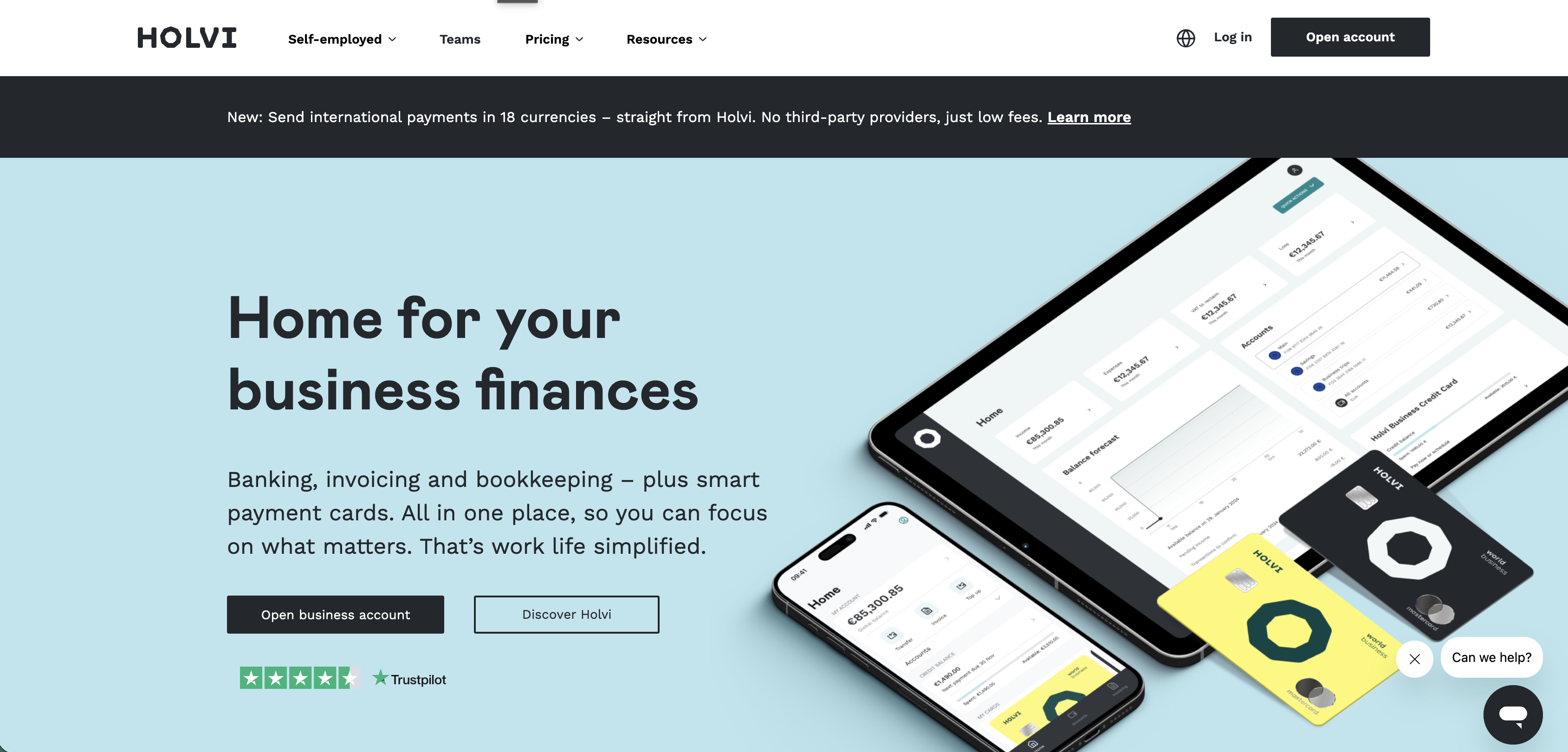
Holvi is a Finnish digital banking platform built specifically for freelancers and small businesses in Europe. Rather than forcing SMEs into generic business accounts designed for larger enterprises, Holvi offers a purpose-built alternative—a business bank account combined with invoicing, expense tracking, and basic financial management in a single app.
The platform strips away unnecessary complexity. You get IBAN accounts, payment cards, instant notifications, and invoice creation without the bureaucratic friction of traditional banks. Holvi has expanded across the Nordic region and into Central Europe, serving tens of thousands of solopreneurs and small teams who want banking that actually understands their workflow.
In a market crowded with neobanks chasing consumer users, Holvi carved out a genuine niche by solving a real problem: traditional banks ignore small businesses, while most fintech platforms treat them as an afterthought. Holvi treats them as the primary customer. The platform integrates accountants' tools, VAT handling, and multi-currency support—the unglamorous features that matter when you're running a real business from your laptop.
Holvi sits at the intersection of business banking, accounting software, and neobanking. It's not trying to be everything to everyone; it's trying to be exactly what a freelancer or micro-entrepreneur actually needs, which is why it's become a quiet but steadily growing fixture in Northern European small business finance.

Invesdor
Wealth🇫🇮 Finland
Invesdor is a European equity crowdfunding platform that lets retail investors back early-stage companies and SMEs with growth potential. Founded in 2012, it operates across the Nordic and Baltic regions, democratizing access to private company investments that were once reserved for institutional players and high-net-worth individuals. The platform handles everything from deal sourcing and due diligence to investor communication and cap table management, removing friction from what is traditionally a complex, opaque process. Unlike traditional venture capital, which concentrates returns among a select few, Invesdor allows ordinary Europeans to own pieces of interesting companies—from deeptech startups to established SMEs looking to scale. The company has facilitated hundreds of millions in funding across its markets, positioning itself as the go-to platform for anyone serious about alternative investing. In a landscape crowded with robo-advisors and passive ETF apps, Invesdor stands apart by offering real company ownership and direct founder engagement. It's become essential infrastructure for the European entrepreneurial ecosystem, bridging the funding gap for companies too ambitious for traditional bank loans but too early for institutional VCs.