27 companies
Adyen
Embedded Finance🇳🇱 Netherlands
Pieter van der Does and Arnout Schuijff had already built and sold one payments company when they sat down in 2006 to start again. The result was Adyen — the name literally means "start over" in Surinamese — and the premise was simple: instead of stitching together the same fragmented payment infrastructure everyone else was using, they would build the whole thing themselves from scratch.
That decision, made in an Amsterdam office nearly two decades ago, is still the reason Adyen is different. Most payment companies are assemblers — they buy a gateway here, a processor there, bolt them together and hope for the best. Adyen owns its own technology stack end to end, which means a merchant integrating once gets access to card processing, local payment methods, point-of-sale terminals, and real-time settlement data through a single platform. No middle layers, no reconciliation headaches, no finger-pointing between vendors when something breaks.
The client list tells you everything about where Adyen sits in the market. McDonald's, Spotify, Microsoft, LVMH, H&M — these are companies with serious payment volumes and zero appetite for systems that don't work. Adyen became the default choice for enterprises that had outgrown the limitations of traditional payment stacks and needed something that could handle global scale without buckling.
Since going public on Euronext Amsterdam in 2018, Adyen has grown into one of Europe's most valuable technology companies, with around 4,300 employees across 23 countries and net revenue of just under €2 billion in 2024. It remains headquartered in Amsterdam and consistently profitable — a combination that's rarer in fintech than it should be.
For businesses that treat payments as infrastructure rather than an afterthought, Adyen is the benchmark everything else gets measured against.
Mollie
Payments🇳🇱 Netherlands
Adriaan Mol built Mollie's first backend while living with his parents in the Netherlands in 2004. No investors, no office, no team — just a founder and an idea that small businesses deserved a payment integration that didn't require a team of lawyers and a six-month setup process. He bootstrapped it for over fifteen years before taking outside funding in 2019. By then, Mollie had already grown into one of the most important payment platforms in European e-commerce, entirely on the back of a product that developers actually liked using.
The proposition is straightforward: one API, one dashboard, and access to the payment methods that actually matter across Europe. That means iDEAL in the Netherlands, Bancontact in Belgium, Klarna and SEPA Direct Debit everywhere, alongside cards, Apple Pay, and a growing list of local methods that would otherwise require separate integrations and separate acquirer relationships. Mollie handles the compliance, the fraud monitoring, and the settlement complexity. Merchants get a clean interface and a single invoice.
For the 250,000 businesses using Mollie today — ranging from Gymshark and Wild to local bakeries and market stalls, as CEO Koen Köppen regularly points out — the appeal is less about feature lists and more about what they don't have to think about. European payments are fragmented by design. Every country has its preferred methods, its own regulatory quirks, its own consumer habits. Mollie's job is to make that invisible.
The numbers from 2024 reflect a company that has found its model. Revenue reached €214 million, up 28% year on year, with gross profit growing 30% to €115 million and the company returning to positive EBITDA for the first time since 2018. Mollie raised a total of $940 million in funding and was valued at $6.5 billion following its 2021 Series C led by Blackstone.
The most significant recent development is the acquisition of GoCardless in December 2025 — bringing the UK-based direct debit specialist into the Mollie group and substantially expanding its recurring payments and bank transfer capabilities across Europe. Combined, the two companies cover a considerable share of European e-commerce payment infrastructure.
Mollie is still headquartered in Amsterdam, with around 900 employees across offices in Ghent, London, Lisbon, Munich, Milan, Paris, and beyond.
Fourthline
Identity & KYC🇳🇱 Netherlands
Fourthline didn't start as a KYC company. It started as a payment institution. Krik Gunning and Chris van Straeten founded Safened in Amsterdam, licensed by the Dutch Central Bank as a regulated payment provider. As Safened onboarded its own customers, it built identity verification technology capable enough that other banks and fintechs started asking to use it directly. The demand was real and growing — digital financial services were expanding rapidly but compliance infrastructure hadn't kept pace. In 2019 Gunning and van Straeten spun the KYC operation out as a standalone company and renamed it Fourthline.
The name refers to compliance being the fourth line of defence in financial crime prevention — after business operations, risk management, and internal audit. It's a deliberately serious framing for a company that treats KYC not as a box to tick but as a technical problem worth solving properly. While many identity verification providers offer generic document checks, Fourthline built its platform around the regulatory requirements of Europe's strictest financial supervisors — the kind of compliance depth that a neobank launching in Germany or a broker entering the Netherlands actually needs to satisfy its regulator, not just its legal team.
The platform covers the full KYC and AML stack through a single API: document verification, biometric checks with liveness detection, AML and sanctions screening, risk scoring, proof of address, and ongoing customer monitoring throughout the customer lifecycle. The modular architecture means regulated institutions can pick the components they need rather than buying a fixed bundle — a practical advantage for fintechs that need identity verification at onboarding but different monitoring requirements at scale.
The client list is a reasonable proxy for the quality of the product. Fourthline verifies identities for N26, Qonto, Trade Republic, flatexDEGIRO, Scalapay, Shine, and Bitpanda — regulated financial businesses across Europe that operate under strict supervisory scrutiny and cannot afford onboarding failures. The company employs around 225 people and has raised approximately $70 million in funding, primarily from Finch Capital.
Leadership and structure have both shifted in 2026. In March, Fourthline appointed Paul Stoddart as CEO, with co-founder Krik Gunning moving into an advisory role after leading the company since its founding. Then in July came the bigger move: Fourthline and Veridas, the Spanish biometrics specialist, agreed to merge their identity platforms. The combination pairs Fourthline's KYC and AML compliance orchestration — built for Europe's strictest supervisors — with Veridas's facial and voice biometric technology, and extends the group's reach beyond Europe into Latin America, where Veridas has an established presence.
The strategic logic tracks the regulatory calendar. The EU's new Anti-Money Laundering Regulation comes into force in July 2027, substantially raising compliance requirements for financial institutions across Europe and expanding the addressable market for exactly this kind of infrastructure. Identity verification is consolidating ahead of that wave — and scale matters when every regulated institution on the continent is about to need more of what you sell.
DEGIRO
Wealth🇳🇱 Netherlands
DEGIRO is a Dutch discount broker built on a single observation: the marginal cost of executing a stock trade is software and settlement, not human labour — so the fees European retail investors were paying bore little relation to what a trade actually cost. Founded in Amsterdam in 2008 by former BinckBank employees, it started as an institutional broker, opened to retail investors in 2013, and undercut the incumbents by a wide enough margin to expand across the continent within a few years.
The product is deliberately unglamorous. No gamification, no social feed, no notification congratulating you on a €5 deposit. DEGIRO offers direct access to dozens of exchanges across Europe and the US, real market data, and low per-trade pricing, and it assumes you already know what you want to buy. That utilitarian positioning has aged well as the novelty of investing apps has faded and European retail investors have matured past the onboarding experience into simply wanting to invest efficiently.
DEGIRO is no longer independent. German broker flatex AG agreed to acquire it for around €250 million in December 2019, with the legal merger into flatexDEGIRO Bank completing in May 2021. The combined group trades on the Frankfurt Stock Exchange, joined the MDAX in March 2025, and converted from an AG to a European Company (SE) at the end of 2025. It now runs three brands — DEGIRO for international European markets, flatex for Germany and Austria, and ViTrade for active traders — together serving more than 3.5 million customers across 16 countries, with over €95 billion in assets under custody and more than 75 million transactions a year. Group revenue reached €559.8 million in 2025 with net income of €160.4 million, up from €71.9 million in 2023.
The regulatory record is less tidy than the pricing story. The Dutch AFM fined the bank €2 million in 2022 over late and inaccurate reporting of unusual transactions, reduced to €797,500 on appeal in 2025. BaFin has issued a series of penalties: €1.05 million in 2023 for breaches of banking supervisory rules, accompanied by additional capital requirements and a special representative appointed to oversee remediation; €560,000 in December 2025 for advertising free investment services without clearly disclosing that a processing fee applied; and €1 million in April 2026 for failing to publish inside information promptly. Leadership has churned alongside it — CEO Frank Niehage resigned in 2024 after a public dispute with founder and major shareholder Bernd Förtsch, and former Morgan Stanley Europe CEO Oliver Behrens took over that October.
Mambu
Financial Infrastructure🇳🇱 Netherlands
Mambu is a cloud-native banking software platform that lets financial institutions and fintechs launch and operate lending and deposit products without building from scratch. Rather than forcing customers into rigid legacy systems, Mambu provides composable banking infrastructure—modular APIs and pre-built components that work together or stand alone, depending on what you actually need.
The company sits at the intersection of two fintech realities: traditional banks are drowning in outdated core systems that can't keep pace with market demands, while new lenders and neobanks need speed without sacrificing compliance or scale. Mambu's approach is to be the operating system underneath, handling the heavy lifting of loan origination, deposit management, portfolio servicing, and regulatory reporting while letting clients focus on customer experience and product innovation.
What makes Mambu different from other core banking platforms is its emphasis on velocity. Institutions deploy in weeks rather than years. The platform is genuinely modular—you can pick the lending module, the deposit module, or both, and layer in third-party services through APIs. This flexibility has resonated with everyone from African microfinance networks to European challenger banks to enterprise lenders managing complex credit products.
Mambu is now a critical piece of infrastructure in the emerging markets fintech ecosystem, particularly across Africa and Asia, where it powers lending operations for hundreds of financial institutions. In Europe, it's carved out space among mid-market and challenger banks looking to avoid the capital expenditure and technical debt of legacy systems. The company represents a broader shift in fintech: away from end-to-end platforms that claim to do everything, toward specialized infrastructure that does one thing—backend financial operations—exceptionally well.
Credolab
Lending🇳🇱 Netherlands
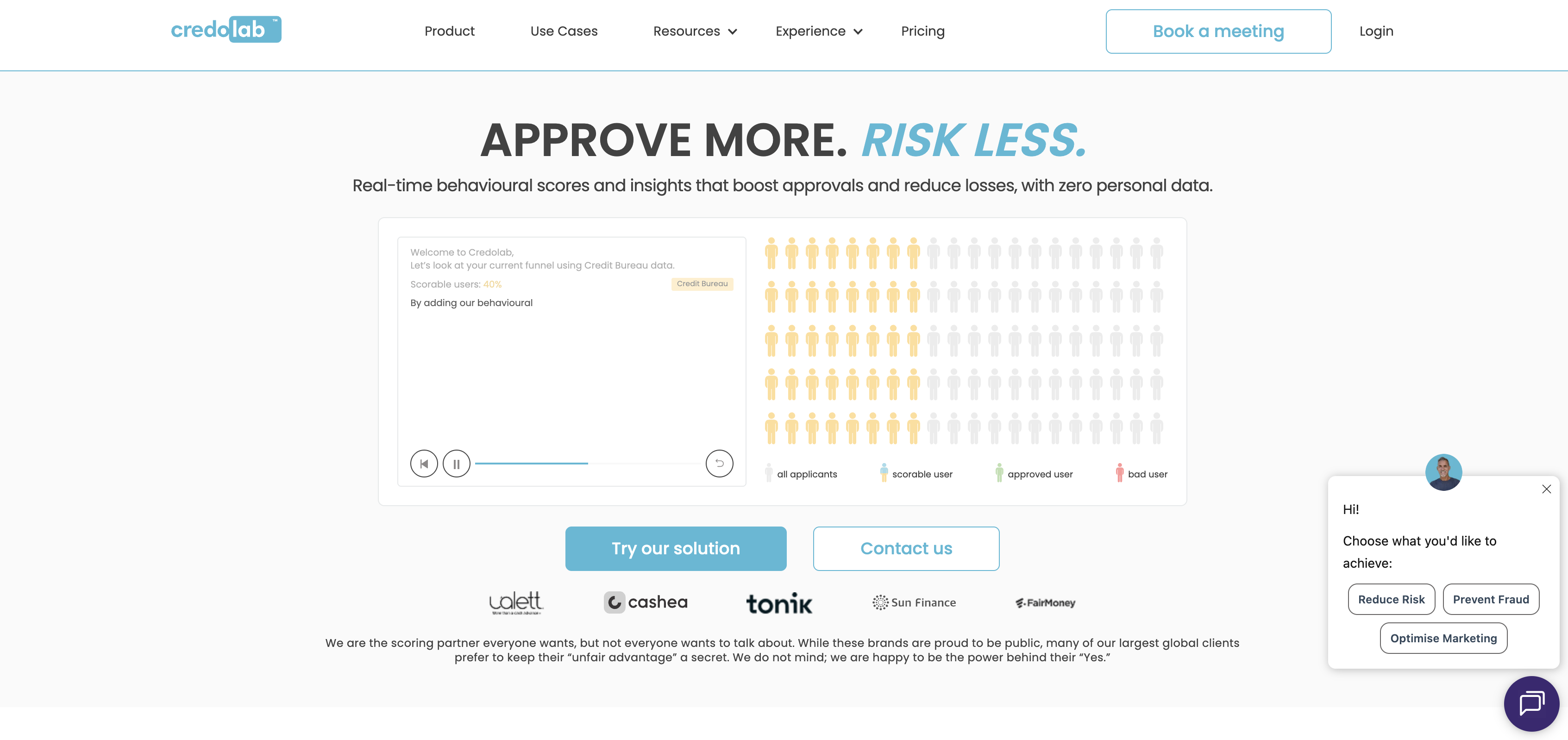
Credit decisions in markets without comprehensive credit bureau coverage have always been hard. The traditional underwriting model relies on credit history, income verification, and identity documents that significant portions of the global population either don't have or can't easily produce. Credolab was founded in 2016 with operations across Asia and Europe to address that gap with an unconventional data source — smartphone metadata. Its platform analyses behavioural patterns from a mobile device — without accessing personal content — to generate credit scores for consumers who have no traditional credit history. The data points are surprisingly predictive: how someone manages their phone storage, the pattern of their app usage, the regularity of their device behaviour all correlate with credit risk in ways that traditional underwriting misses. Credolab serves lenders, telcos, and digital platforms across emerging markets where credit bureau coverage is thin and the demand for digital credit is growing rapidly. In the alternative credit data landscape, where companies are competing to find the data sources that will define the next generation of underwriting, Credolab's behavioural smartphone approach is one of the more distinctive — and one that addresses a genuinely large unmet need in markets where billions of people remain credit-invisible to traditional financial systems.
Pay.nl
Payments🇳🇱 Netherlands
Pay.nl is a Dutch payment processor built for the complexity of modern commerce. Rather than forcing merchants into a one-size-fits-all payment flow, it offers a modular approach where acquirers, payment methods, and risk tools snap together like building blocks. This flexibility appeals to mid-market retailers and platform operators who've outgrown off-the-shelf solutions but don't have the resources to build from scratch.
The company positions itself as the pragmatic middle ground in European payments. While fintechs chase consumer flashiness and traditional PSPs move at legacy speed, Pay.nl focuses on the unglamorous reality of merchant operations: payment routing, multi-currency settlement, real-time reconciliation, and developer experience. Its API-first architecture means integrations take weeks instead of quarters.
Pay.nl operates across the full payment stack—card acquiring, alternative payment methods, tokenization, subscription billing—but treats them as components rather than marketing bullets. This modular thinking extends to risk management and compliance, which the company bundles without overhead.
Within Europe's crowded payments landscape, Pay.nl competes less on consumer reach and more on merchant control. It's the choice for companies that care about payment economics and operational efficiency rather than brand building. Its role in the broader ecosystem is to mature the middle market, proving that European merchants don't need either a tech giant's infrastructure or a startup's rough edges.
ICEPAY
Payments🇳🇱 Netherlands
ICEPAY is a Dutch payment processor that handles everything from card transactions to alternative payment methods across Europe. The company powers checkout experiences for thousands of merchants, managing the complex plumbing of converting customer intent into settled funds. What sets ICEPAY apart is its focus on European merchants—particularly mid-market businesses that need more than a one-size-fits-all gateway. The platform bundles payment processing with risk management, offering fraud detection and chargeback protection alongside the standard card rails. It's built for merchants who want flexibility without complexity, handling both online and in-store payments through a unified infrastructure. ICEPAY operates in a crowded space where most competitors either stay focused on pure payment processing or sprawl into adjacent services. The company positions itself as the European alternative to global juggernauts, with deeper understanding of regional payment preferences and compliance requirements. It's a pragmatic choice for businesses scaling across multiple European markets—less startup energy, more mature operational backbone. In the broader fintech ecosystem, ICEPAY represents the unglamorous but essential layer: the infrastructure that makes European commerce work behind the scenes.
Billink
Payments🇳🇱 Netherlands
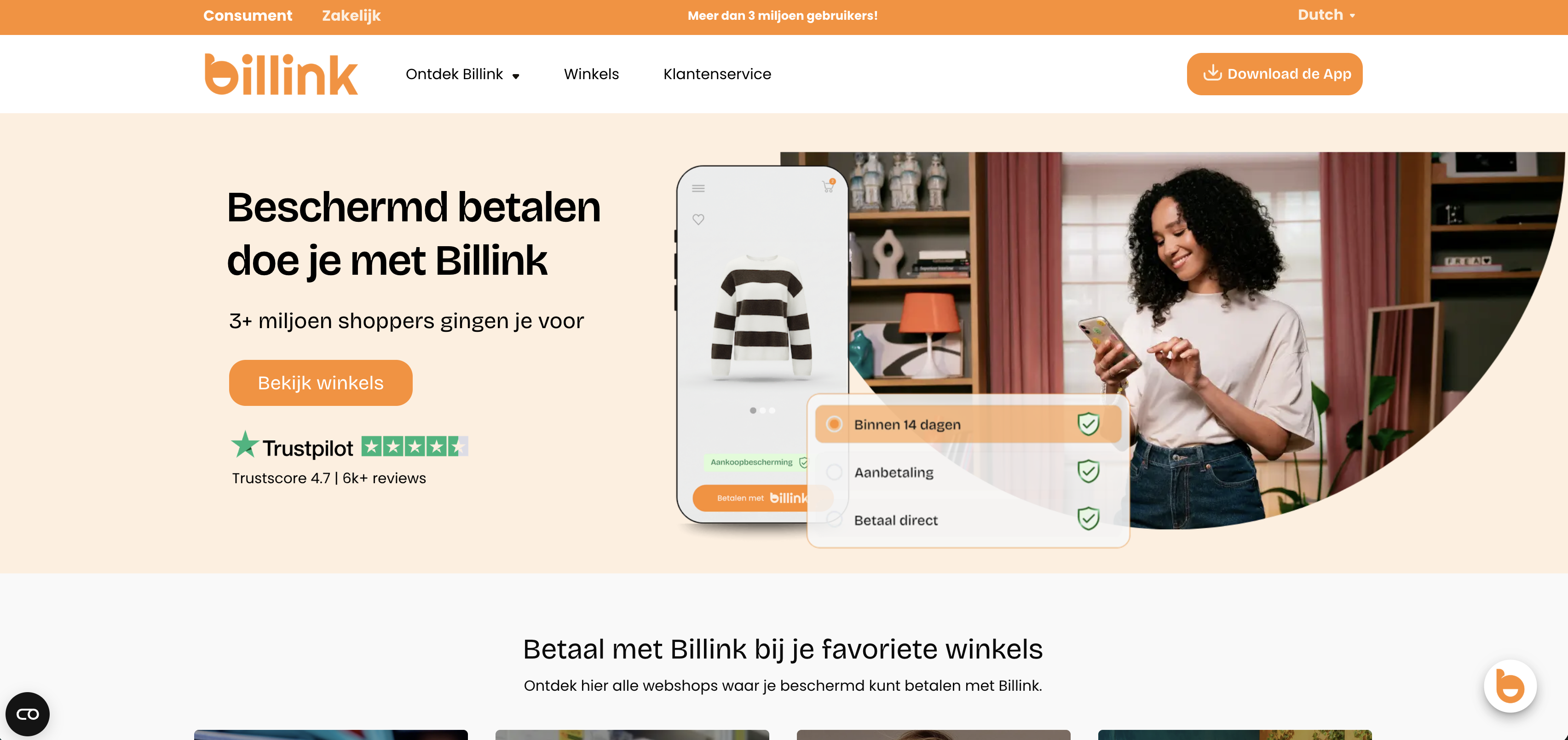
Billink is a Dutch payment platform that strips away the friction from business-to-business transactions. Rather than forcing companies to choose between immediate payment and extended credit terms, Billink lets B2B buyers pay later while sellers get funded upfront—a genuine middle ground that's rare in European commerce. The company operates as a bridge between e-commerce platforms, marketplaces, and their merchants, embedding flexible payment options directly into the checkout experience. For online sellers, Billink handles the credit risk and collections; for buyers, it means cash flow breathing room without the paperwork of traditional trade credit. It's not quite a lender, not quite a payments processor, but something more pragmatic: a working capital solution disguised as a checkout button. The platform has gained traction in the Benelux and beyond by solving a specific, genuine problem—SMEs and small merchants need working capital flexibility, and their customers need better payment terms. Billink does both simultaneously. In a fintech landscape crowded with neobanks and lending startups chasing consumer audiences, Billink operates in the quieter, more profitable corner of B2B commerce, where financial friction still costs businesses real money.

Bux
Wealth🇳🇱 Netherlands
Bux is a mobile-first investing platform that strips away the gatekeeping around stock and ETF trading, making it accessible to anyone with a smartphone and spare change. Founded in the Netherlands, the company lets users trade fractional shares from €1 upward—a deliberate move to democratize markets that traditionally demanded thousands in upfront capital.
The core product is refreshingly simple: a clean app interface where you can buy stocks, ETFs, and crypto without the jargon or friction that traditional brokers impose. Bux's positioning sits at the intersection of retail investing and social trading, with features that encourage discovery and community engagement alongside serious portfolio building. Think of it as the antidote to the institutional gatekeeping of wealth creation.
Among European retail investment platforms, Bux stands out for its aggressive accessibility play—fractional shares, zero commissions, and a user experience designed for people who'd rather scroll than call a broker. It competes in a crowded space alongside the likes of Revolut and Trading 212, but maintains a laser focus on making investing feel less intimidating and more tangible.
In the broader fintech landscape, Bux represents a generation of platforms that have fundamentally rewritten the rules of retail access to capital markets, turning investing from a privilege into a habit.