21 companies
Klarna
Embedded Finance🇸🇪 Sweden
Three Stockholm School of Economics students pitched an idea at a university entrepreneurship competition in 2005: let shoppers receive goods before they pay, and put the credit risk on the merchant side. The pitch finished last. They built it anyway.
Sebastian Siemiatkowski, Niklas Adalberth, and Victor Jacobsson launched what was originally called Kreditor, later renamed Klarna, and spent the next two decades turning that rejected idea into one of Europe's most recognised fintech brands. The core insight held up: millions of people would rather split a purchase into three instalments than reach for a credit card, and merchants would pay for the privilege of offering that option because it reduces cart abandonment and increases average order values.
Klarna grew from a Swedish checkout button into something considerably more complex. It now holds a banking licence in Sweden, offers savings accounts, issues its own card, and operates across more than 45 markets with around 93 million active consumers and 675,000 merchant partners at the end of 2024. The US, which Klarna entered in 2015, has become its largest market by revenue, a fact the company underlined by listing on the New York Stock Exchange in September 2025 under the ticker KLAR, raising $1.37 billion at IPO.
The financial trajectory has been bumpy. Klarna reported net income of $21 million in 2024, a return to profitability after a bruising 2022 that included an 85% valuation cut and significant layoffs that reduced headcount from over 7,000 to around 3,400. What survived the restructuring was a leaner company with $2.81 billion in revenue and a clearer strategic direction: AI. Klarna's partnership with OpenAI produced a customer service assistant it claims handles the equivalent of 700 full-time agents, and generative AI now manages roughly two-thirds of customer chats.
The honest assessment of where Klarna sits today: it's no longer purely a BNPL provider and it's not quite a bank. It's somewhere in between, a consumer finance platform that knows more about your shopping behaviour than your bank does, and is betting that's worth a lot.
Tink
Embedded Finance🇸🇪 Sweden
Daniel Kjellén and Fredrik Hedberg didn't set out to build infrastructure. Tink started in Stockholm in 2012 as a consumer personal finance app — an attempt to give Swedish bank customers a cleaner view of their money across multiple accounts. It was a reasonable idea that ran into an unreasonable obstacle: getting reliable, consistent data out of European banks was extraordinarily hard. The technical problem turned out to be more interesting than the consumer product. In 2018 they pivoted, shifted focus entirely to the B2B layer, and started selling the very infrastructure they'd been forced to build for themselves.
That pivot proved prescient. The EU's PSD2 directive, which came into full effect in 2019, legally required banks to open their data to authorised third parties — creating the regulatory foundation that open banking platforms needed to operate at scale. Tink had spent years building exactly those bank connections. When the regulation arrived, the company was ready.
The platform Kjellén and Hedberg built connects to more than 3,400 banks and financial institutions across Europe, reaching over 250 million bank customers. Through a single API integration, banks, fintechs, and merchants can access aggregated account data, initiate payments directly from customer bank accounts, verify account ownership, and enrich transaction data — without maintaining their own connections to hundreds of separate banking systems with different technical standards and update schedules. Clients include Klarna, PayPal, NatWest, ABN AMRO, and BNP Paribas Fortis.
In March 2022, Visa completed the acquisition of Tink for €1.8 billion — one of the largest European fintech acquisitions of that year, and a clear signal of how seriously the global payments industry had come to take open banking infrastructure. Visa's strategic rationale was straightforward: it had failed to acquire Plaid, the US equivalent, after an antitrust challenge, and needed a European open banking capability. Tink gave it 500 employees, 18 European markets, and relationships with over 300 banks and fintechs built over a decade.
The founders stayed on as CEO and CTO through the transition, continuing to run Tink as a standalone Visa subsidiary from Stockholm. Both departed in 2025 — Kjellén and Hedberg announced they were building Freda, a new AI-driven legal and compliance technology startup, with the pair describing Tink as "now in better hands than ever." Francois Tornier, Visa's VP of Open Banking, took over as CEO. The product roadmap has continued under Visa ownership, including a 2024 expansion of Tink's open banking platform into the US market.
Krea
Lending🇸🇪 Sweden
Krea helps Swedish businesses compare and access financing offers.
Safello
Crypto & Blockchain🇸🇪 Sweden
Safello lets Nordic users buy, sell, and manage crypto through a regulated platform.
Avanza
Wealth🇸🇪 Sweden
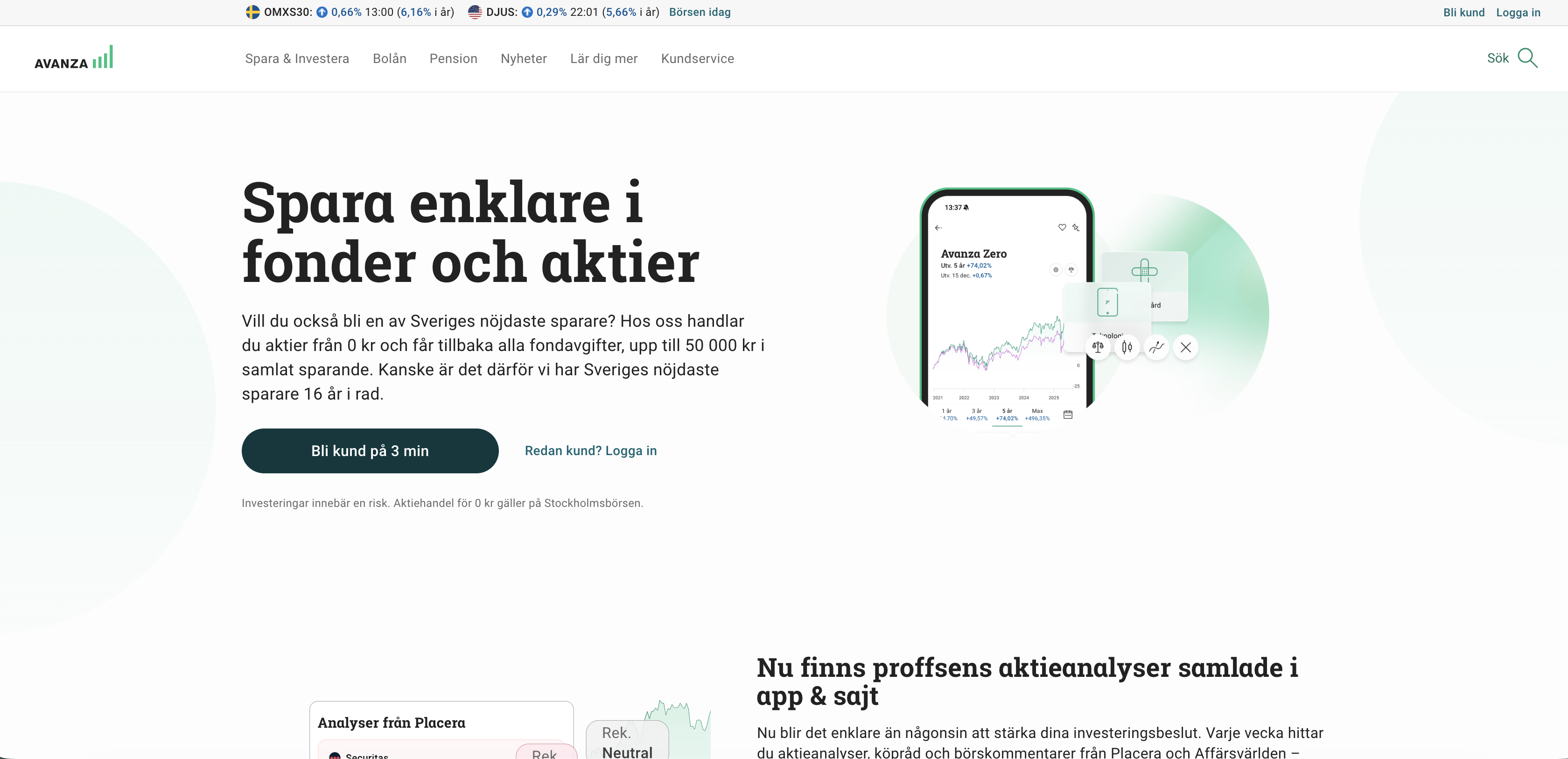
Avanza is Sweden's largest independent online brokerage, a no-frills investment platform that democratized stock trading for Swedish retail investors two decades ago. What started as a scrappy alternative to traditional banks has become the go-to app for millennials and Gen Z who want to trade, invest, and save without paying legacy banking fees. The platform strips away unnecessary complexity—no advisors, no jargon, just direct market access at transparent prices. Avanza operates in that interesting middle ground between a neobank and a pure trading platform. It offers savings accounts, pension accounts, and investment accounts with a sharp focus on user experience and low costs. The company has built a cultural following in Sweden, becoming almost synonymous with retail investing for a generation that views traditional brokers as relics. Beyond just equities and funds, Avanza has expanded into savings products, retirement planning, and financial education—positioning itself as a genuine financial companion rather than just a transaction layer. Its dominance in the Nordic market reflects a broader European shift toward direct-to-consumer investment platforms that compete on transparency, speed, and mobile-first design. Avanza exemplifies how fintech can win by doing one thing exceptionally well and then expanding thoughtfully into adjacent categories. The company's influence extends beyond Sweden into a broader shift in how younger Europeans think about investing: without gatekeepers, without unnecessary fees, and entirely on their own terms.
Zaver
Embedded Finance🇸🇪 Sweden
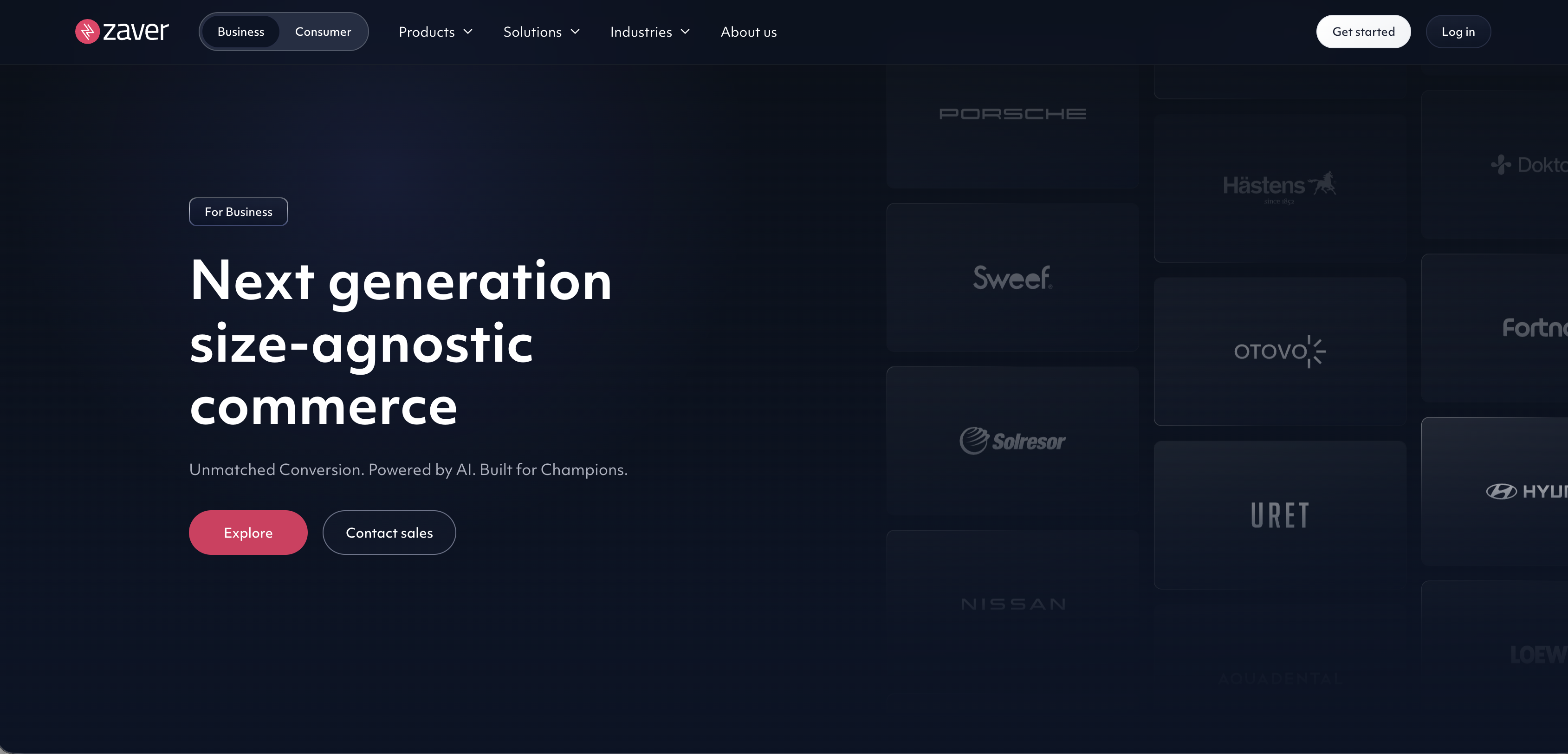
Zaver is a buy-now-pay-later platform built for the European e-commerce and retail landscape, letting shoppers split purchases into manageable payments without the friction of traditional credit checks. The company positions itself as the checkout financing solution for merchants who want to reduce cart abandonment and unlock higher transaction values, while giving consumers a flexible, instant alternative to credit cards and bank loans.
Unlike the mainstream BNPL players that blanket the market with consumer-first messaging, Zaver works backwards from merchant needs—helping online and physical retailers embed installment options directly into their payment flow. The product emphasizes merchant control, transparent pricing, and straightforward integration for businesses of all sizes.
Zaver competes in a crowded BNPL segment but focuses on underserved European markets and SME merchants rather than chasing venture-scale consumer adoption. The company's model centers on merchant acquiring and payment orchestration, positioning BNPL as a revenue driver rather than a customer acquisition cost. In the broader fintech infrastructure play, Zaver represents the shift toward embedded lending—turning payment processing into a financial product.
Brite Payments
Fraud & Security🇸🇪 Sweden
Brite Payments operates in the unglamorous but essential middle of European payments infrastructure, solving the one problem every online merchant dreads: chargebacks and payment disputes. Rather than building another payment gateway or adding another layer to the stack, Brite focuses on the friction that happens after the transaction settles—when customers dispute charges, fraudsters claim they never authorized a payment, or acquirers demand evidence of legitimacy. The company automates the collection and management of transaction evidence, turning what used to be manual spreadsheet hell into a streamlined workflow. For e-commerce teams and payment processors alike, this means faster dispute resolution, lower chargeback rates, and fewer abandoned cases because the right documentation was never dug up in time. Where traditional payment providers treat disputes as a grudging afterthought, Brite has built the entire operation around winning them. The platform integrates with major payment gateways and acquirers, capturing data at the moment of transaction so that when a dispute lands, you're not scrambling to reconstruct what happened six months ago. In a market obsessed with growth and conversion, Brite focuses on the less sexy metric that actually protects margin: keeping more of the money you thought you earned. European merchants and their payment partners recognize the value immediately—this is not innovation theater, it's operational necessity.
Nordnet
Wealth🇸🇪 Sweden
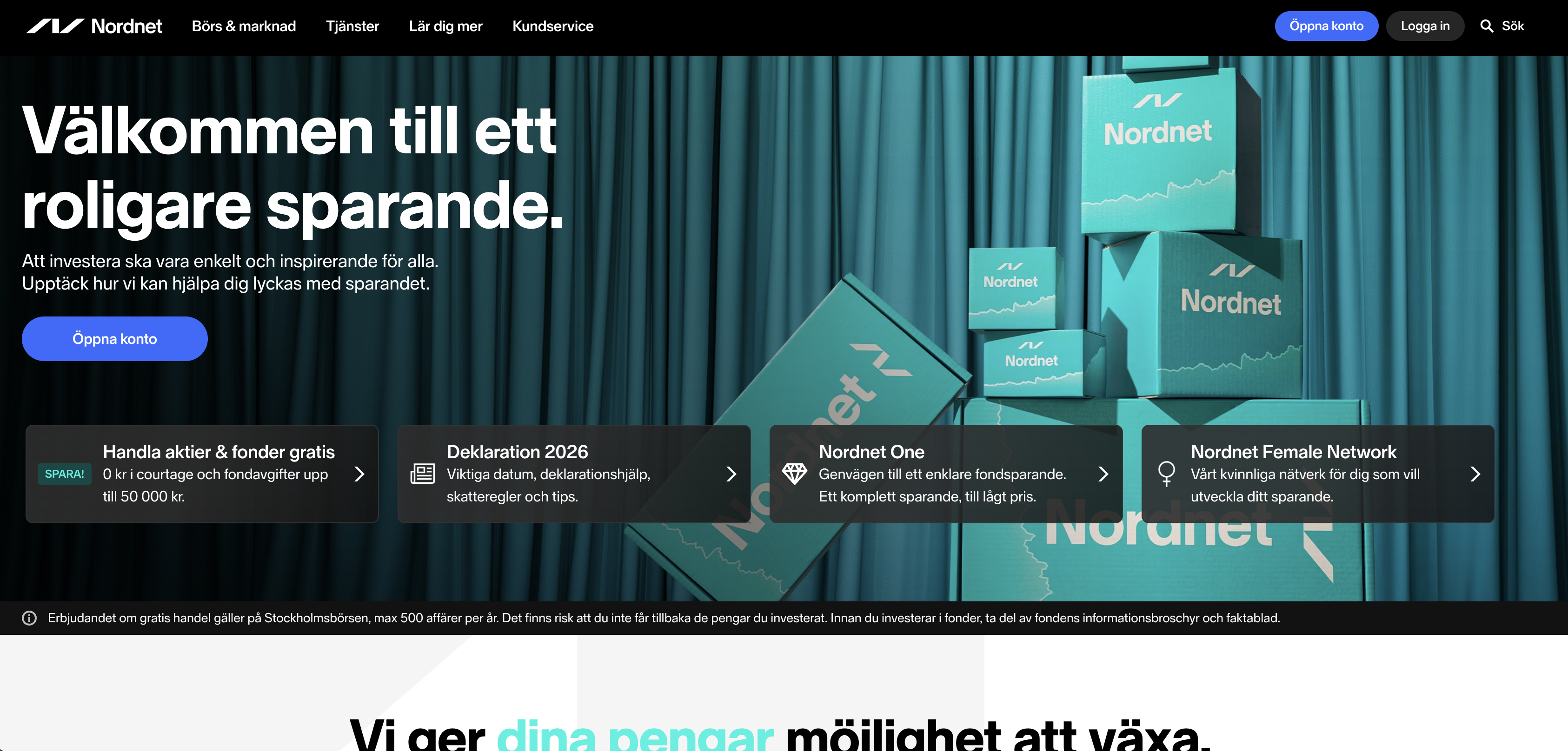
Pan-Nordic retail investing requires more than translating a Swedish product into Norwegian, Danish, and Finnish. Each Nordic market has its own pension system, tax-advantaged investment accounts, regulatory framework, and consumer expectations — complexity that has kept many investment platforms confined to a single national market. Nordnet was founded in Stockholm in 1996 with the explicit ambition to build a genuinely Pan-Nordic investment platform, and has spent nearly three decades doing it. Its platform serves customers across Sweden, Norway, Denmark, and Finland, offering stocks, funds, ETFs, pensions, and savings products tailored to each market's specific tax-advantaged account structures. The cross-border depth is genuinely unusual — most Nordic financial services companies that operate internationally do so through separate national entities with separate products, rather than the integrated platform approach that Nordnet has built. The company is publicly listed on the Stockholm Stock Exchange and competes directly with Avanza in the Swedish market while occupying dominant positions in several other Nordic countries. In the European retail investment landscape, Nordnet's combination of cross-border integration and decades of operational depth makes it one of the most credible regional brokers in any European market — a model that the rest of Europe has been slower to replicate.
Inpay
Embedded Finance🇸🇪 Sweden
Inpay operates in the increasingly crowded space of embedded payments, but with a particular focus on marketplaces and platforms that need to move money between multiple parties. The company essentially builds the financial plumbing that allows non-fintech businesses—think e-commerce platforms, service marketplaces, and SaaS products—to handle payments, payouts, and settlement without building infrastructure from scratch.
What sets Inpay apart is its emphasis on operational simplicity for platforms managing complex payment flows. Rather than forcing partners to integrate with a dozen different providers, Inpay consolidates payment processing, merchant acquiring, and payout capabilities into a single API layer. This means a marketplace can focus on growth without getting bogged down in the mechanics of moving money.
The company operates across Europe, with particular strength in Western Europe, and positions itself as an alternative to larger, more bureaucratic payment infrastructure providers. It's the kind of business that doesn't grab headlines but quietly powers transactions across hundreds of platforms. Inpay sits firmly in the infrastructure category, enabling fintech and non-fintech companies alike to monetize their platforms through embedded payments without the friction of traditional payment processors.
Minna Technologies
Financial Infrastructure🇸🇪 Sweden
Minna Technologies solved a problem almost everyone has and almost no one tracks: the subscriptions you are paying for and have forgotten about. Founded in Gothenburg in 2016, it built subscription management that lives inside a bank's own app — letting customers see every recurring payment they have, and cancel the ones they no longer want, without hunting through a dozen merchant websites or resorting to blocking their card.
The model was deliberately B2B2C. Rather than building a consumer app that had to acquire users, Minna embedded its engine in the banking apps people already opened, reaching customers through partners including Lloyds, Swedbank and ING. The company described itself as the only platform combining an automated subscription management engine with bank-grade compliance and broad global coverage across subscriptions and payment methods, serving over 120 million users through its partners. Crucially, the service was payment-scheme agnostic, working regardless of how a subscription was being paid for.
In October 2024, Mastercard agreed to acquire Minna, and the reasoning explains why a card network wanted a subscription tool. Juniper Research counts 6.8 billion subscriptions globally, projected to reach 9.3 billion by 2028, and the friction in that market costs everyone: consumers who cannot easily cancel end up blocking cards, which severs the merchant relationship entirely and creates involuntary churn that neither the merchant nor the network wants. Mastercard's interest was in fixing that breakage at scale, as part of a broader push beyond card processing into services — the same quarter it spent $2.65 billion on Recorded Future.
Minna is therefore no longer an independent Swedish fintech. It is a capability inside Mastercard's services portfolio, and the Gothenburg team and technology now serve that roadmap. The company is retained in this database as a record of one of Sweden's more quietly influential fintech exits — a business that never had a consumer brand, reached over a hundred million people through other companies' apps, and was bought by the network whose own rails it was designed to work around.