106 companies
Wise
Payments🇬🇧 United Kingdom
Kristo Käärmann and Taavet Hinrikus were two Estonians living in London with the same annoying problem in opposite directions — one paid in pounds needing euros, the other the reverse — and the same discovery that their banks were charging them for the privilege while quoting an exchange rate that wasn't the real one. Their fix was a private arrangement between themselves. Formalised as TransferWise in 2011, it became one of the most genuinely useful ideas in European fintech: don't send money across borders at all. Hold accounts in each country, match inbound and outbound flows domestically, and charge a transparent fee for the matching. No SWIFT chain, no correspondent banks, no hidden spread. The company built its brand on publishing the true cost of the alternative, and for over a decade that transparency was the product.
The business it became is substantial. Wise moves tens of billions of pounds across borders annually for consumers and businesses, has been consistently profitable, and operates Wise Platform — infrastructure sold to banks and fintechs that want cross-border capability without building it. In May 2026 the company moved its primary listing from the London Stock Exchange to Nasdaq under the ticker WSE, a decision that drew a great deal of comment in the UK about the attractiveness of London as a venue for technology companies.
Then 2026 turned difficult, and the honest version of that story is heavier than the headlines suggested. In June, the Brussels Public Prosecutor's Office was reported to be investigating Wise Europe — the Belgian subsidiary through which the group runs its European Economic Area operations — over roughly €500 million in suspicious transactions, with alleged links to fraud, corruption, and drug trafficking. Prosecutors had reportedly noticed Wise accounts appearing in hundreds of cross-border judicial assistance requests from more than 30 European countries. Shares fell sharply. In July, the US Office of the Comptroller of the Currency denied Wise's application for a national trust bank charter, and the language of the decision was unusually direct: the application presented "significant supervisory and compliance concerns," and proposed management and directors had demonstrated a "persistent inability" to manage money-laundering and terrorist-financing risk. The OCC's letter also cited state regulatory actions against Wise — a July 2025 multi-state consent order requiring Wise's US arm to pay $4.2 million and overhaul its Bank Secrecy Act and AML programmes. A proposed securities class action followed in the Southern District of New York at the end of July.
Wise denies wrongdoing, says it is cooperating with the authorities, and told the market its compliance programmes have evolved significantly since the original application was filed. It intends to submit a new charter application under the GENIUS Act framework. All of that is fair to state, and none of the allegations has been established: an investigation is not a finding, and securities class actions follow share price falls as a matter of routine. But two things are already true regardless of outcome. The denial was a rare public rejection from a regulator that had spent the preceding months approving trust charters for Circle, Ripple, Paxos, Coinbase, and others — meaning it was a judgement about Wise specifically rather than a closed door in general. And the charter's absence has a concrete cost: without it, Wise has no direct Federal Reserve access and continues routing US dollar flows through partner banks, which is exactly the dependency and margin leakage the application was meant to remove.
The honest read is uncomfortable for a company whose entire brand is built on being the straightforward one. Wise remains a profitable, well-run business with genuinely better economics than the incumbents it disrupted, and its consumer proposition is unaffected. But the compliance findings now recur across multiple entities, jurisdictions, and regulators — the same control domains each time, over several years — and the OCC has escalated what could have been read as a subsidiary problem to an enterprise-level one. For every European fintech queuing behind Wise for a US charter, Revolut included, the bar just became visible and it is higher than expected.
Monzo
Wealth🇬🇧 United Kingdom
The founding team that built Monzo had all worked together before — at Starling Bank, another challenger startup that didn't survive its internal conflicts. Tom Blomfield, Gary Dolman, Jonas Huckestein, Jason Bates, and Paul Rippon left together in 2015 and started again. The product was initially a prepaid card — a coral-coloured piece of plastic that became one of the most recognisable objects in British fintech — before becoming a fully licensed current account in 2017. The early community was unusual for a bank: public engineering blogs, user forums, beta programmes, and a 2016 crowdfunding round that raised £1 million in 96 seconds, a world record. People felt ownership of the product in a way no high street bank had ever achieved, and that emotional connection became a durable competitive advantage.
A decade on, the results have caught up with the mythology. For the year to March 2026, Monzo reported revenue of £1.71 billion, up 39%, with gross profit crossing £1 billion for the first time and a third consecutive year in the black — statutory pre-tax profit of £87.3 million, up 44%, or £172.6 million adjusted for restructuring charges and a roughly £21 million FCA fine over historical financial-crime control failings. The bank added a record three million customers to reach 15.2 million — one in five UK adults — with deposits up 55% to £25.7 billion, 1.6 million paying subscribers, and business banking growing 45% to 905,000 customers and 14% of revenue. Four separate income streams — current account balances, borrowing, payments, and wealth — each now clear £300 million. Half of active customers use Monzo as their primary bank, which shows up in the metric that anchors every valuation conversation: revenue per active personal customer of £167, against Revolut's £66. The gap is the difference between being someone's bank and being their travel card.
Leadership and strategy both turned over during the year. Diana Layfield, a former Google executive, took over as CEO in February 2026 following TS Anil's departure — a transition shaped in part by board tensions over IPO venue and the company's UK concentration. Her first significant moves were decisive: Monzo closed its US operations entirely, and redirected the international ambition at Europe, where it secured a banking licence from the Central Bank of Ireland, launched in Ireland to a 100,000-person waitlist, and named Spain as the next market. The acquisition of digital mortgage broker Habito completed on 1 April 2026, giving the bank a capital-efficient route into mortgages — a product more than 550,000 customers were already tracking in the app. Costs rose with the ambition: the cost-to-income ratio ticked up to 74% as hiring and marketing accelerated.
Monzo remains private, valued at approximately $5.9 billion in its 2024 secondary sale, and Layfield has told the FT she is "not in a hurry" to list. The strategic bet of this chapter is clear and genuinely contestable: that Monzo's deep-relationship, primary-bank model — expensive to build, lucrative per customer — can be exported to European markets where Revolut arrived a decade earlier with the opposite playbook. The UK numbers say the model works. Europe will say whether it travels.
Starling Bank
Digital Banking🇬🇧 United Kingdom
Starling is a UK digital bank offering personal and business current accounts entirely through a mobile app, with no branches. Founded in January 2014 by Anne Boden, a former Allied Irish Banks COO, it secured a full UK banking licence in 2016 — a distinction that matters more than it sounds. Unlike neobanks that operate on a partner institution's licence, Starling is a bank in its own right, regulated by the FCA and PRA, with deposits FSCS-protected.
It also built its own core banking technology rather than licensing someone else's, and that decision turned out to have a second act. Engine by Starling packages that technology as software-as-a-service and sells it to other banks: Salt Bank in Romania and AMP Bank in Australia were the first clients live on the platform, and Starling is now pushing Engine into North America and the Middle East, targeting what CEO Raman Bhatia has called a £100 billion addressable market. For a bank whose retail footprint stops at the UK border, Engine is the international growth story — and the reason Starling turns up in Banking-as-a-Service conversations as often as digital banking ones.
The core bank remains strong but is no longer on a simple upward curve. Starling reported its fifth consecutive profitable year in 2026, with pre-tax profit of roughly £217 million on £887 million of revenue, serving around 3.5 million personal and business customers, and it has been named Which? Banking Brand of the Year three years running. But that result marked a second straight annual decline, after a 26% profit drop the year before, driven by provisions for pandemic-era Bounce Back Loan issues and a regulatory penalty.
That penalty is the part most profiles leave out. In October 2024 the FCA fined Starling £29 million over anti-money laundering and sanctions screening failures, finding the bank had opened more than 54,000 accounts for high-risk customers in breach of an agreed restriction, and that its screening system had been checking customers against only a fraction of the UK sanctions list since 2017. Starling accepted the findings, apologised, and has invested heavily in remediation — but the episode illustrates the defining challenge of the challenger-bank model: compliance infrastructure that struggles to keep pace with customer growth.
Anne Boden stepped down as CEO in 2023 and left the board in 2024. Raman Bhatia, formerly CEO of OVO and head of HSBC's UK and European digital bank, took over in 2024 and has spent his tenure working through the legacy issues while repositioning the company's growth story around Engine. The bank dropped "Bank" from its name in a September 2025 rebrand.
Pockit
Digital Banking🇬🇧 United Kingdom
Every UK neobank claims to serve people the banks ignore. Pockit actually built its business there. Founded by Virraj Jatania in 2014 as a prepaid card, it grew into a digital account for the roughly 17.5 million UK adults underserved by mainstream banking — people with thin credit files, irregular incomes, or histories that fail high-street onboarding. The product set follows the customer: a simple account and card, cross-border transfers, early wage access, credit building, and cashback — priced as a utility rather than a lifestyle brand. It is the unfashionable end of consumer fintech, and Pockit's bet has always been that unfashionable segments are where loyalty and margins survive, precisely because nobody else is competing for them. The company also carries a scar that shaped it: in 2020, when the FCA froze Wirecard Card Solutions during the Wirecard collapse, Pockit customers were locked out of their money for days — a formative lesson in the risks of renting critical infrastructure.
The transformational move came in October 2024, when Pockit acquired Monese — the pan-European money app founded by Estonian entrepreneur Norris Koppel in 2015 — for a reported £15 million. The price is the story: Monese had raised more than $200 million from investors including HSBC, Kinnevik, and PayPal, and HSBC had already written its stake down to zero. What was a wipeout for Monese's cap table was a coup for Pockit's: the combined group serves roughly three million customers, generates around £30 million in annual revenue, and processes about £5 billion in transactions a year. Just as valuable, Monese brought e-money and consumer credit licences that cut Pockit's transaction costs and open the path to lending products for a customer base otherwise pushed toward high-cost credit — the loan-shark alternative Jatania cites as the mission's sharpest edge. Monese's B2B platform, XYB, was excluded from the deal.
Pockit is backed by Puma Growth Partners and Maven Capital, with a cap table that includes Sir Alex Ferguson, private equity veteran Jon Moulton, and the UK's Future Fund; it raised £10 million in growth funding in 2024 ahead of the acquisition. The integration has been real — headcount stands around 52 after consolidation, against the 100 Monese staff who joined at completion. Jatania's public thesis is that UK fintech is entering a consolidation phase, and Pockit is the proof-of-concept: while Monzo and Revolut fight for the mass market at nine-figure marketing budgets, Pockit is quietly rolling up the segment beneath them — buying at distressed prices the customers that cost its rivals £50 a head to acquire. Whether a low-margin customer base can support a lending business profitably is the open question; the licences to find out are now in hand.
Lendable
Capital Markets🇬🇧 United Kingdom
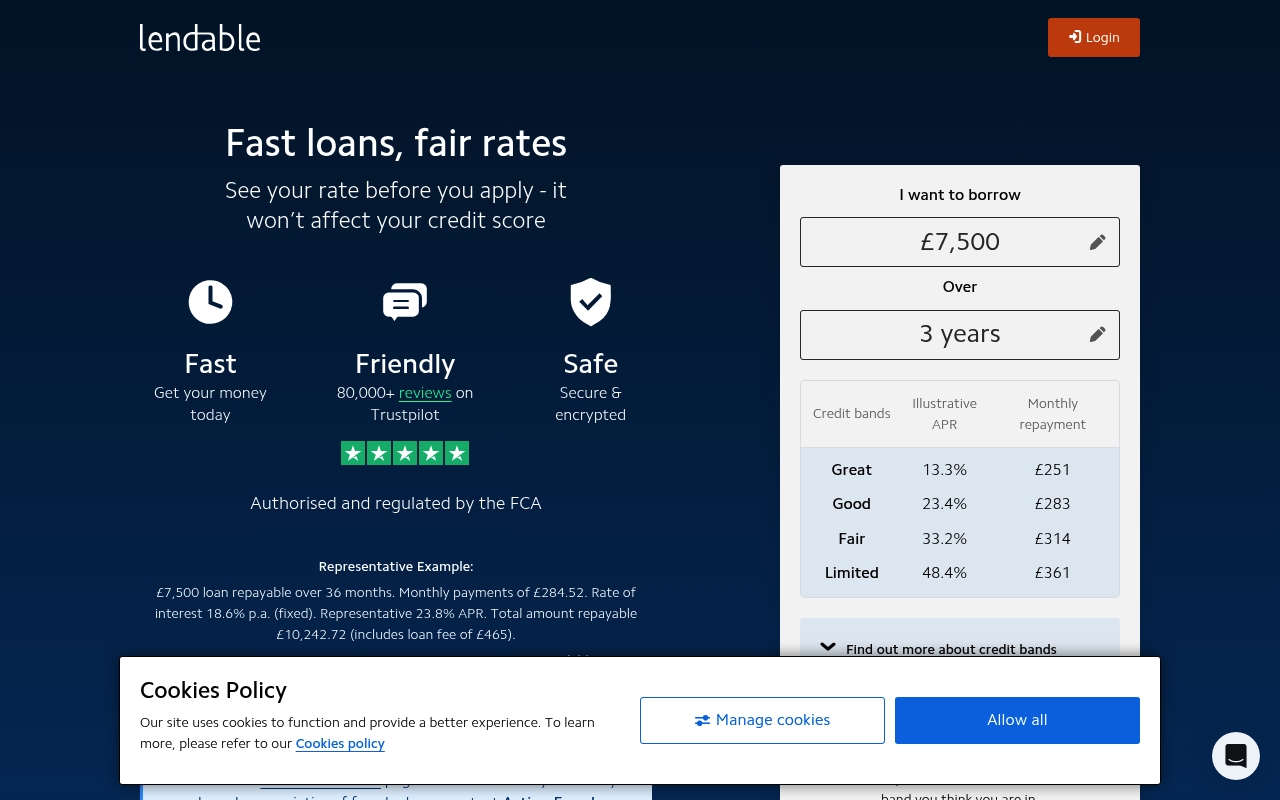
Lendable is the most valuable European fintech most consumers have never heard of, which is partly by design. Martin Kissinger — German-born, LSE and Oxford, an entrepreneur-in-residence at Rocket Internet before founding his own company — started it in London in 2014 with Victoria van Lennep, Paul Pamment, and Jakob Schwarz, in the dying days of the peer-to-peer lending era. The insight that outlived P2P was structural: don't hold loans on your own balance sheet and don't take retail money — aggregate institutional capital from pension funds and hedge funds, and compete purely on underwriting. Lendable's machine-learning models automate credit decisions end to end, approving personal loans in seconds, and the company takes fees for origination and servicing while the institutions take the credit risk. Asset-light, capital-efficient, and — unusually for the category — profitable early and quietly, a combination that had Sifted profiling it as one of Europe's most secretive fintechs back in 2020.
The quiet ended with the numbers. Revenue jumped 90% to £446 million in 2025 with profits more than doubling, and Experian data showed Lendable issued more new consumer credit loans by volume than any other UK lender that year — any bank included — while ranking second in new credit cards issued. A twelve-year-old company with 643 employees out-originating institutions with balance sheets a hundred times its size is the clearest available evidence that consumer credit underwriting is now a data and automation problem, not a branch-network problem. The product range has widened from personal loans into credit cards and car finance, and in July 2026 the company priced its debut public securitisation — a £500 million deal backed by UK personal loans under the Hoxton Consumer Loan Funding programme — opening a cheaper, deeper funding channel alongside its institutional partnerships.
The capital story has been correspondingly disciplined: roughly $290 million in equity across its history, a £210 million round led by Ontario Teachers' Pension Plan in March 2022 valuing the company at £3.5 billion, and Goldman Sachs among the backers. The valuation hasn't been retested publicly since — which cuts both ways in a repriced fintech market — and the IPO question follows Lendable around as persistently as it follows Monzo, with nothing filed. Expansion is the current chapter: the US operation established in 2021 is where profits are being reinvested, with Mexico planned next. Kissinger's thesis for why a lender travels better than a neobank is worth noting — personal loans and credit cards are structurally similar across markets, while current-account propositions are deeply local.
The honest caveat is the one that applies to every consumer lender that has only grown: Lendable's model has been profitable through a decade that included a pandemic and a rate shock, but unsecured consumer credit is cyclical, and an originator whose volumes now lead the UK market carries UK household credit exposure at scale — mediated to institutional investors, but reputationally and operationally its own. The machine has out-underwritten the banks in benign and bumpy conditions alike; a genuine credit downturn remains the test that separates good models from lucky ones.
Zepz
Payments🇬🇧 United Kingdom
Ismail Ahmed spent years as a compliance advisor to the United Nations Development Programme working on remittances, which meant he understood better than almost anyone what the industry cost the people using it — and that the cost fell hardest on migrants sending money to the countries least able to absorb the loss. He founded WorldRemit in London in 2010 with Catherine Wines and Richard Igoe to move that transaction online, cutting out the cash-agent networks that had defined remittances since Western Union.
The company today is a group rather than a brand. WorldRemit acquired Sendwave — a mobile-first remittance company focused on transfers to African and Asian mobile wallets, founded in 2014 by Drew Durbin and Lincoln Quirk — and reorganised in 2021 under the Zepz parent, with both brands operating separately. Combined, they serve more than 11 million customers, send from around 50 countries to more than 130, and operate over 5,000 transfer corridors. Both are fully digital on the sending side; on the receiving end, money lands in bank accounts, mobile wallets, or for cash pickup, depending on what the corridor supports.
The financial history is more turbulent than the mission suggests, and an honest profile has to include it. Zepz was valued at $5 billion in an August 2021 round of $292 million led by Accel. A planned US listing at up to $6 billion was shelved in 2022 while the company resolved what it described as accounting difficulties, amid senior management turnover. Three rounds of layoffs followed — 420 people (26% of staff) in 2023, a smaller round later that year, and around 200 more in early 2025 as it closed operations in Poland and elsewhere. Mark Lenhard, formerly COO of Bill.com, has led the group since 2022, with Ahmed remaining as non-executive chairman. Capital has continued to arrive: $267 million in a Series F in October 2024 led by Accel with LeapFrog, TCV and the IFC, and $165 million in growth financing from HSBC Innovation Banking in April 2025.
The strategic position is genuinely valuable and genuinely difficult. Digital remittances serve a market of enormous social importance — global remittance flows exceed development aid by a wide margin — with structurally thin margins, heavy compliance costs in exactly the corridors that matter most, and competition from both incumbents like Western Union and newer entrants including Wise, Remitly and LemFi. Zepz reached profitability in 2022 and has spent the years since removing the cost duplication that the WorldRemit–Sendwave combination created. Whether the $5 billion mark from 2021 bears any relation to what the business is worth today is unknown; no round since has published a valuation.

GoHenry
Payments🇬🇧 United Kingdom
GoHenry created a category. When Louise Hill and her co-founders launched it in the UK in 2012, financial products for six-to-eighteen-year-olds essentially did not exist beyond a savings account and a paper passbook. GoHenry paired a prepaid debit card with parental controls and an app built for both sides of the relationship: children learn to earn through chores and tasks, spend within limits their parents set, save toward goals, give to charity, and work through gamified money lessons, while parents monitor transactions in real time and guide the decisions.
The business model was as deliberate as the product. Rather than offering the card free and earning interchange on children's spending — which would have meant profiting from kids spending more — GoHenry charged parents a monthly subscription. That alignment is the reason the brand earned the trust it did: more than two million young people have used the app since 2012, and it holds a net promoter score of +58, exceptional for any financial product and remarkable for one sold to parents.
The ownership has changed twice in three years. In April 2023, GoHenry was acquired by Acorns, the US micro-investing app, in an all-equity deal that also brought in Pixpay, the French competitor GoHenry had itself acquired — giving Acorns a European foothold and a combined six million subscribers. Then in June 2026, Barclays agreed to acquire the GoHenry UK business from Acorns for a reported £180 million, with completion expected in Q4 2026 subject to regulatory approval. Acorns retains the US business, now operating as Acorns Early, and Pixpay in Europe.
The Barclays deal is more interesting than its size suggests. A major high street bank buying a children's money app is lifecycle banking made explicit: win the child at eight, keep the relationship through the first current account, the first mortgage and the pension. Barclays has said GoHenry will continue as its own brand and app rather than being folded into the bank. For this directory, the practical position is that GoHenry is a UK fintech that pioneered youth financial education, is currently owned by a US parent, and is in the process of becoming part of Barclays — no longer independent, but still operating, and still the reference product in its category.
Abound
Open Banking🇬🇧 United Kingdom
Gerald Chappell ran digital lending globally at McKinsey; Dr Michelle He was a director at EY advising banks on credit analytics, with a PhD in computer science. Both spent years building credit products for large financial institutions, and both reached the same conclusion about the machinery they were working inside: it was wrong at the individual level. A credit score is a statistical average applied to a person — it captures how someone has borrowed before, not what they can actually afford now. In 2020 they founded Fintern in London to replace that inference with observation, using the bank transaction data PSD2 had just made accessible. Chappell's description of what open banking gives a lender is the sharpest summary of the thesis: financial X-rays.
The consumer product, rebranded from Fintern to Abound, is a UK personal loan of a few thousand pounds up to around £20,000, repayable over one to five years, applied for entirely online with funds arriving within hours of approval. What happens underneath is the actual product. Applicants connect their bank accounts through open banking; Abound's proprietary platform, Render, reads real income and real spending — the rent, the subscriptions, the irregular gig income, the seasonal dip — and calculates affordability from what is there rather than from a bureau file. A soft credit check runs alongside it, so quoted rates carry no credit-score impact. The practical consequence is that people with thin files or a couple of historic blemishes can be approved on evidence a scorecard would never see, and that the company claims default rates roughly 75% below industry standard. That figure is Abound's own and unaudited — but the direction is corroborated by the funding it has been able to raise against the loan book.
That funding is the second thing to understand precisely. Abound has announced facilities totalling more than £1.6 billion since launch — £500 million in 2023, up to £800 million in 2024, a further £250 million from Deutsche Bank in 2025 — from Citi, Deutsche Bank, Waterfall Asset Management, LuminArx, Salica, Informed Ventures, and West Coast Capital. The overwhelming majority is debt to fund lending, not equity in the company; before the 2023 round Abound had raised only around $11 million in equity, and no valuation has ever been disclosed. This is the standard structure for a balance-sheet lender and it says something real — institutional lenders underwrite the underwriter, and £1.6 billion of credit facilities is a market verdict on Render's models — but it is not a $1.6 billion company. The genuinely notable milestone is quieter: Abound reached profitability three years after launch, and has now lent over £1 billion, from a team of roughly 130 in London.
The strategic shape now mirrors what several European fintechs have converged on: run the consumer brand, and rent the machinery. Render is being licensed to other lenders — GAIA Family and LemFi are named clients — as cashflow underwriting infrastructure for companies that want to launch credit products or improve their decisioning without building affordability models themselves. Alongside it sit partner products in retail finance and premium finance. It is the same dual model that made Klarna infrastructure for Apple: the consumer business proves the technology, and the technology business scales beyond what the consumer brand could reach alone. International expansion has been signalled repeatedly but Abound remains UK-only, regulated by the FCA under Fintern Ltd (FRN 929244).
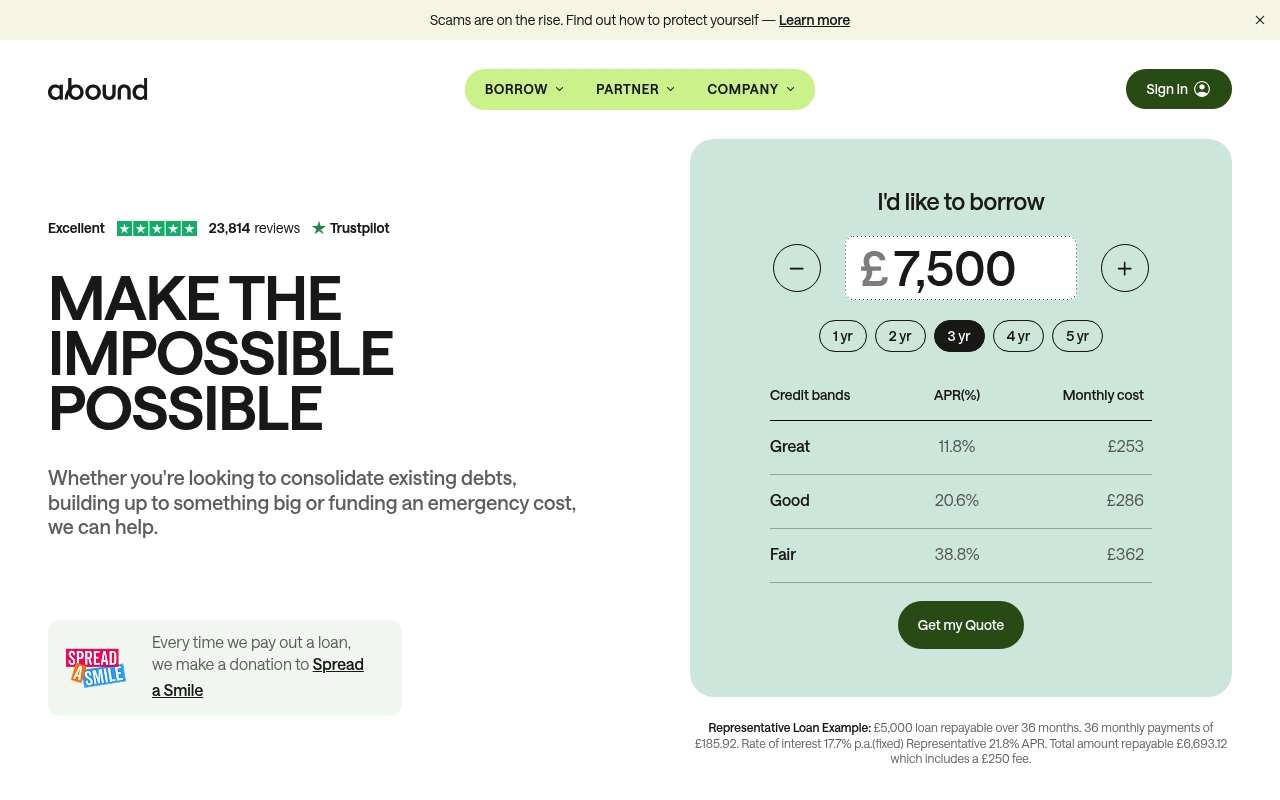
The honest read requires looking at the rate card. Abound markets fairness, and relative to what its customers' alternatives are, the case is strong: representative APR is 21.8%, debt consolidation customers save around £1,000 over a loan's life on the company's numbers, and 25,000-plus Trustpilot reviews average 4.9 — unusually good for consumer credit, a category where people rarely leave happy reviews. But the published bands run from 11.8% for the strongest applicants to 38.8% for the "fair" band, and the sample £5,000 loan carries a £250 fee. This is near-prime and non-prime lending: much cheaper than payday or doorstep credit, considerably more expensive than a high-street personal loan, and priced for a customer the high street declines. The structural question is the one facing every lender that has only grown — Abound's models have been profitable through a rate shock but not yet through a genuine consumer credit downturn, and affordability underwriting is precisely the discipline that either proves itself or doesn't when unemployment moves. What it has already demonstrated is narrower but not trivial: open banking data, six years after PSD2 made it available, can underwrite people the credit bureaus get wrong.
Credit Spring
Lending🇬🇧 United Kingdom
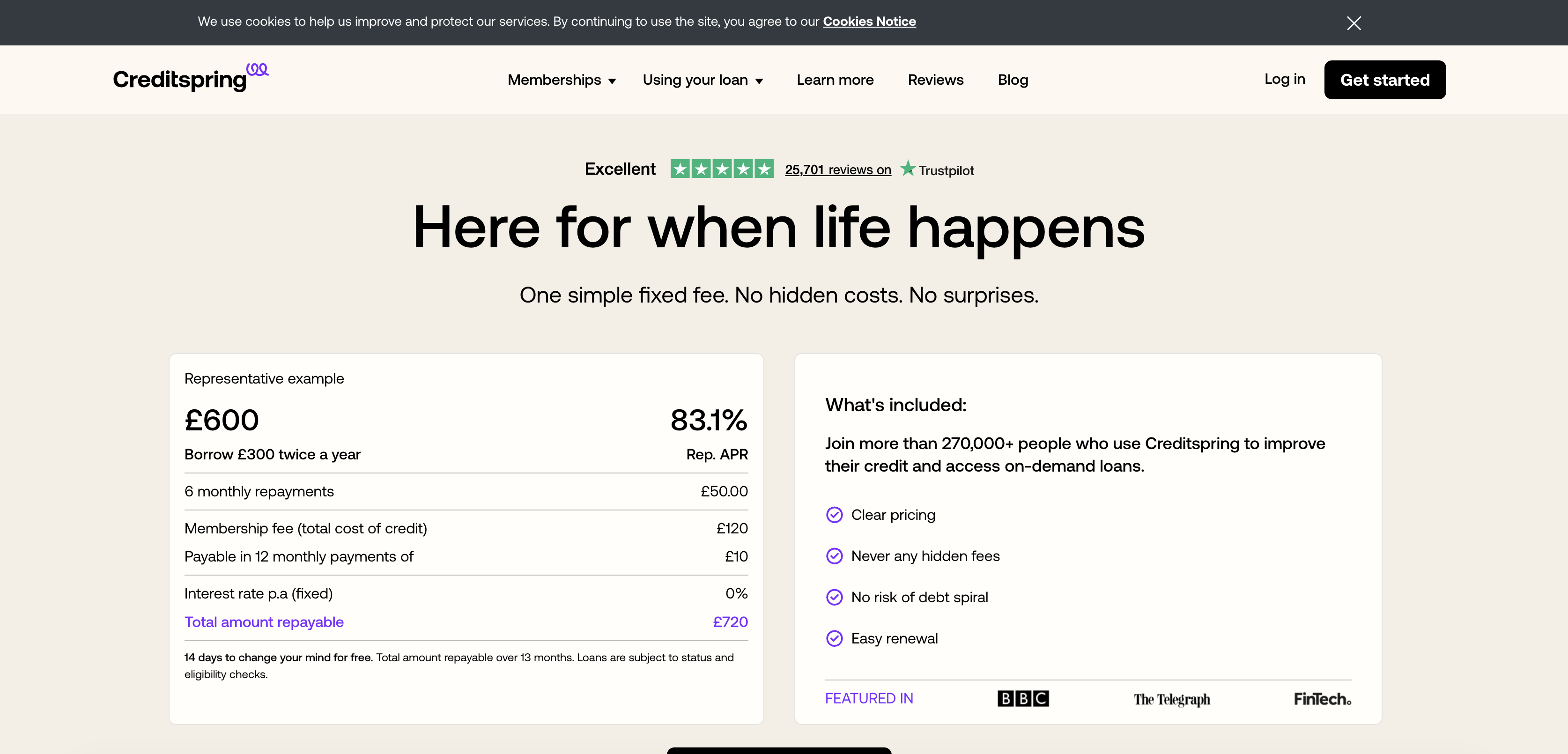
Credit Spring is a UK-based fintech that treats financial distress like a health problem—one that deserves diagnosis and treatment, not judgment. Rather than simply offering credit, the company combines short-term loans with financial coaching and debt management tools, recognizing that a quick cash injection without context is often a band-aid on a bigger problem. The platform helps borrowers understand their spending patterns and rebuild their financial foundation, not just patch a temporary shortfall. It's a provocative stance in a market crowded with BNPL and payday lenders that rarely ask why someone needs money in the first place. Credit Spring targets people in the credit-vulnerable segment—those with poor or limited credit histories who'd normally be shut out of mainstream lending. Instead of algorithmic rejection, the company uses alternative data and behavioral insights to assess creditworthiness beyond traditional scoring. For users, this means faster access to reasonable credit at transparent rates. For the market, it signals a shift toward lending that acknowledges financial fragility as a temporary state, not a permanent condition. The company represents a broader move within fintech to attach financial wellness services to credit products, treating lending as an entry point to deeper financial health rather than a transaction.
ClearBank
Embedded Finance🇬🇧 United Kingdom
ClearBank was the first new clearing bank in the UK in more than 250 years. That sentence is doing a lot of work, because the reason there hadn't been one is that clearing — the plumbing that moves money between banks — had settled into the hands of four incumbents whose systems dated to a different era, and every fintech that wanted to offer accounts had to rent access from one of them. ClearBank launched in 2015 to be the alternative: a purpose-built, cloud-native clearing bank with no legacy estate, accessed through a single API, holding client funds at the Bank of England rather than on its own balance sheet.
The customer list explains the model better than the description does. TrueLayer, Tide, Chip, Coinbase, Raisin and Wealthify all run on ClearBank — companies that wanted to offer accounts and payments without becoming banks themselves. ClearBank provides the regulated banking layer and the real-time payment rails; the client owns the customer relationship. This is embedded banking delivered by an actual bank rather than middleware, which is the distinction that matters when a regulator asks who is holding the money.
The financial trajectory has been unusually disciplined for the category. ClearBank has been profitable since 2022, reported its first full-year pre-tax profit of £18.4 million in 2023, and delivered a third consecutive profitable year in 2025 with group normalised revenue up 34% to £121.6 million. The more significant number is that fee-based income grew 51% and now makes up the majority of revenue — the deliberate pivot away from interest-rate dependency that most banks talk about and few execute. The infrastructure now underpins more than 17 million accounts, and ClearBank UK holds an investment-grade BBB− rating from S&P, rare for a company its age.
Europe is the current chapter, and it resolves an old caveat about ClearBank being UK-only. ClearBank Europe N.V., headquartered in Amsterdam and led by Rintse Zijlstra, received a Credit Institution Licence from the European Central Bank under DNB supervision in 2024, backed by more than €70 million of investment. It gives the group euro accounts and payments alongside sterling, with access to TARGET2, SEPA Credit Transfer and SEPA Instant. By the end of 2025 the European business covered 21 EU countries, had opened a Paris branch, and was processing over a million payments a month — real but early, which is the honest way to frame it against a UK operation of 17 million accounts. Mark Fairless succeeded Charles McManus as chief executive.