← Back to Argenta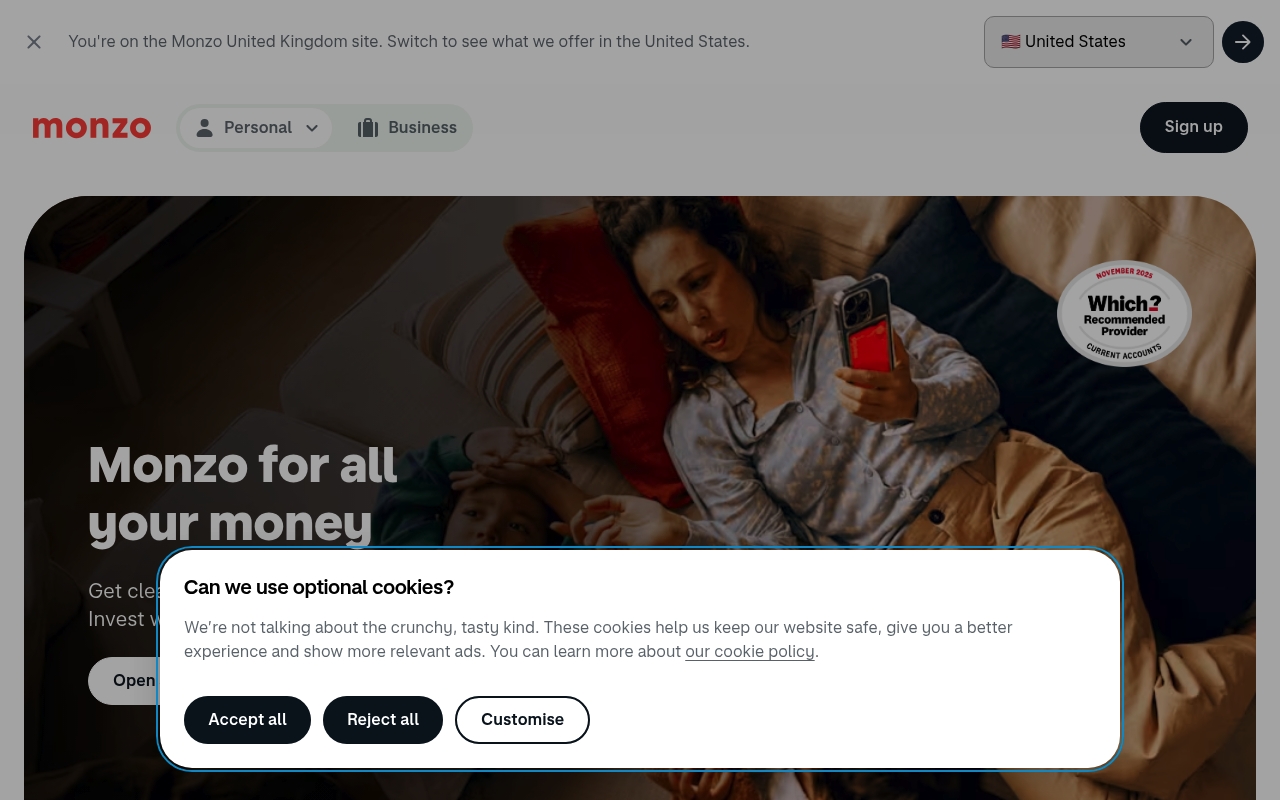


Alternatives
Alternatives to Argenta
Explore 12 European fintech companies similar to Argenta — operating in Wealth and Digital Banking and Real Estate Finance.
12 alternatives to Argenta
Sorted by similarity and popularityMonzo
WealthDigital BankingLendingPersonal Finance
🇬🇧 United Kingdom
The founding team that built Monzo had all worked together before — at Starling Bank, another challenger startup that didn't survive its internal conflicts. Tom Blomfield, Gary Dolman, Jonas Huckestein, Jason Bates, and Paul Rippon left together in 2015 and started again. The product was initially a prepaid card — a coral-coloured piece of plastic that became one of the most recognisable objects in British fintech — before becoming a fully licensed current account in 2017. The early community was unusual for a bank: public engineering blogs, user forums, beta programmes, and a 2016 crowdfunding round that raised £1 million in 96 seconds, a world record. People felt ownership of the product in a way no high street bank had ever achieved, and that emotional connection became a durable competitive advantage.
A decade on, the results have caught up with the mythology. For the year to March 2026, Monzo reported revenue of £1.71 billion, up 39%, with gross profit crossing £1 billion for the first time and a third consecutive year in the black — statutory pre-tax profit of £87.3 million, up 44%, or £172.6 million adjusted for restructuring charges and a roughly £21 million FCA fine over historical financial-crime control failings. The bank added a record three million customers to reach 15.2 million — one in five UK adults — with deposits up 55% to £25.7 billion, 1.6 million paying subscribers, and business banking growing 45% to 905,000 customers and 14% of revenue. Four separate income streams — current account balances, borrowing, payments, and wealth — each now clear £300 million. Half of active customers use Monzo as their primary bank, which shows up in the metric that anchors every valuation conversation: revenue per active personal customer of £167, against Revolut's £66. The gap is the difference between being someone's bank and being their travel card.
Leadership and strategy both turned over during the year. Diana Layfield, a former Google executive, took over as CEO in February 2026 following TS Anil's departure — a transition shaped in part by board tensions over IPO venue and the company's UK concentration. Her first significant moves were decisive: Monzo closed its US operations entirely, and redirected the international ambition at Europe, where it secured a banking licence from the Central Bank of Ireland, launched in Ireland to a 100,000-person waitlist, and named Spain as the next market. The acquisition of digital mortgage broker Habito completed on 1 April 2026, giving the bank a capital-efficient route into mortgages — a product more than 550,000 customers were already tracking in the app. Costs rose with the ambition: the cost-to-income ratio ticked up to 74% as hiring and marketing accelerated.
Monzo remains private, valued at approximately $5.9 billion in its 2024 secondary sale, and Layfield has told the FT she is "not in a hurry" to list. The strategic bet of this chapter is clear and genuinely contestable: that Monzo's deep-relationship, primary-bank model — expensive to build, lucrative per customer — can be exported to European markets where Revolut arrived a decade earlier with the opposite playbook. The UK numbers say the model works. Europe will say whether it travels.
Founded 2015
View profile →
finleap
Embedded FinanceFinancial InfrastructureWealthPaymentsDigital BankingLending
🇩🇪 Germany
finleap is Berlin's answer to a question the European fintech scene keeps asking: how do you build world-class financial companies at scale? Rather than chase unicorn valuations, finleap builds them. The holding company operates as a fintech factory, incubating and scaling financial startups from day one with institutional backing, operational expertise, and a network that spans regulators, banks, and investors across the continent.
What sets finleap apart is the architecture itself. It's not an accelerator or a VC fund—it's a purpose-built engine for creating and nurturing fintech companies. Each portfolio company gets access to finleap's infrastructure, compliance playbooks, and go-to-market templates, which compresses timelines and eliminates the friction that typically derails early-stage fintechs. The model works: companies like Wayfair-backed Finn, B2B payments platform Foxpay, and lending marketplace Evala have all emerged from the finleap stable.
Internally, finleap operates across payments, lending, wealth, and embedded finance—categories where the European market remains genuinely underpenetrated compared to the US. The company's thesis is straightforward: identify white space in financial services, build products faster than traditional banks can move, and create defensible market positions through technology and user experience. It's less about disruption theater and more about pragmatic value creation.
Finleap sits at an interesting intersection in the European fintech landscape: large enough to command resources and regulatory relationships, independent enough to move quickly, and structured in a way that lets founders maintain autonomy while tapping institutional muscle. For a continent that produces good fintech companies but struggles with scaling, finleap represents a new playbook.
Founded 2014
View profile →
Revolut
WealthPaymentsDigital BankingPersonal Finance
🇱🇹 Lithuania
Nik Storonsky was born in Dolgoprudny, Russia, and moved to London in 2006 to work as an equity derivatives trader, first at Lehman Brothers and later at Credit Suisse. Vlad Yatsenko was a software engineer who'd spent years building financial systems. In 2015 they sat down and asked a question that should have occurred to banks years earlier: why does spending money abroad still cost so much?
The answer they built was Revolut — initially a prepaid card with no foreign exchange fees, then a multi-currency account, then a trading platform, then an insurance product, then a business banking offering, then something that's increasingly hard to describe as anything other than a full financial operating system. Revolut didn't unbundle banking so much as rebuild it from scratch for people who found the existing version frustrating and expensive.
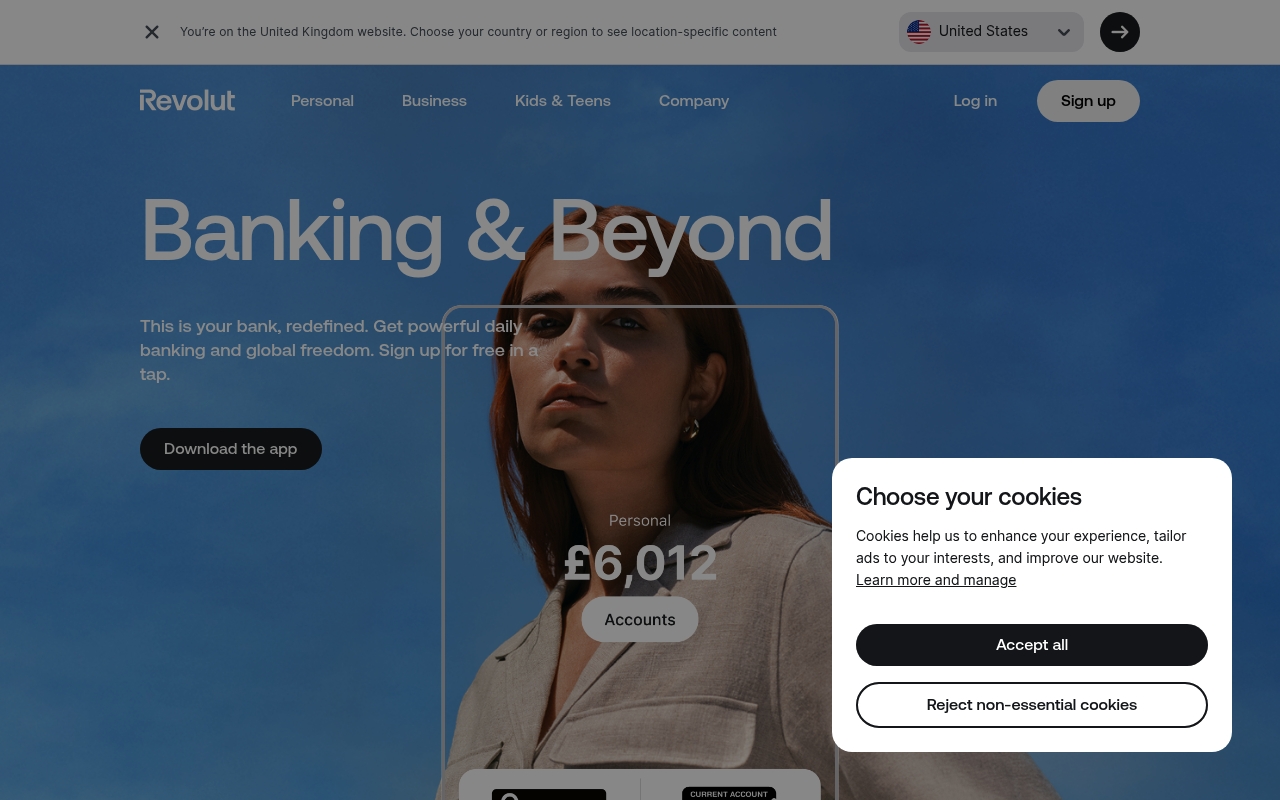
The numbers now are genuinely striking for a company that started with two people and a card. Revenue reached £4.5 billion in 2025, up 46% year on year, with pre-tax profit rising 57% to £1.7 billion. The customer base has passed 75 million retail users, plus 767,000 businesses. The company employs more than 12,000 people and operates in more than 40 markets. In July 2026, a secondary share sale valued Revolut at $115 billion — up from $75 billion just eight months earlier, and more than the market capitalisation of Barclays. It remains Europe's most valuable private technology company by a wide margin.
The milestone that mattered most arrived in March 2026: a full UK banking licence from the Prudential Regulation Authority, ending a five-year application process that had become one of the most-watched regulatory sagas in European fintech. The licence means Revolut can now protect UK deposits up to £120,000, offer authorised consumer credit, and compete directly with high street banks for mortgage and lending business. It's the piece that transforms Revolut from a very successful payments app into a regulated bank.
The global licensing map is filling in quickly, with one persistent gap. In July 2026 Revolut became the first global fintech granted a full Australian Deposit-taking Institution licence by APRA — a regulator whose capital requirements have defeated several domestic neobanks — and launched Revolut Bank Australia. In August it secured a French banking licence, a significant step given that France is its largest European market outside the UK and that holding a local licence rather than passporting from Lithuania changes how it can compete there on lending and deposits. It has also opened its first bank outside Europe, in Mexico. The exception is the United States, where a banking charter application filed in 2024 remains pending — in a period when the OCC has rejected applications from both Wise and bunq.
Around the licences, the product keeps widening past banking: private markets access for European retail customers through funds from Apollo, Ares and Partners Group; a partnership with OpenAI bringing ChatGPT Go to premium tiers; eSIM data plans; and an airport lounge network starting in Copenhagen. The original thesis — that banking could be cheaper, faster, and simpler — hasn't changed. What has changed is that Revolut is no longer only selling banking.
Founded 2015
View profile →
Tinaba
WealthPaymentsDigital Banking
🇮🇹 Italy
Tinaba offers mobile banking, payments, and investment services in Italy.
View profile →
Qonto
PaymentsDigital BankingLendingSME Finance
🇫🇷 France
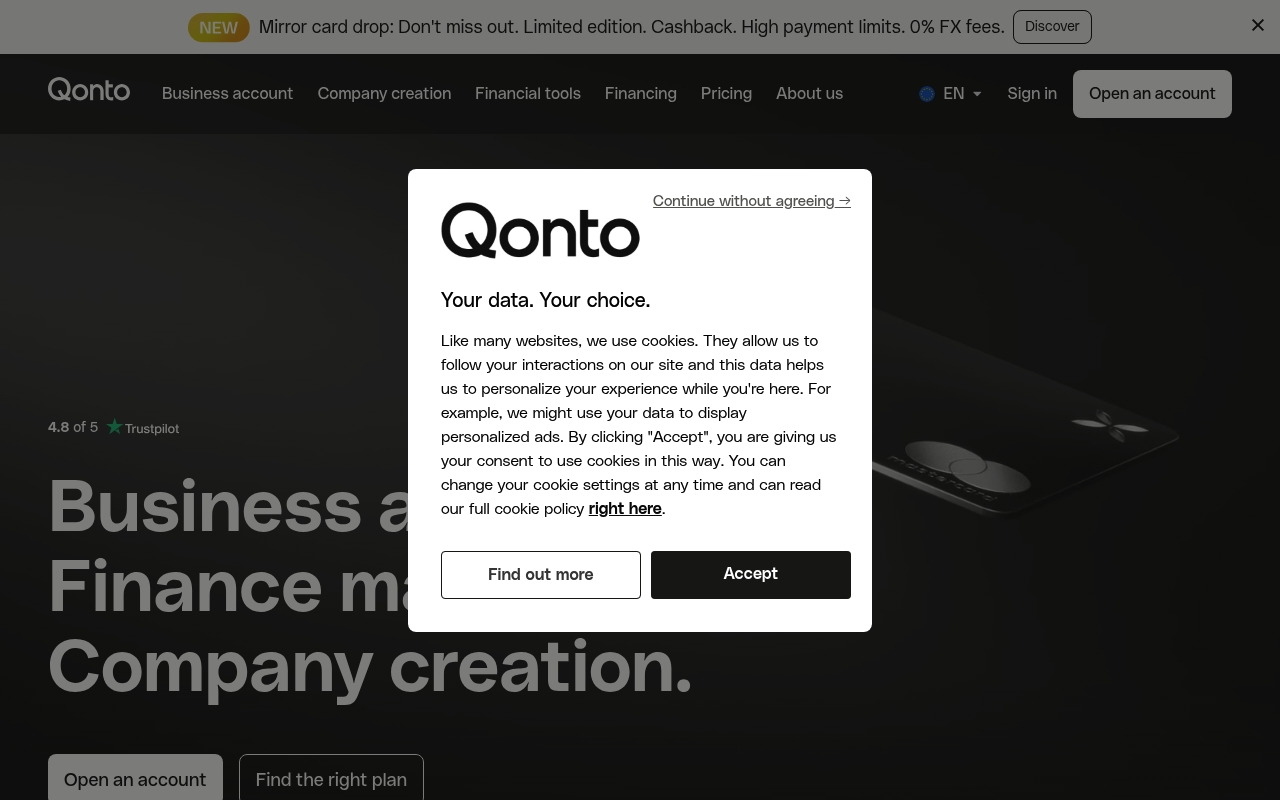
Qonto is a French business banking platform for freelancers and SMEs — though, strictly speaking, it isn't a bank. It has operated since 2018 under a payment institution licence from France's ACPR, with customer funds safeguarded at Crédit Mutuel Arkéa, and only filed for a full French banking licence in July 2025. The distinction matters more than it sounds: that licence is the thing standing between Qonto and the lending, savings, and investment products it wants to sell directly.
Founded in 2016 by Alexandre Prot and Steve Anavi — Prot the son of Baudouin Prot, former chairman of BNP Paribas, which gives the challenger story a certain symmetry — the company set out to build the business account the founders wished they'd had. The product wraps a business account around the admin that surrounds it: invoicing, expense management, bookkeeping automation, cash flow forecasting, sub-accounts, and accounting integrations. Prot's own pitch is that customers save roughly two hours a week on paperwork.
That has scaled into the leading position in European B2B banking. Qonto passed 600,000 customers across eight markets — France, Germany, Italy, Spain, Austria, Belgium, the Netherlands, and Portugal — employs around 1,600 people, and has been profitable since 2023. It raised a $552 million Series D in 2022 at a $5 billion valuation and hasn't needed to raise since; profitability means even the banking licence push can be funded from what it already holds. Two acquisitions shaped it: German rival Penta in 2022, which brought 50,000 customers and a real German footprint, and accounting automation platform Regate in 2024, which opened up accountants and accounting firms as a new customer segment.
The direction of travel is credit. Qonto has launched a Pay Later product, financing from €150 to €50,000, and added its first business credit card and overdraft facilities in January 2026 — all currently dependent on partnerships. A full banking licence would let it do that lending on its own account, which is the entire point of the application and the foundation of its stated goal of two million customers by 2030. Its competitive set is the European business banking cohort: Revolut Business, Tide, Holvi, Pennylane, and the incumbent banks it was built to route around.
Founded 2016
View profile →
Tandem Bank
Digital BankingLending
🇬🇧 United Kingdom
Tandem holds the distinction of being one of the earliest UK challenger banks and one of the very few that reinvented itself successfully. Granted a banking licence in 2015, it spent its first years as a consumer app-based challenger without ever achieving the scale of Monzo or Starling, and its early history included the collapse of an investment that cost it its original licence and forced a restart through the acquisition of Harrods Bank.
The transformation came in January 2022 with the acquisition of Oplo, a consumer lender. The combined business had £1.2 billion in assets, over 171,000 customers and — critically — a lending book that made it profitable almost immediately. Alongside it came a strategic repositioning that has defined the bank since: Tandem rebuilt itself as the UK's greener digital bank, using competitive savings rates to fund green lending for home improvements, solar installations, heat pumps and electric vehicles. Further acquisitions followed, including green home improvement lender Allium and the money-sharing app Loop in 2023.
The strategy has produced consistent results. Tandem reported underlying profit of £24.1 million in 2024, up 40%, on revenue of £98.7 million and assets under management above £1.5 billion — a third consecutive profitable year and its first statutory profit. Green lending reached £572 million, 38% of total lending. 2025 delivered a fourth straight profitable year with £17.4 million in operating profit, and the bank reported more than £820 million in green and pathway-to-green home improvement funding to over 170,000 customers, with customers collectively saving an estimated 75,600 tonnes of CO2 during the year.
The proposition is genuinely differentiated in a way that most challenger bank positioning is not, because the green lending is the business rather than a marketing layer over a conventional one: savings deposits fund loans for measures that reduce household emissions and household bills at the same time. The risks are the ordinary ones for a consumer lender of this size — Tandem is a fraction of Monzo's scale, competes for deposits on rate against much larger balance sheets, and carries motor finance exposure at a time when the FCA's review of historic motor finance commissions has extended into 2026 with a compensation scheme pending. That last item is a live uncertainty for every UK lender with a motor finance book, and worth watching.
View profile →
Scalable Capital
WealthDigital Banking
🇩🇪 Germany
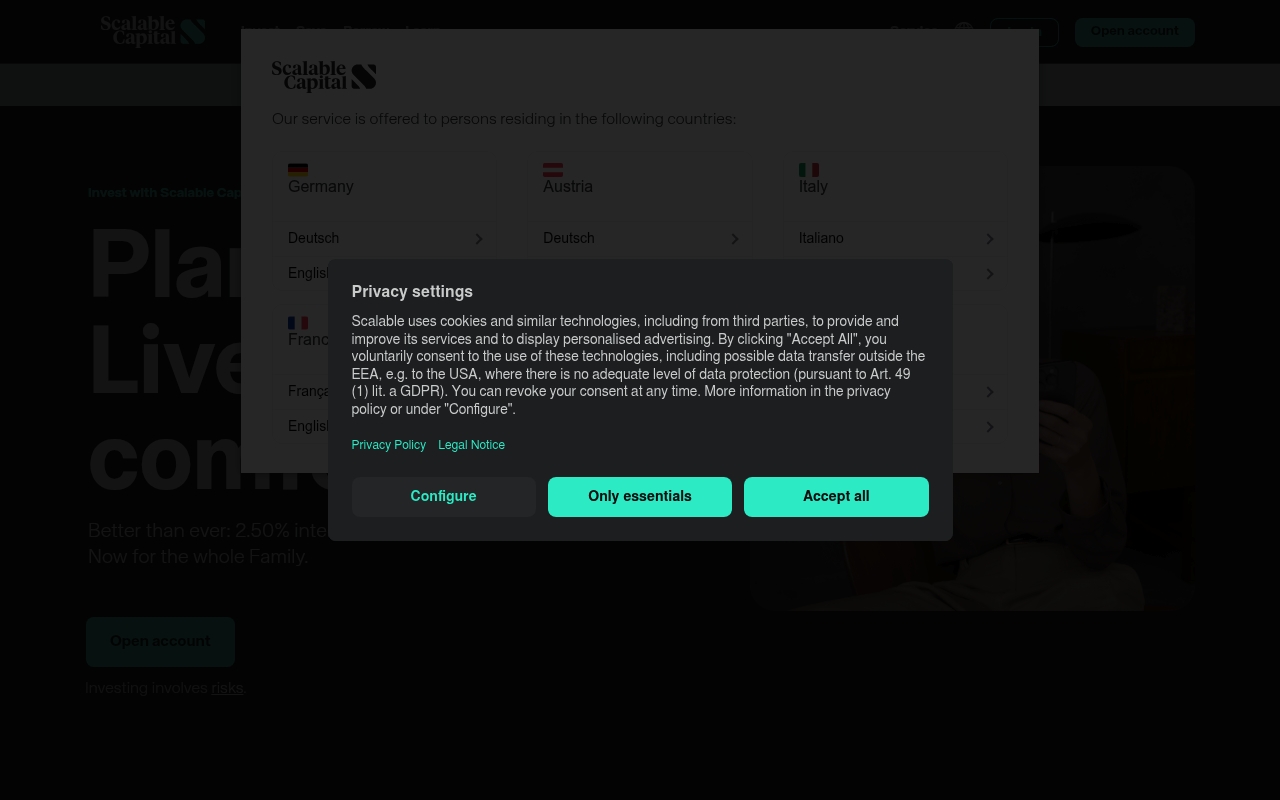
Scalable Capital was founded in Munich in 2014 by an unusually complementary quartet: Erik Podzuweit, a former Goldman Sachs banker; Florian Prucker, his co-CEO to this day; Adam French, who built the UK business; and Stefan Mittnik, an econometrics professor who gave the company its quantitative risk-management backbone. The product they launched in 2016 was a robo-advisor — algorithmically managed ETF portfolios for German savers who had money in zero-interest accounts and no relationship with the stock market. The early growth hack was distribution rather than marketing: a 2017 partnership put Scalable's digital wealth management inside ING Germany's retail bank, and BlackRock joined the cap table the same year. By 2018 it was managing €1 billion and ranked among the fastest-growing robo-advisors anywhere.
The decision that transformed the company came in 2020: the launch of Scalable Broker, a flat-fee trading platform built around a subscription model — the PRIME tiers — rather than per-trade commissions. It arrived at exactly the moment a generation of Germans discovered investing, and it made recurring ETF savings plans, the culturally German path into the market, effectively free at scale. Scalable became one of continental Europe's two dominant neobrokers, locked in a now decade-defining duel with Berlin's Trade Republic, with the low-cost incumbent DEGIRO fighting the same war from the Netherlands.
What distinguishes Scalable strategically is how far it has pushed vertical integration. When the EU banned payment for order flow — the revenue model most neobrokers were built on — Scalable's answer was to co-found its own trading venue, the European Investor Exchange, with Börse Hannover in 2023, keeping headline trading costs low by bringing execution in-house. It launched its own World ETF with DWS and MSCI in 2024, and opened private equity access to retail investors through a BlackRock partnership in 2025. Independent reviewers note the obvious tension in this design: when a broker routes client orders to its own exchange, execution quality and spreads deserve as much scrutiny as the visible fees — a fair caveat about a structure that is otherwise a genuine competitive moat.
The capstone came in September 2025, when the European Central Bank granted Scalable Capital a full banking licence, making it a CRR credit institution supervised by BaFin and the Bundesbank. The licence collapsed the remaining dependency on partner banks: Scalable now handles custody, clearing, settlement, deposits, and lending itself. Interest-bearing deposits launched within weeks, spread across Scalable's own bank and partner institutions with the distribution visible in-app, and a flexible credit product followed — loans from €1,000 to €250,000 with no fixed term. Podzuweit's framing of the ambition is lifelong: everything a customer and their family need for investing, saving, and financing, from the first savings-plan euro to retirement. It's the same full-stack endgame Trade Republic reached via its own licence — the two German rivals have independently concluded that the neobroker business ends in becoming a bank.
The scale now backs the ambition. Scalable Capital manages more than €30 billion for over one million customers across Germany, Austria, France, Italy, Spain, and the Netherlands, with around 845 employees across Munich, Berlin, London, Vienna, and Milan. A $175 million round led by Sofina and Noteus Partners in June 2025 — joined by Balderton, Tencent, and HV Capital — took total funding past half a billion dollars, three months before the banking licence landed. A decade in, the company that started by automating ETF portfolios for cautious German savers has become one of Europe's few vertically integrated investment banks for retail: its own exchange, its own ETF, its own banking licence, and a product that now touches every stage of a customer's financial life.
Founded 2014
View profile →
Vivid Money
WealthDigital BankingCrypto & BlockchainPersonal Finance
🇩🇪 Germany
Vivid Money is a Berlin-based fintech that collapsed the traditional distinction between banking, investing, and spending into a single mobile-first experience. Launched in 2020, it positioned itself as the European answer to all-in-one financial apps—a place where you could manage your checking account, invest in fractional shares and crypto, and pay with virtual cards, all without leaving the app.
The platform built its early reputation on speed and accessibility. Account opening took minutes rather than days. The investment side felt more like TradingView-for-consumers than stuffy wealth management. Virtual card creation was instantaneous, and the app's design sensibility leaned toward the minimalist and modern rather than corporate banking's beige aesthetic.
Vivid positioned itself against traditional banks' glacial pace and regulatory burden, while also differentiating from pure-play neobanks that didn't offer investing. It moved quickly to add crypto features when the market demanded them, and secured backing from tier-one investors who believed in the all-in-one thesis.
However, the company faced headwinds from regulatory tightening around crypto and the broader fintech funding winter. In late 2024, reports emerged of operational restructuring and potential insolvency, marking a sobering turn for what had been one of Europe's most closely watched fintech challengers. Vivid's arc—from breakthrough disruptor to distressed turnaround—reflects the volatility of the European fintech landscape and the challenge of building a diversified financial platform without institutional heritage or captive customer bases.
Founded 2020
View profile →
Avanza
WealthDigital BankingPersonal Finance
🇸🇪 Sweden
Avanza is Sweden's largest independent online brokerage, a no-frills investment platform that democratized stock trading for Swedish retail investors two decades ago. What started as a scrappy alternative to traditional banks has become the go-to app for millennials and Gen Z who want to trade, invest, and save without paying legacy banking fees. The platform strips away unnecessary complexity—no advisors, no jargon, just direct market access at transparent prices. Avanza operates in that interesting middle ground between a neobank and a pure trading platform. It offers savings accounts, pension accounts, and investment accounts with a sharp focus on user experience and low costs. The company has built a cultural following in Sweden, becoming almost synonymous with retail investing for a generation that views traditional brokers as relics. Beyond just equities and funds, Avanza has expanded into savings products, retirement planning, and financial education—positioning itself as a genuine financial companion rather than just a transaction layer. Its dominance in the Nordic market reflects a broader European shift toward direct-to-consumer investment platforms that compete on transparency, speed, and mobile-first design. Avanza exemplifies how fintech can win by doing one thing exceptionally well and then expanding thoughtfully into adjacent categories. The company's influence extends beyond Sweden into a broader shift in how younger Europeans think about investing: without gatekeepers, without unnecessary fees, and entirely on their own terms.
Founded 1999
View profile →
Inbank
Digital BankingLendingBNPL
🇪🇪 Estonia
Specialised banking for consumer credit — focused on lending products distributed through merchant partnerships rather than building general-purpose retail banking — is a model with deeper European roots than the venture-backed BNPL conversation suggests. Inbank was founded in Tallinn in 2011 as a specialist lender focused on point-of-sale consumer credit, partnering with retailers across Estonia and the broader Baltic and Central European region to offer instalment finance at the moment of purchase. The company received a full Estonian banking licence and has built operations across Estonia, Latvia, Lithuania, Poland, and the Czech Republic, expanding from a domestic specialist into a Pan-European consumer finance bank. Inbank is publicly listed on the Nasdaq Tallinn exchange — one of the few publicly traded Baltic fintechs — giving it both the regulatory standing of a licensed bank and the funding access of a public company. Its product range covers point-of-sale finance, BNPL, and consumer deposit products, with merchant partnerships across automotive, electronics, home improvement, and other categories where consumers commonly finance purchases. In the European specialist consumer banking landscape, Inbank represents one of the more successful examples of a focused operator scaling across borders while maintaining the operational discipline of a regulated bank.
Founded 2011
View profile →
Crealogix
Financial InfrastructureWealthDigital Banking
🇨🇭 Switzerland
Crealogix is a Swiss fintech company that builds digital banking platforms for financial institutions across Europe. Rather than starting from scratch, banks and wealth managers plug into Crealogix's modular software suite to modernize their customer experience—covering everything from retail and corporate banking interfaces to wealth management portals and mobile apps.
The company operates as an infrastructure play in the digital transformation space. Its platforms run on a microservices architecture, letting financial institutions pick and choose the components they need rather than ripping out legacy systems entirely. This approach has gained traction with mid-market and enterprise banks looking to compete with neobanks without the cost of a complete rebuild.
Crealogix sits in a pragmatic middle ground between traditional banking software vendors and modern fintech disruptors. It's not trying to be a bank itself; instead, it partners with incumbents and increasingly with smaller financial institutions across German-speaking Europe and beyond. The company's strength lies in understanding both the technical demands of modern digital banking and the regulatory complexity that traditional banks navigate daily.
In the evolving European fintech landscape, Crealogix represents the infrastructure generation—the companies enabling the banking industry's digital transition rather than replacing it entirely.
Founded 1999
View profile →
EstateGuru
Real Estate FinanceLending
🇪🇪 Estonia
EstateGuru was founded in Tallinn in 2014 by Marek Pärtel and co-founders, and for most of a decade it was the reference platform for property-backed lending in Europe. The model is debt, not equity — the structural opposite of Reinvest24. Investors fund short-term loans to small property developers and businesses, each loan secured by a first-rank mortgage on real estate, starting from €50. If the borrower repays, investors collect interest of roughly 8–11%. If the borrower defaults, the platform enforces the mortgage and sells the collateral. That security model — boring, bank-like, collateralised — is what let EstateGuru scale to more than €700 million in funded loans across eight European markets, and it is also what the platform's crisis would ultimately stress-test.
The crisis came from Germany. EstateGuru expanded aggressively there in 2020 and 2021, originating a large loan book at speed just before the German property market entered its sharpest correction in decades. In January 2023 the company announced an internal investigation into its German team over violations of internal lending guidelines during those origination years; new German lending was paused shortly after, then Finland, then the platform retreated to its Baltic core. The damage was substantial: over €78 million of the German book alone ended up in recovery, defaults across the affected markets drew widespread criticism — one community tracker puts non-performing rates above 50% for the legacy portfolio and voted EstateGuru its worst crowdlending platform of the year — and individual investors with German exposure have publicly reported negative annual returns on their portfolios.
What distinguishes EstateGuru from the platforms that didn't survive this cycle is what happened next. The company holds the ECSP authorisation that became mandatory for European crowdfunding in November 2023 — the licence Reinvest24 never obtained — and kept originating in Estonia, Latvia, and Lithuania throughout the workout. It hired the German debt-servicing specialist Steinberg to run enforcement, and puts roughly €100,000 a month of its own capital into recovery efforts, over €1.1 million in 2024 alone. Spain and Sweden have been fully wound down with all loans repaid; Portugal is being closed the same way. Leadership turned over twice: Pärtel moved to chairman, Mihkel Stamm ran the restructuring for two and a half years, and in September 2025 long-time insider Daniil Aal, previously COO, took over as CEO. Along the way the platform introduced fees investors of the growth era never paid — a monthly management fee on performing principal and a €3 withdrawal charge — a decision that funded the recovery machinery and permanently annoyed a portion of the investor base.
The mid-2026 picture is a company running two businesses at once. The active Baltic business has €101.9 million outstanding, roughly two-thirds performing, and continues to fund new mortgage-secured loans under tightened risk policies. The legacy business is a slow-motion workout: €97.7 million still outstanding in the inactive markets, nearly all of it in active recovery, with the company estimating three to five years to resolve. Against that, EstateGuru has recovered around €70 million in principal for investors to date — €7.5 million in 2025, €6.3 million in the first half of 2026, and a further €5.3 million under signed agreements. All figures are self-reported; the platform publishes monthly repayment and recovery updates, which is more transparency than the category average, if less than burned investors would like.
Founded 2014
View profile →