← Back to Coinmate
Alternatives
Alternatives to Coinmate
Explore 12 European fintech companies similar to Coinmate — operating in Crypto & Blockchain.
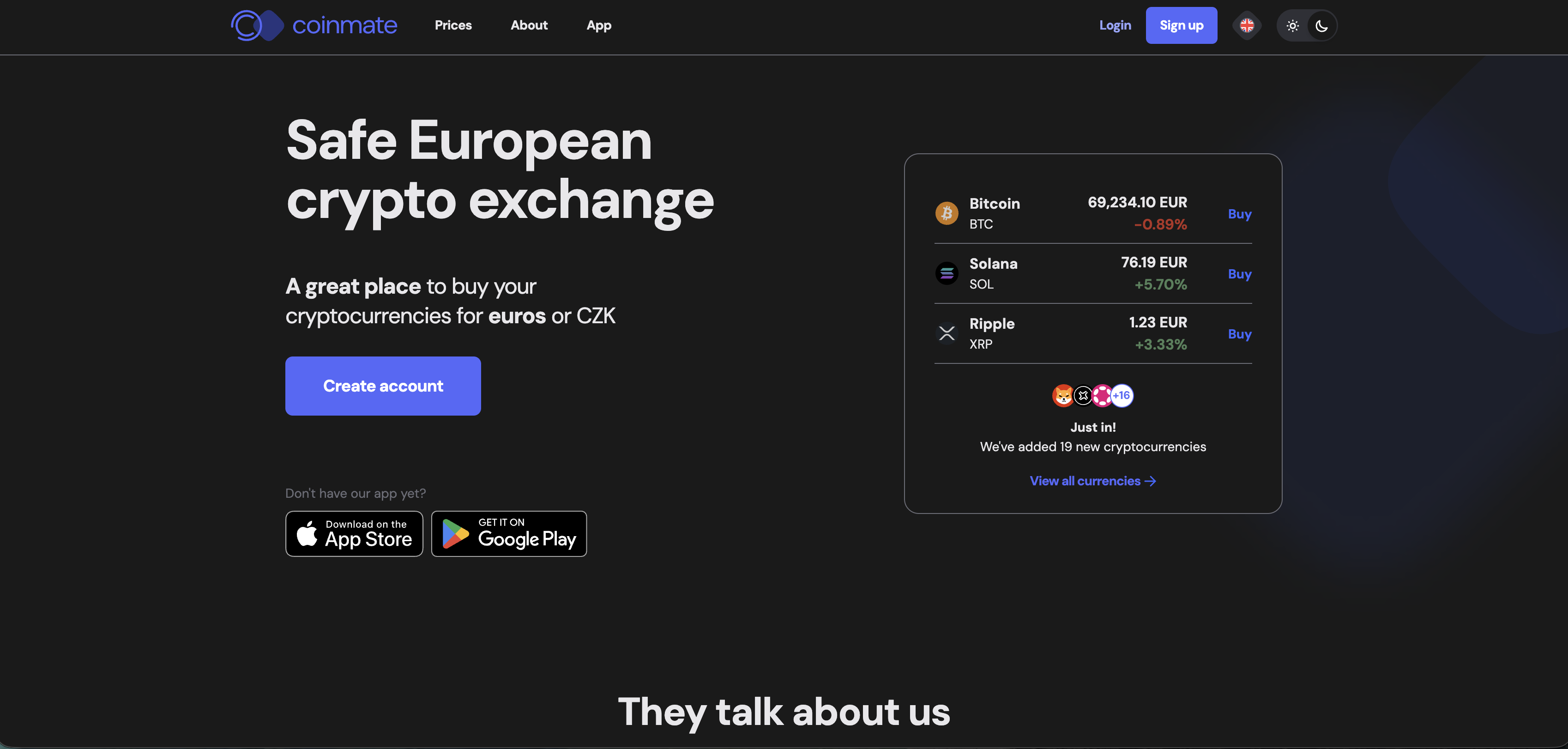
12 alternatives to Coinmate
Sorted by similarity and popularityBVNK
Crypto & Blockchain
🇬🇧 United Kingdom
BVNK is a digital asset infrastructure company built for the institutional world. Founded to bridge traditional finance and crypto, it provides custody, settlement, and liquidity services for digital assets across multiple blockchain networks. Rather than positioning itself as a trading platform or exchange, BVNK operates as plumbing—a behind-the-scenes infrastructure layer that lets banks, payment processors, and fintech companies add digital asset capabilities to their existing systems. The platform handles the technical and regulatory complexity that kept institutions out of crypto, offering institutional-grade security and compliance tooling alongside access to decentralized finance. In a market flooded with retail-focused crypto products, BVNK targets the institutional infrastructure gap. It serves as the counterparty settlement layer and liquidity provider for financial institutions that want to offer digital assets without building their own custody and execution infrastructure. The company counts major payment networks and banking infrastructure providers among its early customers, positioning itself as the connective tissue between traditional finance rails and blockchain networks. BVNK reflects a maturation in crypto infrastructure—less about speculation and retail adoption, more about institutional plumbing that will quietly power the next generation of financial services.
Founded 2021
View profile →
Paymium
Crypto & Blockchain
🇫🇷 France
Bitcoin exchanges in Europe's early crypto years were characterised by technical fragility, regulatory opacity, and the constant possibility that the platform you were using would simply disappear. Paymium was founded in Paris in 2011 as one of Europe's first Bitcoin exchanges and has the unusual distinction of still operating today — a survival record that sets it apart from the majority of its early-era peers. Its longevity reflects a deliberate choice to operate as a regulated financial institution from the beginning, obtaining French regulatory authorisation and maintaining compliance standards that many early crypto platforms treated as optional. Paymium serves both retail and institutional users in the French market, offering Bitcoin trading with the regulatory framework and consumer protection standards of a licensed payment institution. In the contemporary European crypto landscape — dominated by Coinbase, Binance, and Kraken — Paymium is a niche player by volume but a significant one by longevity and regulatory credibility. For French institutional investors and the segment of retail users who prioritise regulatory protection over trading fees, Paymium's fifteen-year track record of compliant operation is a genuine differentiator in an industry where that record is extraordinarily rare.
Founded 2011
View profile →
GoCrypto
PaymentsCrypto & Blockchain
🇸🇮 Slovenia
GoCrypto enables merchants to accept crypto and digital payments at checkout.
Founded 2018
View profile →
Safello
Crypto & Blockchain
🇸🇪 Sweden
Safello lets Nordic users buy, sell, and manage crypto through a regulated platform.
Founded 2013
View profile →
Vivid Money
WealthDigital BankingCrypto & BlockchainPersonal Finance
🇩🇪 Germany
Vivid Money is a Berlin-based fintech that collapsed the traditional distinction between banking, investing, and spending into a single mobile-first experience. Launched in 2020, it positioned itself as the European answer to all-in-one financial apps—a place where you could manage your checking account, invest in fractional shares and crypto, and pay with virtual cards, all without leaving the app.
The platform built its early reputation on speed and accessibility. Account opening took minutes rather than days. The investment side felt more like TradingView-for-consumers than stuffy wealth management. Virtual card creation was instantaneous, and the app's design sensibility leaned toward the minimalist and modern rather than corporate banking's beige aesthetic.
Vivid positioned itself against traditional banks' glacial pace and regulatory burden, while also differentiating from pure-play neobanks that didn't offer investing. It moved quickly to add crypto features when the market demanded them, and secured backing from tier-one investors who believed in the all-in-one thesis.
However, the company faced headwinds from regulatory tightening around crypto and the broader fintech funding winter. In late 2024, reports emerged of operational restructuring and potential insolvency, marking a sobering turn for what had been one of Europe's most closely watched fintech challengers. Vivid's arc—from breakthrough disruptor to distressed turnaround—reflects the volatility of the European fintech landscape and the challenge of building a diversified financial platform without institutional heritage or captive customer bases.
Founded 2020
View profile →
Ledger
Crypto & Blockchain
🇫🇷 France
Ledger is the world's most recognizable cryptocurrency hardware wallet manufacturer, though the company has evolved well beyond that single product. Founded in 2014, it pioneered the idea that self-custody of digital assets could be both secure and user-friendly, making crypto accessible to millions who otherwise would have left their holdings on exchanges. The company operates as a full-stack crypto infrastructure provider, offering hardware wallets (Ledger Nano S and X), a software wallet platform, and developer APIs that let third-party services integrate Ledger's security model into their own products.
What sets Ledger apart in the crypto space is its obsessive focus on security through isolation. While competitors often offer software wallets or custodial solutions, Ledger's approach keeps private keys permanently offline, eliminating the attack surface that plagues hot wallets. The company has successfully maintained that zero-breach record for a decade, which matters enormously in an industry built on trust and skepticism. Beyond hardware, Ledger has quietly built a platform ecosystem—Ledger Live (the official app) aggregates portfolio tracking, staking, swaps, and third-party integrations, turning the wallet into something closer to a financial operating system for crypto natives.
Ledger operates at a fascinating intersection of consumer hardware business and B2B infrastructure play. Millions of individual users buy Ledger devices directly, but the company also licenses its technology to banks, exchanges, and other financial institutions looking to offer institutional-grade custody. It's a rare position in fintech: simultaneously a consumer brand (few non-crypto companies sell physical products as recognizable as a Ledger Nano) and an enterprise security provider. That duality has made Ledger one of Europe's most valuable fintech unicorns, though it remains private. In the broader fintech ecosystem, Ledger represents the backbone layer—the infrastructure that makes decentralized finance possible without requiring users to become security experts themselves.
Founded 2014
View profile →
MoonPay
Embedded FinanceCrypto & Blockchain
🇬🇧 United Kingdom
MoonPay sits at the intersection of crypto and traditional finance, offering on and off-ramps that let people move money between their bank account and crypto wallets with minimal friction. Founded in 2018, the London-based company has quietly become one of Europe's most important infrastructure plays in the emerging crypto economy, handling billions in transactions across more than 150 countries.
What sets MoonPay apart is its unglamorous but essential positioning: it's not trying to be a crypto exchange or a trading platform. Instead, it's the plumbing layer that makes crypto accessible to ordinary people. You buy crypto through MoonPay the same way you'd buy a digital service—seamless, compliant, and fast. The company operates with full EU regulation, holding licenses across multiple jurisdictions while maintaining the kind of compliance rigor that traditional banks expect. MoonPay's API-first approach means startups, wallets, and even traditional fintech apps can embed crypto purchasing directly into their user experience. This white-label capability has attracted partnerships with everyone from music platforms to gaming studios. The company has raised substantial funding and is valued at over a billion dollars, a testament to how critical crypto infrastructure has become. In a market obsessed with trading speculation and yield farming, MoonPay represents something more fundamental: the normalization of crypto as a payment asset class. It's doing for cryptocurrency what Stripe did for online payments—removing the technical and regulatory barriers that kept it confined to specialists.
Founded 2018
View profile →
Blockchain.com
Financial InfrastructureCrypto & Blockchain
🇬🇧 United Kingdom
Blockchain.com is one of the oldest and most-visited crypto infrastructure platforms in the world, operating as a bridge between traditional finance and digital assets. The company runs a full-stack crypto ecosystem—a blockchain explorer that millions use to track transactions, a self-custody wallet that puts users in control of their private keys, and a suite of institutional-grade services for serious players. Where most crypto platforms treat blockchain as a trading venue, Blockchain.com treats it as infrastructure. The platform serves retail users seeking transparency and control, developers building on-chain applications, and institutions entering crypto with proper compliance frameworks. The company has maintained a distinctly crypto-native stance while gradually building enterprise services that acknowledge regulatory reality. Its wallet remains one of the most downloaded in the space, offering both simplicity for newcomers and advanced features for power users. Blockchain.com sits at an interesting inflection point in fintech—old enough to have survived multiple market cycles, serious enough to work with regulators, yet still fundamentally aligned with decentralized principles. The platform's role in the broader landscape is foundational: it enables crypto participation across the entire user spectrum, from curious individuals to multinational corporations managing digital asset reserves.
Founded 2011
View profile →
Lavanet
Financial InfrastructureCrypto & Blockchain
🇮🇸 Iceland
Lavanet is building a decentralized infrastructure network that lets applications and services tap into blockchain resources without the usual constraints of centralized providers. Think of it as a peer-to-peer marketplace for computational power, but for Web3 apps. Instead of relying on a single RPC provider or node operator, developers can access redundant, distributed infrastructure that's both more reliable and resistant to censorship. The network operates through a token-incentivized model where node operators earn rewards for serving requests, creating an open market for blockchain infrastructure rather than a walled garden controlled by a few large players. This approach addresses a real friction point in crypto adoption: the dependency on centralized infrastructure providers that can throttle, monitor, or shut down access. Lavanet democratizes access to blockchain resources by spreading that responsibility across thousands of independent operators. For developers, it means faster, cheaper, and more resilient connections to blockchains. For node operators, it's an opportunity to monetize spare computational capacity. In the broader context of decentralized finance and Web3, Lavanet represents infrastructure-layer innovation—the kind of plumbing work that rarely gets headlines but is essential for making the entire ecosystem more robust and genuinely decentralized.
Founded 2022
View profile →
Tonkeeper
Crypto & Blockchain
🇮🇸 Iceland
Tonkeeper is a mobile wallet built for the TON blockchain, designed to make crypto accessible to people who've never touched digital assets before. It strips away the complexity that typically comes with self-custody, offering a clean interface for sending, receiving, and storing TON tokens without requiring deep technical knowledge. The app handles key management transparently, so users can focus on their money rather than their keys.
What sets Tonkeeper apart is its unapologetic simplicity. While most wallets load their interfaces with charts, advanced trading features, and portfolio analytics, Tonkeeper keeps things focused and minimal. It's built for people who want a wallet that works, not a platform that tries to be everything. The team clearly understands that friction is the enemy of adoption.
Tonkeeper sits at the intersection of consumer-friendly design and genuine decentralization. It's not a custodial service, so users retain full control of their assets, but the UX suggests that security and usability don't have to be enemies. As the TON ecosystem grows beyond crypto enthusiasts into mainstream use, Tonkeeper's approachable design makes it the natural entry point for newcomers. In a space often dominated by overwrought interfaces and jargon, it feels almost refreshingly straightforward.
Founded 2021
View profile →
CEX.IO
Crypto & Blockchain
🇬🇧 United Kingdom
CEX.IO is a cryptocurrency exchange that's been operating since 2013, making it one of Europe's older players in the digital asset space. The platform lets users buy, sell, and trade Bitcoin, Ethereum, and a growing roster of altcoins through a web interface and mobile app. It's positioned itself as a regulated exchange with fiat on-ramps, meaning you can fund your account with euros or other currencies through bank transfers and cards, then move into crypto—a crucial bridge that separates real exchanges from purely peer-to-peer platforms. The company operates across multiple jurisdictions and maintains compliance frameworks that matter to retail traders in Europe who want institutional-grade infrastructure without the complexity of decentralized exchanges. CEX.IO doesn't reinvent fintech architecture; instead, it focuses on being reliable, regulated, and accessible for mainstream users discovering cryptocurrency. In the fragmented European crypto landscape, where regulation remains patchy and trust is everything, CEX.IO represents the pragmatic middle ground between full decentralization and traditional finance's gatekeeping.
Founded 2013
View profile →
Coinhouse
Crypto & Blockchain
🇫🇷 France
Crypto for institutions requires a different product than crypto for retail. The compliance requirements, the custody standards, the reporting obligations, and the client servicing expectations of professional investors are categorically different from those of an individual buying Bitcoin through an app. Coinhouse was founded in Paris in 2014 as one of France's first regulated crypto asset service providers, building a platform designed for the higher standards that institutional and professional clients require. Its services cover crypto trading, custody, staking, and portfolio management for professional investors — with the regulatory standing of a PSAN (Prestataire de Services sur Actifs Numériques) registration under France's crypto asset framework. Coinhouse has positioned itself as the French institutional crypto bridge — the regulated, professional-grade alternative to the consumer exchanges that dominate by volume but not by client sophistication. In the European institutional crypto market, where MiCA regulation is creating clearer requirements for crypto asset service providers, platforms that have already built their compliance infrastructure to institutional standards are better positioned than those scrambling to retrofit regulation onto consumer products.
Founded 2014
View profile →