← Back to Monavate

Alternatives
Alternatives to Monavate
Explore 12 European fintech companies similar to Monavate — operating in Financial Infrastructure.
12 alternatives to Monavate
Sorted by similarity and popularityTink
Embedded FinanceFinancial InfrastructureOpen Banking
🇸🇪 Sweden
Daniel Kjellén and Fredrik Hedberg didn't set out to build infrastructure. Tink started in Stockholm in 2012 as a consumer personal finance app — an attempt to give Swedish bank customers a cleaner view of their money across multiple accounts. It was a reasonable idea that ran into an unreasonable obstacle: getting reliable, consistent data out of European banks was extraordinarily hard. The technical problem turned out to be more interesting than the consumer product. In 2018 they pivoted, shifted focus entirely to the B2B layer, and started selling the very infrastructure they'd been forced to build for themselves.
That pivot proved prescient. The EU's PSD2 directive, which came into full effect in 2019, legally required banks to open their data to authorised third parties — creating the regulatory foundation that open banking platforms needed to operate at scale. Tink had spent years building exactly those bank connections. When the regulation arrived, the company was ready.
The platform Kjellén and Hedberg built connects to more than 3,400 banks and financial institutions across Europe, reaching over 250 million bank customers. Through a single API integration, banks, fintechs, and merchants can access aggregated account data, initiate payments directly from customer bank accounts, verify account ownership, and enrich transaction data — without maintaining their own connections to hundreds of separate banking systems with different technical standards and update schedules. Clients include Klarna, PayPal, NatWest, ABN AMRO, and BNP Paribas Fortis.
In March 2022, Visa completed the acquisition of Tink for €1.8 billion — one of the largest European fintech acquisitions of that year, and a clear signal of how seriously the global payments industry had come to take open banking infrastructure. Visa's strategic rationale was straightforward: it had failed to acquire Plaid, the US equivalent, after an antitrust challenge, and needed a European open banking capability. Tink gave it 500 employees, 18 European markets, and relationships with over 300 banks and fintechs built over a decade.
The founders stayed on as CEO and CTO through the transition, continuing to run Tink as a standalone Visa subsidiary from Stockholm. Both departed in 2025 — Kjellén and Hedberg announced they were building Freda, a new AI-driven legal and compliance technology startup, with the pair describing Tink as "now in better hands than ever." Francois Tornier, Visa's VP of Open Banking, took over as CEO. The product roadmap has continued under Visa ownership, including a 2024 expansion of Tink's open banking platform into the US market.
Founded 2012
View profile →
Kontomatik
Financial InfrastructureOpen BankingLending
🇵🇱 Poland
Kontomatik provides open banking data and credit decisioning tools.
Founded 2009
View profile →
LHV
Financial InfrastructureDigital BankingSME Finance
🇪🇪 Estonia
LHV has the distinction of being both Estonia's largest domestic bank and one of the most important banking infrastructure providers in European fintech. Founded in Tallinn in 1999 — making it ancient by Estonian standards in a country whose digital infrastructure is itself only a few decades old — LHV grew from an investment firm into a full retail bank, navigating Estonia's evolution from post-Soviet transition economy to digital society more successfully than many of its peers. The bank serves Estonian retail and business customers across the full range of banking products, with particular strength in investment services that reflects its origins as a brokerage. Beyond its domestic banking business, LHV has built a Pan-European operation providing banking services to fintechs — issuing accounts, IBANs, and payment infrastructure to many of the UK and European fintechs that needed banking partnerships to operate compliantly. The fintech banking business has made LHV one of the most important behind-the-scenes infrastructure providers in European fintech, even if most of the consumer-facing companies that rely on it never mention LHV publicly. In the European banking landscape, LHV represents the unusual combination of small national bank and Pan-European fintech enabler — a position that few institutions have managed to occupy.
Founded 1999
View profile →
Dateio
Financial InfrastructureOpen BankingLending
🇨🇿 Czech Republic
Dateio is a European open banking platform that sits at the intersection of data and credit. The company aggregates financial data from multiple banks and institutions across Europe, then applies machine learning to unlock lending decisions and financial insights that traditional scoring can't capture. Unlike legacy credit bureaus, Dateio builds its models on real transaction history and behavioral patterns, not just loan defaults and payment records.
The company positions itself as a data partner for fintechs, banks, and lenders who need smarter underwriting. Rather than building consumer-facing products, Dateio focuses on B2B infrastructure—providing APIs that other companies plug into to understand customer creditworthiness in real time. This approach means Dateio operates in the quieter, more valuable layer of fintech: the plumbing that powers better decisions.
In a market crowded with credit score providers and ID verification vendors, Dateio stands out by going deeper into the data layer. Most competitors offer point solutions; Dateio aggregates, normalizes, and analyzes transaction flows across borders. That matters in Europe, where fragmented banking systems and privacy rules have made cross-border financial data unusually hard to access. For lenders tired of crude risk models, Dateio offers a more granular, behavior-based alternative that reflects how Europeans actually spend and save money.
The company represents a broader shift in European fintech toward infrastructure and data intelligence, rather than consumer apps. As regulation tightens and competition intensifies in lending, better data becomes the primary competitive advantage. Dateio operates in that space.
Founded 2017
View profile →
Solaris
Financial InfrastructureDigital Banking
🇩🇪 Germany
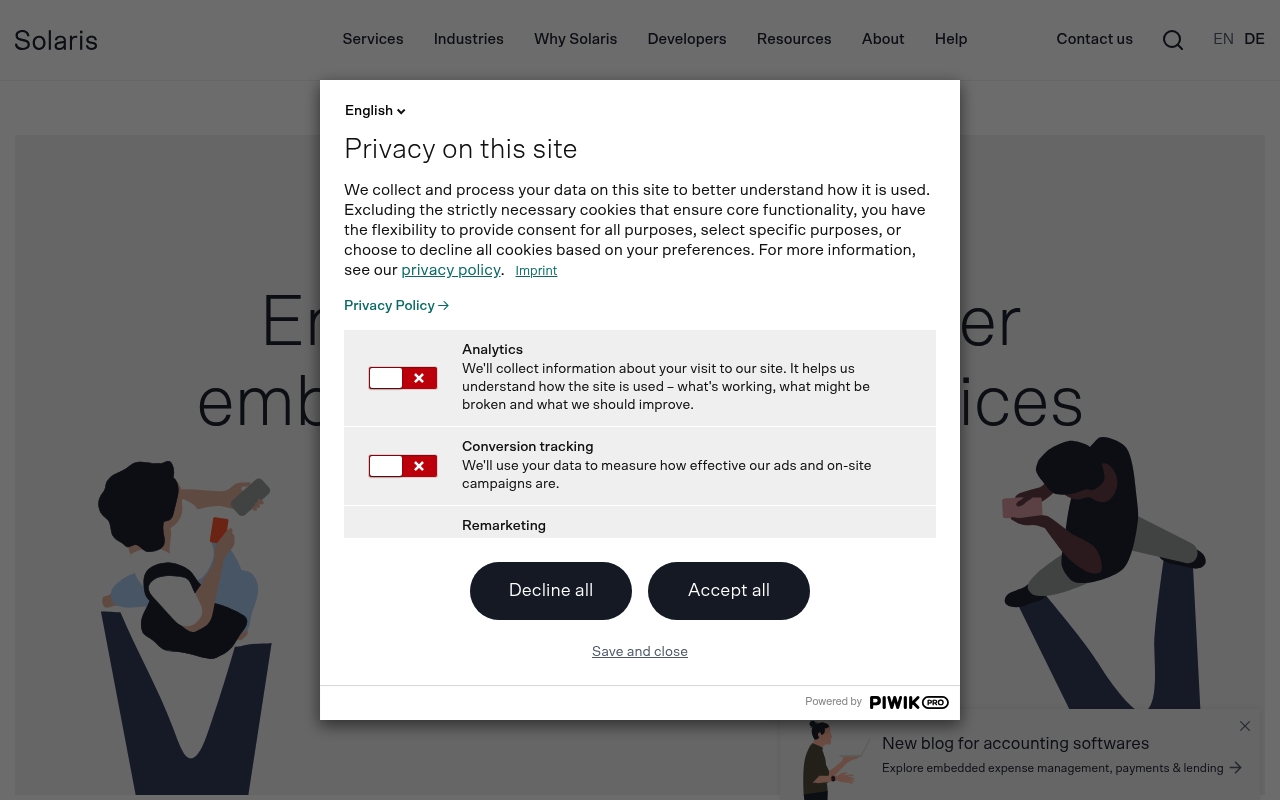
Solaris is a Berlin-based fintech infrastructure platform that lets financial institutions and fintechs launch their own digital banking products without building tech from scratch. Rather than wrestling with legacy core banking systems, clients plug into Solaris's cloud-native API layer to issue cards, manage accounts, and process payments at speed.
The company operates in the shadows of most consumer apps—you won't see the Solaris logo in an app store—but its backbone runs through dozens of European fintechs, neobanks, and traditional financial institutions. Think of it as the plumbing that powers other people's banking ambitions.
Solaris dominates a specific niche: the BaaS (Banking-as-a-Service) and embedded finance layer for Europe. While competitors like Thought Machine and Temenos chase enterprise banking overhauls, Solaris stays focused on the modern fintech workflow. Its modular design appeals to companies that need speed and flexibility, not a 10-year implementation project.
In a market crowded with infrastructure plays, Solaris has become essential plumbing for European digital banking. It sits at the intersection of regulatory compliance, technical simplicity, and startup ambition—precisely where the next wave of European fintech is being built.
Founded 2015
View profile →
Mitigram
Financial InfrastructureSME Finance
🇸🇪 Sweden
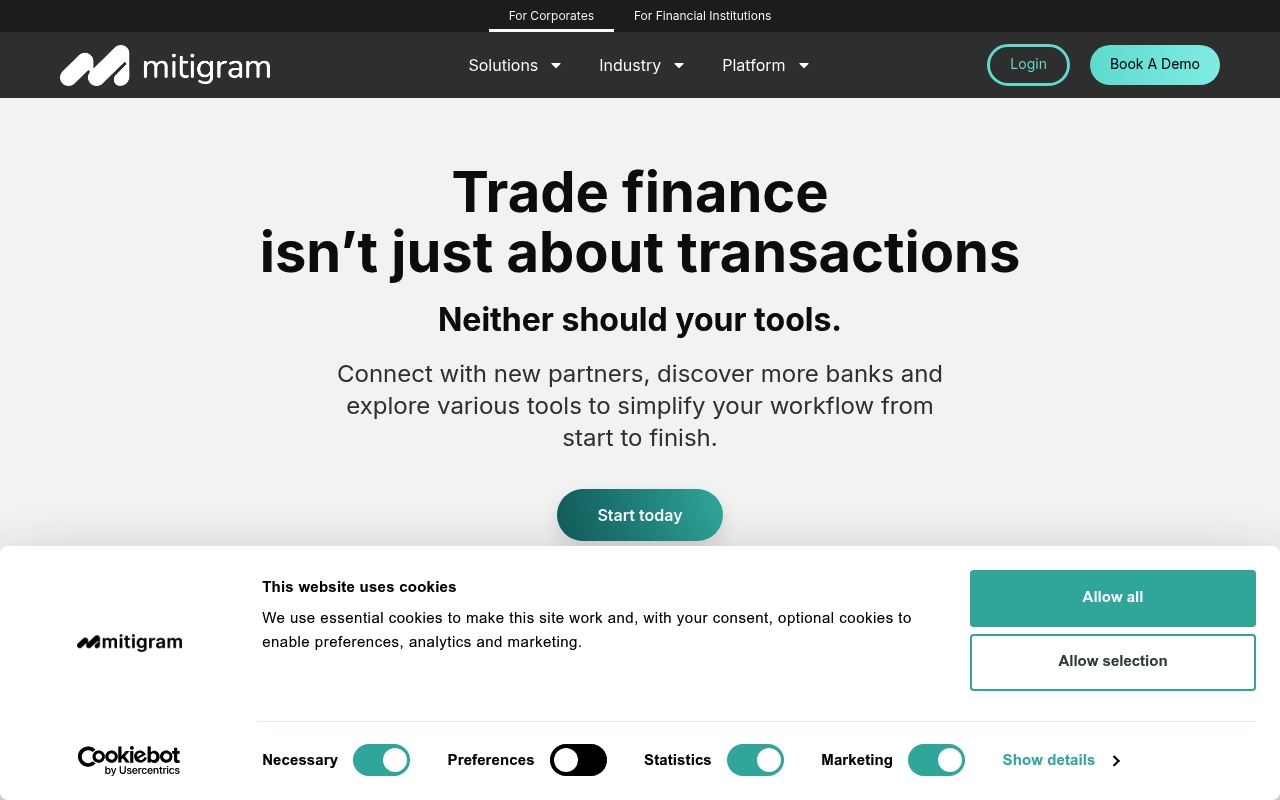
Mitigram digitizes trade finance workflows for corporates and financial institutions.
Founded 2014
View profile →
ClearBank
Embedded FinanceFinancial Infrastructure
🇬🇧 United Kingdom
ClearBank was the first new clearing bank in the UK in more than 250 years. That sentence is doing a lot of work, because the reason there hadn't been one is that clearing — the plumbing that moves money between banks — had settled into the hands of four incumbents whose systems dated to a different era, and every fintech that wanted to offer accounts had to rent access from one of them. ClearBank launched in 2015 to be the alternative: a purpose-built, cloud-native clearing bank with no legacy estate, accessed through a single API, holding client funds at the Bank of England rather than on its own balance sheet.
The customer list explains the model better than the description does. TrueLayer, Tide, Chip, Coinbase, Raisin and Wealthify all run on ClearBank — companies that wanted to offer accounts and payments without becoming banks themselves. ClearBank provides the regulated banking layer and the real-time payment rails; the client owns the customer relationship. This is embedded banking delivered by an actual bank rather than middleware, which is the distinction that matters when a regulator asks who is holding the money.
The financial trajectory has been unusually disciplined for the category. ClearBank has been profitable since 2022, reported its first full-year pre-tax profit of £18.4 million in 2023, and delivered a third consecutive profitable year in 2025 with group normalised revenue up 34% to £121.6 million. The more significant number is that fee-based income grew 51% and now makes up the majority of revenue — the deliberate pivot away from interest-rate dependency that most banks talk about and few execute. The infrastructure now underpins more than 17 million accounts, and ClearBank UK holds an investment-grade BBB− rating from S&P, rare for a company its age.
Europe is the current chapter, and it resolves an old caveat about ClearBank being UK-only. ClearBank Europe N.V., headquartered in Amsterdam and led by Rintse Zijlstra, received a Credit Institution Licence from the European Central Bank under DNB supervision in 2024, backed by more than €70 million of investment. It gives the group euro accounts and payments alongside sterling, with access to TARGET2, SEPA Credit Transfer and SEPA Instant. By the end of 2025 the European business covered 21 EU countries, had opened a Paris branch, and was processing over a million payments a month — real but early, which is the honest way to frame it against a UK operation of 17 million accounts. Mark Fairless succeeded Charles McManus as chief executive.
Founded 2015
View profile →
Embat
Financial InfrastructurePayments
🇪🇸 Spain
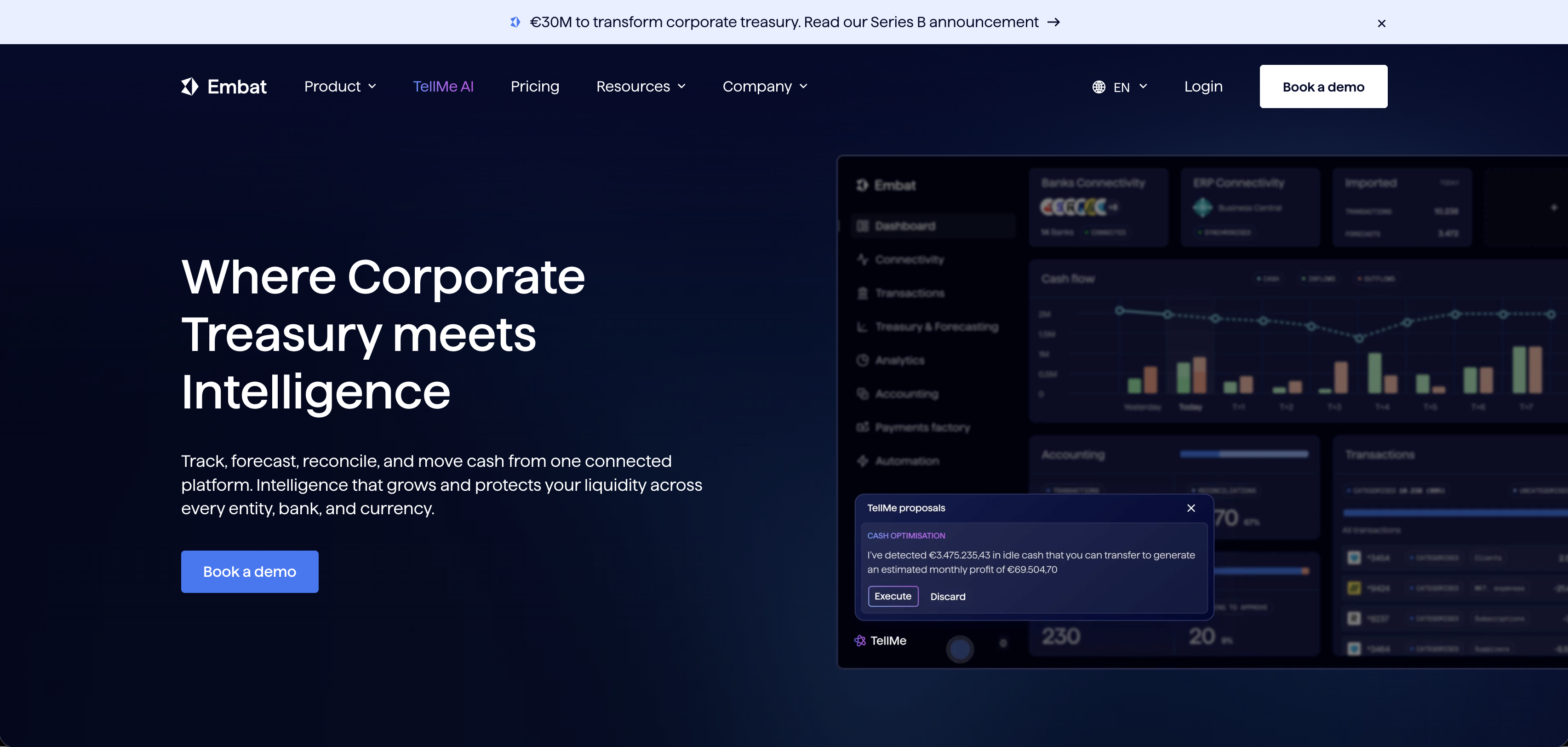
Embat is a European fintech platform built for the era when payments moved beyond the checkout. Founded on the principle that modern businesses need payment infrastructure that speaks their language—not the other way around—Embat offers a composable payments stack designed for developers and merchants who refuse to settle for legacy constraints.
The platform combines payment orchestration, processing, and settlement into a single, modular system. Rather than forcing clients into rigid vendor relationships, Embat lets companies plug in their preferred processors, acquirers, and gateway partners while maintaining unified visibility and control. This flexibility appeals to enterprises and merchants tired of vendor lock-in and technical debt.
What sets Embat apart in the crowded European payments landscape is its developer-first design philosophy. The company recognizes that payments sit at the intersection of multiple systems—loyalty, inventory, subscriptions, marketplaces—and builds its API architecture accordingly. This contrasts sharply with older payment solutions that treat payments as an isolated transaction layer rather than a core business platform.
Embat occupies a distinct position between monolithic payment processors and lightweight API providers. It's built for companies that have outgrown commodity payment gateways but don't want to stitch together five different vendors to get what they need. In the increasingly competitive European fintech market, Embat represents the modern infrastructure play: solving real operational complexity for merchants and enterprises through intelligent, flexible payment technology.
Founded 2021
View profile →
ION Group
Financial InfrastructureRegTechCapital MarketsTreasury
🇬🇧 United Kingdom
Andrea Pignataro founded ION in London in 1999, after leaving a trading role at Salomon Brothers with a conviction that the software running global markets was held together with too much manual process. Over the following two and a half decades he built ION into one of the largest, most acquisitive players in capital-markets technology — absorbing dozens of specialist vendors, including Fidessa and Broadway Technology, and folding them into a single group.
The core business is still the unglamorous plumbing of institutional finance: trading platforms across equities, fixed income, foreign exchange, and cleared derivatives; risk management; post-trade processing; clearing and settlement; and market data. Investment banks, hedge funds, and corporate treasuries run parts of their daily operations on ION's systems, often without their own customers ever knowing it.
Less visible is ION's regulatory technology line. Products including ION LookOut and Fidessa Surveillance handle trade surveillance, market-abuse detection, and regulatory reporting across multiple jurisdictions, and ION's compliance tools have placed in FinTech Global's RegTech 100 list for three consecutive years. It's a smaller part of the business than the trading and post-trade platforms, but a genuine one — which is why ION appears under both Capital Markets and RegTech in this directory, rather than just one.
The company is headquartered in London, employs more than 13,000 people across over 50 offices worldwide, and remains privately held under Pignataro's control — a scale most consumer-facing fintechs never approach, built almost entirely on customers who are themselves in finance.
Founded 1999
View profile →
Enable Banking
Financial InfrastructureOpen Banking
🇫🇮 Finland
Most open banking aggregators want your data. That is the business model: connect to the banks, pull the transactions, store them, enrich them, and sell the enriched product back. Enable Banking built the opposite. The company describes itself as the postman of your data — it moves financial information from the bank to the customer's application and does not retain, process, or build models on what passes through. For a fintech that considers its transaction data a competitive asset, or a customer with strict data residency requirements, that neutrality is the entire pitch.
Joonas Tomperi and Fedor Tyurin founded the company in Espoo in 2019, at the point where PSD2 had legally opened European bank APIs but had not made them usable. Each bank interpreted the standard differently, each shipped its own authentication quirks, and each updated on its own schedule. The regulation created the right; someone still had to build the plumbing. Enable Banking started with Finland and the Nordics and expanded outward, and now connects to more than 2,700 banks across 30 European countries through a single PSD2-compliant API — account information from all of them, and payment initiation from over 1,500.
What makes the company genuinely unusual is its scale relative to that coverage. Enable Banking has raised roughly €600,000 in total, in a single seed round in 2022 led by Wellstreet and Forward VC, and employs somewhere between fourteen and seventeen people distributed across seven countries. Tink sold to Visa for €1.8 billion with 500 employees. TrueLayer has raised hundreds of millions. Enable Banking is covering comparable European ground with a team that would fit around one table, which says something about how much of open banking infrastructure is disciplined engineering rather than capital.
The company holds its own Account Information Service Provider registration, supervised by Finland's FIN-FSA — which means other companies can build on top of its licence rather than obtaining their own. That is the model behind open-banking.io, the Danish developer tool that resells Enable Banking access at €3 per month without customers needing eIDAS certificates. It is also why Enable Banking's no-data-retention architecture matters structurally: because the platform never holds readable customer data, the companies building on it can make stronger privacy guarantees than they otherwise could.
Two smaller details are revealing about who this is built for. Enable Banking runs a balanced split between business and consumer accounts — roughly half of its ten million monthly API calls come from each, where most early open banking providers targeted consumer accounts only and treated corporate banking as an afterthought. And it offers a live production environment for testing without requiring a contract, which is a small thing that tells you the company expects developers to evaluate it by using it rather than by booking a call. Tomperi now chairs the board of Fintech Finland, the national industry association.
Founded 2019
View profile →
Divilo
Financial InfrastructureSME Finance
🇪🇸 Spain
Divilo is building the infrastructure for European businesses to manage their international payroll at scale. Rather than juggling multiple vendors across different countries—payroll processors here, compliance specialists there, currency brokers elsewhere—Divilo consolidates the entire stack into one operating system. The platform handles everything from local employment law compliance to multi-currency payments, tax filing, and benefits administration across the continent. For HR teams and CFOs wrestling with the complexity of expanding internationally, it's a rare case of genuine consolidation rather than another bolted-on layer. The European payroll market remains fragmented by design—local rules, tax codes, and banking infrastructure mean there's no true continental standard. Divilo is attacking this head-on with a unified API and dashboard that speaks to both the technical and operational reality of cross-border employment. It's the kind of infrastructure play that sounds boring until you realize how much operational friction it removes for companies thinking beyond their home market.
Founded 2021
View profile →
Omnius
Financial InfrastructurePayments
🇩🇪 Germany
Omnius is a European fintech infrastructure player that builds the plumbing for digital finance. Rather than launching consumer apps or chasing trends, the company focuses on giving financial institutions and fintech operators the core technology to move faster. The platform handles payment processing, account management, and the underlying APIs that let banks and non-banks operate at scale without reinventing the wheel.
What distinguishes Omnius in a crowded infrastructure market is its pragmatic approach to complexity. European banks still manage legacy core systems alongside new digital channels—a messy, expensive reality most fintech companies ignore. Omnius doesn't fight that; it sits in the middle, connecting old and new, and abstracts the chaos away from the business logic above it.
The company targets institutions that need to modernize faster than their technology stacks allow. That includes challenger banks that need banking-as-a-service foundations, traditional banks building new digital channels, and fintech companies that want to scale without owning every layer. It's unsexy infrastructure work—the kind that doesn't generate headlines but quietly powers the financial services layer that consumers interact with.
In the European fintech stack, Omnius occupies a critical but overlooked position: the vendor that lets faster companies stay fast, and slower ones move at all.
View profile →