53 companies
N26
Payments🇩🇪 Germany
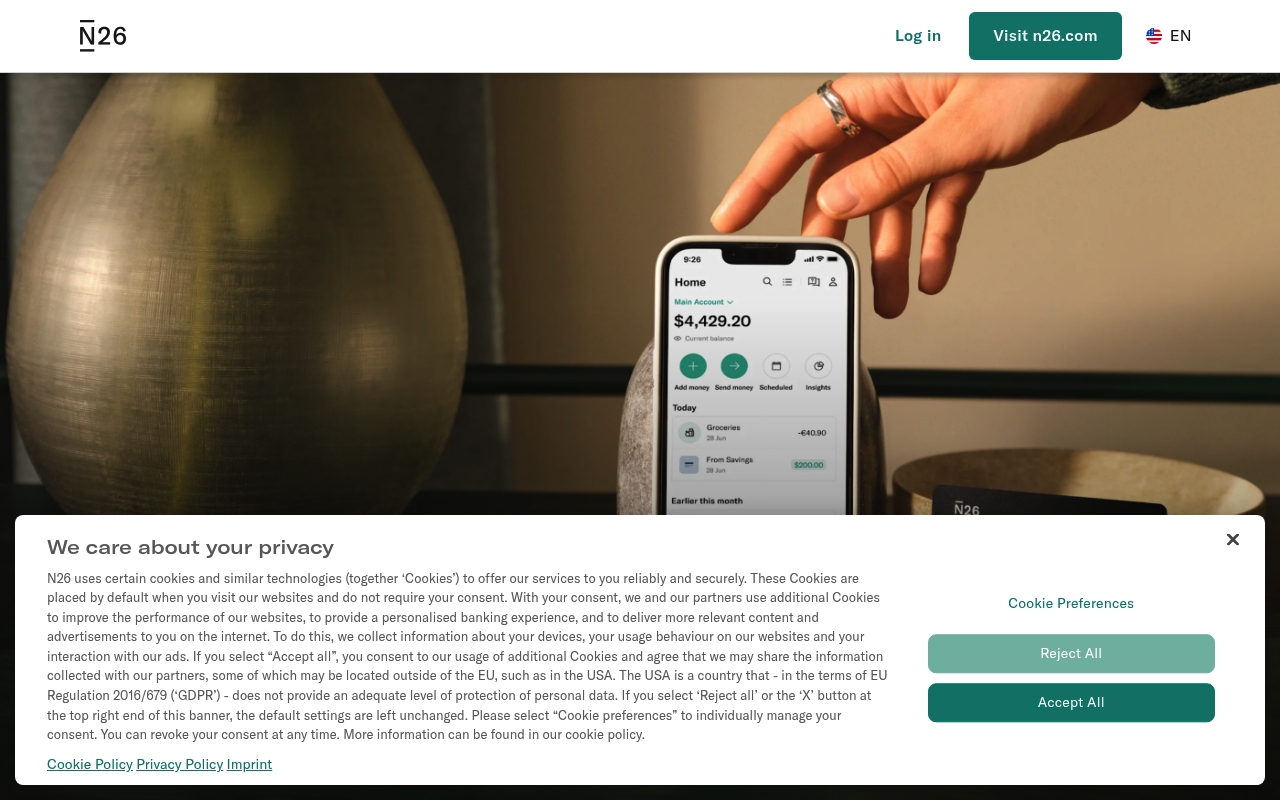
Valentin Stalf and Maximilian Tayenthal started in Vienna in 2013 with a product that sounds strange now and sounded stranger then: a prepaid card for teenagers, controlled by their parents through an app. The pivot came quickly. What they had actually built was a mobile-first banking interface, and the teenagers were incidental. Relaunched as N26 and relocated to Berlin, it became the first of the European neobanks to look genuinely modern — instant push notifications on every transaction, sign-up in minutes by video identification, an interface that made incumbent German banking apps look like they had been designed by a committee, which they had. In 2016 N26 received its own full German banking licence from BaFin, three years after founding, an unusually fast route to becoming a real bank.
Growth followed, and then the growth became the problem. BaFin, which had granted the licence, concluded that N26's controls had not scaled with its customer base. In 2021 the regulator imposed a growth cap limiting the bank to roughly 50,000 new customers per month — a restriction with no real precedent for a German bank — alongside a special monitor and fines relating to late suspicious activity reports. The cap was lifted in 2024 after substantial investment in compliance, financial crime prevention, and internal controls, but it cost N26 the better part of three years at exactly the moment Revolut and Monzo were compounding. The company also withdrew from the UK after Brexit and exited the US, narrowing to its European core.
The company that emerged is a different one, and its leadership reflects that. Both founders have stepped back from executive roles, with Mike Dargan — previously group technology head at UBS — appointed chief executive. In August 2026 the refresh reached the rest of the C-suite: CFO Arnd Schwierholz, who steered the bank through the BaFin period, announced he is stepping away with a search under way for a successor, while N26 hired Nathalie Picquot from Santander as Chief Growth and Marketing Officer and Marcin Pakulnicki from ING as Chief Technology Officer. The pattern is unmistakable and increasingly common among mature neobanks: the executives now being recruited come from the incumbent banks the challengers were built to replace, because the problems have changed from product-market fit to regulatory scale.
N26 serves millions of customers across the eurozone with a product set that has broadened well past the original current account — savings, investments including ETFs and crypto, insurance, and a subscription tier structure that has been the company's answer to interchange-dependent economics since long before that became fashionable. Its onboarding runs on Fourthline's identity verification, one of several European fintech supply-chain relationships this directory tracks. The strategic position is coherent but no longer leading: N26 is the eurozone-native neobank, strongest in Germany, Austria, France, Italy, and Spain, competing against a Revolut that is now valued at $115 billion and licensed on three continents, and a Monzo generating £1.7 billion in revenue from a single market. The three years spent fixing what BaFin found were three years not spent building, and the current chapter is about whether an institutionally rebuilt N26 can convert regulatory soundness back into growth.
SumUp
Payments🇩🇪 Germany
SumUp is a payments company built for the merchants traditional providers never bothered with. Founded in 2012 and headquartered in London, it sells low-cost card readers and point-of-sale hardware to small businesses — market traders, cafés, hairdressers, tradespeople — who could never justify the monthly fees, multi-year contracts, and cumbersome terminals that legacy processors demanded. The core proposition has barely changed since launch: buy a card reader outright for a modest one-off price, pay a small percentage per transaction, and sign nothing.
That model has scaled a long way past its origins. SumUp now serves more than 4 million merchants across roughly 35 markets, employs around 4,000 people, and was valued at about €8 billion in a 2022 round led by Bain Capital. In 2024 it raised a €1.5 billion private credit facility led by Goldman Sachs, and it has been weighing a stock market listing that could value it as high as $15 billion.
The more significant shift is that SumUp is no longer a card reader company. Through a run of acquisitions — Payleven, the e-commerce platform Shoplo, the core banking provider Paysolut, POS software firm Tiller, and the US loyalty startup Fivestars — it has assembled a full financial stack for micro-businesses: a business account and card, invoicing, an online store, loyalty tools, self-service kiosks, and SDKs for developers who want to embed card acceptance in their own products. The ambition is to be the only software a small merchant needs to run their business.
That leaves SumUp in an unusual competitive position. On hardware and in-person payments it faces Square, Zettle, and Dojo; as a broader business platform it edges toward Stripe, Mollie, and Revolut Business. Its defensibility rests on the segment most of the industry finds too small to serve properly — the micro and nano merchants that make up the long tail of European commerce.
Artemundi
Wealth🇩🇪 Germany
Artemundi is an alternative asset manager built for the modern wealth ecosystem. Rather than chasing traditional markets, the firm specializes in emerging market debt, private equity, and distressed assets—seeking returns where conventional investors see opacity. It's positioned at the intersection of hedge fund sophistication and institutional rigor, attracting wealth managers and sophisticated investors who understand that real returns often live outside the mainstream.
The company runs multiple investment vehicles targeting different risk appetites and timeframes, each managed with the discipline of a tier-one institutional shop. Their approach combines deep emerging market expertise with operational rigor, allowing them to navigate complexity that smaller competitors cannot. This isn't retail wealth management repackaged; it's institutional-grade alternative investing for those who can access it.
In the European wealth tech landscape, Artemundi represents the alternative asset class gatekeepers—firms that manage substantial capital across non-traditional strategies. While the fintech world obsesses over fractional shares and gamified trading, Artemundi operates in the space where serious capital allocation happens. They cater to family offices, pension funds, and institutional investors who view alternative assets as core portfolio components rather than exotic bets.
The firm embodies a particular European investment philosophy: skepticism of index-heavy approaches, appetite for frontier markets, and belief that skilled managers can exploit inefficiencies where passive strategies cannot. In an era of wealth fragmentation and advisor tech disruption, Artemundi remains a destination for institutional-grade alternative returns.
C24
Real Estate Finance🇩🇪 Germany
C24 is a Berlin-based mortgage platform that has quietly become one of Germany's fastest-growing digital real estate lenders. Rather than reinventing the entire mortgage process, C24 did something smarter: it took the bureaucratic nightmare of getting a home loan and compressed it into an app. You can apply, get a decision, and lock in rates without ever visiting a bank branch or talking to a loan officer.
The platform combines AI-powered underwriting with human expertise, delivering mortgage approvals in days instead of weeks. Borrowers upload documents once, answer questions about their property and finances through an intuitive interface, and receive personalized offers that compare across multiple lenders. The whole experience feels less like visiting a German bank and more like ordering something online.
In a market traditionally dominated by relationship banking and paperwork, C24 stands out by making mortgages transparent and competitive. German homebuyers, used to opaque pricing and slow processes, have embraced the speed and clarity. The company has grown into one of Central Europe's most recognized mortgage tech platforms, processing billions in loan volume annually.
C24 represents a broader shift in real estate finance: when you automate the friction, good execution becomes a competitive advantage. In Germany's conservative lending landscape, that's revolutionary.
Exporo
Real Estate Finance🇩🇪 Germany
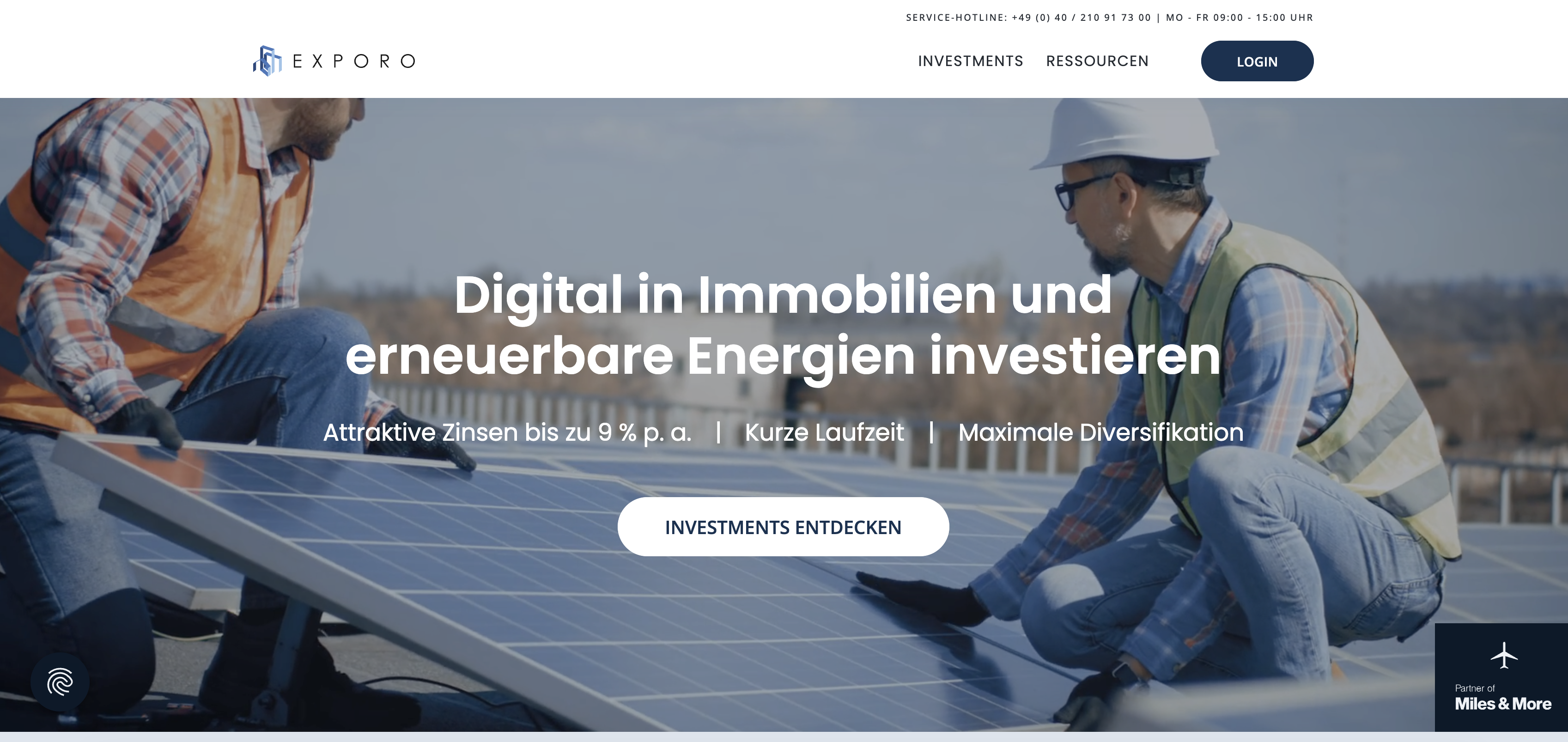
Exporo democratizes real estate investment in Europe by letting regular investors back commercial property projects with surprisingly small cheques. Instead of needing six figures and a relationship manager, you can pledge €500 towards a Berlin office building or Hamburg retail space and earn returns as the project completes. The platform essentially crowdfunds property deals across Germany, Austria, and Switzerland, handling the legal complexity and underwriting legwork while keeping investors in the loop through transparent updates and quarterly reports.
What sets Exporo apart is its focus on institutional-quality real estate rather than speculative ventures. Projects are vetted by in-house analysts, and the company retains skin in the game by co-investing on deals it underwrites. The platform appeals to people frustrated with negative interest rates at traditional banks—here you're earning 4–7% returns tied to actual brick-and-mortar assets rather than betting on stock price appreciation.
In a landscape crowded with retail investment apps and crypto-enabled speculation, Exporo occupies a distinctly European middle ground: serious about underwriting standards, transparent about risk, and aligned with the slow-moving rhythms of real property finance rather than algorithmic trading. It's become the go-to platform for German-speaking investors seeking alternative yields without moving into illiquid private equity.
Scalable Capital
Wealth🇩🇪 Germany
Scalable Capital was founded in Munich in 2014 by an unusually complementary quartet: Erik Podzuweit, a former Goldman Sachs banker; Florian Prucker, his co-CEO to this day; Adam French, who built the UK business; and Stefan Mittnik, an econometrics professor who gave the company its quantitative risk-management backbone. The product they launched in 2016 was a robo-advisor — algorithmically managed ETF portfolios for German savers who had money in zero-interest accounts and no relationship with the stock market. The early growth hack was distribution rather than marketing: a 2017 partnership put Scalable's digital wealth management inside ING Germany's retail bank, and BlackRock joined the cap table the same year. By 2018 it was managing €1 billion and ranked among the fastest-growing robo-advisors anywhere.
The decision that transformed the company came in 2020: the launch of Scalable Broker, a flat-fee trading platform built around a subscription model — the PRIME tiers — rather than per-trade commissions. It arrived at exactly the moment a generation of Germans discovered investing, and it made recurring ETF savings plans, the culturally German path into the market, effectively free at scale. Scalable became one of continental Europe's two dominant neobrokers, locked in a now decade-defining duel with Berlin's Trade Republic, with the low-cost incumbent DEGIRO fighting the same war from the Netherlands.
What distinguishes Scalable strategically is how far it has pushed vertical integration. When the EU banned payment for order flow — the revenue model most neobrokers were built on — Scalable's answer was to co-found its own trading venue, the European Investor Exchange, with Börse Hannover in 2023, keeping headline trading costs low by bringing execution in-house. It launched its own World ETF with DWS and MSCI in 2024, and opened private equity access to retail investors through a BlackRock partnership in 2025. Independent reviewers note the obvious tension in this design: when a broker routes client orders to its own exchange, execution quality and spreads deserve as much scrutiny as the visible fees — a fair caveat about a structure that is otherwise a genuine competitive moat.
The capstone came in September 2025, when the European Central Bank granted Scalable Capital a full banking licence, making it a CRR credit institution supervised by BaFin and the Bundesbank. The licence collapsed the remaining dependency on partner banks: Scalable now handles custody, clearing, settlement, deposits, and lending itself. Interest-bearing deposits launched within weeks, spread across Scalable's own bank and partner institutions with the distribution visible in-app, and a flexible credit product followed — loans from €1,000 to €250,000 with no fixed term. Podzuweit's framing of the ambition is lifelong: everything a customer and their family need for investing, saving, and financing, from the first savings-plan euro to retirement. It's the same full-stack endgame Trade Republic reached via its own licence — the two German rivals have independently concluded that the neobroker business ends in becoming a bank.
The scale now backs the ambition. Scalable Capital manages more than €30 billion for over one million customers across Germany, Austria, France, Italy, Spain, and the Netherlands, with around 845 employees across Munich, Berlin, London, Vienna, and Milan. A $175 million round led by Sofina and Noteus Partners in June 2025 — joined by Balderton, Tencent, and HV Capital — took total funding past half a billion dollars, three months before the banking licence landed. A decade in, the company that started by automating ETF portfolios for cautious German savers has become one of Europe's few vertically integrated investment banks for retail: its own exchange, its own ETF, its own banking licence, and a product that now touches every stage of a customer's financial life.
Clark
InsurTech🇩🇪 Germany
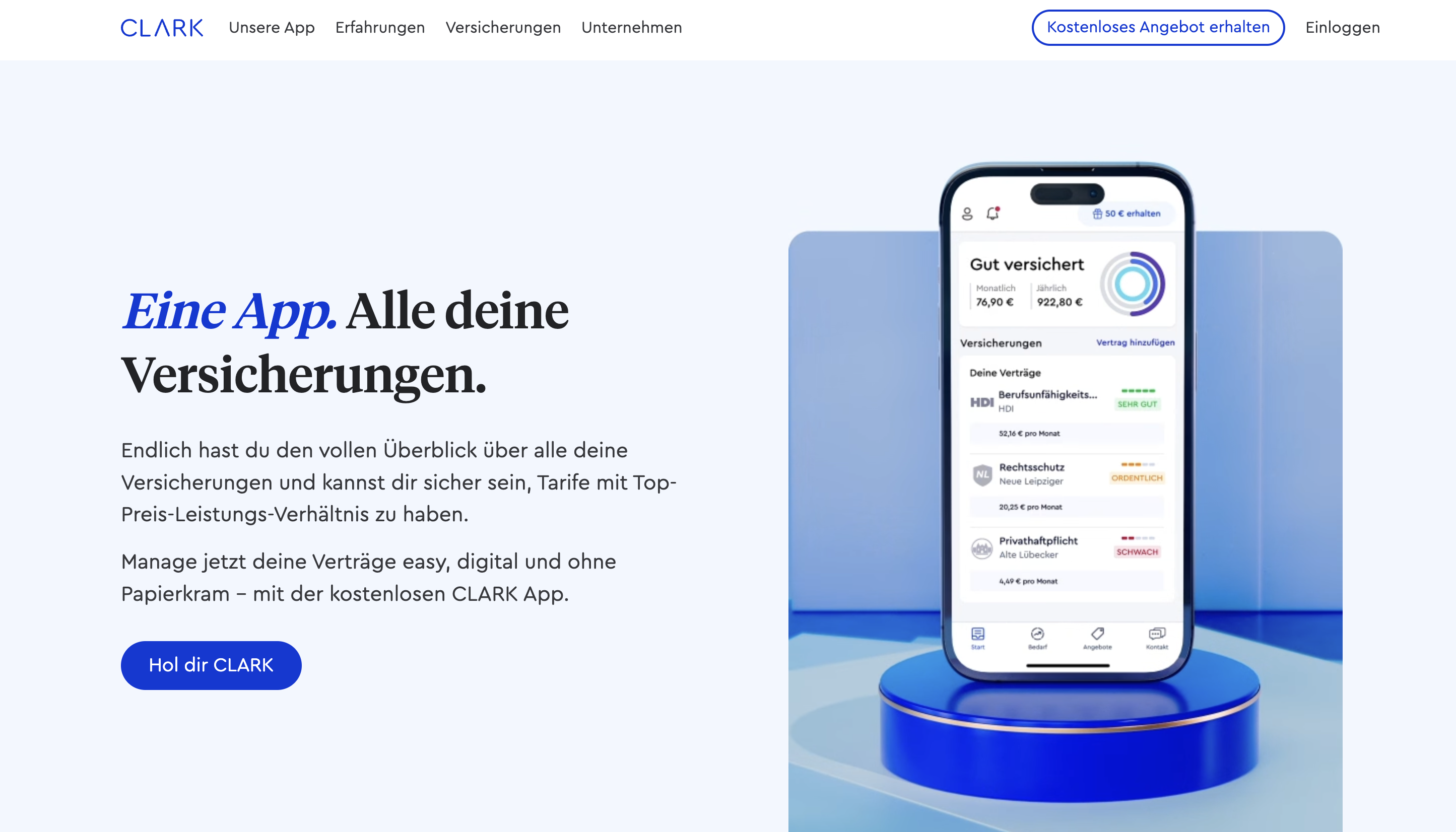
Clark is disrupting the messy business of insurance administration in Germany, Austria, and Switzerland by giving customers a single digital interface to manage all their policies—regardless of which insurer they're with. Rather than forcing people to juggle multiple providers and renewal notices, Clark aggregates everything into one place and handles the administrative grunt work: comparing coverage, finding better deals, and switching policies when it makes sense.
The app has become the go-to way for tens of thousands of Europeans to actually understand what they're paying for and stop overpaying. What sets Clark apart is that it doesn't just manage policies after you buy them—it actively renegotiates on your behalf, leveraging collective bargaining power to find cheaper rates across competitors. You authorize the switch, Clark handles the paperwork. Most insurance platforms either sell you products or help you compare; Clark does neither. Instead, it sits between you and the entire market, keeping your interests first and taking a commission only when it saves you money. The company has essentially made insurance administration feel like it's from the 2020s rather than the 1990s. For millions of Europeans stuck with scattered policies, outdated coverage, and premium shock every renewal cycle, Clark has become infrastructure.
Solaris
Financial Infrastructure🇩🇪 Germany
Solaris is a Berlin-based fintech infrastructure platform that lets financial institutions and fintechs launch their own digital banking products without building tech from scratch. Rather than wrestling with legacy core banking systems, clients plug into Solaris's cloud-native API layer to issue cards, manage accounts, and process payments at speed.
The company operates in the shadows of most consumer apps—you won't see the Solaris logo in an app store—but its backbone runs through dozens of European fintechs, neobanks, and traditional financial institutions. Think of it as the plumbing that powers other people's banking ambitions.
Solaris dominates a specific niche: the BaaS (Banking-as-a-Service) and embedded finance layer for Europe. While competitors like Thought Machine and Temenos chase enterprise banking overhauls, Solaris stays focused on the modern fintech workflow. Its modular design appeals to companies that need speed and flexibility, not a 10-year implementation project.
In a market crowded with infrastructure plays, Solaris has become essential plumbing for European digital banking. It sits at the intersection of regulatory compliance, technical simplicity, and startup ambition—precisely where the next wave of European fintech is being built.
IDnow
Identity & KYC🇩🇪 Germany
Knowing who your customer is has always been a regulatory requirement in financial services. Proving it, digitally, in real time, across dozens of jurisdictions with different document standards and compliance frameworks, is a genuinely hard engineering and operational problem. IDnow was founded in Munich in 2014 to solve it. Its identity verification platform offers a range of methods — video identification, automated AI-driven document checks, and eID integration — giving regulated businesses the flexibility to choose the right verification approach for their risk profile and customer base. The company has built particular depth in the German market, where video identification has a specific legal status under financial regulation, but has expanded across Europe serving banks, insurance companies, crypto platforms, and any business that needs to onboard customers with confidence. IDnow was acquired by Corsair Capital in 2021 and has continued expanding through partnerships and product development. In a regulatory environment where digital onboarding requirements are tightening and fraud is becoming more sophisticated, the identity verification layer is one of the most critical — and most contested — parts of the fintech stack.
Blackcat
SME Finance🇩🇪 Germany
Blackcat is a German fintech platform designed to help freelancers and self-employed professionals manage their finances with minimal friction. Rather than forcing users into complex accounting workflows, Blackcat simplifies the entire money flow—from invoicing to tax filing—with a mobile-first interface that feels more like a consumer app than enterprise software.
The platform tackles a real pain point in the European freelance economy: most existing tools are either bloated legacy systems or fragmented point solutions that don't talk to each other. Blackcat bundles invoicing, expense tracking, tax preparation, and business banking into one coherent experience, removing the cognitive load of juggling multiple services.
What sets Blackcat apart is its opinionated approach to simplicity. Rather than mirroring traditional accounting software's feature sprawl, it prioritizes the workflows that matter most to freelancers—getting paid faster, documenting expenses, and staying tax-compliant without the headache. The platform's integration with German tax authorities and compliance frameworks positions it as particularly valuable in the DACH region, where self-employed taxation can be notoriously complex.
In a market crowded with accounting tools and SME platforms, Blackcat represents a new generation of fintech that starts with the freelancer's actual needs rather than retrofitting legacy processes into a digital wrapper. It's part of a broader shift toward consolidated SME finance platforms that understand that complexity itself is the problem.