5 companies
Mangopay
Embedded Finance🇱🇺 Luxembourg
Mangopay sits at the intersection of payments infrastructure and marketplace complexity. Rather than selling fintech features individually, the company tackles the full stack problem: how do you actually move money between dozens of parties—buyers, sellers, platforms, creators—when everyone needs different settlement rules and nobody trusts a stranger with their cash.
Founded in 2011, Mangopay is a Brussels-based powerhouse that specializes in payout infrastructure for marketplaces, platforms, and creator economies. The platform handles the messy reality of modern commerce: a freelancer in Barcelona getting paid by a client in London, a marketplace taking commission, a payment processor taking a fee, and a tax authority wanting its cut—all simultaneously, all reconciled, all compliant.
What sets Mangopay apart is its pragmatism. While most payment processors treat multi-party transactions as an edge case, Mangopay designed around it from the start. The company's white-label approach means you barely know it's there—you integrate their APIs, they handle the regulatory nightmare, and your users see your brand. That's the opposite of fintech theater.
The European fintech world has fractured into specialists: payments here, compliance there, ledger systems somewhere else. Mangopay refuses that fragmentation. In a landscape where payment orchestration feels trendy and new, Mangopay has been solving it at scale for over a decade.
Banking Circle
Financial Infrastructure🇱🇺 Luxembourg
Correspondent banking is one of the most expensive and least efficient parts of global finance — a network of bilateral relationships between banks that enables cross-border payments but extracts significant cost and time in the process. Banking Circle was founded in Luxembourg in 2016 to build an alternative — a licensed bank that provides financial infrastructure to payment businesses, banks, and fintechs, enabling them to offer cross-border payment and banking services without relying on traditional correspondent banking relationships. Its platform provides virtual IBANs, multi-currency accounts, cross-border payments, and lending products to payment service providers and fintechs that need banking infrastructure without wanting to become a bank themselves. Banking Circle holds a full European banking licence from the Luxembourg financial regulator, giving it the regulatory standing to provide banking services across the EEA. The company processes hundreds of billions in payment volume annually, making it one of the most significant financial infrastructure providers in Europe that most consumers have never heard of. In the embedded finance and Banking-as-a-Service landscape, Banking Circle occupies the institutional layer — providing the actual banking infrastructure that BaaS platforms often rely on to deliver their own products.
Payxpert
Payments🇱🇺 Luxembourg
Payxpert operates in the unglamorous but essential world of payment processing—the infrastructure that keeps European commerce humming. Founded to solve the messy reality of multi-currency, multi-channel payments, Payxpert provides acquiring and payment gateway services that handle everything from card transactions to alternative payment methods. What sets them apart is their focus on complex merchants: online platforms, travel companies, and e-retailers that can't afford technical friction or settlement delays. Rather than chasing consumer fintech glory, Payxpert built a backbone. They offer white-label solutions and direct merchant acquiring across multiple geographies, meaning they're invisible to most people but indispensable to the businesses they serve. In a market crowded with payment startups obsessed with frictionless checkout, Payxpert quietly handles the hard part: making sure money actually arrives where it's supposed to, reliably and at scale. They're the kind of company that doesn't trend on Twitter but keeps European e-commerce running.
Frictionless Markets
Financial Infrastructure🇱🇺 Luxembourg
Frictionless Markets is building the infrastructure layer for cross-border capital flows in Europe. Rather than forcing companies to navigate fragmented clearing and settlement systems across jurisdictions, they've created a unified platform that collapses the friction out of moving money across borders—think of it as the plumbing that lets financial institutions actually operate seamlessly across the continent.
The company tackles a surprisingly stubborn problem: despite decades of fintech progress, moving capital between countries still involves Byzantine manual processes, multiple intermediaries, and settlement delays that would make a 1990s bank nervous. Frictionless automates what should be simple, letting institutions execute, clear, and settle cross-border transactions in a fraction of the time it currently takes.
What sets them apart is their approach to the European market specifically. While global platforms treat Europe as one market, Frictionless has built infrastructure that actually understands and respects the regional regulatory mosaic—different clearing codes, settlement windows, compliance requirements. They're not trying to bulldoze standardization; they're engineering around fragmentation.
The company sits at the critical intersection where traditional finance infrastructure meets modern fintech. As regulatory frameworks like T2S consolidation and PSD3 continue reshaping European payments, Frictionless is positioned as the connective tissue that makes the transition actually work for mid-market institutions.
Tokeny
Financial Infrastructure🇱🇺 Luxembourg
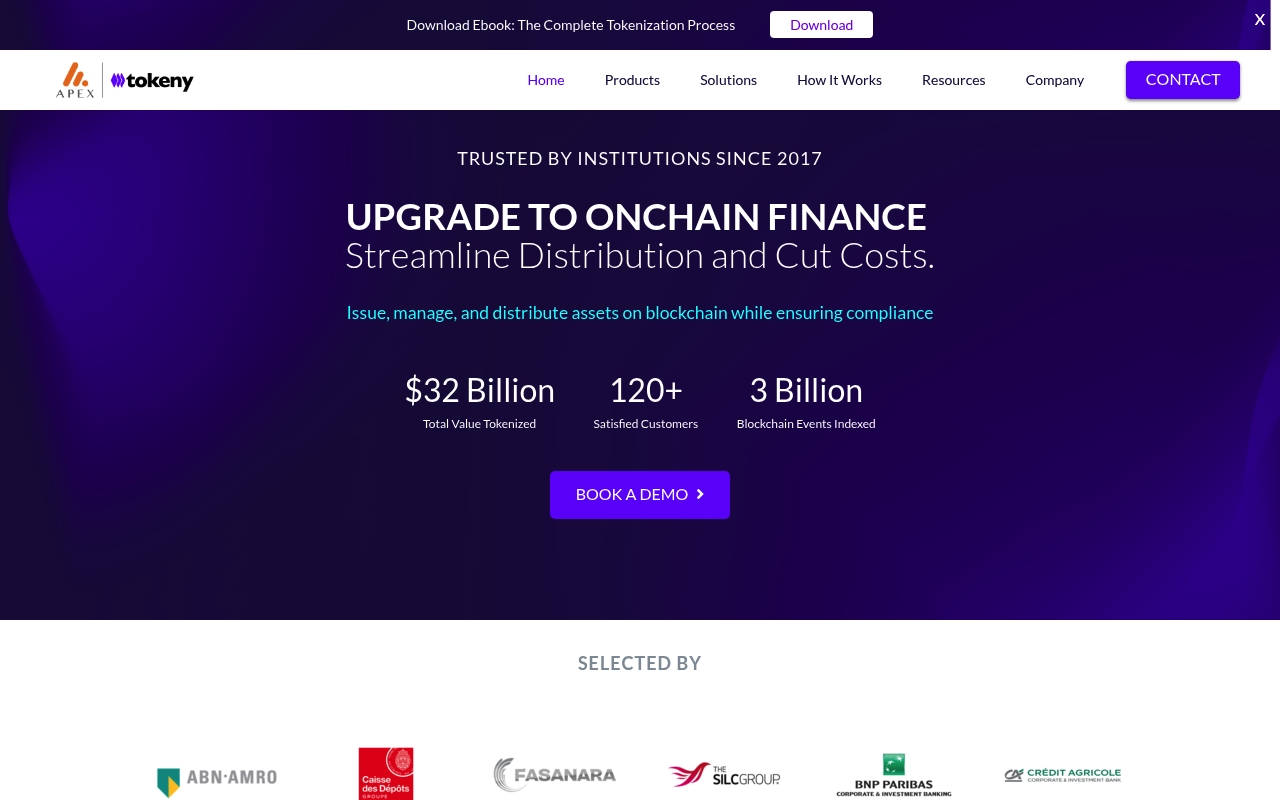
Tokeny sits at the intersection of traditional finance and blockchain, building the infrastructure for institutions to tokenize real-world assets. The company transforms illiquid holdings—real estate, private equity, bonds, commodities—into tradeable digital securities, giving wealth managers and asset owners a way to unlock capital without the friction of traditional markets.
What sets Tokeny apart is its focus on institutional credibility. Rather than chasing retail crypto excitement, the company has built compliance-first tooling that speaks the language of regulators, custodians, and fund administrators. Their platform handles the entire lifecycle: issuance, custody, trading, and settlement, all wrapped in the governance frameworks that institutional clients actually need.
The European fintech scene is crowded with blockchain evangelists; Tokeny reads differently. It's less "decentralize everything" and more "make institutional finance move at digital speed." In a market where real asset tokenization is still nascent, Tokeny occupies the pragmatic middle ground—Web3 infrastructure without the ideology.
The company is positioning itself as essential plumbing for an inevitable shift: the digitization of capital markets. As regulatory frameworks clarify across Europe, tokenization moves from proof-of-concept to production, and Tokeny's early positioning in the institutional layer could prove valuable.