← All services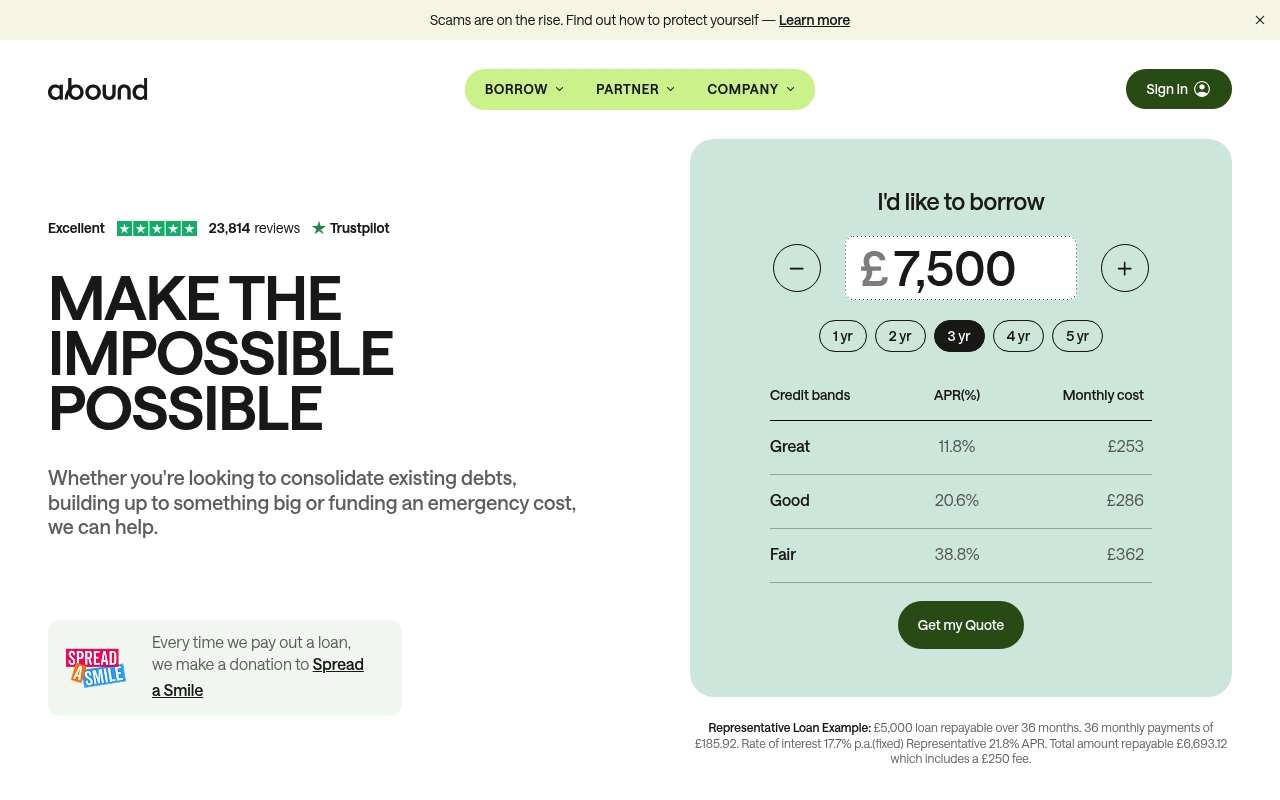
4 European companies
Underwriting AI Providers in Europe
Underwriting AI applies machine learning to the assessment of insurance and credit risk — using broader data sets, more complex pattern recognition, and continuous model improvement to make more accurate risk decisions than traditional actuarial and rules-based underwriting. AI underwriting is particularly valuable for novel risk types and for assessing applicants whose profiles do not fit neatly into traditional underwriting categories.
Typically offered by
European fintech companies offering underwriting AI
Abound
Open Banking🇬🇧 United Kingdom
Gerald Chappell ran digital lending globally at McKinsey; Dr Michelle He was a director at EY advising banks on credit analytics, with a PhD in computer science. Both spent years building credit products for large financial institutions, and both reached the same conclusion about the machinery they were working inside: it was wrong at the individual level. A credit score is a statistical average applied to a person — it captures how someone has borrowed before, not what they can actually afford now. In 2020 they founded Fintern in London to replace that inference with observation, using the bank transaction data PSD2 had just made accessible. Chappell's description of what open banking gives a lender is the sharpest summary of the thesis: financial X-rays.
The consumer product, rebranded from Fintern to Abound, is a UK personal loan of a few thousand pounds up to around £20,000, repayable over one to five years, applied for entirely online with funds arriving within hours of approval. What happens underneath is the actual product. Applicants connect their bank accounts through open banking; Abound's proprietary platform, Render, reads real income and real spending — the rent, the subscriptions, the irregular gig income, the seasonal dip — and calculates affordability from what is there rather than from a bureau file. A soft credit check runs alongside it, so quoted rates carry no credit-score impact. The practical consequence is that people with thin files or a couple of historic blemishes can be approved on evidence a scorecard would never see, and that the company claims default rates roughly 75% below industry standard. That figure is Abound's own and unaudited — but the direction is corroborated by the funding it has been able to raise against the loan book.
That funding is the second thing to understand precisely. Abound has announced facilities totalling more than £1.6 billion since launch — £500 million in 2023, up to £800 million in 2024, a further £250 million from Deutsche Bank in 2025 — from Citi, Deutsche Bank, Waterfall Asset Management, LuminArx, Salica, Informed Ventures, and West Coast Capital. The overwhelming majority is debt to fund lending, not equity in the company; before the 2023 round Abound had raised only around $11 million in equity, and no valuation has ever been disclosed. This is the standard structure for a balance-sheet lender and it says something real — institutional lenders underwrite the underwriter, and £1.6 billion of credit facilities is a market verdict on Render's models — but it is not a $1.6 billion company. The genuinely notable milestone is quieter: Abound reached profitability three years after launch, and has now lent over £1 billion, from a team of roughly 130 in London.
The strategic shape now mirrors what several European fintechs have converged on: run the consumer brand, and rent the machinery. Render is being licensed to other lenders — GAIA Family and LemFi are named clients — as cashflow underwriting infrastructure for companies that want to launch credit products or improve their decisioning without building affordability models themselves. Alongside it sit partner products in retail finance and premium finance. It is the same dual model that made Klarna infrastructure for Apple: the consumer business proves the technology, and the technology business scales beyond what the consumer brand could reach alone. International expansion has been signalled repeatedly but Abound remains UK-only, regulated by the FCA under Fintern Ltd (FRN 929244).
The honest read requires looking at the rate card. Abound markets fairness, and relative to what its customers' alternatives are, the case is strong: representative APR is 21.8%, debt consolidation customers save around £1,000 over a loan's life on the company's numbers, and 25,000-plus Trustpilot reviews average 4.9 — unusually good for consumer credit, a category where people rarely leave happy reviews. But the published bands run from 11.8% for the strongest applicants to 38.8% for the "fair" band, and the sample £5,000 loan carries a £250 fee. This is near-prime and non-prime lending: much cheaper than payday or doorstep credit, considerably more expensive than a high-street personal loan, and priced for a customer the high street declines. The structural question is the one facing every lender that has only grown — Abound's models have been profitable through a rate shock but not yet through a genuine consumer credit downturn, and affordability underwriting is precisely the discipline that either proves itself or doesn't when unemployment moves. What it has already demonstrated is narrower but not trivial: open banking data, six years after PSD2 made it available, can underwrite people the credit bureaus get wrong.
Founded 2020
Akur8
InsurTech🇫🇷 France
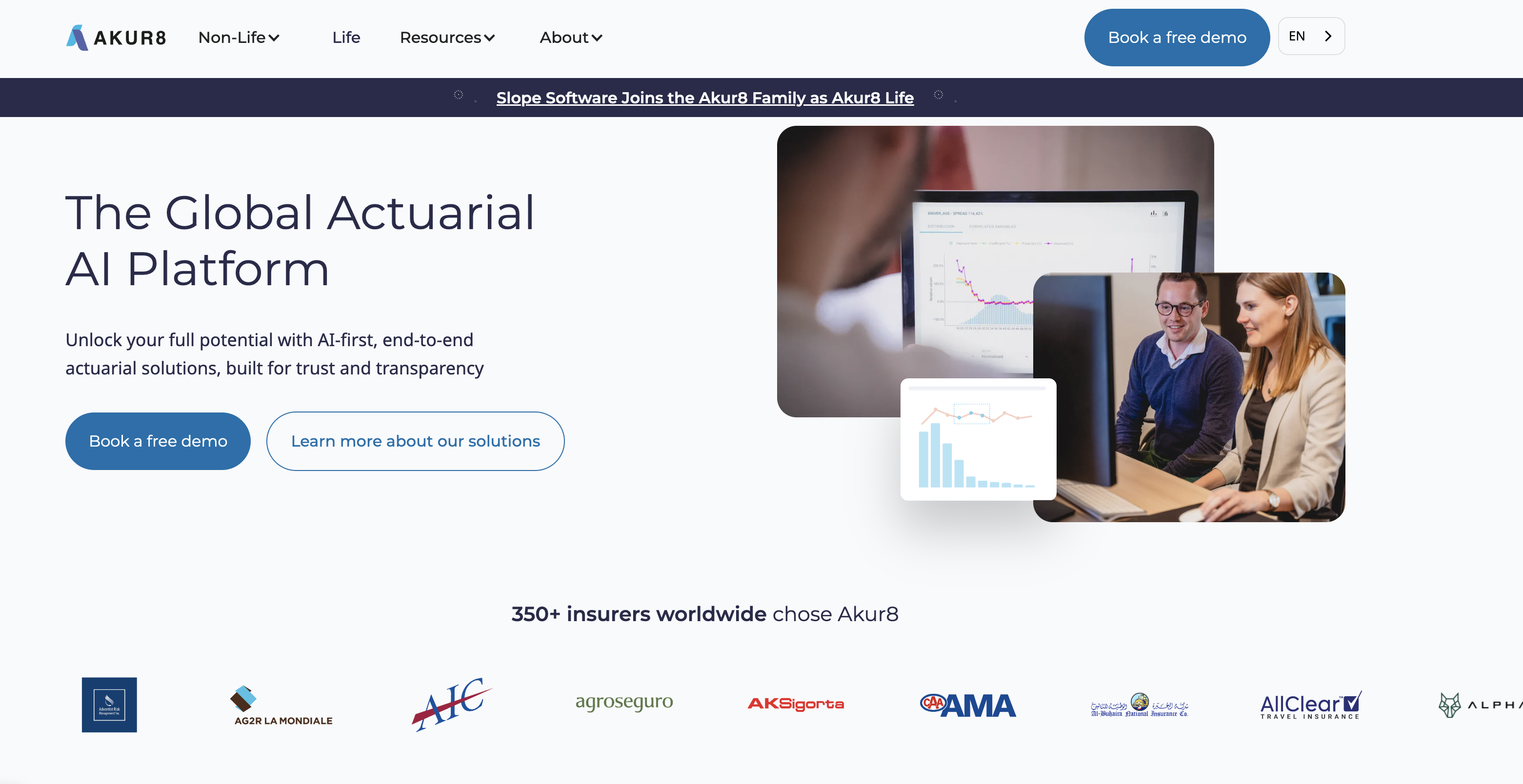
Akur8 is an AI-powered insurance underwriting platform that automates and accelerates pricing decisions for insurers. Rather than relying on traditional actuarial models that can take months to build and update, Akur8 uses machine learning to rapidly discover optimal pricing strategies from historical claims data, enabling insurers to compete faster and adapt to market shifts in weeks rather than quarters.
The platform is built for underwriters and actuaries who are tired of being bottlenecked by legacy systems. Akur8 sits between an insurer's data warehouse and their pricing engine, learning patterns that humans might miss and generating transparent, explainable models that regulators will actually approve. The company positions itself as the bridge between insurance's analog past and a data-driven future.
In the European insurance market, where digitalization remains patchy and many carriers still rely on spreadsheet-heavy workflows, Akur8 stands out by being genuinely usable—not just technically sophisticated, but designed for the reality of how insurance actually operates. Its customers include major European insurers looking to modernize underwriting without dismantling their entire infrastructure.
The company represents a broader shift toward embedded AI in financial services, where the technology doesn't replace humans but makes them exponentially more effective at their core job: pricing risk accurately.
Founded 2016
MiFin
Lending🇸🇰 Slovakia
MiFin is a machine learning platform built for the realities of alternative finance. Rather than forcing lenders into rigid credit scoring models designed for prime borrowers, MiFin works backward from actual lending performance—building custom risk algorithms that reflect real portfolio behavior. The platform ingests historical loan data and market conditions to generate underwriting rules that scale, whether you're lending to gig workers, small merchants, or emerging market entrepreneurs. It's the kind of infrastructure that lets alternative lenders compete on speed and accuracy without building everything from scratch. Where traditional risk models assume stability, MiFin expects volatility and prices for it. The platform serves lenders who operate at the edges of the conventional credit system—the segments where standard scorecards fail and data-driven judgment becomes competitive advantage. MiFin sits at the intersection of fintech infrastructure and alternative finance, solving a very specific problem: how do you automate credit decisions when your borrowers don't fit into standard categories? The answer, it turns out, is to stop trying to fit them into those categories at all.
Founded 2014
wefox
InsurTech🇨🇭 Switzerland
Wefox is a digital insurance broker that cuts through the noise of traditional insurance shopping. Rather than piecing together quotes from multiple providers, customers get personalized coverage recommendations through a streamlined mobile-first platform. The company bundles home, auto, and pet insurance into a single digital experience, handling everything from comparison to claims—no brokers in grey suits required.
What sets wefox apart in Europe's insurance landscape is its focus on simplicity. While legacy brokers still rely on phone calls and paperwork, wefox does the legwork algorithmically, comparing hundreds of policies in seconds and presenting only the relevant options. The interface feels less like insurance shopping and more like opening a fintech app.
The company operates across multiple European markets, building a tech-forward alternative to the tired insurance broker model. It's positioned as insurance for people who'd rather not think about insurance—until they need to claim. In the broader fintech ecosystem, wefox represents a straightforward play on distribution innovation: taking an opaque, offline-first industry and making it transparent, fast, and mobile-native.
Founded 2015