← Back to Belvo

Alternatives
Alternatives to Belvo
Explore 12 European fintech companies similar to Belvo — operating in Embedded Finance and Financial Infrastructure and Open Banking.
12 alternatives to Belvo
Sorted by similarity and popularityFabrick
Embedded FinanceFinancial InfrastructurePaymentsOpen BankingLending
🇮🇹 Italy
Fabrick operates in the unglamorous but essential corner of fintech where plumbing meets innovation. The Italian firm builds the digital infrastructure that lets banks, fintechs, and non-financial companies offer financial services without building everything from scratch. It's Banking-as-a-Service for a continent that still runs on legacy rails, but Fabrick is quietly rewiring how money moves across borders and between accounts.
The company offers a full stack of APIs and platforms covering payments, accounts, lending, and open banking connectivity. Rather than forcing clients into rigid templates, Fabrick positions itself as a modular toolbox: plug in what you need, leave out what you don't. This flexibility appeals to enterprises tired of one-size-fits-all solutions and startups wanting to launch financial products without the regulatory headache of building a bank license from scratch.
In a European fintech landscape dominated by consumer-facing rebels, Fabrick is the B2B backbone nobody talks about at conferences but everyone quietly depends on. It competes by being boring in all the right ways—reliable, compliant, and deep enough in the weeds to handle edge cases that make other platforms crumble. The company has steadily expanded across Europe, positioning itself as the infrastructure layer for a generation of embedded finance plays.
Founded 2014
View profile →
Tink
Embedded FinanceFinancial InfrastructureOpen Banking
🇸🇪 Sweden
Daniel Kjellén and Fredrik Hedberg didn't set out to build infrastructure. Tink started in Stockholm in 2012 as a consumer personal finance app — an attempt to give Swedish bank customers a cleaner view of their money across multiple accounts. It was a reasonable idea that ran into an unreasonable obstacle: getting reliable, consistent data out of European banks was extraordinarily hard. The technical problem turned out to be more interesting than the consumer product. In 2018 they pivoted, shifted focus entirely to the B2B layer, and started selling the very infrastructure they'd been forced to build for themselves.
That pivot proved prescient. The EU's PSD2 directive, which came into full effect in 2019, legally required banks to open their data to authorised third parties — creating the regulatory foundation that open banking platforms needed to operate at scale. Tink had spent years building exactly those bank connections. When the regulation arrived, the company was ready.
The platform Kjellén and Hedberg built connects to more than 3,400 banks and financial institutions across Europe, reaching over 250 million bank customers. Through a single API integration, banks, fintechs, and merchants can access aggregated account data, initiate payments directly from customer bank accounts, verify account ownership, and enrich transaction data — without maintaining their own connections to hundreds of separate banking systems with different technical standards and update schedules. Clients include Klarna, PayPal, NatWest, ABN AMRO, and BNP Paribas Fortis.
In March 2022, Visa completed the acquisition of Tink for €1.8 billion — one of the largest European fintech acquisitions of that year, and a clear signal of how seriously the global payments industry had come to take open banking infrastructure. Visa's strategic rationale was straightforward: it had failed to acquire Plaid, the US equivalent, after an antitrust challenge, and needed a European open banking capability. Tink gave it 500 employees, 18 European markets, and relationships with over 300 banks and fintechs built over a decade.
The founders stayed on as CEO and CTO through the transition, continuing to run Tink as a standalone Visa subsidiary from Stockholm. Both departed in 2025 — Kjellén and Hedberg announced they were building Freda, a new AI-driven legal and compliance technology startup, with the pair describing Tink as "now in better hands than ever." Francois Tornier, Visa's VP of Open Banking, took over as CEO. The product roadmap has continued under Visa ownership, including a 2024 expansion of Tink's open banking platform into the US market.
Founded 2012
View profile →
Kontomatik
Financial InfrastructureOpen BankingLending
🇵🇱 Poland
Kontomatik provides open banking data and credit decisioning tools.
Founded 2009
View profile →
Dateio
Financial InfrastructureOpen BankingLending
🇨🇿 Czech Republic
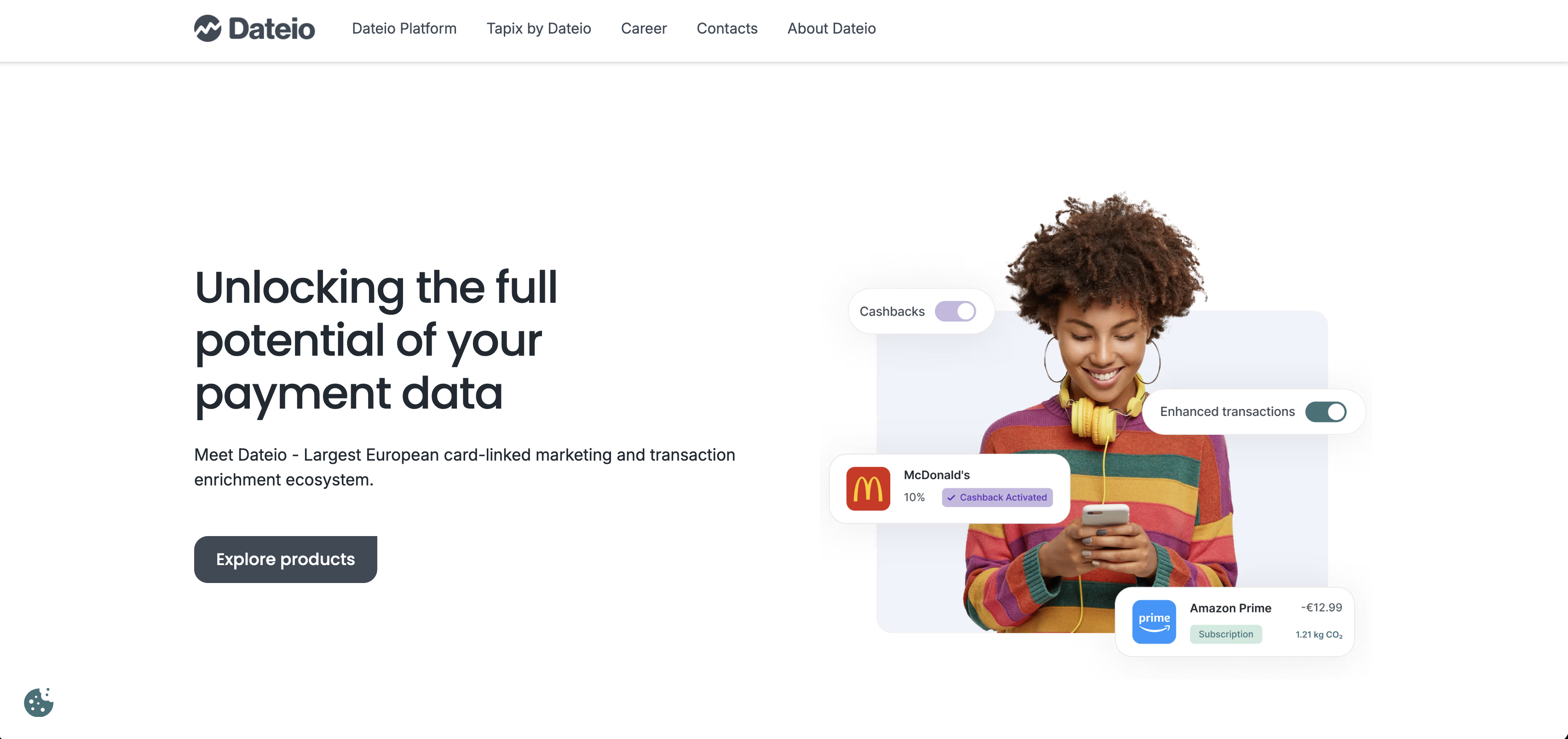
Dateio is a European open banking platform that sits at the intersection of data and credit. The company aggregates financial data from multiple banks and institutions across Europe, then applies machine learning to unlock lending decisions and financial insights that traditional scoring can't capture. Unlike legacy credit bureaus, Dateio builds its models on real transaction history and behavioral patterns, not just loan defaults and payment records.
The company positions itself as a data partner for fintechs, banks, and lenders who need smarter underwriting. Rather than building consumer-facing products, Dateio focuses on B2B infrastructure—providing APIs that other companies plug into to understand customer creditworthiness in real time. This approach means Dateio operates in the quieter, more valuable layer of fintech: the plumbing that powers better decisions.
In a market crowded with credit score providers and ID verification vendors, Dateio stands out by going deeper into the data layer. Most competitors offer point solutions; Dateio aggregates, normalizes, and analyzes transaction flows across borders. That matters in Europe, where fragmented banking systems and privacy rules have made cross-border financial data unusually hard to access. For lenders tired of crude risk models, Dateio offers a more granular, behavior-based alternative that reflects how Europeans actually spend and save money.
The company represents a broader shift in European fintech toward infrastructure and data intelligence, rather than consumer apps. As regulation tightens and competition intensifies in lending, better data becomes the primary competitive advantage. Dateio operates in that space.
Founded 2017
View profile →
Yapily
Embedded FinanceFinancial InfrastructureOpen Banking
🇬🇧 United Kingdom
Yapily sits at the intersection of open banking and embedded finance, building the plumbing that lets fintech companies and enterprises tap into banking data and payments without reinventing the wheel. Founded in 2016, the London-based company operates as an API infrastructure layer—connecting to banks across Europe and beyond to unlock account information, payment initiation, and consent management at scale.
What makes Yapily different is how it abstracts away the complexity of working with hundreds of banks and their inconsistent technical standards. Rather than forcing developers to build individual integrations for each bank's API, Yapily provides a unified interface that normalizes everything. It's the translator between your app and the messy reality of legacy banking infrastructure.
The company operates in the B2B2C space, partnering with fintechs, neobanks, and enterprise software providers who need banking connectivity but lack the resources to build it themselves. Their customer base spans lending platforms, wealth apps, accounting software, and payment orchestration layers—essentially anyone whose product benefits from real-time access to customer bank accounts or the ability to initiate payments.
Yapily's positioning is deliberately unsexy: they're infrastructure, not consumer-facing. But that's precisely the point. In a landscape crowded with consumer fintechs chasing headlines, Yapily has built a quiet, profitable business serving the builders themselves. They're to open banking what Stripe is to payments—the backbone that lets innovation happen faster.
Founded 2016
View profile →
Powens
Fraud & SecurityFinancial InfrastructureOpen BankingLending
🇫🇷 France
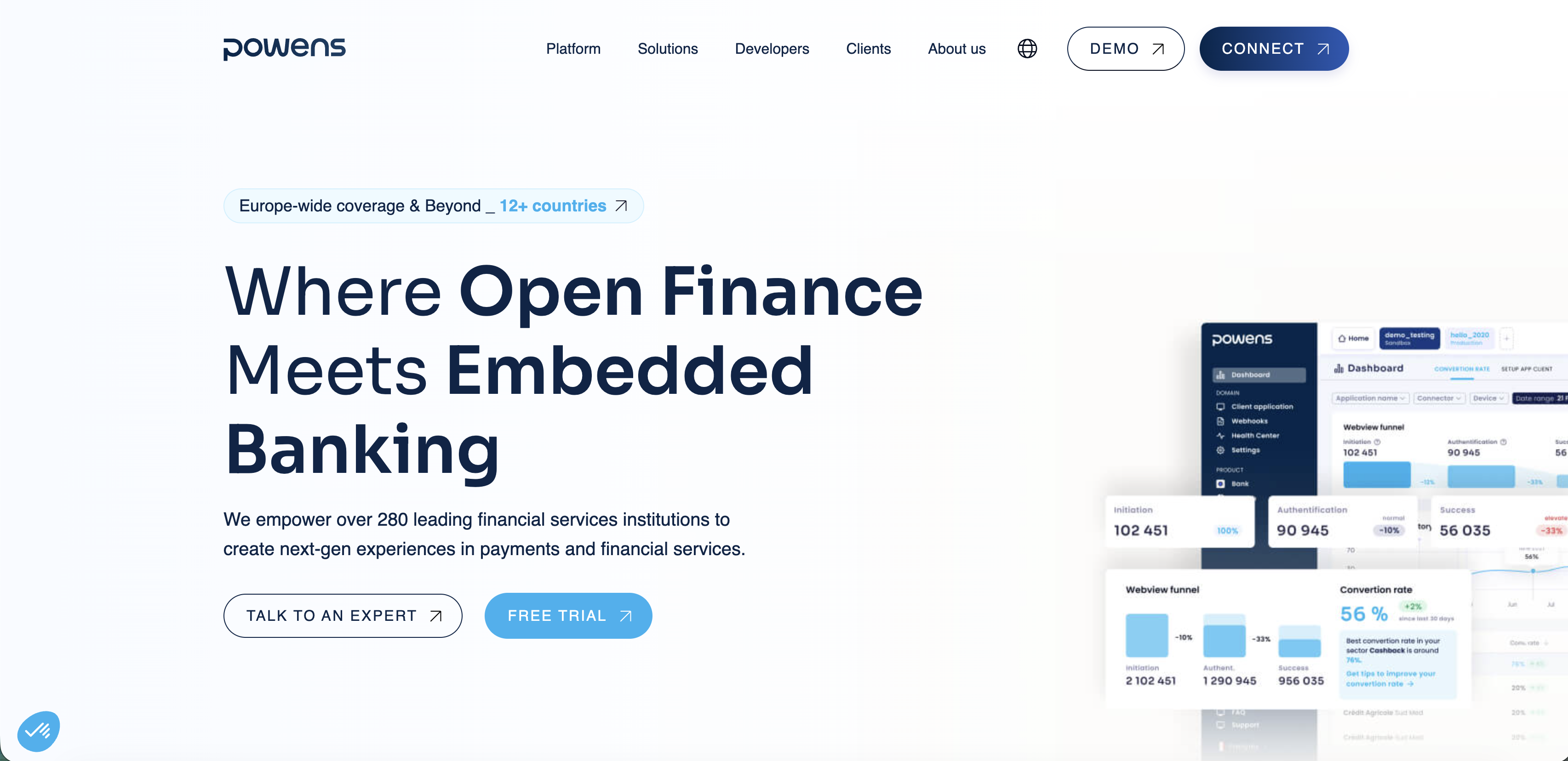
Powens sits at the intersection of open banking and financial data aggregation, helping European fintechs and traditional banks make sense of the fragmented payment and account landscape. Rather than building another me-too aggregator, the company positions itself as the connective tissue between institutions and the data they need to move capital efficiently and securely. Their platform ingests transaction data, payment initiation flows, and account information from thousands of financial institutions across Europe, surfacing clean, standardized intelligence to power lending decisions, fraud detection, and embedded finance experiences. What sets Powens apart is its focus on the continental European market—where open banking adoption is uneven and legacy banking infrastructure still dominates. While UK and US aggregators have enjoyed first-mover advantage, Powens saw an opportunity to build native expertise in Germany, France, Spain, and Benelux, where regulatory tailwinds and fragmented banking systems created genuine demand. The company works with both consumer-facing fintechs and institutional clients, meaning they've learned to navigate the messy reality of building infrastructure that talks to both sleek fintech apps and stuffy corporate banking platforms. This dual-sided approach has become their competitive moat—they understand both the user experience expectations of modern fintech and the compliance complexity of traditional finance. In the broader European fintech stack, Powens functions as a critical middleware layer, solving the unglamorous but essential problem of data connectivity that powers everything downstream—from embedded lending to fraud prevention to wealth management.
Founded 2015
View profile →
finleap
Embedded FinanceFinancial InfrastructureWealthPaymentsDigital BankingLending
🇩🇪 Germany
finleap is Berlin's answer to a question the European fintech scene keeps asking: how do you build world-class financial companies at scale? Rather than chase unicorn valuations, finleap builds them. The holding company operates as a fintech factory, incubating and scaling financial startups from day one with institutional backing, operational expertise, and a network that spans regulators, banks, and investors across the continent.
What sets finleap apart is the architecture itself. It's not an accelerator or a VC fund—it's a purpose-built engine for creating and nurturing fintech companies. Each portfolio company gets access to finleap's infrastructure, compliance playbooks, and go-to-market templates, which compresses timelines and eliminates the friction that typically derails early-stage fintechs. The model works: companies like Wayfair-backed Finn, B2B payments platform Foxpay, and lending marketplace Evala have all emerged from the finleap stable.
Internally, finleap operates across payments, lending, wealth, and embedded finance—categories where the European market remains genuinely underpenetrated compared to the US. The company's thesis is straightforward: identify white space in financial services, build products faster than traditional banks can move, and create defensible market positions through technology and user experience. It's less about disruption theater and more about pragmatic value creation.
Finleap sits at an interesting intersection in the European fintech landscape: large enough to command resources and regulatory relationships, independent enough to move quickly, and structured in a way that lets founders maintain autonomy while tapping institutional muscle. For a continent that produces good fintech companies but struggles with scaling, finleap represents a new playbook.
Founded 2014
View profile →
ClearBank
Embedded FinanceFinancial Infrastructure
🇬🇧 United Kingdom
ClearBank was the first new clearing bank in the UK in more than 250 years. That sentence is doing a lot of work, because the reason there hadn't been one is that clearing — the plumbing that moves money between banks — had settled into the hands of four incumbents whose systems dated to a different era, and every fintech that wanted to offer accounts had to rent access from one of them. ClearBank launched in 2015 to be the alternative: a purpose-built, cloud-native clearing bank with no legacy estate, accessed through a single API, holding client funds at the Bank of England rather than on its own balance sheet.
The customer list explains the model better than the description does. TrueLayer, Tide, Chip, Coinbase, Raisin and Wealthify all run on ClearBank — companies that wanted to offer accounts and payments without becoming banks themselves. ClearBank provides the regulated banking layer and the real-time payment rails; the client owns the customer relationship. This is embedded banking delivered by an actual bank rather than middleware, which is the distinction that matters when a regulator asks who is holding the money.
The financial trajectory has been unusually disciplined for the category. ClearBank has been profitable since 2022, reported its first full-year pre-tax profit of £18.4 million in 2023, and delivered a third consecutive profitable year in 2025 with group normalised revenue up 34% to £121.6 million. The more significant number is that fee-based income grew 51% and now makes up the majority of revenue — the deliberate pivot away from interest-rate dependency that most banks talk about and few execute. The infrastructure now underpins more than 17 million accounts, and ClearBank UK holds an investment-grade BBB− rating from S&P, rare for a company its age.
Europe is the current chapter, and it resolves an old caveat about ClearBank being UK-only. ClearBank Europe N.V., headquartered in Amsterdam and led by Rintse Zijlstra, received a Credit Institution Licence from the European Central Bank under DNB supervision in 2024, backed by more than €70 million of investment. It gives the group euro accounts and payments alongside sterling, with access to TARGET2, SEPA Credit Transfer and SEPA Instant. By the end of 2025 the European business covered 21 EU countries, had opened a Paris branch, and was processing over a million payments a month — real but early, which is the honest way to frame it against a UK operation of 17 million accounts. Mark Fairless succeeded Charles McManus as chief executive.
Founded 2015
View profile →
Narvi
Embedded FinanceLendingBNPL
🇫🇮 Finland
Narvi is a European fintech that simplifies embedded lending for e-commerce and marketplace platforms. Rather than forcing merchants to build lending infrastructure from scratch, Narvi handles the entire loan lifecycle—from origination through servicing—as a white-label API that integrates directly into checkout flows.
The company targets online retailers and marketplace operators who want to offer buy-now-pay-later and installment credit without the operational overhead of underwriting, collections, or compliance. Narvi handles credit decisions using proprietary scoring models and manages all regulatory requirements, while merchants simply embed a widget and capture incremental revenue.
In a market crowded with point-solution BNPL providers, Narvi positions itself as a full-stack lending partner rather than a payment mode. The company serves merchants across Europe and has built integrations with major e-commerce platforms, making it simpler for smaller retailers to compete with well-funded rivals on financing offerings.
Narvi represents a growing class of embedded finance infrastructure plays—companies enabling non-financial businesses to offer financial products without becoming financial institutions themselves. Its role is to abstract complexity and regulatory burden, letting merchants focus on customer experience and growth.
Founded 2020
View profile →
Enable Banking
Financial InfrastructureOpen Banking
🇫🇮 Finland
Most open banking aggregators want your data. That is the business model: connect to the banks, pull the transactions, store them, enrich them, and sell the enriched product back. Enable Banking built the opposite. The company describes itself as the postman of your data — it moves financial information from the bank to the customer's application and does not retain, process, or build models on what passes through. For a fintech that considers its transaction data a competitive asset, or a customer with strict data residency requirements, that neutrality is the entire pitch.
Joonas Tomperi and Fedor Tyurin founded the company in Espoo in 2019, at the point where PSD2 had legally opened European bank APIs but had not made them usable. Each bank interpreted the standard differently, each shipped its own authentication quirks, and each updated on its own schedule. The regulation created the right; someone still had to build the plumbing. Enable Banking started with Finland and the Nordics and expanded outward, and now connects to more than 2,700 banks across 30 European countries through a single PSD2-compliant API — account information from all of them, and payment initiation from over 1,500.
What makes the company genuinely unusual is its scale relative to that coverage. Enable Banking has raised roughly €600,000 in total, in a single seed round in 2022 led by Wellstreet and Forward VC, and employs somewhere between fourteen and seventeen people distributed across seven countries. Tink sold to Visa for €1.8 billion with 500 employees. TrueLayer has raised hundreds of millions. Enable Banking is covering comparable European ground with a team that would fit around one table, which says something about how much of open banking infrastructure is disciplined engineering rather than capital.
The company holds its own Account Information Service Provider registration, supervised by Finland's FIN-FSA — which means other companies can build on top of its licence rather than obtaining their own. That is the model behind open-banking.io, the Danish developer tool that resells Enable Banking access at €3 per month without customers needing eIDAS certificates. It is also why Enable Banking's no-data-retention architecture matters structurally: because the platform never holds readable customer data, the companies building on it can make stronger privacy guarantees than they otherwise could.
Two smaller details are revealing about who this is built for. Enable Banking runs a balanced split between business and consumer accounts — roughly half of its ten million monthly API calls come from each, where most early open banking providers targeted consumer accounts only and treated corporate banking as an afterthought. And it offers a live production environment for testing without requiring a contract, which is a small thing that tells you the company expects developers to evaluate it by using it rather than by booking a call. Tomperi now chairs the board of Fintech Finland, the national industry association.
Founded 2019
View profile →
Abound
Open BankingLending
🇬🇧 United Kingdom
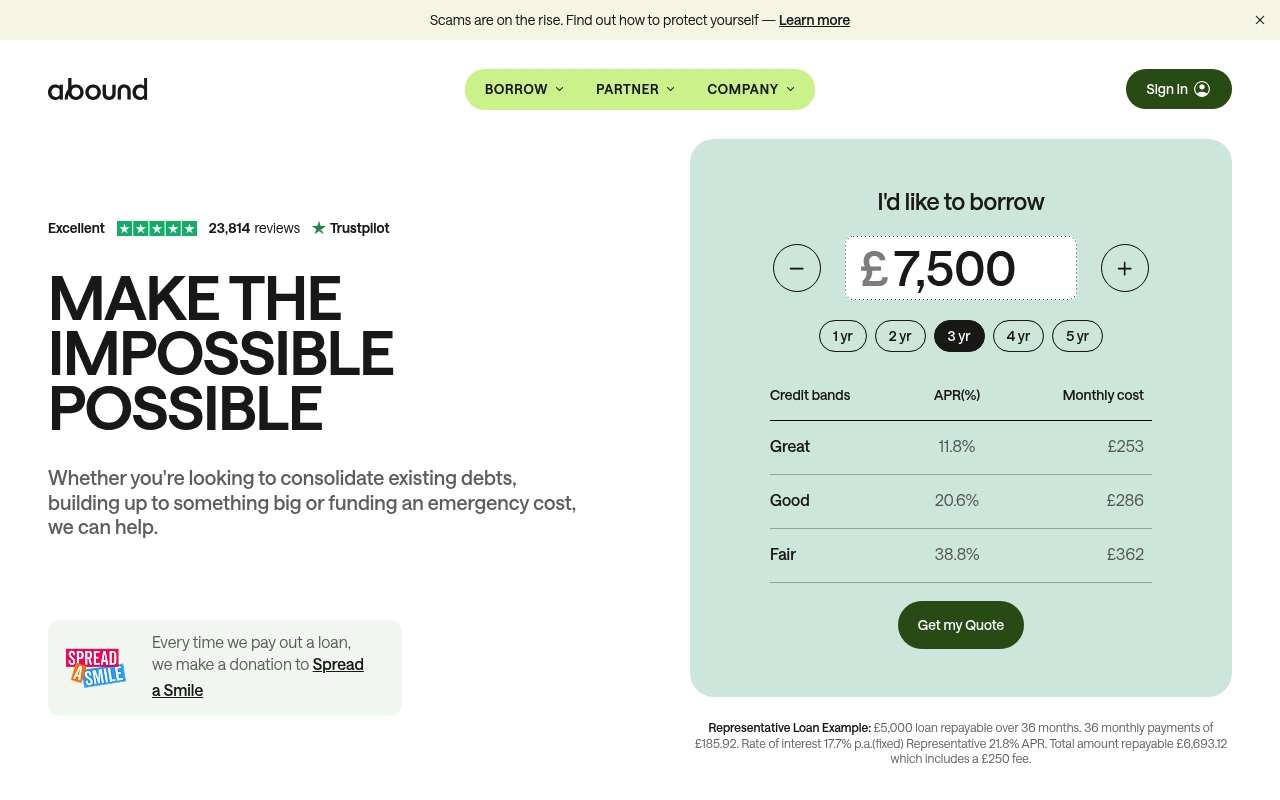
Gerald Chappell ran digital lending globally at McKinsey; Dr Michelle He was a director at EY advising banks on credit analytics, with a PhD in computer science. Both spent years building credit products for large financial institutions, and both reached the same conclusion about the machinery they were working inside: it was wrong at the individual level. A credit score is a statistical average applied to a person — it captures how someone has borrowed before, not what they can actually afford now. In 2020 they founded Fintern in London to replace that inference with observation, using the bank transaction data PSD2 had just made accessible. Chappell's description of what open banking gives a lender is the sharpest summary of the thesis: financial X-rays.
The consumer product, rebranded from Fintern to Abound, is a UK personal loan of a few thousand pounds up to around £20,000, repayable over one to five years, applied for entirely online with funds arriving within hours of approval. What happens underneath is the actual product. Applicants connect their bank accounts through open banking; Abound's proprietary platform, Render, reads real income and real spending — the rent, the subscriptions, the irregular gig income, the seasonal dip — and calculates affordability from what is there rather than from a bureau file. A soft credit check runs alongside it, so quoted rates carry no credit-score impact. The practical consequence is that people with thin files or a couple of historic blemishes can be approved on evidence a scorecard would never see, and that the company claims default rates roughly 75% below industry standard. That figure is Abound's own and unaudited — but the direction is corroborated by the funding it has been able to raise against the loan book.
That funding is the second thing to understand precisely. Abound has announced facilities totalling more than £1.6 billion since launch — £500 million in 2023, up to £800 million in 2024, a further £250 million from Deutsche Bank in 2025 — from Citi, Deutsche Bank, Waterfall Asset Management, LuminArx, Salica, Informed Ventures, and West Coast Capital. The overwhelming majority is debt to fund lending, not equity in the company; before the 2023 round Abound had raised only around $11 million in equity, and no valuation has ever been disclosed. This is the standard structure for a balance-sheet lender and it says something real — institutional lenders underwrite the underwriter, and £1.6 billion of credit facilities is a market verdict on Render's models — but it is not a $1.6 billion company. The genuinely notable milestone is quieter: Abound reached profitability three years after launch, and has now lent over £1 billion, from a team of roughly 130 in London.
The strategic shape now mirrors what several European fintechs have converged on: run the consumer brand, and rent the machinery. Render is being licensed to other lenders — GAIA Family and LemFi are named clients — as cashflow underwriting infrastructure for companies that want to launch credit products or improve their decisioning without building affordability models themselves. Alongside it sit partner products in retail finance and premium finance. It is the same dual model that made Klarna infrastructure for Apple: the consumer business proves the technology, and the technology business scales beyond what the consumer brand could reach alone. International expansion has been signalled repeatedly but Abound remains UK-only, regulated by the FCA under Fintern Ltd (FRN 929244).
The honest read requires looking at the rate card. Abound markets fairness, and relative to what its customers' alternatives are, the case is strong: representative APR is 21.8%, debt consolidation customers save around £1,000 over a loan's life on the company's numbers, and 25,000-plus Trustpilot reviews average 4.9 — unusually good for consumer credit, a category where people rarely leave happy reviews. But the published bands run from 11.8% for the strongest applicants to 38.8% for the "fair" band, and the sample £5,000 loan carries a £250 fee. This is near-prime and non-prime lending: much cheaper than payday or doorstep credit, considerably more expensive than a high-street personal loan, and priced for a customer the high street declines. The structural question is the one facing every lender that has only grown — Abound's models have been profitable through a rate shock but not yet through a genuine consumer credit downturn, and affordability underwriting is precisely the discipline that either proves itself or doesn't when unemployment moves. What it has already demonstrated is narrower but not trivial: open banking data, six years after PSD2 made it available, can underwrite people the credit bureaus get wrong.
Founded 2020
View profile →
Vodeno
Embedded FinanceFinancial InfrastructurePayments
🇧🇪 Belgium
Vodeno is a European fintech building the infrastructure layer for embedded finance—letting any company slip banking and lending directly into their product without the complexity of traditional integrations. The platform abstracts away the operational headaches of regulatory compliance, bank connectivity, and fund management that typically come with embedding financial services, making it possible for non-financial businesses to offer credit, accounts, and payments to their users almost as easily as adding a API call.
What sets Vodeno apart is its focus on the operational backbone rather than the customer-facing experience. While most embedded finance platforms emphasize sleek user flows, Vodeno solves the unglamorous but critical problem: how do you actually manage the banking, settlement, and risk infrastructure when you're issuing credit to thousands of users across multiple jurisdictions? They handle the plumbing that traditional banks spent decades building.
The company targets both B2B2C platforms and B2B software providers looking to monetize their customer relationships through financial products. It competes in a growing category alongside players like Marqeta and Unit, but Vodeno's European roots give it a natural advantage in navigating the continent's fragmented regulatory landscape and banking infrastructure. As embedded finance reshapes how non-financial companies interact with their customers, platforms like Vodeno are becoming essential infrastructure—sitting invisibly in the background, making finance work at speed.
Founded 2021
View profile →