← Back to Enable Banking
Alternatives
Alternatives to Enable Banking
Explore 12 European fintech companies similar to Enable Banking — operating in Financial Infrastructure and Open Banking.
12 alternatives to Enable Banking
Sorted by similarity and popularityTink
Embedded FinanceFinancial InfrastructureOpen Banking
🇸🇪 Sweden
Daniel Kjellén and Fredrik Hedberg didn't set out to build infrastructure. Tink started in Stockholm in 2012 as a consumer personal finance app — an attempt to give Swedish bank customers a cleaner view of their money across multiple accounts. It was a reasonable idea that ran into an unreasonable obstacle: getting reliable, consistent data out of European banks was extraordinarily hard. The technical problem turned out to be more interesting than the consumer product. In 2018 they pivoted, shifted focus entirely to the B2B layer, and started selling the very infrastructure they'd been forced to build for themselves.
That pivot proved prescient. The EU's PSD2 directive, which came into full effect in 2019, legally required banks to open their data to authorised third parties — creating the regulatory foundation that open banking platforms needed to operate at scale. Tink had spent years building exactly those bank connections. When the regulation arrived, the company was ready.
The platform Kjellén and Hedberg built connects to more than 3,400 banks and financial institutions across Europe, reaching over 250 million bank customers. Through a single API integration, banks, fintechs, and merchants can access aggregated account data, initiate payments directly from customer bank accounts, verify account ownership, and enrich transaction data — without maintaining their own connections to hundreds of separate banking systems with different technical standards and update schedules. Clients include Klarna, PayPal, NatWest, ABN AMRO, and BNP Paribas Fortis.
In March 2022, Visa completed the acquisition of Tink for €1.8 billion — one of the largest European fintech acquisitions of that year, and a clear signal of how seriously the global payments industry had come to take open banking infrastructure. Visa's strategic rationale was straightforward: it had failed to acquire Plaid, the US equivalent, after an antitrust challenge, and needed a European open banking capability. Tink gave it 500 employees, 18 European markets, and relationships with over 300 banks and fintechs built over a decade.
The founders stayed on as CEO and CTO through the transition, continuing to run Tink as a standalone Visa subsidiary from Stockholm. Both departed in 2025 — Kjellén and Hedberg announced they were building Freda, a new AI-driven legal and compliance technology startup, with the pair describing Tink as "now in better hands than ever." Francois Tornier, Visa's VP of Open Banking, took over as CEO. The product roadmap has continued under Visa ownership, including a 2024 expansion of Tink's open banking platform into the US market.
Founded 2012
View profile →
Kontomatik
Financial InfrastructureOpen BankingLending
🇵🇱 Poland
Kontomatik provides open banking data and credit decisioning tools.
Founded 2009
View profile →
Dateio
Financial InfrastructureOpen BankingLending
🇨🇿 Czech Republic
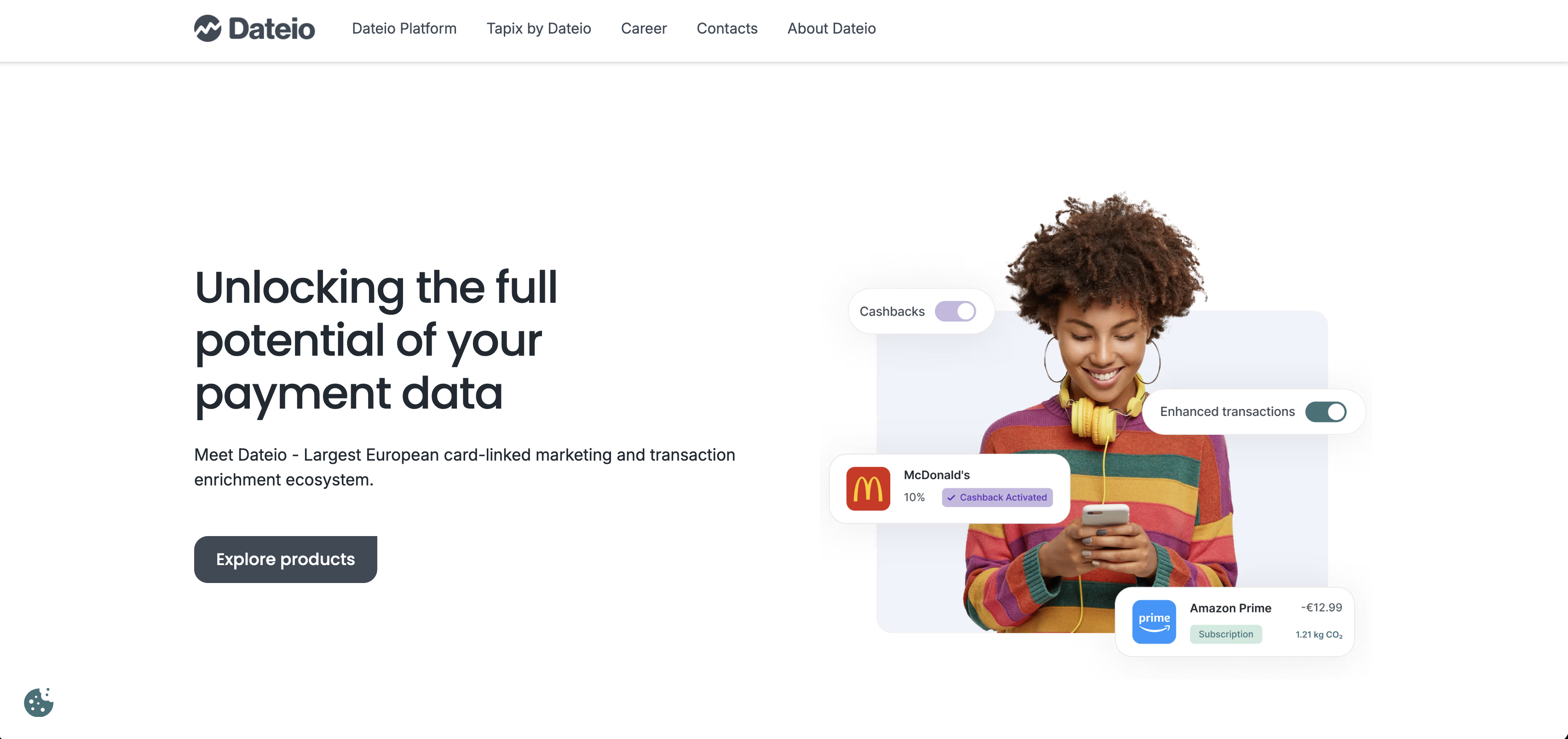
Dateio is a European open banking platform that sits at the intersection of data and credit. The company aggregates financial data from multiple banks and institutions across Europe, then applies machine learning to unlock lending decisions and financial insights that traditional scoring can't capture. Unlike legacy credit bureaus, Dateio builds its models on real transaction history and behavioral patterns, not just loan defaults and payment records.
The company positions itself as a data partner for fintechs, banks, and lenders who need smarter underwriting. Rather than building consumer-facing products, Dateio focuses on B2B infrastructure—providing APIs that other companies plug into to understand customer creditworthiness in real time. This approach means Dateio operates in the quieter, more valuable layer of fintech: the plumbing that powers better decisions.
In a market crowded with credit score providers and ID verification vendors, Dateio stands out by going deeper into the data layer. Most competitors offer point solutions; Dateio aggregates, normalizes, and analyzes transaction flows across borders. That matters in Europe, where fragmented banking systems and privacy rules have made cross-border financial data unusually hard to access. For lenders tired of crude risk models, Dateio offers a more granular, behavior-based alternative that reflects how Europeans actually spend and save money.
The company represents a broader shift in European fintech toward infrastructure and data intelligence, rather than consumer apps. As regulation tightens and competition intensifies in lending, better data becomes the primary competitive advantage. Dateio operates in that space.
Founded 2017
View profile →
Fintecture
Financial InfrastructurePaymentsOpen Banking
🇫🇷 France
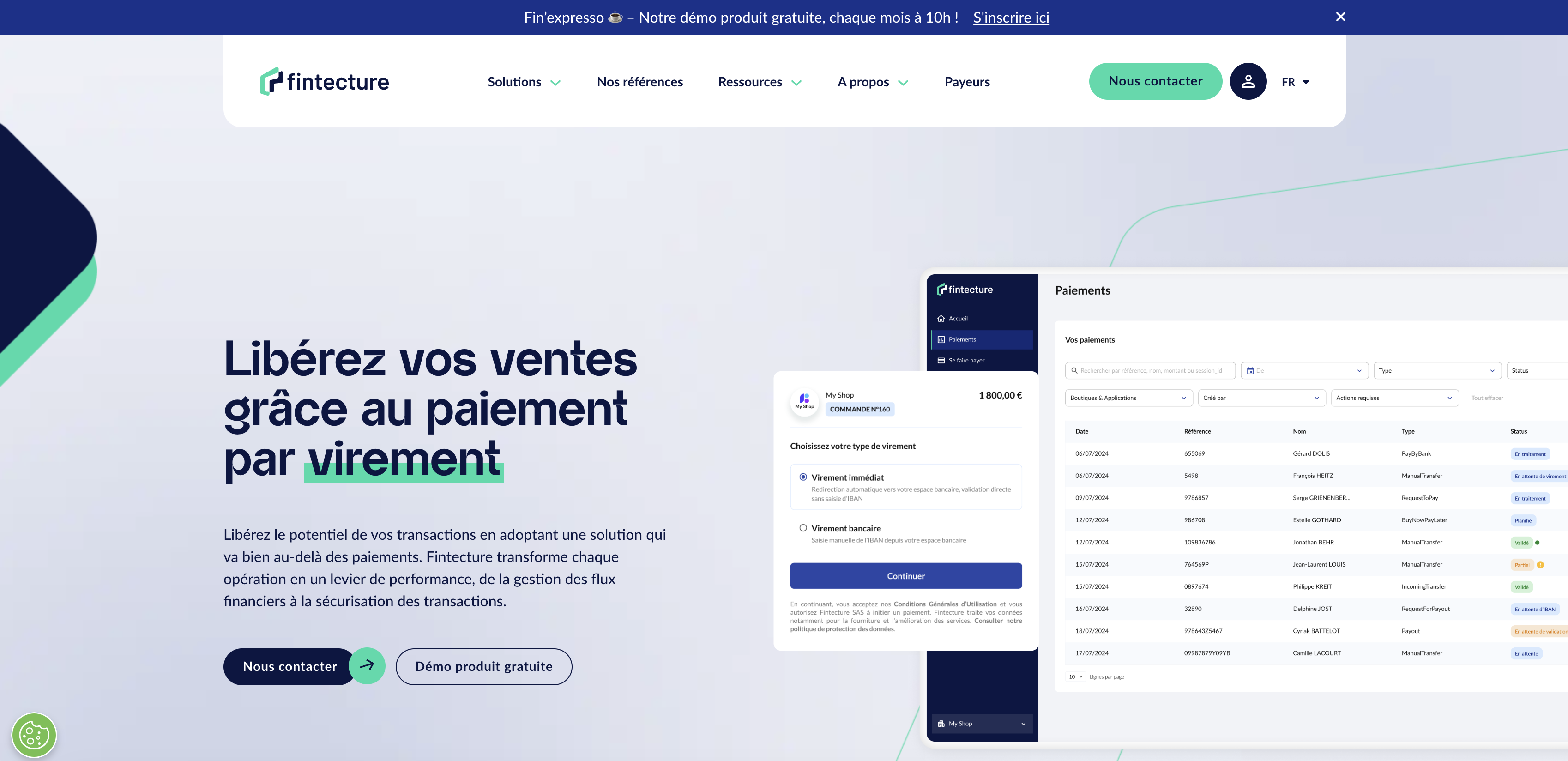
Fintecture is building the plumbing that makes open banking actually work for merchants and platforms across Europe. Rather than forcing businesses to cobble together fragmented payment APIs and banking connectors, Fintecture consolidates access to bank accounts and payment rails across the continent into a single integration point.
The company's core offering is elegantly straightforward: a unified API that lets merchants initiate payments directly from customer bank accounts without managing dozens of individual bank connections. This sits somewhere between traditional payment gateways and the messy reality of banking infrastructure—it handles the complexity of navigating different banking standards, regulatory environments, and technical protocols across European markets so businesses don't have to.
What sets Fintecture apart is its focus on the merchant experience rather than the bank experience. While most open banking platforms were built to satisfy regulators, Fintecture designed its product assuming developers actually want to use it. The company operates across 30+ European countries and integrates with over 4,000 banks, which means a single merchant can reach customers wherever they bank without building country-by-country integrations.
In a landscape crowded with both traditional payment processors and newer open banking specialists, Fintecture occupies a distinct middle ground—not replacing card networks, but offering an alternative rails that's cheaper for merchants, more transparent for customers, and increasingly difficult for incumbents to ignore.
Founded 2017
View profile →
TrueLayer
Financial InfrastructurePaymentsOpen Banking
🇬🇧 United Kingdom
TrueLayer is a payments and open banking infrastructure platform that lets fintech companies, payment processors, and traditional banks access real-time financial data and initiate payments directly from consumer bank accounts across Europe. Rather than building APIs from scratch or waiting months for bank integrations, developers plug into TrueLayer's unified network and immediately get access to payment initiation, account aggregation, and transaction data from thousands of financial institutions.
The company operates as a critical middleware layer in European fintech. While most payment infrastructure still relies on cards or legacy rails, TrueLayer routes transactions through bank-grade open banking rails, making transfers faster, cheaper, and less friction-heavy. Its API-first approach means a startup launching in five countries gets the same clean integration experience as an enterprise player.
In the competitive open banking space, TrueLayer stands out through breadth of coverage and developer experience. The platform supports payments in 17+ European countries and has built integrations with hundreds of banks—not through partnerships alone, but through technical depth in handling regional quirks and regulatory complexity. Its customer base spans neobanks like Wise and Revolut, major payment processors, and traditional banks replatforming their operations.
TrueLayer essentially democratized access to Europe's banking infrastructure at a moment when open banking regulations made that access possible but still technically demanding. For any fintech building on the continent, it's become a foundational piece of modern payment architecture.
Founded 2016
View profile →
Token
Financial InfrastructureDigital BankingOpen Banking
🇬🇧 United Kingdom
Token is a London-based open banking platform that sits at the intersection of infrastructure and consumer experience, making API-driven financial connectivity feel less like plumbing and more like a natural part of how money moves. Rather than asking users to log into their banks manually or hand over passwords, Token handles account aggregation and payment initiation through direct bank connections—the infrastructure most fintech apps and traditional banks should have built themselves but didn't.
The company's core insight is that open banking is only useful if it actually works across borders, across device types, and across the chaos of fragmented financial systems. Token's platform standardizes this mess, letting fintechs, banks, and payment companies offer seamless experiences without getting bogged down in regional variations or legacy bank APIs that still feel like they were written in 2003.
What sets Token apart in the European market is its focus on developer experience without sacrificing enterprise-grade security and compliance. While competitors offer raw API access or clunky consent flows, Token treats the entire interaction—from user authentication to transaction confirmation—as a product problem, not just a technical one. They're essentially the connective tissue that lets modern financial products actually work at scale.
Token's role in fintech infrastructure means it powers an invisible layer: the moment you authorize a payment or link an account in an app that "just works," Token's orchestration is likely running underneath. That's the kind of foundational utility the ecosystem desperately needs.
Founded 2015
View profile →
Yapily
Embedded FinanceFinancial InfrastructureOpen Banking
🇬🇧 United Kingdom
Yapily sits at the intersection of open banking and embedded finance, building the plumbing that lets fintech companies and enterprises tap into banking data and payments without reinventing the wheel. Founded in 2016, the London-based company operates as an API infrastructure layer—connecting to banks across Europe and beyond to unlock account information, payment initiation, and consent management at scale.
What makes Yapily different is how it abstracts away the complexity of working with hundreds of banks and their inconsistent technical standards. Rather than forcing developers to build individual integrations for each bank's API, Yapily provides a unified interface that normalizes everything. It's the translator between your app and the messy reality of legacy banking infrastructure.
The company operates in the B2B2C space, partnering with fintechs, neobanks, and enterprise software providers who need banking connectivity but lack the resources to build it themselves. Their customer base spans lending platforms, wealth apps, accounting software, and payment orchestration layers—essentially anyone whose product benefits from real-time access to customer bank accounts or the ability to initiate payments.
Yapily's positioning is deliberately unsexy: they're infrastructure, not consumer-facing. But that's precisely the point. In a landscape crowded with consumer fintechs chasing headlines, Yapily has built a quiet, profitable business serving the builders themselves. They're to open banking what Stripe is to payments—the backbone that lets innovation happen faster.
Founded 2016
View profile →
Inxy
Financial InfrastructureOpen Banking
🇵🇱 Poland
Inxy is a European open banking platform that lets businesses tap into customer financial data through APIs, turning fragmented banking relationships into a single source of truth. Rather than asking customers to manually upload statements or reconnect accounts every few months, Inxy maintains a live, permission-based link to real bank data—making it effortless for fintechs, lenders, and SaaS platforms to build smarter underwriting, risk assessment, and financial insights on top of their core products. The platform sits squarely in the infrastructure layer, designed for teams building financial experiences rather than consumers managing their own money. What sets Inxy apart in a crowded open banking space is its focus on simplicity and reliability. While competitors often require technical gymnastics or lengthy integrations, Inxy's API is direct and frictionless. It handles the complexity of PSD2 compliance, account connectivity, and data standardization behind the scenes. The result: lenders can make faster, more informed decisions; embedded finance platforms can offer instant credit lines; accounting tools can automatically reconcile transactions. Inxy is fundamentally changing how financial data moves between banks and the applications that need it most, making it an essential building block for modern European fintech.
Founded 2020
View profile →
Powens
Fraud & SecurityFinancial InfrastructureOpen BankingLending
🇫🇷 France
Powens sits at the intersection of open banking and financial data aggregation, helping European fintechs and traditional banks make sense of the fragmented payment and account landscape. Rather than building another me-too aggregator, the company positions itself as the connective tissue between institutions and the data they need to move capital efficiently and securely. Their platform ingests transaction data, payment initiation flows, and account information from thousands of financial institutions across Europe, surfacing clean, standardized intelligence to power lending decisions, fraud detection, and embedded finance experiences. What sets Powens apart is its focus on the continental European market—where open banking adoption is uneven and legacy banking infrastructure still dominates. While UK and US aggregators have enjoyed first-mover advantage, Powens saw an opportunity to build native expertise in Germany, France, Spain, and Benelux, where regulatory tailwinds and fragmented banking systems created genuine demand. The company works with both consumer-facing fintechs and institutional clients, meaning they've learned to navigate the messy reality of building infrastructure that talks to both sleek fintech apps and stuffy corporate banking platforms. This dual-sided approach has become their competitive moat—they understand both the user experience expectations of modern fintech and the compliance complexity of traditional finance. In the broader European fintech stack, Powens functions as a critical middleware layer, solving the unglamorous but essential problem of data connectivity that powers everything downstream—from embedded lending to fraud prevention to wealth management.
Founded 2015
View profile →
Currency Cloud
Financial InfrastructurePaymentsOpen Banking
🇬🇧 United Kingdom
Currency Cloud powers cross-border payments for fintechs, banks, and platforms that move money internationally. Rather than building payment rails from scratch, companies plug into Currency Cloud's infrastructure to send, receive, and manage multi-currency transactions at scale. The platform handles the compliance complexity, FX pricing, and settlement logistics that make global payments so difficult.
What sets Currency Cloud apart is its positioning as the backbone rather than the front-end. While fintech darlings grab headlines with sleek consumer apps, Currency Cloud quietly powers payments behind the scenes for hundreds of financial services companies across Europe, Asia, and beyond. The company works with everyone from neobanks to traditional institutions to embedded finance platforms, letting them offer international payments without the headache of building their own infrastructure.
The European fintech scene has become increasingly reliant on infrastructure layers like this one—companies that solve the hard infrastructure problems so others can focus on customer experience and product innovation. Currency Cloud sits in that crucial middle tier, handling the pipes while others decorate the storefronts. It's a less visible kind of power, but arguably more fundamental to how modern fintech works.
Founded 2012
View profile →
Fabrick
Embedded FinanceFinancial InfrastructurePaymentsOpen BankingLending
🇮🇹 Italy
Fabrick operates in the unglamorous but essential corner of fintech where plumbing meets innovation. The Italian firm builds the digital infrastructure that lets banks, fintechs, and non-financial companies offer financial services without building everything from scratch. It's Banking-as-a-Service for a continent that still runs on legacy rails, but Fabrick is quietly rewiring how money moves across borders and between accounts.
The company offers a full stack of APIs and platforms covering payments, accounts, lending, and open banking connectivity. Rather than forcing clients into rigid templates, Fabrick positions itself as a modular toolbox: plug in what you need, leave out what you don't. This flexibility appeals to enterprises tired of one-size-fits-all solutions and startups wanting to launch financial products without the regulatory headache of building a bank license from scratch.
In a European fintech landscape dominated by consumer-facing rebels, Fabrick is the B2B backbone nobody talks about at conferences but everyone quietly depends on. It competes by being boring in all the right ways—reliable, compliant, and deep enough in the weeds to handle edge cases that make other platforms crumble. The company has steadily expanded across Europe, positioning itself as the infrastructure layer for a generation of embedded finance plays.
Founded 2014
View profile →
Swan
Financial InfrastructurePaymentsOpen Banking
🇫🇷 France
Swan is reshaping how European businesses handle payments by offering a modern, developer-friendly infrastructure layer that sits between companies and the complexity of traditional banking rails. Rather than forcing startups and established firms to navigate fragmented payment ecosystems, Swan bundles together payment processing, banking APIs, and compliance tooling into a single, coherent platform.
The company targets mid-market and enterprise customers—think e-commerce platforms, SaaS businesses, and financial services—who need to embed payments into their core operations without hiring a dedicated payments team. Swan's core strength lies in its ability to strip away legacy banking friction: it handles card processing, instant payments, payouts, and cross-border transfers through a unified API, while managing the regulatory headaches that usually consume engineering bandwidth.
In a European landscape crowded with payment gateways and banking APIs, Swan distinguishes itself through developer experience and architectural clarity. Where competitors often bolt together disparate services, Swan presents a genuinely integrated stack—one codebase, one dashboard, one billing model. The company serves as both a payments operator and a bridge to traditional banking, making it particularly valuable for businesses scaling beyond their first million transactions.
Swan represents a broader maturation in European fintech infrastructure: the shift from "we'll process your payments" to "we'll become your payments backbone," enabling a generation of companies to focus on their core product rather than payment plumbing.
Founded 2019
View profile →