← Back to OpenWrks
Alternatives
Alternatives to OpenWrks
Explore 12 European fintech companies similar to OpenWrks — operating in Open Banking.
12 alternatives to OpenWrks
Sorted by similarity and popularityTink
Embedded FinanceFinancial InfrastructureOpen Banking
🇸🇪 Sweden
Daniel Kjellén and Fredrik Hedberg didn't set out to build infrastructure. Tink started in Stockholm in 2012 as a consumer personal finance app — an attempt to give Swedish bank customers a cleaner view of their money across multiple accounts. It was a reasonable idea that ran into an unreasonable obstacle: getting reliable, consistent data out of European banks was extraordinarily hard. The technical problem turned out to be more interesting than the consumer product. In 2018 they pivoted, shifted focus entirely to the B2B layer, and started selling the very infrastructure they'd been forced to build for themselves.
That pivot proved prescient. The EU's PSD2 directive, which came into full effect in 2019, legally required banks to open their data to authorised third parties — creating the regulatory foundation that open banking platforms needed to operate at scale. Tink had spent years building exactly those bank connections. When the regulation arrived, the company was ready.
The platform Kjellén and Hedberg built connects to more than 3,400 banks and financial institutions across Europe, reaching over 250 million bank customers. Through a single API integration, banks, fintechs, and merchants can access aggregated account data, initiate payments directly from customer bank accounts, verify account ownership, and enrich transaction data — without maintaining their own connections to hundreds of separate banking systems with different technical standards and update schedules. Clients include Klarna, PayPal, NatWest, ABN AMRO, and BNP Paribas Fortis.
In March 2022, Visa completed the acquisition of Tink for €1.8 billion — one of the largest European fintech acquisitions of that year, and a clear signal of how seriously the global payments industry had come to take open banking infrastructure. Visa's strategic rationale was straightforward: it had failed to acquire Plaid, the US equivalent, after an antitrust challenge, and needed a European open banking capability. Tink gave it 500 employees, 18 European markets, and relationships with over 300 banks and fintechs built over a decade.
The founders stayed on as CEO and CTO through the transition, continuing to run Tink as a standalone Visa subsidiary from Stockholm. Both departed in 2025 — Kjellén and Hedberg announced they were building Freda, a new AI-driven legal and compliance technology startup, with the pair describing Tink as "now in better hands than ever." Francois Tornier, Visa's VP of Open Banking, took over as CEO. The product roadmap has continued under Visa ownership, including a 2024 expansion of Tink's open banking platform into the US market.
Founded 2012
View profile →
Kontomatik
Financial InfrastructureOpen BankingLending
🇵🇱 Poland
Kontomatik provides open banking data and credit decisioning tools.
Founded 2009
View profile →
Moneyhub
WealthOpen BankingPersonal Finance
🇬🇧 United Kingdom
Open banking's promise — that financial data, properly used, can help people make better decisions — has been articulated by hundreds of companies. Moneyhub has spent longer than most actually delivering it. Founded in Bristol in 2014, it built one of the UK's first and most comprehensive open banking platforms, aggregating financial accounts, pension data, and property values into a unified financial picture that gives users — and the institutions serving them — a genuinely complete view of financial health. Its B2B platform powers the open banking and financial wellness features of major UK employers, financial advice firms, and pension providers, white-labelling its data aggregation and analytics capabilities under their brands. The pensions integration is particularly significant — Moneyhub connects to pension providers alongside bank accounts, giving users visibility into their retirement savings alongside their current financial position. That breadth of financial data coverage — beyond the current account focus of most open banking platforms — is a genuine differentiator. In the UK open banking ecosystem, where the FCA's consumer duty requirements are pushing financial institutions to demonstrate they understand their customers' broader financial circumstances, Moneyhub's comprehensive data view is becoming infrastructure rather than a nice-to-have.
Founded 2014
View profile →
Dateio
Financial InfrastructureOpen BankingLending
🇨🇿 Czech Republic
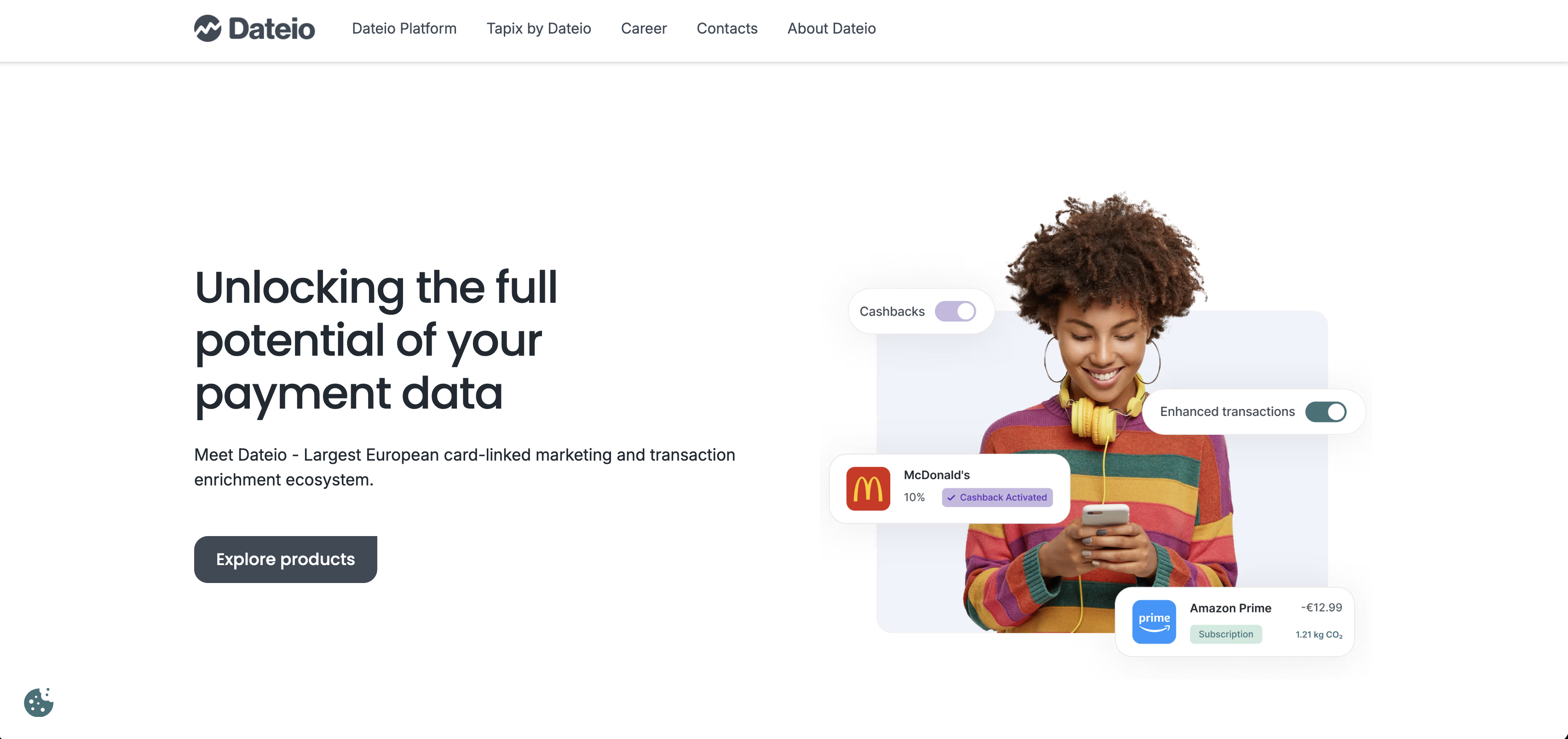
Dateio is a European open banking platform that sits at the intersection of data and credit. The company aggregates financial data from multiple banks and institutions across Europe, then applies machine learning to unlock lending decisions and financial insights that traditional scoring can't capture. Unlike legacy credit bureaus, Dateio builds its models on real transaction history and behavioral patterns, not just loan defaults and payment records.
The company positions itself as a data partner for fintechs, banks, and lenders who need smarter underwriting. Rather than building consumer-facing products, Dateio focuses on B2B infrastructure—providing APIs that other companies plug into to understand customer creditworthiness in real time. This approach means Dateio operates in the quieter, more valuable layer of fintech: the plumbing that powers better decisions.
In a market crowded with credit score providers and ID verification vendors, Dateio stands out by going deeper into the data layer. Most competitors offer point solutions; Dateio aggregates, normalizes, and analyzes transaction flows across borders. That matters in Europe, where fragmented banking systems and privacy rules have made cross-border financial data unusually hard to access. For lenders tired of crude risk models, Dateio offers a more granular, behavior-based alternative that reflects how Europeans actually spend and save money.
The company represents a broader shift in European fintech toward infrastructure and data intelligence, rather than consumer apps. As regulation tightens and competition intensifies in lending, better data becomes the primary competitive advantage. Dateio operates in that space.
Founded 2017
View profile →
Enable Banking
Financial InfrastructureOpen Banking
🇫🇮 Finland
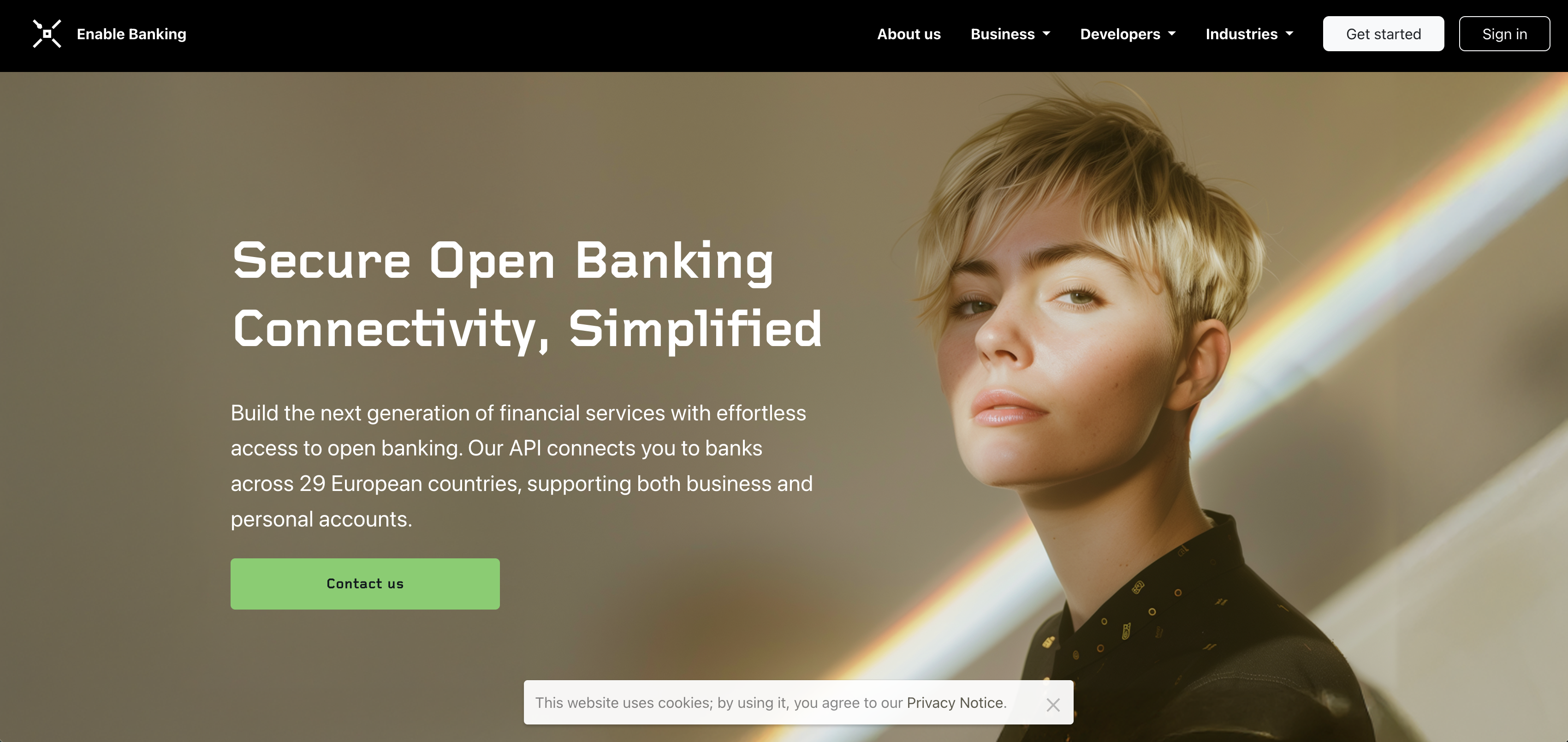
Most open banking aggregators want your data. That is the business model: connect to the banks, pull the transactions, store them, enrich them, and sell the enriched product back. Enable Banking built the opposite. The company describes itself as the postman of your data — it moves financial information from the bank to the customer's application and does not retain, process, or build models on what passes through. For a fintech that considers its transaction data a competitive asset, or a customer with strict data residency requirements, that neutrality is the entire pitch.
Joonas Tomperi and Fedor Tyurin founded the company in Espoo in 2019, at the point where PSD2 had legally opened European bank APIs but had not made them usable. Each bank interpreted the standard differently, each shipped its own authentication quirks, and each updated on its own schedule. The regulation created the right; someone still had to build the plumbing. Enable Banking started with Finland and the Nordics and expanded outward, and now connects to more than 2,700 banks across 30 European countries through a single PSD2-compliant API — account information from all of them, and payment initiation from over 1,500.
What makes the company genuinely unusual is its scale relative to that coverage. Enable Banking has raised roughly €600,000 in total, in a single seed round in 2022 led by Wellstreet and Forward VC, and employs somewhere between fourteen and seventeen people distributed across seven countries. Tink sold to Visa for €1.8 billion with 500 employees. TrueLayer has raised hundreds of millions. Enable Banking is covering comparable European ground with a team that would fit around one table, which says something about how much of open banking infrastructure is disciplined engineering rather than capital.
The company holds its own Account Information Service Provider registration, supervised by Finland's FIN-FSA — which means other companies can build on top of its licence rather than obtaining their own. That is the model behind open-banking.io, the Danish developer tool that resells Enable Banking access at €3 per month without customers needing eIDAS certificates. It is also why Enable Banking's no-data-retention architecture matters structurally: because the platform never holds readable customer data, the companies building on it can make stronger privacy guarantees than they otherwise could.
Two smaller details are revealing about who this is built for. Enable Banking runs a balanced split between business and consumer accounts — roughly half of its ten million monthly API calls come from each, where most early open banking providers targeted consumer accounts only and treated corporate banking as an afterthought. And it offers a live production environment for testing without requiring a contract, which is a small thing that tells you the company expects developers to evaluate it by using it rather than by booking a call. Tomperi now chairs the board of Fintech Finland, the national industry association.
Founded 2019
View profile →
Nexi
PaymentsOpen Banking
🇮🇹 Italy
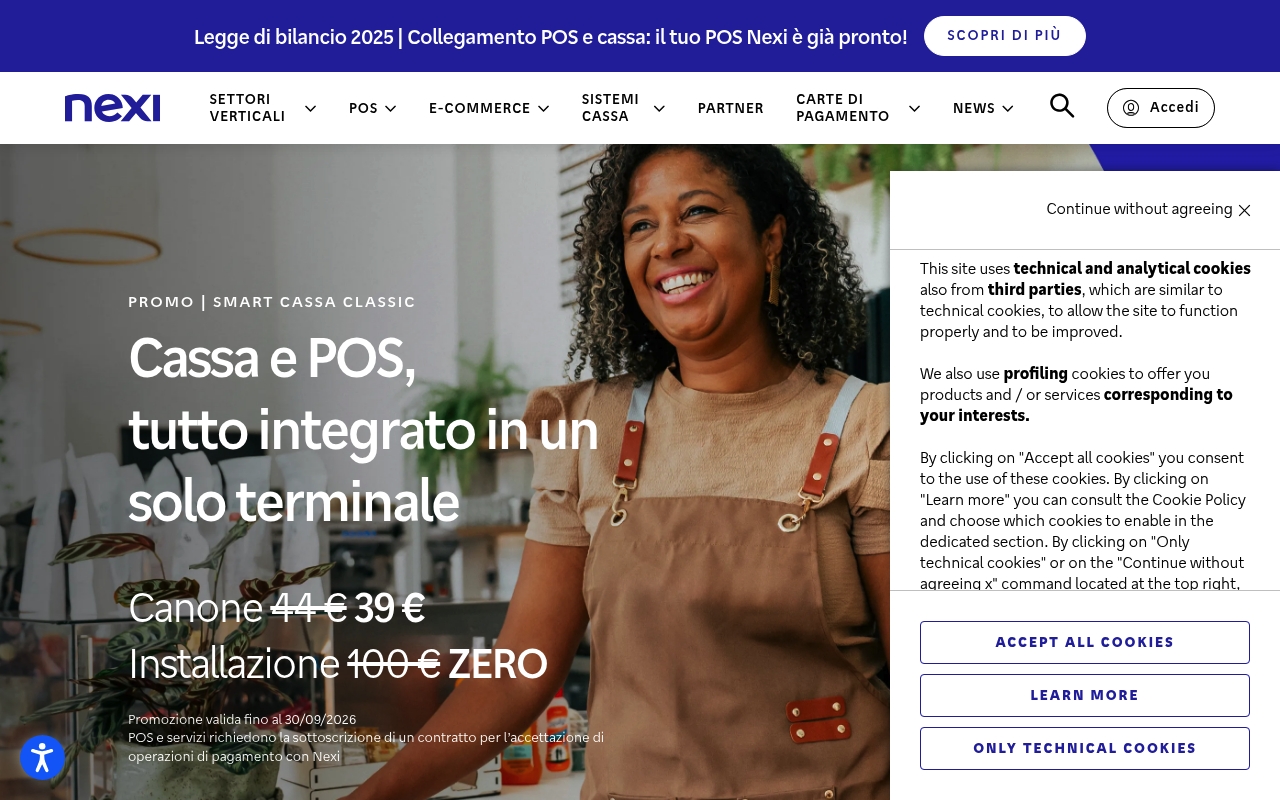
Nexi is what happened when Italy decided to build a payments champion. The company's roots run through decades of bank-owned card infrastructure — the CartaSi and ICBPI lineage that processed Italian card payments on behalf of the banking system — before private equity firms Advent, Bain, and Clessidra reshaped it into a company and took it public on Borsa Italiana in 2019. Then came the two deals that defined it: the merger with SIA, Italy's interbank payments infrastructure, and the acquisition of Denmark's Nets, both closed in 2021. The result was "The European PayTech" — a group operating in more than 25 countries with around 9,200 employees, spanning merchant acquiring, card issuing for banks, and national payment infrastructure from Italy to the Nordics to Poland, where Nets' acquisitions of Przelewy24 and Dotpay sit inside the group.
The strategy was scale through consolidation, and for a while the market believed in it. It no longer does, and March 2026 was the moment that became undeniable. Nexi's full-year 2025 results — revenue of €3.58 billion, EBITDA of €1.9 billion, growth of just 2.1% — arrived with a €3.7 billion writedown on previously acquired businesses, chiefly Nets, and guidance that 2026 would be flat, with growth not returning until 2028. The stock fell more than 20% in a day to a record low. CEO Paolo Bertoluzzo's framing to investors was unusually candid for the genre: Nexi was transitioning from a growth company to one that produces steady cash flows — "you don't have to believe we can go to the moon" — with a dividend hiked 20% and €1.1 billion in shareholder returns planned through 2028 as the consolation. His defence of the writedown was equally frank: Nexi bought companies at high prices, but paid in shares that were then worth six times their current value.
The ownership structure completed its own transition in early 2026. Advent and Bain, the private equity firms that built and listed the company, sold their remaining stake in February — leaving Hellman & Friedman and CDP, the Italian state investor, as the two anchor shareholders at roughly a fifth each. The parallel with Worldline is hard to miss: Europe's two great payments roll-ups of the 2019–2021 era have both ended the cycle written down, growth-challenged, and anchored by state-linked capital — Nexi without the compliance scandal, which is a meaningful distinction, but with the same underlying lesson about buying growth with expensive shares. CVC explored a bid in 2024, sending the shares up 19% in a day; nothing came of it, though the episode established that the company is viewed as acquirable.
Leadership turned over with the strategy: Bernardo Mingrone, Nexi's long-serving finance chief, succeeded Bertoluzzo as CEO in 2026, presenting his first half-year results in July. The growth initiatives under way are real if unglamorous — Zippay, a person-to-person payment service built on Nexi infrastructure launching in Ireland with AIB, Bank of Ireland, and PTSB; integration of the European wallet Wero into German e-commerce; a Visa partnership on managed card issuing for German banks; and the €105 million acquisition of Banca Popolare di Sondrio's merchant book, continuing the model of buying banks' payment operations that built the company. Nexi remains one of Europe's largest payment processors and the default infrastructure of Italian digital payments. The question its own guidance poses is whether that is a platform for renewed growth from 2028, or simply a very large utility returning cash to patient shareholders. The current share price says the market has priced the utility.
Founded 2013
View profile →
Abound
Open BankingLending
🇬🇧 United Kingdom
Gerald Chappell ran digital lending globally at McKinsey; Dr Michelle He was a director at EY advising banks on credit analytics, with a PhD in computer science. Both spent years building credit products for large financial institutions, and both reached the same conclusion about the machinery they were working inside: it was wrong at the individual level. A credit score is a statistical average applied to a person — it captures how someone has borrowed before, not what they can actually afford now. In 2020 they founded Fintern in London to replace that inference with observation, using the bank transaction data PSD2 had just made accessible. Chappell's description of what open banking gives a lender is the sharpest summary of the thesis: financial X-rays.
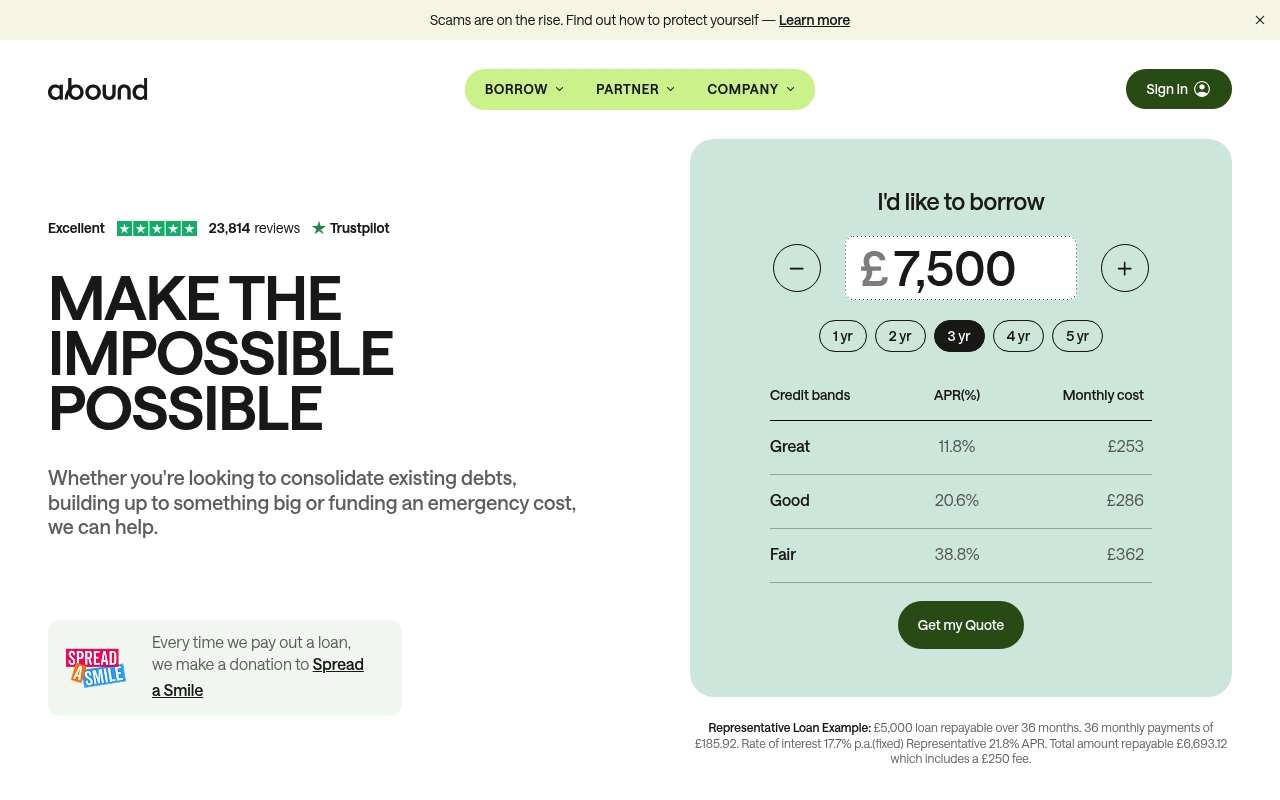
The consumer product, rebranded from Fintern to Abound, is a UK personal loan of a few thousand pounds up to around £20,000, repayable over one to five years, applied for entirely online with funds arriving within hours of approval. What happens underneath is the actual product. Applicants connect their bank accounts through open banking; Abound's proprietary platform, Render, reads real income and real spending — the rent, the subscriptions, the irregular gig income, the seasonal dip — and calculates affordability from what is there rather than from a bureau file. A soft credit check runs alongside it, so quoted rates carry no credit-score impact. The practical consequence is that people with thin files or a couple of historic blemishes can be approved on evidence a scorecard would never see, and that the company claims default rates roughly 75% below industry standard. That figure is Abound's own and unaudited — but the direction is corroborated by the funding it has been able to raise against the loan book.
That funding is the second thing to understand precisely. Abound has announced facilities totalling more than £1.6 billion since launch — £500 million in 2023, up to £800 million in 2024, a further £250 million from Deutsche Bank in 2025 — from Citi, Deutsche Bank, Waterfall Asset Management, LuminArx, Salica, Informed Ventures, and West Coast Capital. The overwhelming majority is debt to fund lending, not equity in the company; before the 2023 round Abound had raised only around $11 million in equity, and no valuation has ever been disclosed. This is the standard structure for a balance-sheet lender and it says something real — institutional lenders underwrite the underwriter, and £1.6 billion of credit facilities is a market verdict on Render's models — but it is not a $1.6 billion company. The genuinely notable milestone is quieter: Abound reached profitability three years after launch, and has now lent over £1 billion, from a team of roughly 130 in London.
The strategic shape now mirrors what several European fintechs have converged on: run the consumer brand, and rent the machinery. Render is being licensed to other lenders — GAIA Family and LemFi are named clients — as cashflow underwriting infrastructure for companies that want to launch credit products or improve their decisioning without building affordability models themselves. Alongside it sit partner products in retail finance and premium finance. It is the same dual model that made Klarna infrastructure for Apple: the consumer business proves the technology, and the technology business scales beyond what the consumer brand could reach alone. International expansion has been signalled repeatedly but Abound remains UK-only, regulated by the FCA under Fintern Ltd (FRN 929244).
The honest read requires looking at the rate card. Abound markets fairness, and relative to what its customers' alternatives are, the case is strong: representative APR is 21.8%, debt consolidation customers save around £1,000 over a loan's life on the company's numbers, and 25,000-plus Trustpilot reviews average 4.9 — unusually good for consumer credit, a category where people rarely leave happy reviews. But the published bands run from 11.8% for the strongest applicants to 38.8% for the "fair" band, and the sample £5,000 loan carries a £250 fee. This is near-prime and non-prime lending: much cheaper than payday or doorstep credit, considerably more expensive than a high-street personal loan, and priced for a customer the high street declines. The structural question is the one facing every lender that has only grown — Abound's models have been profitable through a rate shock but not yet through a genuine consumer credit downturn, and affordability underwriting is precisely the discipline that either proves itself or doesn't when unemployment moves. What it has already demonstrated is narrower but not trivial: open banking data, six years after PSD2 made it available, can underwrite people the credit bureaus get wrong.
Founded 2020
View profile →
Fintecture
Financial InfrastructurePaymentsOpen Banking
🇫🇷 France
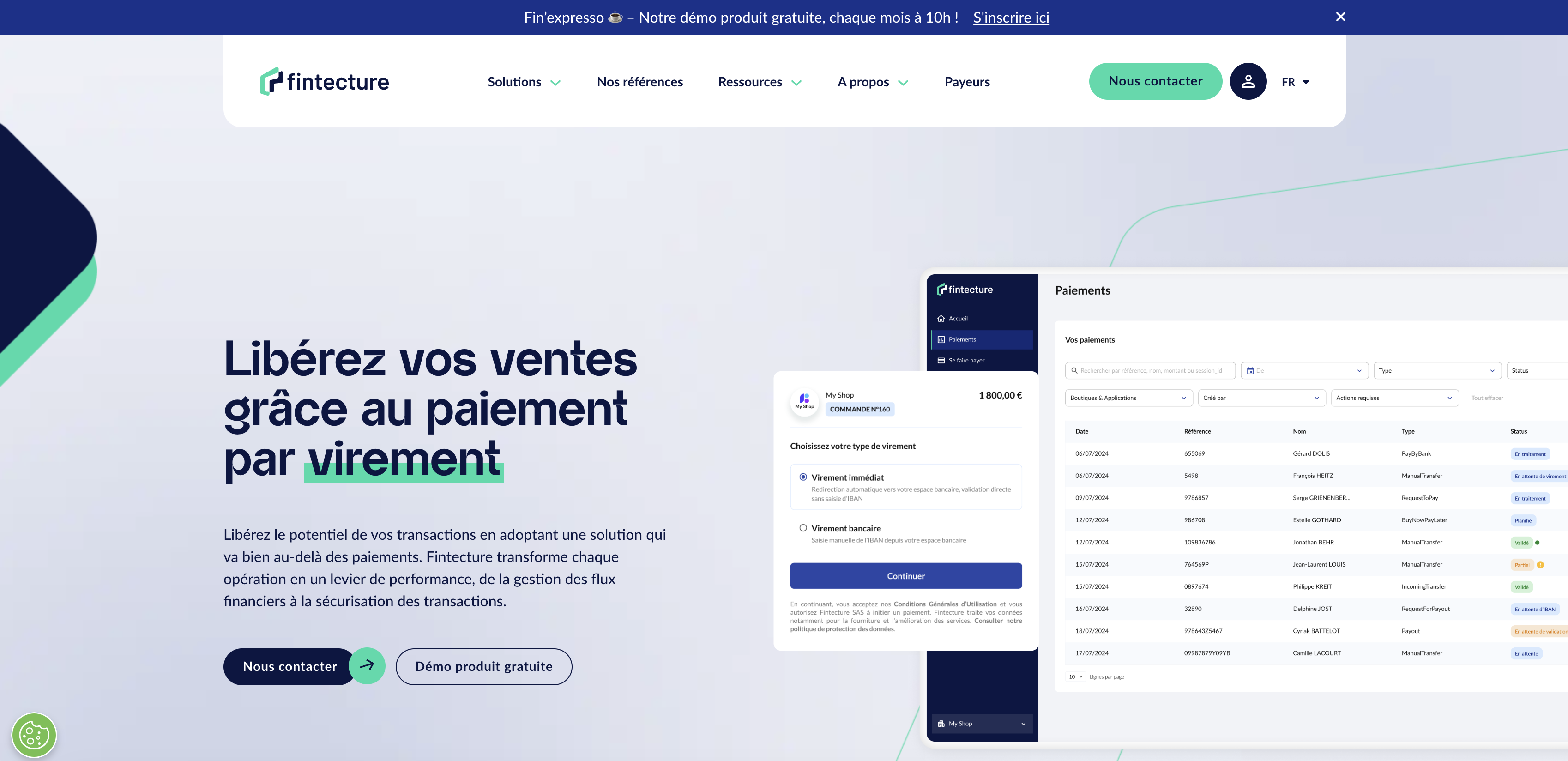
Fintecture is building the plumbing that makes open banking actually work for merchants and platforms across Europe. Rather than forcing businesses to cobble together fragmented payment APIs and banking connectors, Fintecture consolidates access to bank accounts and payment rails across the continent into a single integration point.
The company's core offering is elegantly straightforward: a unified API that lets merchants initiate payments directly from customer bank accounts without managing dozens of individual bank connections. This sits somewhere between traditional payment gateways and the messy reality of banking infrastructure—it handles the complexity of navigating different banking standards, regulatory environments, and technical protocols across European markets so businesses don't have to.
What sets Fintecture apart is its focus on the merchant experience rather than the bank experience. While most open banking platforms were built to satisfy regulators, Fintecture designed its product assuming developers actually want to use it. The company operates across 30+ European countries and integrates with over 4,000 banks, which means a single merchant can reach customers wherever they bank without building country-by-country integrations.
In a landscape crowded with both traditional payment processors and newer open banking specialists, Fintecture occupies a distinct middle ground—not replacing card networks, but offering an alternative rails that's cheaper for merchants, more transparent for customers, and increasingly difficult for incumbents to ignore.
Founded 2017
View profile →
TrueLayer
Financial InfrastructurePaymentsOpen Banking
🇬🇧 United Kingdom
TrueLayer is a payments and open banking infrastructure platform that lets fintech companies, payment processors, and traditional banks access real-time financial data and initiate payments directly from consumer bank accounts across Europe. Rather than building APIs from scratch or waiting months for bank integrations, developers plug into TrueLayer's unified network and immediately get access to payment initiation, account aggregation, and transaction data from thousands of financial institutions.
The company operates as a critical middleware layer in European fintech. While most payment infrastructure still relies on cards or legacy rails, TrueLayer routes transactions through bank-grade open banking rails, making transfers faster, cheaper, and less friction-heavy. Its API-first approach means a startup launching in five countries gets the same clean integration experience as an enterprise player.
In the competitive open banking space, TrueLayer stands out through breadth of coverage and developer experience. The platform supports payments in 17+ European countries and has built integrations with hundreds of banks—not through partnerships alone, but through technical depth in handling regional quirks and regulatory complexity. Its customer base spans neobanks like Wise and Revolut, major payment processors, and traditional banks replatforming their operations.
TrueLayer essentially democratized access to Europe's banking infrastructure at a moment when open banking regulations made that access possible but still technically demanding. For any fintech building on the continent, it's become a foundational piece of modern payment architecture.
Founded 2016
View profile →
Token
Financial InfrastructureDigital BankingOpen Banking
🇬🇧 United Kingdom
Token is a London-based open banking platform that sits at the intersection of infrastructure and consumer experience, making API-driven financial connectivity feel less like plumbing and more like a natural part of how money moves. Rather than asking users to log into their banks manually or hand over passwords, Token handles account aggregation and payment initiation through direct bank connections—the infrastructure most fintech apps and traditional banks should have built themselves but didn't.
The company's core insight is that open banking is only useful if it actually works across borders, across device types, and across the chaos of fragmented financial systems. Token's platform standardizes this mess, letting fintechs, banks, and payment companies offer seamless experiences without getting bogged down in regional variations or legacy bank APIs that still feel like they were written in 2003.
What sets Token apart in the European market is its focus on developer experience without sacrificing enterprise-grade security and compliance. While competitors offer raw API access or clunky consent flows, Token treats the entire interaction—from user authentication to transaction confirmation—as a product problem, not just a technical one. They're essentially the connective tissue that lets modern financial products actually work at scale.
Token's role in fintech infrastructure means it powers an invisible layer: the moment you authorize a payment or link an account in an app that "just works," Token's orchestration is likely running underneath. That's the kind of foundational utility the ecosystem desperately needs.
Founded 2015
View profile →
Yapily
Embedded FinanceFinancial InfrastructureOpen Banking
🇬🇧 United Kingdom
Yapily sits at the intersection of open banking and embedded finance, building the plumbing that lets fintech companies and enterprises tap into banking data and payments without reinventing the wheel. Founded in 2016, the London-based company operates as an API infrastructure layer—connecting to banks across Europe and beyond to unlock account information, payment initiation, and consent management at scale.
What makes Yapily different is how it abstracts away the complexity of working with hundreds of banks and their inconsistent technical standards. Rather than forcing developers to build individual integrations for each bank's API, Yapily provides a unified interface that normalizes everything. It's the translator between your app and the messy reality of legacy banking infrastructure.
The company operates in the B2B2C space, partnering with fintechs, neobanks, and enterprise software providers who need banking connectivity but lack the resources to build it themselves. Their customer base spans lending platforms, wealth apps, accounting software, and payment orchestration layers—essentially anyone whose product benefits from real-time access to customer bank accounts or the ability to initiate payments.
Yapily's positioning is deliberately unsexy: they're infrastructure, not consumer-facing. But that's precisely the point. In a landscape crowded with consumer fintechs chasing headlines, Yapily has built a quiet, profitable business serving the builders themselves. They're to open banking what Stripe is to payments—the backbone that lets innovation happen faster.
Founded 2016
View profile →
Inxy
Financial InfrastructureOpen Banking
🇵🇱 Poland
Inxy is a European open banking platform that lets businesses tap into customer financial data through APIs, turning fragmented banking relationships into a single source of truth. Rather than asking customers to manually upload statements or reconnect accounts every few months, Inxy maintains a live, permission-based link to real bank data—making it effortless for fintechs, lenders, and SaaS platforms to build smarter underwriting, risk assessment, and financial insights on top of their core products. The platform sits squarely in the infrastructure layer, designed for teams building financial experiences rather than consumers managing their own money. What sets Inxy apart in a crowded open banking space is its focus on simplicity and reliability. While competitors often require technical gymnastics or lengthy integrations, Inxy's API is direct and frictionless. It handles the complexity of PSD2 compliance, account connectivity, and data standardization behind the scenes. The result: lenders can make faster, more informed decisions; embedded finance platforms can offer instant credit lines; accounting tools can automatically reconcile transactions. Inxy is fundamentally changing how financial data moves between banks and the applications that need it most, making it an essential building block for modern European fintech.
Founded 2020
View profile →