← Back to payever
Alternatives
Alternatives to payever
Explore 12 European fintech companies similar to payever — operating in Embedded Finance and Payments and SME Finance.
12 alternatives to payever
Sorted by similarity and popularityAdyen
Embedded FinancePayments
🇳🇱 Netherlands
Pieter van der Does and Arnout Schuijff had already built and sold one payments company when they sat down in 2006 to start again. The result was Adyen — the name literally means "start over" in Surinamese — and the premise was simple: instead of stitching together the same fragmented payment infrastructure everyone else was using, they would build the whole thing themselves from scratch.
That decision, made in an Amsterdam office nearly two decades ago, is still the reason Adyen is different. Most payment companies are assemblers — they buy a gateway here, a processor there, bolt them together and hope for the best. Adyen owns its own technology stack end to end, which means a merchant integrating once gets access to card processing, local payment methods, point-of-sale terminals, and real-time settlement data through a single platform. No middle layers, no reconciliation headaches, no finger-pointing between vendors when something breaks.
The client list tells you everything about where Adyen sits in the market. McDonald's, Spotify, Microsoft, LVMH, H&M — these are companies with serious payment volumes and zero appetite for systems that don't work. Adyen became the default choice for enterprises that had outgrown the limitations of traditional payment stacks and needed something that could handle global scale without buckling.
Since going public on Euronext Amsterdam in 2018, Adyen has grown into one of Europe's most valuable technology companies, with around 4,300 employees across 23 countries and net revenue of just under €2 billion in 2024. It remains headquartered in Amsterdam and consistently profitable — a combination that's rarer in fintech than it should be.
For businesses that treat payments as infrastructure rather than an afterthought, Adyen is the benchmark everything else gets measured against.
Founded 2006
View profile →
Klarna
Embedded FinancePaymentsDigital BankingBNPL
🇸🇪 Sweden
Three Stockholm School of Economics students pitched an idea at a university entrepreneurship competition in 2005: let shoppers receive goods before they pay, and put the credit risk on the merchant side. The pitch finished last. They built it anyway.
Sebastian Siemiatkowski, Niklas Adalberth, and Victor Jacobsson launched what was originally called Kreditor, later renamed Klarna, and spent the next two decades turning that rejected idea into one of Europe's most recognised fintech brands. The core insight held up: millions of people would rather split a purchase into three instalments than reach for a credit card, and merchants would pay for the privilege of offering that option because it reduces cart abandonment and increases average order values.
Klarna grew from a Swedish checkout button into something considerably more complex. It now holds a banking licence in Sweden, offers savings accounts, issues its own card, and operates across more than 45 markets with around 93 million active consumers and 675,000 merchant partners at the end of 2024. The US, which Klarna entered in 2015, has become its largest market by revenue, a fact the company underlined by listing on the New York Stock Exchange in September 2025 under the ticker KLAR, raising $1.37 billion at IPO.
The financial trajectory has been bumpy. Klarna reported net income of $21 million in 2024, a return to profitability after a bruising 2022 that included an 85% valuation cut and significant layoffs that reduced headcount from over 7,000 to around 3,400. What survived the restructuring was a leaner company with $2.81 billion in revenue and a clearer strategic direction: AI. Klarna's partnership with OpenAI produced a customer service assistant it claims handles the equivalent of 700 full-time agents, and generative AI now manages roughly two-thirds of customer chats.
The honest assessment of where Klarna sits today: it's no longer purely a BNPL provider and it's not quite a bank. It's somewhere in between, a consumer finance platform that knows more about your shopping behaviour than your bank does, and is betting that's worth a lot.
Founded 2005
View profile →
SumUp
PaymentsDigital BankingSME Finance
🇩🇪 Germany
SumUp is a payments company built for the merchants traditional providers never bothered with. Founded in 2012 and headquartered in London, it sells low-cost card readers and point-of-sale hardware to small businesses — market traders, cafés, hairdressers, tradespeople — who could never justify the monthly fees, multi-year contracts, and cumbersome terminals that legacy processors demanded. The core proposition has barely changed since launch: buy a card reader outright for a modest one-off price, pay a small percentage per transaction, and sign nothing.
That model has scaled a long way past its origins. SumUp now serves more than 4 million merchants across roughly 35 markets, employs around 4,000 people, and was valued at about €8 billion in a 2022 round led by Bain Capital. In 2024 it raised a €1.5 billion private credit facility led by Goldman Sachs, and it has been weighing a stock market listing that could value it as high as $15 billion.
The more significant shift is that SumUp is no longer a card reader company. Through a run of acquisitions — Payleven, the e-commerce platform Shoplo, the core banking provider Paysolut, POS software firm Tiller, and the US loyalty startup Fivestars — it has assembled a full financial stack for micro-businesses: a business account and card, invoicing, an online store, loyalty tools, self-service kiosks, and SDKs for developers who want to embed card acceptance in their own products. The ambition is to be the only software a small merchant needs to run their business.
That leaves SumUp in an unusual competitive position. On hardware and in-person payments it faces Square, Zettle, and Dojo; as a broader business platform it edges toward Stripe, Mollie, and Revolut Business. Its defensibility rests on the segment most of the industry finds too small to serve properly — the micro and nano merchants that make up the long tail of European commerce.
Founded 2012
View profile →
Qonto
PaymentsDigital BankingLendingSME Finance
🇫🇷 France
Qonto is a French business banking platform for freelancers and SMEs — though, strictly speaking, it isn't a bank. It has operated since 2018 under a payment institution licence from France's ACPR, with customer funds safeguarded at Crédit Mutuel Arkéa, and only filed for a full French banking licence in July 2025. The distinction matters more than it sounds: that licence is the thing standing between Qonto and the lending, savings, and investment products it wants to sell directly.
Founded in 2016 by Alexandre Prot and Steve Anavi — Prot the son of Baudouin Prot, former chairman of BNP Paribas, which gives the challenger story a certain symmetry — the company set out to build the business account the founders wished they'd had. The product wraps a business account around the admin that surrounds it: invoicing, expense management, bookkeeping automation, cash flow forecasting, sub-accounts, and accounting integrations. Prot's own pitch is that customers save roughly two hours a week on paperwork.
That has scaled into the leading position in European B2B banking. Qonto passed 600,000 customers across eight markets — France, Germany, Italy, Spain, Austria, Belgium, the Netherlands, and Portugal — employs around 1,600 people, and has been profitable since 2023. It raised a $552 million Series D in 2022 at a $5 billion valuation and hasn't needed to raise since; profitability means even the banking licence push can be funded from what it already holds. Two acquisitions shaped it: German rival Penta in 2022, which brought 50,000 customers and a real German footprint, and accounting automation platform Regate in 2024, which opened up accountants and accounting firms as a new customer segment.
The direction of travel is credit. Qonto has launched a Pay Later product, financing from €150 to €50,000, and added its first business credit card and overdraft facilities in January 2026 — all currently dependent on partnerships. A full banking licence would let it do that lending on its own account, which is the entire point of the application and the foundation of its stated goal of two million customers by 2030. Its competitive set is the European business banking cohort: Revolut Business, Tide, Holvi, Pennylane, and the incumbent banks it was built to route around.
Founded 2016
View profile →
Biller
PaymentsBNPLSME Finance
🇳🇱 Netherlands
Biller provides B2B buy-now-pay-later and invoice payment solutions.
View profile →
Memo Bank
PaymentsDigital BankingSME Finance
🇫🇷 France
Memo Bank is a European SME banking platform built for the realities of modern business. Rather than forcing entrepreneurs into legacy banking workflows, Memo gives small business owners a financial operating system designed around how they actually work—combining business accounts, payments, invoicing, and expense management in one interface. The platform handles the friction points that plague traditional business banking: slow payments, fragmented tooling, and compliance overhead that feels designed for a different era.
What sets Memo apart is its architecture. Instead of bolting payment features onto a traditional account system, the company built integrated workflows from the ground up. You get real-time visibility into cash flow, automated invoice management, and seamless integrations with accounting software—the kind of coherence you find in consumer fintech but rarely in business banking. Multi-currency and cross-border payments work as smoothly as domestic transfers, stripping away the complexity that makes international business a headache for SMEs.
Memo competes in a crowded space, but it's positioned differently from both legacy business banks and fragmented fintech stacks. It's not trying to be a wholesale replacement for every financial service a business might need. Instead, it's building the core banking layer that everything else should connect to—one that actually talks to how modern SMEs operate. In the broader European fintech landscape, Memo represents a maturing category: purpose-built business banking that treats SMEs as sophisticated customers rather than smaller versions of enterprises.
Founded 2017
View profile →
Pleo
PaymentsSME FinanceTreasury
🇩🇰 Denmark
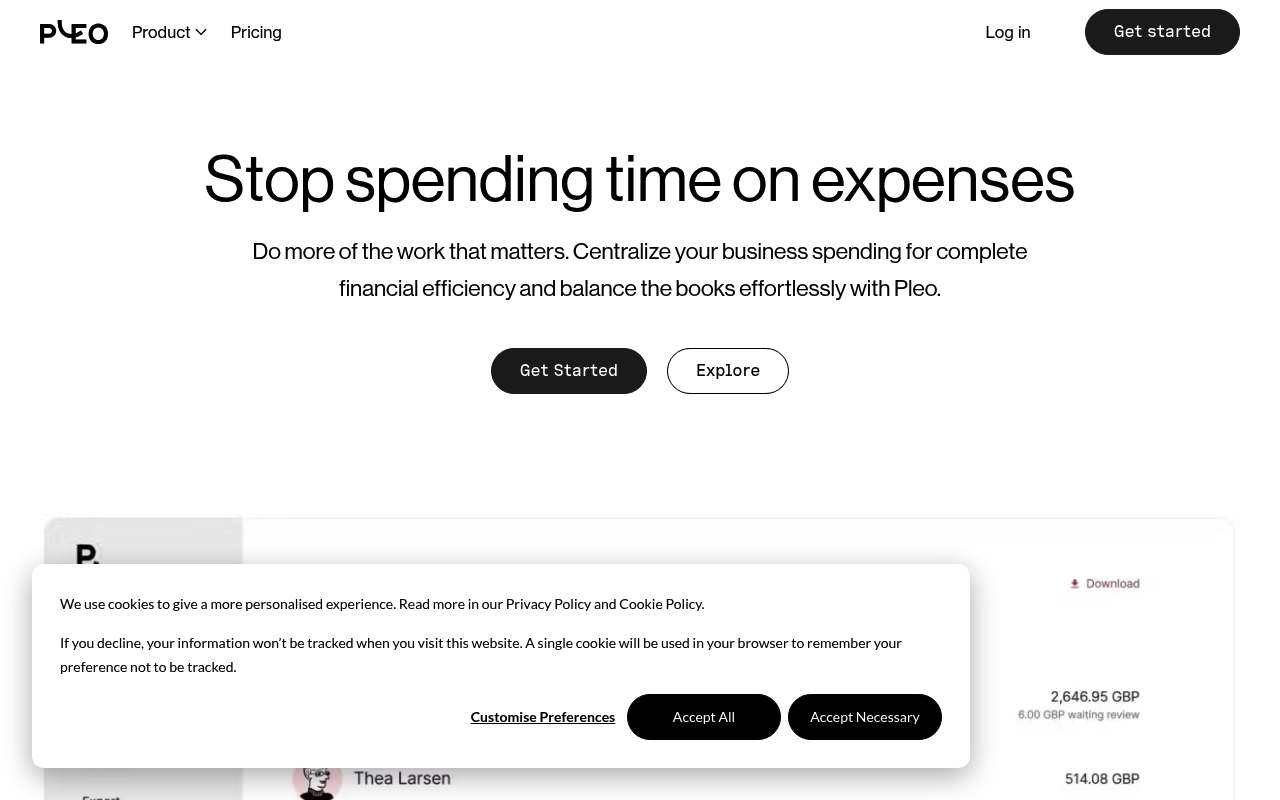
Pleo is a Danish spend management platform that hands employees a company card and removes the expense report from the equation entirely. It was founded in Copenhagen in 2015 by Jeppe Rindom and Niccolo Perra, both early employees at Tradeshift — where Rindom was CFO and lived the problem daily. Their observation was simple: consumer payments had gone frictionless while business payments were still stranded in paper receipts and month-end spreadsheet reconciliation.
The mechanic is straightforward. Employees get physical or virtual Mastercards with limits set by finance. When they buy something, the app prompts them to photograph the receipt on the spot, categorises the transaction automatically, and pushes it through to the accounting system. The claim form, the reimbursement cycle, and the shoebox of receipts all disappear — and finance sees spending as it happens rather than three weeks after the fact.
The platform has since grown well beyond cards. Pleo now handles supplier invoices end to end — capture, approval, payment, and bookkeeping — alongside reimbursements for out-of-pocket spend and integrations with accounting tools including Xero and QuickBooks, with credit lines and payroll on the roadmap. It serves more than 40,000 businesses across 16 European countries, employs around 950 people, and runs offices in Copenhagen, London, Berlin, Stockholm, Madrid, Lisbon, Paris, Amsterdam, and Chennai.
Pleo has raised roughly $434 million across nine rounds from investors including Kinnevik, Creandum, Bain Capital Ventures, and Thrive Capital. It reached a $4.7 billion valuation in December 2021, following a $150 million Series C that made it a unicorn earlier that year — a peak-era mark that has not been publicly revisited since. Its competitive set is the European spend management cohort: Spendesk, Payhawk, and Moss, with SAP Concur as the incumbent it was built to displace.
Founded 2015
View profile →
Vodeno
Embedded FinanceFinancial InfrastructurePayments
🇧🇪 Belgium
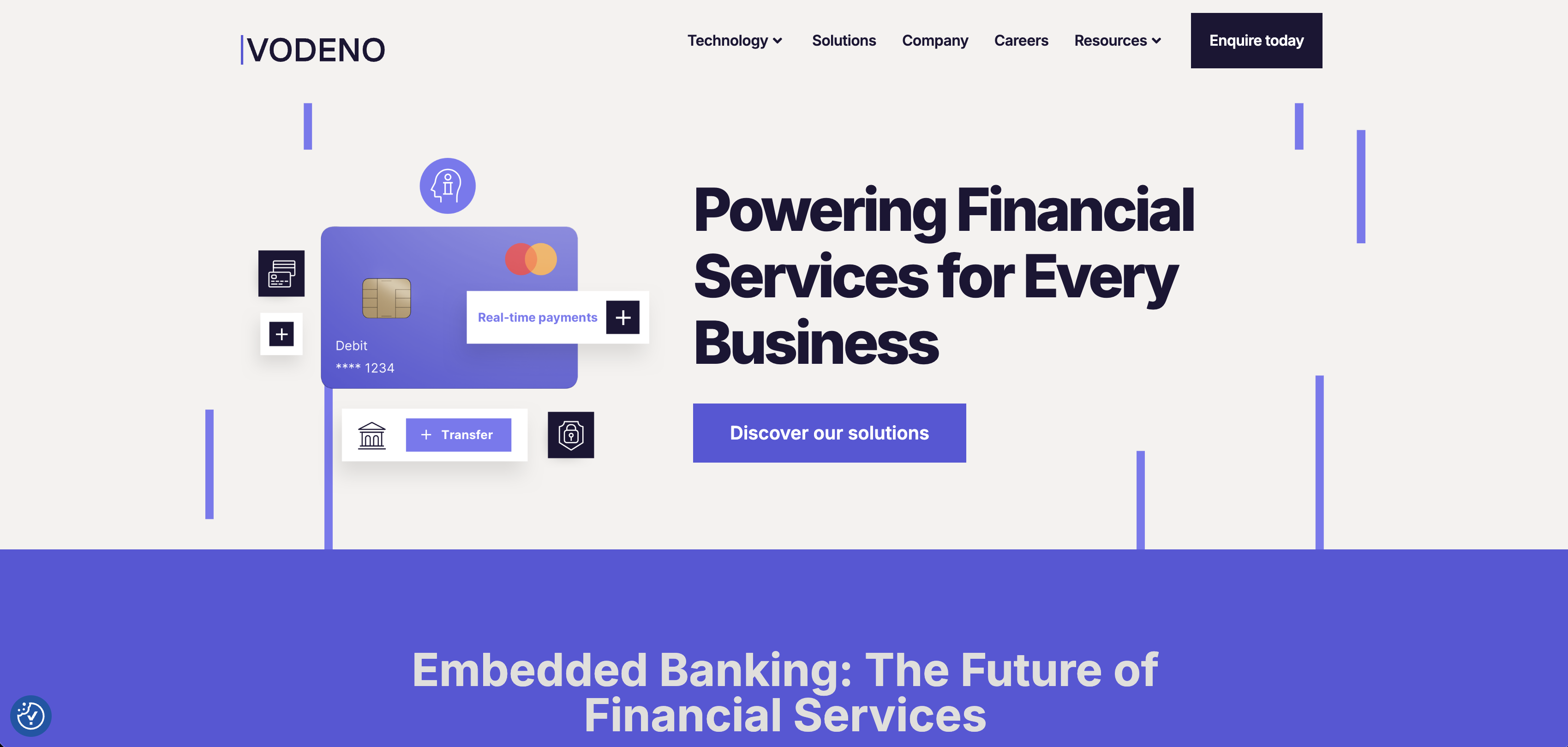
Vodeno is a European fintech building the infrastructure layer for embedded finance—letting any company slip banking and lending directly into their product without the complexity of traditional integrations. The platform abstracts away the operational headaches of regulatory compliance, bank connectivity, and fund management that typically come with embedding financial services, making it possible for non-financial businesses to offer credit, accounts, and payments to their users almost as easily as adding a API call.
What sets Vodeno apart is its focus on the operational backbone rather than the customer-facing experience. While most embedded finance platforms emphasize sleek user flows, Vodeno solves the unglamorous but critical problem: how do you actually manage the banking, settlement, and risk infrastructure when you're issuing credit to thousands of users across multiple jurisdictions? They handle the plumbing that traditional banks spent decades building.
The company targets both B2B2C platforms and B2B software providers looking to monetize their customer relationships through financial products. It competes in a growing category alongside players like Marqeta and Unit, but Vodeno's European roots give it a natural advantage in navigating the continent's fragmented regulatory landscape and banking infrastructure. As embedded finance reshapes how non-financial companies interact with their customers, platforms like Vodeno are becoming essential infrastructure—sitting invisibly in the background, making finance work at speed.
Founded 2021
View profile →
Mokka
Financial InfrastructurePaymentsSME Finance
🇷🇴 Romania
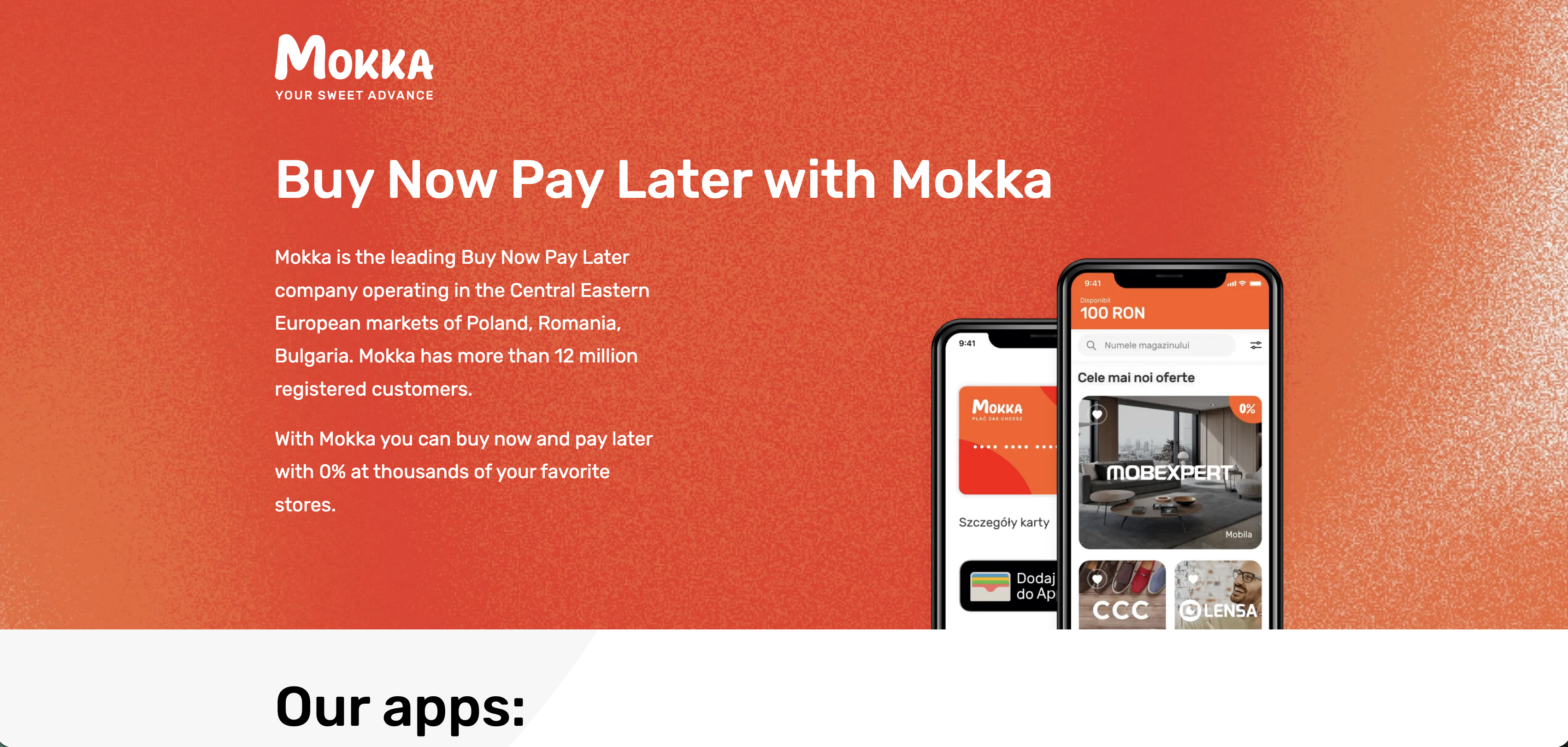
Mokka is a Romanian fintech platform built for the modern seller. Rather than forcing merchants into the rigid infrastructure of traditional payment processors, Mokka gives them a unified dashboard to manage payments, invoicing, and business basics from one place. The platform handles card payments, digital wallets, and local payment methods—all wired into a clean, merchant-friendly interface that feels less like enterprise software and more like something designed for actual humans. For Romanian SMEs and freelancers tired of juggling multiple logins and opaque fee structures, Mokka offers transparency and control that legacy banking and payment gateways simply don't provide. It's part merchant acquirer, part business backbone—a practical response to how payment infrastructure in Central & Eastern Europe still lags behind Western standards. Mokka sits at the intersection of embedded finance and merchant enablement, serving businesses that want payment functionality without the complexity.
Founded 2020
View profile →
Paysera
Financial InfrastructurePaymentsDigital BankingSME Finance
🇱🇹 Lithuania
Paysera is a Lithuanian fintech company that has quietly built one of Europe's most comprehensive payment and banking platforms, serving millions of users across the continent. Rather than chasing hype, Paysera focuses on practical utility—combining payment processing, digital accounts, currency exchange, and invoicing tools into a single interface that works across borders and languages. The platform powers everything from freelancers managing invoices to SMEs handling payroll, while also offering consumer-facing services like multi-currency wallets and competitive exchange rates. What sets Paysera apart is its unglamorous pragmatism: it solves real friction in how Europeans move, spend, and manage money across different countries, without the startup theatrics. It's the kind of company that doesn't dominate headlines but has become indispensable infrastructure for a significant portion of the continent's digital economy. In the crowded European fintech landscape, where newer players chase consumer attention and legacy banks chase compliance, Paysera operates in the profitable middle—trusted by businesses and individuals who value reliability and cross-border simplicity over brand prestige.
Founded 2004
View profile →
bnext
PaymentsDigital BankingSME Finance
🇪🇸 Spain
bnext is a Spanish neobank built for the self-employed and small business owners who've outgrown traditional banking but don't need enterprise complexity. It strips away the bloat of legacy banks and focuses on what actually matters: a mobile-first account, competitive forex rates, and transparent fees with no surprise charges. The platform handles invoicing, expense tracking, and basic bookkeeping alongside core banking, positioning itself as a unified workspace rather than just another digital bank. Where established institutions still treat SMEs as afterthoughts, bnext treats them as the primary customer. It's designed for the freelancer checking balances between client calls and the startup founder who wants one dashboard instead of five browser tabs. The company has carved out real traction in Spain and increasingly across Europe, proving there's genuine demand for banking that actually understands how modern small business works.
Founded 2015
View profile →
Ramp
Financial InfrastructurePaymentsSME Finance
🇵🇱 Poland
Ramp is rewriting how companies spend money. Built for finance teams tired of spreadsheets and manual processes, it combines a corporate card, expense management, and accounting integrations into a single platform that actually talks to the software finance teams already use. Most corporate card programs feel like they were designed in 1995. Ramp feels like software built this decade—mobile-first, API-forward, and deeply integrated with tools like NetSuite and QuickBooks. The company started by solving a real problem: CFOs and controllers wasting hours reconciling card statements and expense reports. Instead of patching that broken workflow, Ramp replaced it entirely. You get a card, real-time spending controls, automated categorization, and instant syncing to your accounting system. No more manual entries, no more approval bottlenecks, no more spreadsheet chaos. The platform goes deeper than most competitors by combining physical and virtual cards with embedded controls—spend limits by department, merchant category, or individual employee. Finance teams can actually enforce policy in real time rather than auditing violations weeks later. Ramp operates in a crowded space, but it's differentiated by speed and simplicity. Where competitors try to be everything to everyone, Ramp has kept focus on what CFOs actually care about: reducing manual work, improving visibility, and cutting unnecessary spending. Its integration-first approach means it's not trying to replace your entire finance stack—it's designed to slot in and make your existing tools work harder. For mid-market companies tired of manual expense management and lacking the complexity of enterprise-grade solutions, Ramp has become the obvious choice. It's also been ruthless about profitability, reaching positive unit economics early, which matters in a category where many competitors burned through billions before proving their model worked.
Founded 2019
View profile →