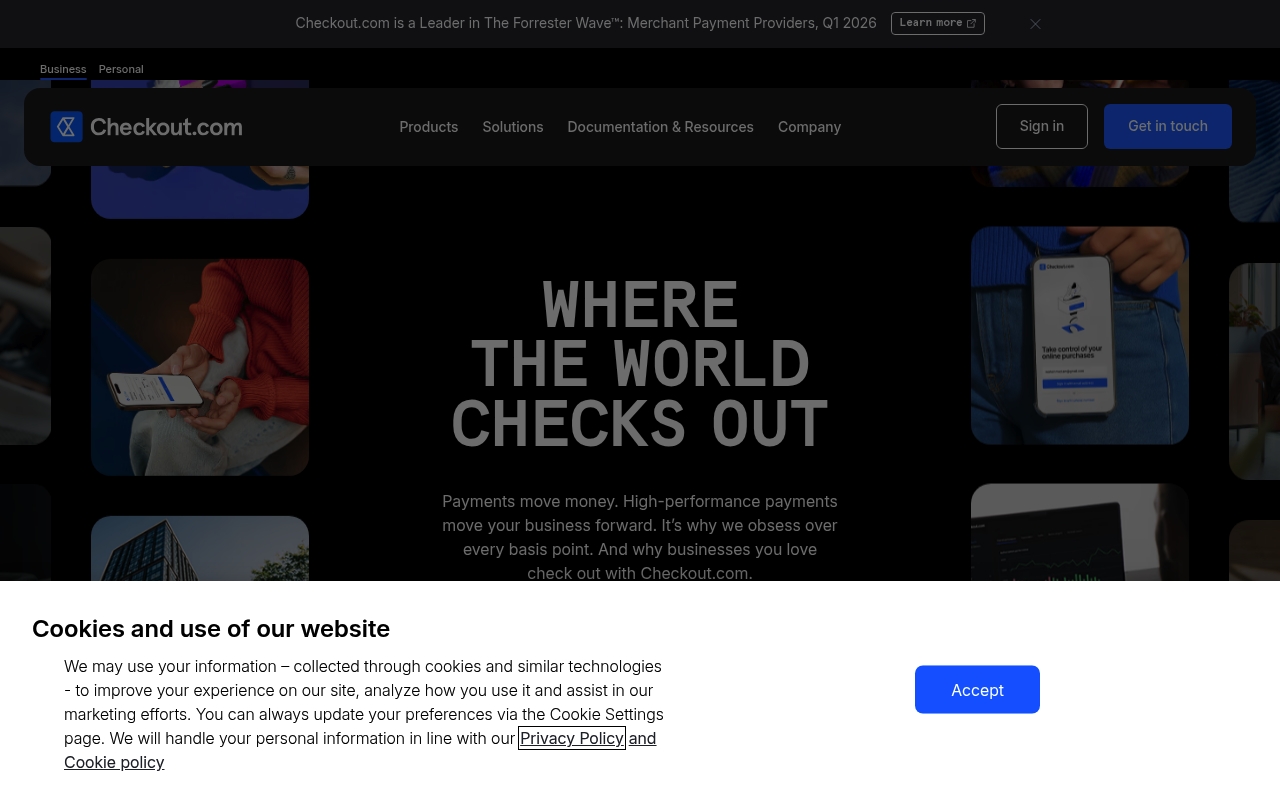
Checkout.com is a global payment processing platform built for enterprise merchants, combining payment gateway, acquiring, fraud prevention, and card issuing in a single API. Founded in 2012 by Swiss entrepreneur Guillaume Pousaz and headquartered in London, it processes payments for more than 1,000 enterprise merchants worldwide, including Netflix, Uber, eBay, Spotify, Sony, and Temu.
What separates Checkout.com from a conventional payment gateway is how much of the payment stack it owns. Rather than passing transactions to third-party acquirers, it connects directly to the card networks and holds its own acquiring licences — which gives it tighter control over authorisation rates and far more visibility into why a payment failed. At enterprise scale that detail is the whole game: a fraction of a percentage point in acceptance rate is worth millions, which is why the company built Intelligent Acceptance, an AI engine dedicated to recovering transactions that would otherwise be falsely declined.
The numbers reflect a business that has come through a hard correction. Checkout.com processed over $300 billion in payment volume in 2025 — a 64% year-on-year jump — and returned to full-year EBITDA profitability with margins above 10%. Its valuation tells the story of the wider fintech cycle: $40 billion at the January 2022 peak, written down to $9.35 billion by 2023, and back to $12 billion in a September 2025 employee share buyback. The company was bootstrapped for its first seven years and took outside capital only in 2019, in what was then the largest Series A ever raised by a European fintech.
Checkout.com competes with Adyen and Stripe at the top of the market and deliberately does not chase SMEs — 63 of its merchants each process over $1 billion a year. Its current strategic bet is agentic commerce, where AI agents make purchases on a consumer's behalf, with support already live for Visa Intelligent Commerce, Mastercard Agent Pay, and Google's payment protocols.