← All services
27 European companies
Identity Verification Providers in Europe
Identity verification confirms that a person is who they claim to be by combining document analysis, biometric matching, liveness detection, and database checks. The accuracy and speed of identity verification directly affects onboarding conversion rates — every additional second or step in the verification process results in application abandonment — while rigour determines whether fraudulent identities are successfully screened out.
Typically offered by
European fintech companies offering identity verification
Fourthline
Identity & KYC🇳🇱 Netherlands
Fourthline didn't start as a KYC company. It started as a payment institution. Krik Gunning and Chris van Straeten founded Safened in Amsterdam, licensed by the Dutch Central Bank as a regulated payment provider. As Safened onboarded its own customers, it built identity verification technology capable enough that other banks and fintechs started asking to use it directly. The demand was real and growing — digital financial services were expanding rapidly but compliance infrastructure hadn't kept pace. In 2019 Gunning and van Straeten spun the KYC operation out as a standalone company and renamed it Fourthline.
The name refers to compliance being the fourth line of defence in financial crime prevention — after business operations, risk management, and internal audit. It's a deliberately serious framing for a company that treats KYC not as a box to tick but as a technical problem worth solving properly. While many identity verification providers offer generic document checks, Fourthline built its platform around the regulatory requirements of Europe's strictest financial supervisors — the kind of compliance depth that a neobank launching in Germany or a broker entering the Netherlands actually needs to satisfy its regulator, not just its legal team.
The platform covers the full KYC and AML stack through a single API: document verification, biometric checks with liveness detection, AML and sanctions screening, risk scoring, proof of address, and ongoing customer monitoring throughout the customer lifecycle. The modular architecture means regulated institutions can pick the components they need rather than buying a fixed bundle — a practical advantage for fintechs that need identity verification at onboarding but different monitoring requirements at scale.
The client list is a reasonable proxy for the quality of the product. Fourthline verifies identities for N26, Qonto, Trade Republic, flatexDEGIRO, Scalapay, Shine, and Bitpanda — regulated financial businesses across Europe that operate under strict supervisory scrutiny and cannot afford onboarding failures. The company employs around 225 people and has raised approximately $70 million in funding, primarily from Finch Capital.
Leadership and structure have both shifted in 2026. In March, Fourthline appointed Paul Stoddart as CEO, with co-founder Krik Gunning moving into an advisory role after leading the company since its founding. Then in July came the bigger move: Fourthline and Veridas, the Spanish biometrics specialist, agreed to merge their identity platforms. The combination pairs Fourthline's KYC and AML compliance orchestration — built for Europe's strictest supervisors — with Veridas's facial and voice biometric technology, and extends the group's reach beyond Europe into Latin America, where Veridas has an established presence.
The strategic logic tracks the regulatory calendar. The EU's new Anti-Money Laundering Regulation comes into force in July 2027, substantially raising compliance requirements for financial institutions across Europe and expanding the addressable market for exactly this kind of infrastructure. Identity verification is consolidating ahead of that wave — and scale matters when every regulated institution on the continent is about to need more of what you sell.
Founded 2017
Fenergo
Financial Infrastructure🇮🇪 Ireland
Compliance has long been the unglamorous backroom operation of financial services—heavy, expensive, and often painfully slow. Fenergo flips that script by turning regulatory friction into operational advantage. The Dublin-based software company automates the gruelling work of onboarding clients, managing their data, and staying compliant with an ever-shifting maze of regulations. What banks and investment firms once treated as a cost center, Fenergo repositions as competitive edge.
At its core, Fenergo is a digital client lifecycle management platform. It consolidates onboarding, KYC, AML screening, sanctions checks, and ongoing regulatory monitoring into a single, integrated workflow. Rather than legacy institutions juggling multiple point solutions and manual spreadsheet cultures, Fenergo orchestrates the entire client journey—from first interaction through renewal—in a single intelligent system. The software ingests regulatory data, flags anomalies, and automates approvals where rules allow, freeing compliance teams to focus on judgment calls that actually require human expertise.
What sets Fenergo apart in a crowded RegTech space is its disciplined focus on the regulated financial institution as customer, not the consumer. While plenty of fintechs chase sexy consumer-facing applications, Fenergo has built deep, sticky relationships with banks, asset managers, and brokers who need sophisticated, audit-proof compliance infrastructure. It operates at institutional scale—handling millions of client records, complex entity hierarchies, and regulatory jurisdictions spanning continents.
In an era when regulatory fines have become nine-figure line items and reputational damage from compliance failures can tank a bank's stock price, Fenergo sits at the nerve center of institutional risk management. It's not the flashy side of fintech, but it's arguably the most essential.
Founded 2008
IDnow
Identity & KYC🇩🇪 Germany
Knowing who your customer is has always been a regulatory requirement in financial services. Proving it, digitally, in real time, across dozens of jurisdictions with different document standards and compliance frameworks, is a genuinely hard engineering and operational problem. IDnow was founded in Munich in 2014 to solve it. Its identity verification platform offers a range of methods — video identification, automated AI-driven document checks, and eID integration — giving regulated businesses the flexibility to choose the right verification approach for their risk profile and customer base. The company has built particular depth in the German market, where video identification has a specific legal status under financial regulation, but has expanded across Europe serving banks, insurance companies, crypto platforms, and any business that needs to onboard customers with confidence. IDnow was acquired by Corsair Capital in 2021 and has continued expanding through partnerships and product development. In a regulatory environment where digital onboarding requirements are tightening and fraud is becoming more sophisticated, the identity verification layer is one of the most critical — and most contested — parts of the fintech stack.
Founded 2014
ComplyAdvantage
Fraud & Security🇬🇧 United Kingdom
Charles Delingpole had already built two companies before this one — The Student Room, the UK's largest student community, started when he was sixteen, and MarketInvoice, the invoice finance platform he co-founded after Cambridge. It was at MarketInvoice that he met the problem that became ComplyAdvantage: every regulated financial business is legally required to screen its customers against sanctions lists, politically exposed persons registers, and adverse media — and the databases everyone relied on for this were built by armies of analysts manually copying names into lists. The data was stale, the false-positive rates were punishing, and compliance teams spent their days clearing alerts on people who shared a name with someone on a watchlist. In 2014 he founded ComplyAdvantage in London on a simple inversion: instead of selling software that queries someone else's manually curated lists, build the risk database itself — with machine learning, from primary sources, updating in real time.
That database is the product. ComplyAdvantage continuously processes millions of structured and unstructured data points a day — sanctions updates, regulatory notices, court records, news in dozens of languages — into risk profiles on more than 150 million entities, surfacing tens of thousands of new risk events daily. On top of the data layer sit the tools regulated firms actually deploy: customer screening at onboarding, ongoing monitoring as risk profiles change, payment and transaction screening, and — since 2023 — a fraud detection product that extends the platform from "who is this customer" to "what is this customer doing." The strategic position is precise: this is the data layer of financial crime compliance, sold as an API, competing directly with Dow Jones Risk & Compliance, LSEG's World-Check, and LexisNexis — incumbents whose core asset is exactly the manual process ComplyAdvantage was built to obsolete.
The customer base is over 500 enterprises across 75 countries, weighted toward the businesses that grew up alongside it: fintechs, payment companies, crypto platforms, and digital banks that needed compliance infrastructure as programmable as the rest of their stack. Named clients have included Gemini and TransferMate, with partnerships spanning blockchain analytics (Elliptic) and Banking-as-a-Service (Raisin Bank). The company was selected as a World Economic Forum Technology Pioneer, employs around 480 people, and has raised over $150 million from Balderton Capital, Index Ventures, Ontario Teachers' Pension Plan, and Goldman Sachs. In December 2023 it acquired Golden, the a16z-backed knowledge-graph startup, folding structured entity data and its engineering team into the core database.
Leadership formalised the company's second act in early 2023: Delingpole moved to executive chairman and Vatsa Narasimha — previously CEO of the trading platform OANDA, and ComplyAdvantage's COO through its scaling years — took over as chief executive. The regulatory backdrop since has run entirely in the company's favour. AMLD6 and the EU's new AML Authority raise screening and monitoring obligations across the continent from 2027, and every expansion of the compliance perimeter — crypto under MiCA, instant payments with sanctions screening at ten-second settlement speeds — enlarges the addressable market for exactly what ComplyAdvantage sells.
The honest read is about the market's direction. Financial crime and identity infrastructure is consolidating fast — Featurespace went to Visa, Fourthline is merging with Veridas, World-Check sits inside LSEG — which leaves ComplyAdvantage as one of the few independent, at-scale data players left standing. That independence is a genuine selling point for customers wary of buying compliance data from a card network or an exchange group, and it simultaneously makes the company one of the most obvious acquisition targets in European regtech. The other open question is the arms race it chose: the same generative AI that makes screening sharper is making the launderers' synthetic identities and shell structures cheaper to produce. ComplyAdvantage's bet since 2014 has been that the detection side compounds faster. So far, the market has agreed.
Founded 2014
Scanye
Identity & KYC🇵🇱 Poland
Scanye is a Polish fintech company that makes document verification and identity management accessible to European businesses. Instead of piecing together fragmented KYC solutions, companies get a unified platform that scans documents, verifies identities, and handles compliance in one place. The platform combines optical character recognition with AI-powered document analysis to catch forgeries and mismatches in real time, cutting the friction out of onboarding without the headaches of legacy compliance workflows.
What sets Scanye apart in a crowded identity verification market is its focus on simplicity. While competitors layer complexity with API integrations and compliance jargon, Scanye abstracts away the technical noise. Banks, fintechs, and e-commerce platforms in Poland and neighboring markets use it to streamline customer verification without building custom solutions. The company operates at the intersection of friction reduction and regulatory necessity—solving the problem that most businesses grudgingly accept rather than one they're excited to tackle.
Scanya sits squarely in the identity and KYC infrastructure layer that European fintechs depend on but rarely celebrate. It's become part of the plumbing that makes digital onboarding actually work, handling the verification step that determines whether a customer gets through the door or bounces away frustrated. For a region still maturing its fintech stack, that positioning is both practical and strategically sound.
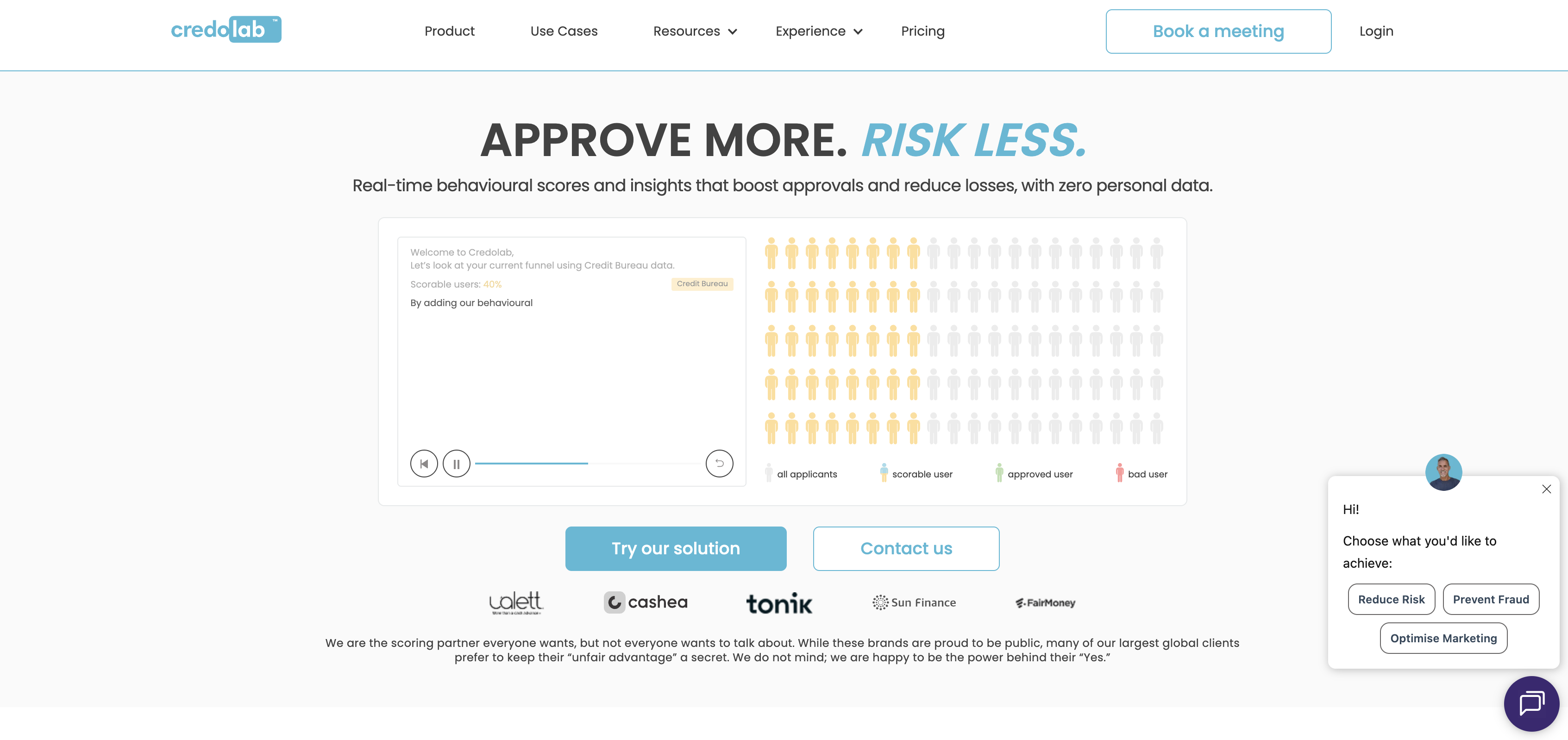
Credolab
Lending🇳🇱 Netherlands
Credit decisions in markets without comprehensive credit bureau coverage have always been hard. The traditional underwriting model relies on credit history, income verification, and identity documents that significant portions of the global population either don't have or can't easily produce. Credolab was founded in 2016 with operations across Asia and Europe to address that gap with an unconventional data source — smartphone metadata. Its platform analyses behavioural patterns from a mobile device — without accessing personal content — to generate credit scores for consumers who have no traditional credit history. The data points are surprisingly predictive: how someone manages their phone storage, the pattern of their app usage, the regularity of their device behaviour all correlate with credit risk in ways that traditional underwriting misses. Credolab serves lenders, telcos, and digital platforms across emerging markets where credit bureau coverage is thin and the demand for digital credit is growing rapidly. In the alternative credit data landscape, where companies are competing to find the data sources that will define the next generation of underwriting, Credolab's behavioural smartphone approach is one of the more distinctive — and one that addresses a genuinely large unmet need in markets where billions of people remain credit-invisible to traditional financial systems.
Founded 2016
Sumsub
Fraud & Security🇬🇧 United Kingdom
Three brothers — Andrey Sever and his twins Jacob and Peter — founded Sumsub in 2015 to solve a problem that regulated digital businesses had been solving badly: verifying who a customer is, fast enough that they don't abandon signup, and rigorously enough that a regulator accepts it. What began as a document verification vendor has become an onboarding orchestration platform covering the full compliance lifecycle: identity verification, business verification (KYB) including ownership-structure analysis, AML screening, transaction monitoring, fraud prevention, and case management, delivered through API and SDKs.
The scale claims are aggressive and specific: over 6,500 document types across 220 countries and regions, verification in under a minute on average, and conversion rates published per market — the kind of numbers a company only publishes when conversion is its main selling point against competitors. The methodology follows FATF recommendations and is built against FINMA, FCA, CySEC, MAS and BaFin requirements, which tells you the customer profile: crypto exchanges, trading platforms, fintechs, marketplaces and gaming operators, in that rough order of historical concentration.
Two things distinguish Sumsub in this directory's context. First is what happened in March 2022: following the invasion of Ukraine, the company ceased its Russian operations, chartering flights to relocate team members out of Russia, Ukraine and Belarus — an unusually consequential decision for a company that had built engineering capacity there, and one that reset its corporate footprint toward London and Limassol. Second is where it is going: reusable identity, so a verified user can onboard elsewhere in a few clicks, and — launched January 2026 — AI agent verification, binding automated agents to verified human identities. That second product is a direct answer to the agentic commerce thesis Checkout.com and Adyen have both been building toward. If AI agents start transacting on people's behalf, someone has to establish which human is accountable, and Sumsub is betting that becomes an identity product.
Founded 2015
Zopa
Lending🇬🇧 United Kingdom
Zopa rewrote the lending playbook by putting people before profit margins. Founded in 2005, it was the original peer-to-peer lending platform in the UK—a marketplace where ordinary people could lend to one another, bypassing the bank middleman entirely. That ethos still runs through everything it does, though the model has evolved considerably.
Today, Zopa operates as a digital lender offering personal loans and credit products directly to consumers, backed by institutional funding rather than peer capital. It's stripped away the complexity traditional lenders love and built something genuinely transparent: you get a real interest rate upfront, no hidden fees, and a lending decision in minutes rather than days. The platform targets people with thin credit histories or subprime scores—segments that banks treat with suspicion and expensive rates.
What separates Zopa from the noise is its refusal to play the conventional credit game. Most lenders obscure terms or rely on manipulative affordability checks. Zopa's approach feels almost quaint by comparison: fair pricing, straightforward underwriting, and a genuine attempt to lend responsibly. It's positioned itself as the anti-bank lender in a market cluttered with me-too fintechs chasing the same high-income borrowers.
In Europe's competitive lending landscape, Zopa represents a maturing fintech that's learned to balance mission with sustainability—proof that there's still room for players who refuse to compromise on transparency.
Founded 2005
Curve
Payments🇬🇧 United Kingdom
Curve sits at the intersection of payment practicality and modern banking convenience. The London-based fintech lets you consolidate all your cards and bank accounts into a single card and app, eliminating the friction of managing multiple payment methods across Europe. Rather than forcing you to choose between a credit card, debit card, and travel account, Curve sits on top of your existing financial life and intelligently routes transactions, offering real-time currency conversion, fraud protection, and transaction insights in one unified interface.
What makes Curve different is its approach to payment routing—the app learns your spending patterns and automatically decides which underlying card to use based on rewards, exchange rates, and cashback opportunities. You control the rules, but Curve does the heavy lifting. The platform supports cards and accounts from traditional banks, but also increasingly integrates with newer fintech providers, making it a natural gateway for anyone juggling multiple financial relationships. It's not a neobank replacement, but rather a layer above your existing banking infrastructure that makes managing money across borders and multiple institutions feel seamless. In the wider fintech ecosystem, Curve represents a growing category of unified banking experiences that acknowledge the reality of modern financial life—most people don't want one bank, they want all their banks working in sync.
Founded 2015
Signicat
Financial Infrastructure🇳🇴 Norway
Signicat solved a problem that only exists in Europe. Across the continent, national electronic identity schemes — BankID in Sweden and Norway, NemID/MitID in Denmark, iDIN in the Netherlands, itsme in Belgium — mean that verifying a citizen means integrating with a different sovereign or bank-consortium system in every market. Founded in Trondheim in 2006, Signicat built the hub: a single integration point giving access to the widest available pool of eIDs, registry lookups, document scanning and electronic signature, so a bank entering five countries integrates once instead of five times.
The customer list reflects how deeply embedded it is in Nordic and European financial services: DNB, Klarna, Rabobank, Santander, Société Générale, Western Union, and non-financial names including BMW and Schibsted. Nordic Capital acquired the company in 2019, when it had around 115 employees and roughly €19 million in revenue, and used it as a buy-and-build platform. Seven acquisitions followed — Idfy in 2019 to consolidate the Nordics, Connectis in 2020 to build out the European platform, and others since — taking Signicat past 500 employees and into more than 45 markets.
The strategic position is about to be tested by the thing that created it. eIDAS 2 and the European Digital Identity Wallet, which member states are required to offer citizens, are an attempt to standardise exactly the fragmentation Signicat monetises. The optimistic reading is that a new scheme in every member state is more integration work, not less, and that someone still has to orchestrate acceptance, verification and signature on top — which is Signicat's business. The pessimistic reading is that a genuinely interoperable wallet erodes the value of a hub. Signicat's answer so far has been to move up the stack into orchestration and fraud, and its position across both regulated and non-regulated verticals gives it more room than a pure eID broker would have.
Founded 2006
Zwipe
Financial Infrastructure🇳🇴 Norway
Zwipe is building the infrastructure for secure, contactless payments at the physical point of sale. The company makes biometric card technology—specifically fingerprint-activated payment cards—that eliminate the need for PINs and signatures while dramatically reducing fraud. Instead of fumbling for passwords or worrying about shoulder surfers, you just tap and touch.What makes Zwipe different is its focus on the hardware layer. While most fintech companies live in apps and APIs, Zwipe sits at the intersection of physical cards and digital security, creating a tangible product that banks and card issuers can actually deploy. The biometric verification happens on the card itself, not on a terminal or in the cloud, which means faster transactions and genuine privacy—your fingerprint never leaves the card.The company operates in a narrow but critical space: the next generation of payment cards. As contactless payments have become mainstream, Zwipe sees the obvious next step: making those cards smarter and more secure. European banks and payment networks are watching closely, particularly as regulators tighten authentication standards. Zwipe's technology addresses a real pain point in the payment infrastructure stack, positioning it as a key player in the hardware innovation side of fintech.
Founded 2014
Saferpay
Payments🇨🇭 Switzerland
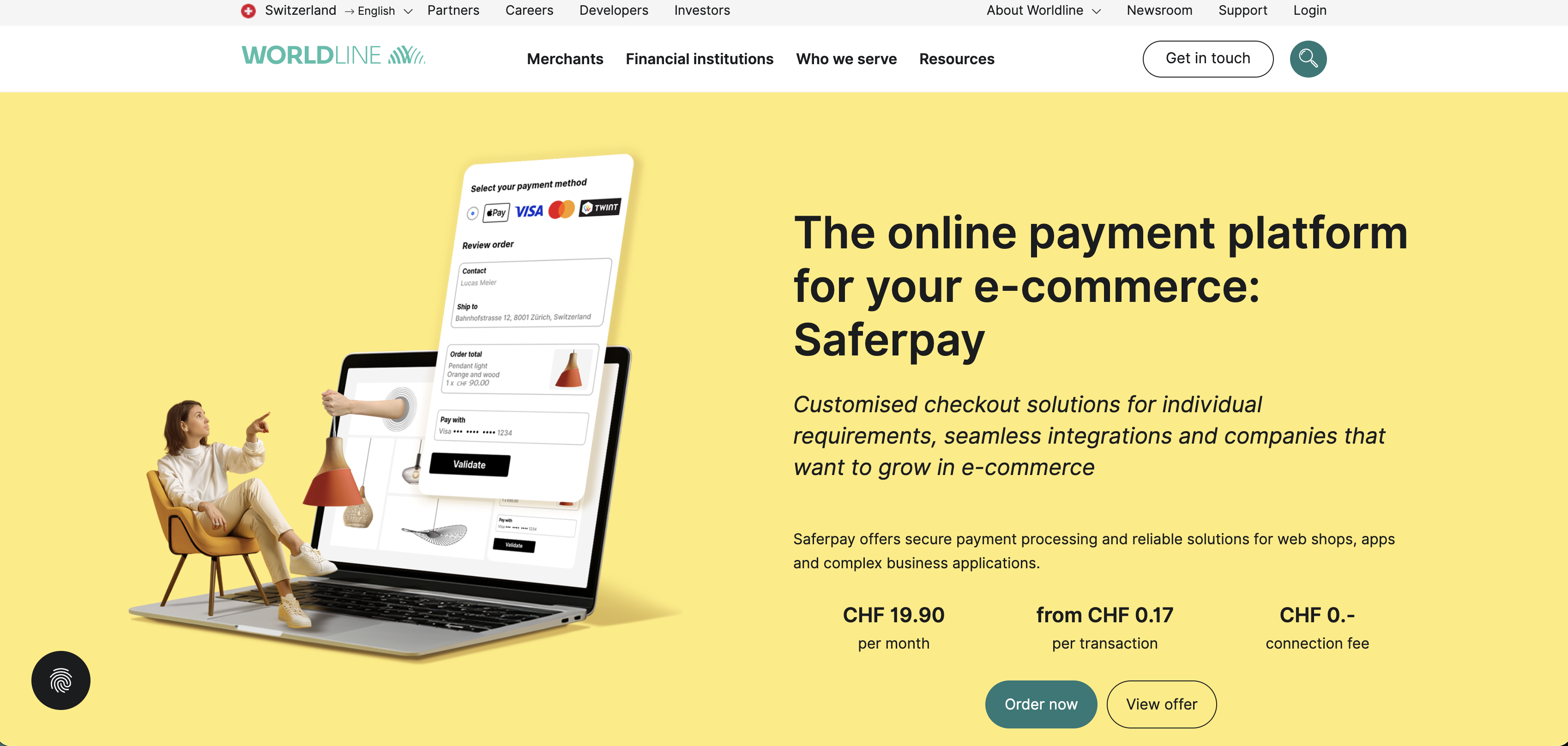
Saferpay is a Swiss payment solution that handles the unglamorous but critical work of processing card transactions safely. It sits between merchants and their customers, quietly managing the complexity of international payments, fraud prevention, and regulatory compliance that most people never think about until something goes wrong. The company has been around since the late 1990s, which in fintech terms makes it practically ancient—yet it continues to evolve rather than rest on its reputation. What sets Saferpay apart is its focus on security-first architecture. While newer payment players chase trends, Saferpay maintains obsessive attention to PCI DSS compliance, tokenization, and advanced fraud detection. It handles everything from simple card processing to complex multi-currency transactions across Europe and beyond. The platform is particularly strong in the DACH region and other heavily regulated European markets where compliance isn't negotiable. Saferpay operates as a B2B2C business, serving merchants directly and through integrations with banking partners and payment aggregators. Rather than trying to be everything to everyone, it's positioned itself as the reliable backbone for businesses that can't afford payment failures. For European merchants operating internationally or those in highly regulated industries, Saferpay offers a mature, battle-tested alternative to flashier payment startups.
Founded 1998
Showing 12 of 27 companies. View all in the directory →