Embedded payments Companies in Europe
Embedded payments allow non-financial platforms to offer payment acceptance and disbursement natively within their product — enabling marketplaces to pay sellers, software platforms to collect fees, and any business to handle money movement without directing users to a third-party processor.
European Embedded payments companies in our database
Notable embedded payments companies include Adyen, Klarna, Tink, ClearBank and Paynetics.
Pieter van der Does and Arnout Schuijff had already built and sold one payments company when they sat down in 2006 to start again. The result was Adyen — the name literally means "start over" in Surinamese — and the premise was simple: instead of stitching together the same fragmented payment infrastructure everyone else was using, they would build the whole thing themselves from scratch. That decision, made in an Amsterdam office nearly two decades ago, is still the reason Adyen is different. Most payment companies are assemblers — they buy a gateway here, a processor there, bolt them together and hope for the best. Adyen owns its own technology stack end to end, which means a merchant integrating once gets access to card processing, local payment methods, point-of-sale terminals, and real-time settlement data through a single platform. No middle layers, no reconciliation headaches, no finger-pointing between vendors when something breaks. The client list tells you everything about where Adyen sits in the market. McDonald's, Spotify, Microsoft, LVMH, H&M — these are companies with serious payment volumes and zero appetite for systems that don't work. Adyen became the default choice for enterprises that had outgrown the limitations of traditional payment stacks and needed something that could handle global scale without buckling. Since going public on Euronext Amsterdam in 2018, Adyen has grown into one of Europe's most valuable technology companies, with around 4,300 employees across 23 countries and net revenue of just under €2 billion in 2024. It remains headquartered in Amsterdam and consistently profitable — a combination that's rarer in fintech than it should be. For businesses that treat payments as infrastructure rather than an afterthought, Adyen is the benchmark everything else gets measured against.
Three Stockholm School of Economics students pitched an idea at a university entrepreneurship competition in 2005: let shoppers receive goods before they pay, and put the credit risk on the merchant side. The pitch finished last. They built it anyway. Sebastian Siemiatkowski, Niklas Adalberth, and Victor Jacobsson launched what was originally called Kreditor, later renamed Klarna, and spent the next two decades turning that rejected idea into one of Europe's most recognised fintech brands. The core insight held up: millions of people would rather split a purchase into three instalments than reach for a credit card, and merchants would pay for the privilege of offering that option because it reduces cart abandonment and increases average order values. Klarna grew from a Swedish checkout button into something considerably more complex. It now holds a banking licence in Sweden, offers savings accounts, issues its own card, and operates across more than 45 markets with around 93 million active consumers and 675,000 merchant partners at the end of 2024. The US, which Klarna entered in 2015, has become its largest market by revenue, a fact the company underlined by listing on the New York Stock Exchange in September 2025 under the ticker KLAR, raising $1.37 billion at IPO. The financial trajectory has been bumpy. Klarna reported net income of $21 million in 2024, a return to profitability after a bruising 2022 that included an 85% valuation cut and significant layoffs that reduced headcount from over 7,000 to around 3,400. What survived the restructuring was a leaner company with $2.81 billion in revenue and a clearer strategic direction: AI. Klarna's partnership with OpenAI produced a customer service assistant it claims handles the equivalent of 700 full-time agents, and generative AI now manages roughly two-thirds of customer chats. The honest assessment of where Klarna sits today: it's no longer purely a BNPL provider and it's not quite a bank. It's somewhere in between, a consumer finance platform that knows more about your shopping behaviour than your bank does, and is betting that's worth a lot.
Daniel Kjellén and Fredrik Hedberg didn't set out to build infrastructure. Tink started in Stockholm in 2012 as a consumer personal finance app — an attempt to give Swedish bank customers a cleaner view of their money across multiple accounts. It was a reasonable idea that ran into an unreasonable obstacle: getting reliable, consistent data out of European banks was extraordinarily hard. The technical problem turned out to be more interesting than the consumer product. In 2018 they pivoted, shifted focus entirely to the B2B layer, and started selling the very infrastructure they'd been forced to build for themselves. That pivot proved prescient. The EU's PSD2 directive, which came into full effect in 2019, legally required banks to open their data to authorised third parties — creating the regulatory foundation that open banking platforms needed to operate at scale. Tink had spent years building exactly those bank connections. When the regulation arrived, the company was ready. The platform Kjellén and Hedberg built connects to more than 3,400 banks and financial institutions across Europe, reaching over 250 million bank customers. Through a single API integration, banks, fintechs, and merchants can access aggregated account data, initiate payments directly from customer bank accounts, verify account ownership, and enrich transaction data — without maintaining their own connections to hundreds of separate banking systems with different technical standards and update schedules. Clients include Klarna, PayPal, NatWest, ABN AMRO, and BNP Paribas Fortis. In March 2022, Visa completed the acquisition of Tink for €1.8 billion — one of the largest European fintech acquisitions of that year, and a clear signal of how seriously the global payments industry had come to take open banking infrastructure. Visa's strategic rationale was straightforward: it had failed to acquire Plaid, the US equivalent, after an antitrust challenge, and needed a European open banking capability. Tink gave it 500 employees, 18 European markets, and relationships with over 300 banks and fintechs built over a decade. The founders stayed on as CEO and CTO through the transition, continuing to run Tink as a standalone Visa subsidiary from Stockholm. Both departed in 2025 — Kjellén and Hedberg announced they were building Freda, a new AI-driven legal and compliance technology startup, with the pair describing Tink as "now in better hands than ever." Francois Tornier, Visa's VP of Open Banking, took over as CEO. The product roadmap has continued under Visa ownership, including a 2024 expansion of Tink's open banking platform into the US market.
ClearBank was the first new clearing bank in the UK in more than 250 years. That sentence is doing a lot of work, because the reason there hadn't been one is that clearing — the plumbing that moves money between banks — had settled into the hands of four incumbents whose systems dated to a different era, and every fintech that wanted to offer accounts had to rent access from one of them. ClearBank launched in 2015 to be the alternative: a purpose-built, cloud-native clearing bank with no legacy estate, accessed through a single API, holding client funds at the Bank of England rather than on its own balance sheet. The customer list explains the model better than the description does. TrueLayer, Tide, Chip, Coinbase, Raisin and Wealthify all run on ClearBank — companies that wanted to offer accounts and payments without becoming banks themselves. ClearBank provides the regulated banking layer and the real-time payment rails; the client owns the customer relationship. This is embedded banking delivered by an actual bank rather than middleware, which is the distinction that matters when a regulator asks who is holding the money. The financial trajectory has been unusually disciplined for the category. ClearBank has been profitable since 2022, reported its first full-year pre-tax profit of £18.4 million in 2023, and delivered a third consecutive profitable year in 2025 with group normalised revenue up 34% to £121.6 million. The more significant number is that fee-based income grew 51% and now makes up the majority of revenue — the deliberate pivot away from interest-rate dependency that most banks talk about and few execute. The infrastructure now underpins more than 17 million accounts, and ClearBank UK holds an investment-grade BBB− rating from S&P, rare for a company its age. Europe is the current chapter, and it resolves an old caveat about ClearBank being UK-only. ClearBank Europe N.V., headquartered in Amsterdam and led by Rintse Zijlstra, received a Credit Institution Licence from the European Central Bank under DNB supervision in 2024, backed by more than €70 million of investment. It gives the group euro accounts and payments alongside sterling, with access to TARGET2, SEPA Credit Transfer and SEPA Instant. By the end of 2025 the European business covered 21 EU countries, had opened a Paris branch, and was processing over a million payments a month — real but early, which is the honest way to frame it against a UK operation of 17 million accounts. Mark Fairless succeeded Charles McManus as chief executive.

Paynetics operates at the intersection of payment infrastructure and embedded finance, building the plumbing that lets fintechs and traditional companies accept, process, and manage payments without wrestling with legacy banking systems. The Bulgarian-founded company has positioned itself as a critical middleware layer—connecting merchants, fintech platforms, and financial institutions through a unified API. Rather than forcing clients into proprietary ecosystems, Paynetics emphasizes flexibility and interoperability, allowing partners to plug into multiple acquiring networks, payment gateways, and settlement rails from a single integration point. This approach has resonated particularly with regional players across Europe seeking alternatives to Western-dominated payment processors. The company's strength lies not in flashy consumer-facing products but in unglamorous, essential infrastructure: payment orchestration that routes transactions intelligently, card issuing APIs that power embedded finance plays, and acquiring services that work across markets where local nuance matters. For fintech founders building in Central and Eastern Europe or scaling across fragmented European payment corridors, Paynetics removes the friction of navigating dozens of local processors and compliance regimes. Its expansion into treasury and FX services suggests ambitions beyond pure payments—positioning itself as a platform for companies managing cross-border complexity. In an industry dominated by American giants and large European incumbents, Paynetics represents a rare example of a challenger emerging from the region's underestimated fintech ecosystem, proving that critical infrastructure doesn't always require Silicon Valley pedigree.
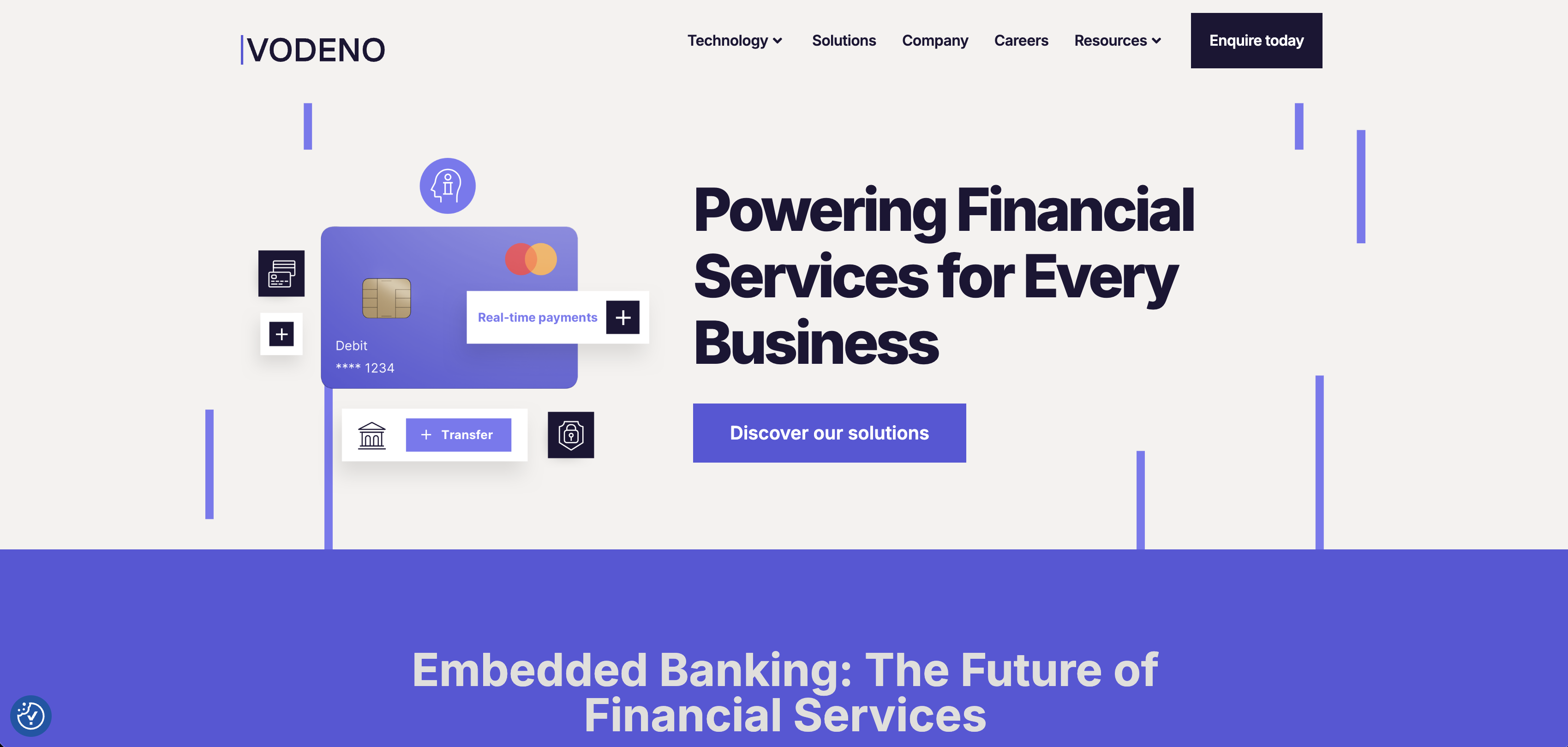
Vodeno is a European fintech building the infrastructure layer for embedded finance—letting any company slip banking and lending directly into their product without the complexity of traditional integrations. The platform abstracts away the operational headaches of regulatory compliance, bank connectivity, and fund management that typically come with embedding financial services, making it possible for non-financial businesses to offer credit, accounts, and payments to their users almost as easily as adding a API call. What sets Vodeno apart is its focus on the operational backbone rather than the customer-facing experience. While most embedded finance platforms emphasize sleek user flows, Vodeno solves the unglamorous but critical problem: how do you actually manage the banking, settlement, and risk infrastructure when you're issuing credit to thousands of users across multiple jurisdictions? They handle the plumbing that traditional banks spent decades building. The company targets both B2B2C platforms and B2B software providers looking to monetize their customer relationships through financial products. It competes in a growing category alongside players like Marqeta and Unit, but Vodeno's European roots give it a natural advantage in navigating the continent's fragmented regulatory landscape and banking infrastructure. As embedded finance reshapes how non-financial companies interact with their customers, platforms like Vodeno are becoming essential infrastructure—sitting invisibly in the background, making finance work at speed.