Embedded lending Companies in Europe
Embedded lending integrates loan products — working capital advances, instalment financing, revenue-based financing, or credit lines — into the workflow of a non-financial platform. An accounting software company can offer its SME customers a working capital advance based on their invoicing data. A B2B marketplace can offer buyers trade credit at checkout. Embedded lending works because the platform already has data about the customer that enables faster, more accurate underwriting than a standalone lender could achieve.
European Embedded lending companies in our database
Notable embedded lending companies include Vodeno, Narvi, Fagura, Defacto and Enity.
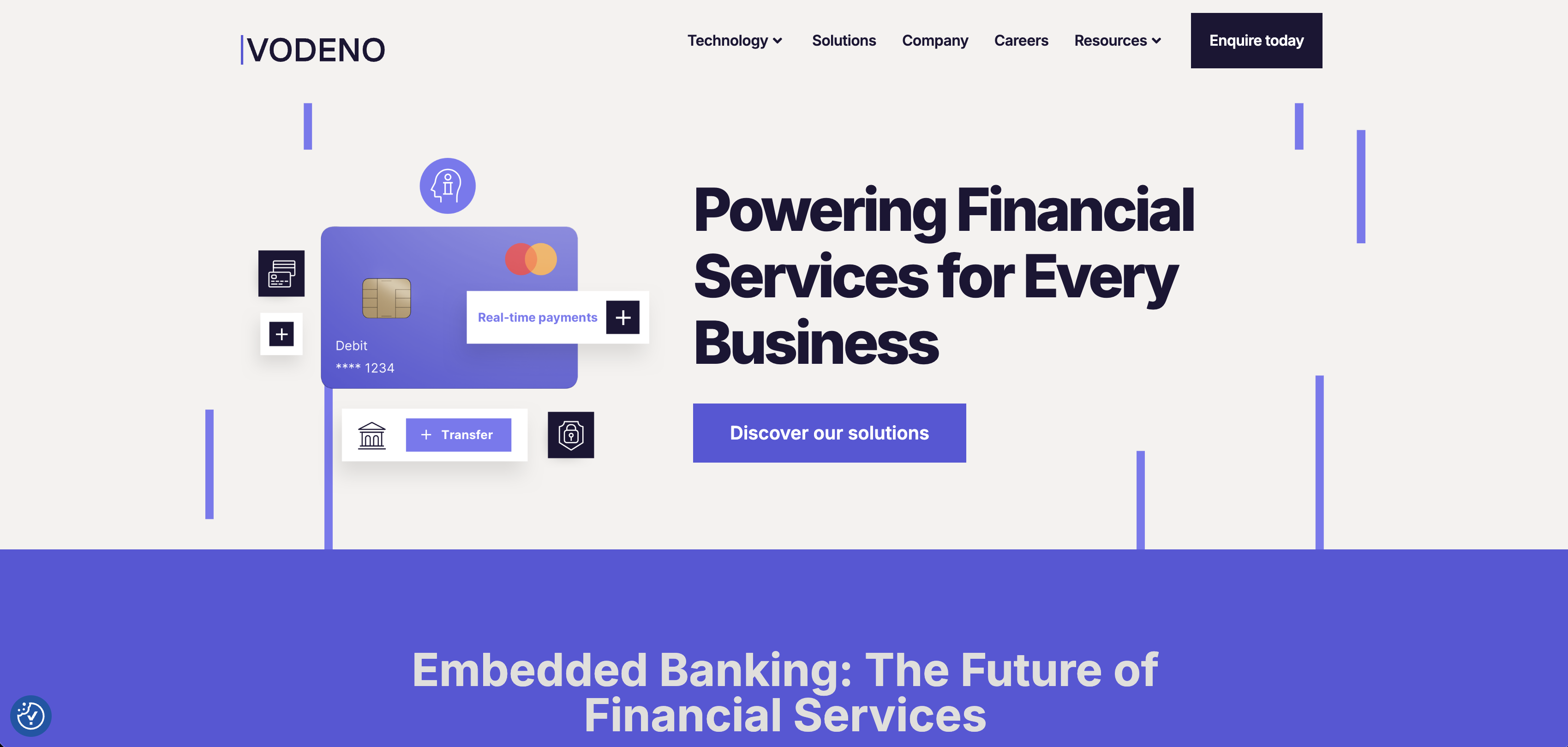
Vodeno is a European fintech building the infrastructure layer for embedded finance—letting any company slip banking and lending directly into their product without the complexity of traditional integrations. The platform abstracts away the operational headaches of regulatory compliance, bank connectivity, and fund management that typically come with embedding financial services, making it possible for non-financial businesses to offer credit, accounts, and payments to their users almost as easily as adding a API call. What sets Vodeno apart is its focus on the operational backbone rather than the customer-facing experience. While most embedded finance platforms emphasize sleek user flows, Vodeno solves the unglamorous but critical problem: how do you actually manage the banking, settlement, and risk infrastructure when you're issuing credit to thousands of users across multiple jurisdictions? They handle the plumbing that traditional banks spent decades building. The company targets both B2B2C platforms and B2B software providers looking to monetize their customer relationships through financial products. It competes in a growing category alongside players like Marqeta and Unit, but Vodeno's European roots give it a natural advantage in navigating the continent's fragmented regulatory landscape and banking infrastructure. As embedded finance reshapes how non-financial companies interact with their customers, platforms like Vodeno are becoming essential infrastructure—sitting invisibly in the background, making finance work at speed.
Narvi is a European fintech that simplifies embedded lending for e-commerce and marketplace platforms. Rather than forcing merchants to build lending infrastructure from scratch, Narvi handles the entire loan lifecycle—from origination through servicing—as a white-label API that integrates directly into checkout flows. The company targets online retailers and marketplace operators who want to offer buy-now-pay-later and installment credit without the operational overhead of underwriting, collections, or compliance. Narvi handles credit decisions using proprietary scoring models and manages all regulatory requirements, while merchants simply embed a widget and capture incremental revenue. In a market crowded with point-solution BNPL providers, Narvi positions itself as a full-stack lending partner rather than a payment mode. The company serves merchants across Europe and has built integrations with major e-commerce platforms, making it simpler for smaller retailers to compete with well-funded rivals on financing offerings. Narvi represents a growing class of embedded finance infrastructure plays—companies enabling non-financial businesses to offer financial products without becoming financial institutions themselves. Its role is to abstract complexity and regulatory burden, letting merchants focus on customer experience and growth.

Fagura is a B2B wholesale marketplace that lets retailers and resellers source products directly from manufacturers across Europe. Rather than hunting through scattered suppliers or dealing with traditional wholesale distribution, users navigate a single platform to compare prices, find new suppliers, and place orders. The model cuts out the middleman, giving small retailers the margins they need to compete on price while manufacturers reach customers they'd otherwise struggle to find. What makes Fagura stand out in the broader fintech landscape is its embedded finance layer—the company operates a working capital financing facility that lets buyers pay for inventory purchases over time, turning what would otherwise be a cash-flow bottleneck into a growth lever. This isn't fintech as a standalone product; it's fintech woven into the nuts and bolts of how small business inventory gets funded. Fagura has built something rare: a marketplace where financial services don't just sit on top, they're baked into the commercial mechanics. For SMEs across Europe struggling to finance seasonal stock or scale quickly, Fagura represents a different way to structure working capital—accessible, automatic, and tied directly to real purchasing behavior.
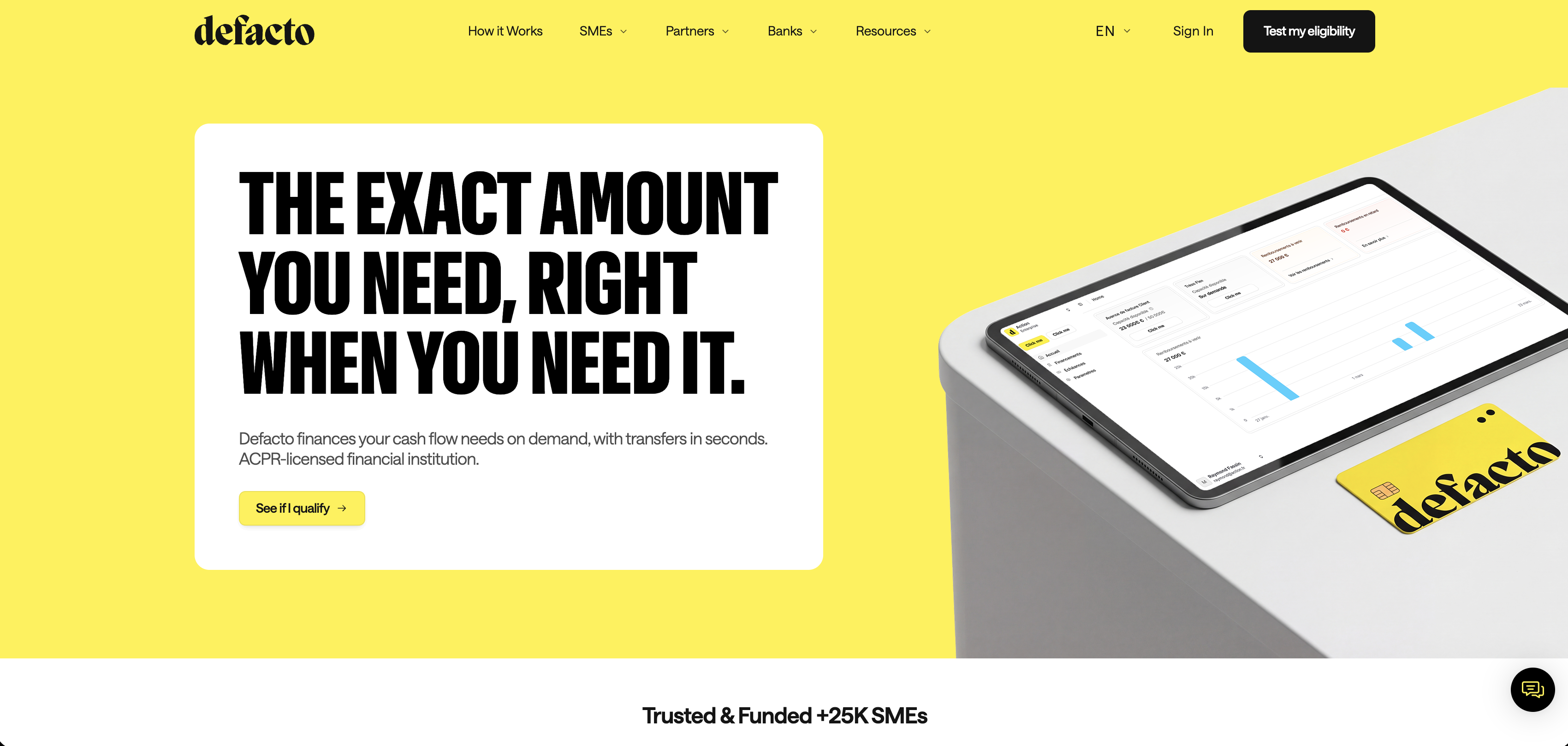
Defacto is a supply chain financing platform built for the digital age, targeting the gap between small suppliers and the large enterprises that depend on them. Rather than waiting 30, 60, or 90 days for payment, suppliers can access capital immediately based on their invoices and purchase orders—turning cash flow from a bottleneck into a competitive advantage. The platform connects directly to procurement systems, automating the approval and funding process with minimal friction. What sets Defacto apart is its focus on transparency and speed. Traditional supply chain finance has always been opaque, expensive, and slow. Defacto strips that away, offering suppliers a straightforward alternative to bank loans or factoring arrangements that drain margins. For corporates, it becomes a working capital tool that improves supplier relationships while unlocking liquidity across the supply chain. The company operates in an increasingly crowded space, but its emphasis on automation and real-time data integration—pulling directly from ERP and procurement systems—gives it operational efficiency competitors struggle to match. In the broader fintech landscape, Defacto represents a shift toward embedded finance solutions that solve real business problems rather than chasing consumer attention. It's helping reshape how money flows through global supply chains, one invoice at a time.

Enity sits at the intersection of embedded finance and merchant payments, letting businesses embed lending directly into their checkout flows. Rather than forcing customers to apply for credit elsewhere, Enity's API lets companies offer point-of-sale financing instantly—think Buy Now, Pay Later but more flexible and customizable. The platform handles underwriting, decisioning, and funding, meaning merchants don't carry the credit risk themselves. It's the kind of infrastructure that makes sense as e-commerce and marketplaces mature beyond simple transaction processing. Enity works across Europe, tapping into fragmented credit markets where unified APIs for embedded finance remain rare. The company positions itself against both traditional BNPL providers—which often dictate terms to merchants—and against the friction of integrating multiple lenders. Its real edge is speed and developer experience: getting live takes days, not months. For merchants handling high-value transactions or B2B sales, Enity's underwriting engine and multi-lender orchestration solve a genuine pain point. The rise of embedded lending means platforms like this will become table stakes for any serious commerce infrastructure player.

finleap is Berlin's answer to a question the European fintech scene keeps asking: how do you build world-class financial companies at scale? Rather than chase unicorn valuations, finleap builds them. The holding company operates as a fintech factory, incubating and scaling financial startups from day one with institutional backing, operational expertise, and a network that spans regulators, banks, and investors across the continent. What sets finleap apart is the architecture itself. It's not an accelerator or a VC fund—it's a purpose-built engine for creating and nurturing fintech companies. Each portfolio company gets access to finleap's infrastructure, compliance playbooks, and go-to-market templates, which compresses timelines and eliminates the friction that typically derails early-stage fintechs. The model works: companies like Wayfair-backed Finn, B2B payments platform Foxpay, and lending marketplace Evala have all emerged from the finleap stable. Internally, finleap operates across payments, lending, wealth, and embedded finance—categories where the European market remains genuinely underpenetrated compared to the US. The company's thesis is straightforward: identify white space in financial services, build products faster than traditional banks can move, and create defensible market positions through technology and user experience. It's less about disruption theater and more about pragmatic value creation. Finleap sits at an interesting intersection in the European fintech landscape: large enough to command resources and regulatory relationships, independent enough to move quickly, and structured in a way that lets founders maintain autonomy while tapping institutional muscle. For a continent that produces good fintech companies but struggles with scaling, finleap represents a new playbook.