Fintech APIs for SaaS Companies in Europe
Fintech APIs for SaaS allow software companies to embed financial services capabilities — payments, lending, banking, insurance — directly into their existing products without building financial infrastructure from scratch. A payroll SaaS can add wage advance features; a procurement platform can add supply chain finance; an accounting tool can add a business account. The fintech API provider handles the regulatory, banking, and operational complexity behind the scenes.
European Fintech APIs for SaaS companies in our database
Notable fintech apis for saas companies include Tink, Credimi, Fumbi, Relayr and Neterium.
Daniel Kjellén and Fredrik Hedberg didn't set out to build infrastructure. Tink started in Stockholm in 2012 as a consumer personal finance app — an attempt to give Swedish bank customers a cleaner view of their money across multiple accounts. It was a reasonable idea that ran into an unreasonable obstacle: getting reliable, consistent data out of European banks was extraordinarily hard. The technical problem turned out to be more interesting than the consumer product. In 2018 they pivoted, shifted focus entirely to the B2B layer, and started selling the very infrastructure they'd been forced to build for themselves. That pivot proved prescient. The EU's PSD2 directive, which came into full effect in 2019, legally required banks to open their data to authorised third parties — creating the regulatory foundation that open banking platforms needed to operate at scale. Tink had spent years building exactly those bank connections. When the regulation arrived, the company was ready. The platform Kjellén and Hedberg built connects to more than 3,400 banks and financial institutions across Europe, reaching over 250 million bank customers. Through a single API integration, banks, fintechs, and merchants can access aggregated account data, initiate payments directly from customer bank accounts, verify account ownership, and enrich transaction data — without maintaining their own connections to hundreds of separate banking systems with different technical standards and update schedules. Clients include Klarna, PayPal, NatWest, ABN AMRO, and BNP Paribas Fortis. In March 2022, Visa completed the acquisition of Tink for €1.8 billion — one of the largest European fintech acquisitions of that year, and a clear signal of how seriously the global payments industry had come to take open banking infrastructure. Visa's strategic rationale was straightforward: it had failed to acquire Plaid, the US equivalent, after an antitrust challenge, and needed a European open banking capability. Tink gave it 500 employees, 18 European markets, and relationships with over 300 banks and fintechs built over a decade. The founders stayed on as CEO and CTO through the transition, continuing to run Tink as a standalone Visa subsidiary from Stockholm. Both departed in 2025 — Kjellén and Hedberg announced they were building Freda, a new AI-driven legal and compliance technology startup, with the pair describing Tink as "now in better hands than ever." Francois Tornier, Visa's VP of Open Banking, took over as CEO. The product roadmap has continued under Visa ownership, including a 2024 expansion of Tink's open banking platform into the US market.
Credimi sits at the intersection of e-commerce and embedded finance, solving a problem that online retailers have largely ignored: making checkout friction disappear. Rather than forcing customers to choose between card payments and bank transfers, Credimi lets shoppers access buy-now-pay-later directly at the point of sale, turning the checkout moment into a financing decision rather than a payment one. The company essentially white-labels installment lending for merchants, handling everything from credit decisioning to collections behind the scenes. What sets Credimi apart in a crowded BNPL market is its focus on the merchant relationship rather than the consumer one. While competitors chase customer loyalty through branded apps and direct marketing, Credimi takes a B2B approach, embedding its credit engine into partner payment flows and e-commerce platforms. This means retailers get better conversion rates without bearing the customer acquisition cost. The company operates across multiple European markets, particularly strong in the Nordics and DACH region, where fintech-native commerce has matured fastest. In an industry obsessed with speed and simplicity, Credimi's real edge is its underwriting—it deploys machine learning to make instant credit decisions without the awkward friction of traditional lending. This isn't flashy consumer fintech; it's infrastructure. But it's exactly what online retailers need to compete in markets where BNPL has become table stakes.

Fumbi is a Slovak-based open banking platform built for the embedded finance era. It strips away the complexity of connecting to fragmented European banking infrastructure by providing a single API layer that lets fintechs and platforms plug financial services directly into their products. Rather than building the plumbing themselves, companies like marketplaces, e-commerce platforms, and SaaS tools use Fumbi to offer payments, lending, and account services without becoming a bank. The platform connects to hundreds of banks across Europe through standardized protocols, handling everything from payment initiation to real-time account data—work that traditionally required months of engineering and compliance headaches. Fumbi's core insight is that the real bottleneck isn't fintech innovation; it's the infrastructure gap between fintechs and incumbent banks. By sitting in that middle ground, Fumbi lets startups and enterprises move at fintech speed while maintaining the regulatory rigor that traditional banking demands. It's the connective tissue that makes embedded finance actually work at scale, turning API calls into real financial transactions without the regulatory liability.
Industrial IoT sits at the intersection of manufacturing, data analytics, and financial services in a way that most fintech companies never encounter. Relayr was founded in Berlin in 2013 to build IoT middleware — the software layer that connects industrial machines to data platforms — but evolved toward a financial services model that is genuinely unusual: outcome-based financing for industrial equipment. Rather than selling IoT software or hardware outright, Relayr structures deals where manufacturers pay based on machine uptime and performance rather than purchasing equipment capital. That model — closer to equipment-as-a-service than traditional finance — requires IoT data as the foundation of the financial structure. Relayr was acquired by Munich Re, the German reinsurance giant, in 2018, reflecting the insurance group's interest in using IoT data to price and manage industrial risk. In the European fintech landscape, Relayr is an outlier — a company that sits at the boundary between industrial technology and financial services, using sensor data to underwrite equipment performance in a way that has no real precedent in traditional finance. It represents the direction that embedded finance takes when the embedded context is a factory floor rather than a consumer checkout.
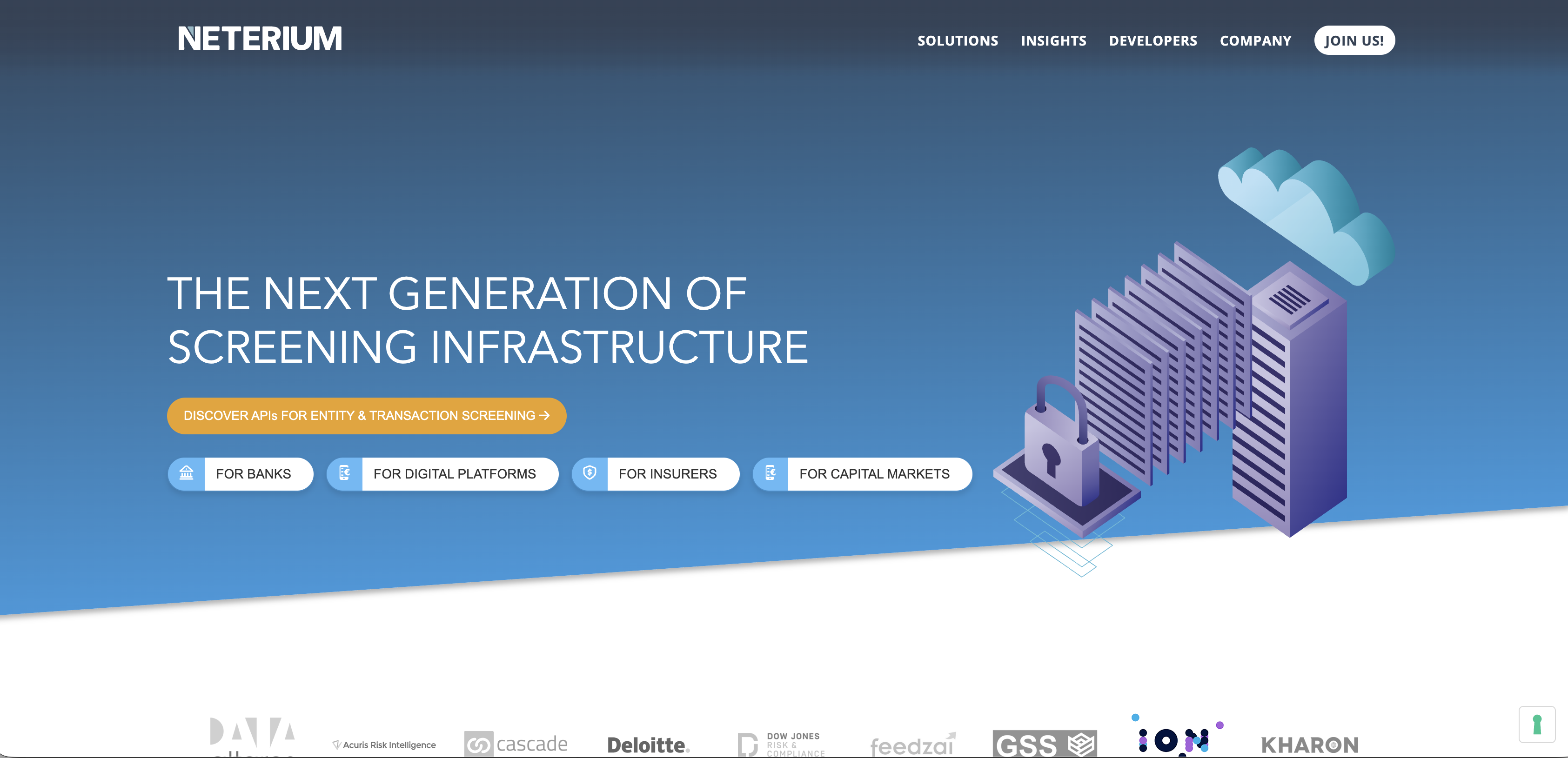
Neterium sits at the intersection of enterprise infrastructure and embedded finance, building payment rails for companies that want to monetize financial services without becoming fintech themselves. The platform handles the technical grunt work—card issuing, wallet management, transaction settling—letting software businesses focus on their core product while capturing new revenue streams through white-label finance. What sets Neterium apart is its developer-first approach. Rather than forcing companies into rigid integrations, it offers modular APIs that slot into existing ecosystems. You're not ripping out infrastructure; you're plugging in a financial operating system that feels native to your product. Most fintech infrastructure companies treat their partners as clients needing onboarding. Neterium treats them as extensions of its own platform—the distinction matters. It competes less with traditional payment processors and more with companies trying to build financial capabilities in-house, which is why its positioning resonates with the new wave of vertical SaaS and embedded finance platforms. In the broader landscape, Neterium represents a quiet but significant trend: the financialization of non-financial software. As consumer and business applications become increasingly financial in nature, companies like this provide the scaffolding that makes that transition possible without requiring teams to become banking experts.
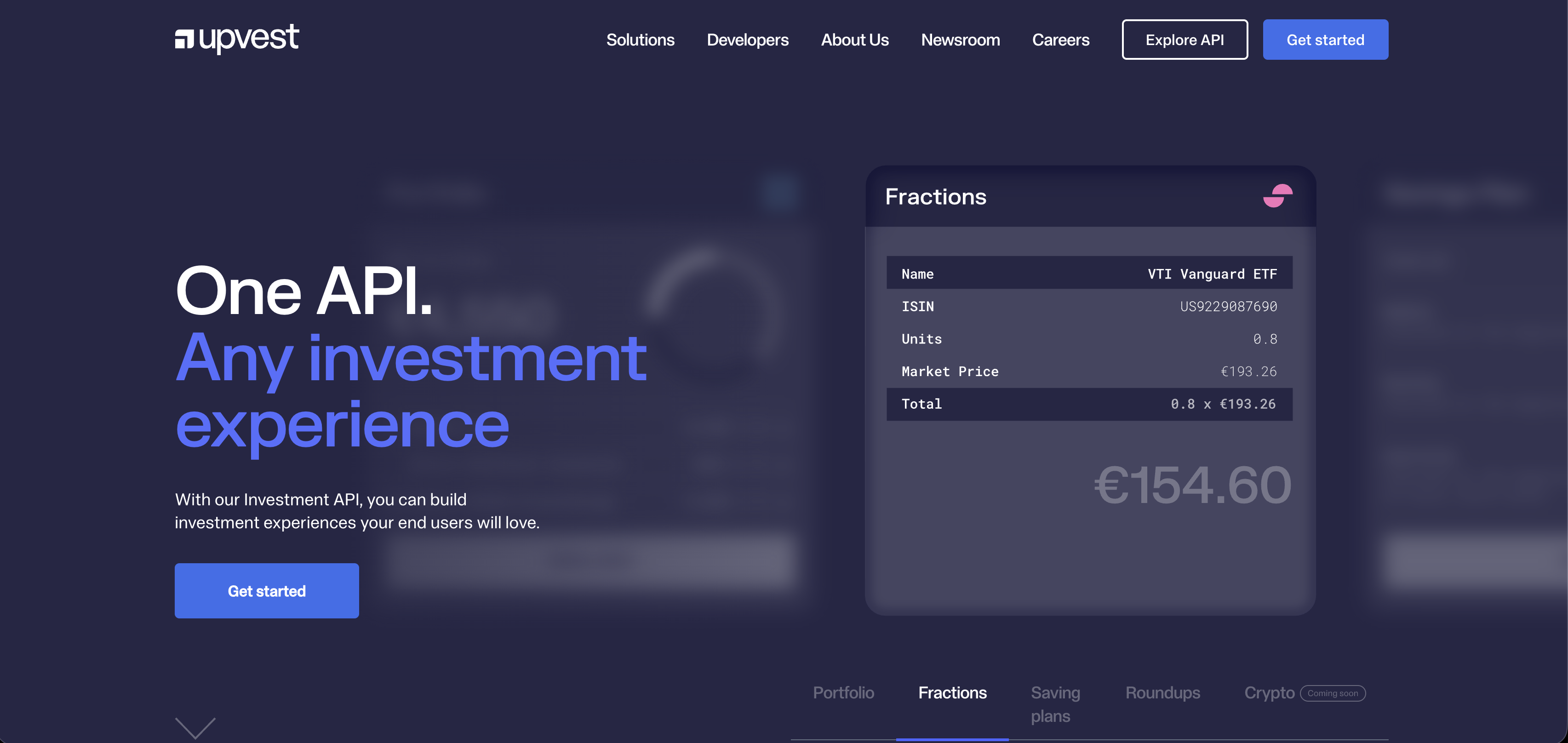
Every fintech that decides to add investing discovers the same thing: the interface is the easy part. Behind a "buy" button sits brokerage licensing, custody, order routing, settlement, corporate actions, tax reporting and regulatory permissions across every market you operate in — years of work, most of it invisible to the customer. Upvest, founded in Berlin in 2017, sells that entire stack as an API. The proposition is a single modular integration covering stocks, ETFs, mutual funds and fractional shares, with brokerage, trading, custody and settlement included and the necessary licences held by Upvest rather than the client. A neobank or a savings app can launch investing without becoming a broker. The infrastructure reportedly reaches more than 50 million end-users through client applications and processes over a million trades a week, with revenue growing at around 25% month-on-month during 2024. Funding reflects the capital intensity of regulated infrastructure: a €105 million Series C in December 2024 brought total raised to roughly €198 million, at a reported valuation in the $420–630 million range. That's a meaningful gap between money in and valuation, which is normal for licensed infrastructure businesses and worth understanding — the licences and the balance sheet requirements consume capital that a pure software company wouldn't need. Strategically, Upvest sits in the same layer as Swan and Solaris but for investing rather than banking, and it benefits from the same structural trend: European retail investing participation is rising from a low base, and the apps capturing that demand overwhelmingly prefer to buy the infrastructure rather than build it. The competitive pressure comes from both directions — neobrokers like Scalable Capital and Trade Republic that built their own stacks and could licence them out, and the incumbent custodians whose businesses this disintermediates. The dependency risk runs the other way too: as with any infrastructure provider, a small number of large clients can represent a large share of volume.