DatabaseServicesArticlesCountriesGlossaryNewsletterRequest listing
← All countries
🇬🇧

Fintech in United Kingdom

102 companies·View all in directory →
About the United Kingdom fintech ecosystem

London is the undisputed centre of European fintech, and the numbers support the claim. The UK has produced more fintech unicorns than any other European country — Revolut, Wise, Monzo, Starling, Checkout.com, GoCardless, Funding Circle, and dozens more — and London's concentration of financial services talent, venture capital, and regulatory infrastructure has created a self-reinforcing ecosystem that other European cities have been trying to replicate for a decade.

The Financial Conduct Authority's regulatory sandbox, launched in 2016, gave the UK a first-mover advantage in fintech regulation that shaped how regulators across Europe subsequently approached innovation. The FCA's willingness to engage with new business models — issuing e-money licences to neobanks, authorising open banking initiatives, and developing a specific regime for crypto assets — created the conditions for companies to build and scale regulated financial products in the UK before expanding internationally.

Post-Brexit, the UK has retained its position as Europe's leading fintech hub despite losing passporting rights that previously allowed UK-authorised firms to operate across the EU without additional licensing. Most significant UK fintechs have established EU entities — typically in Ireland, Lithuania, or the Netherlands — to serve European customers, while maintaining London as their operational headquarters. The UK's fintech sector continues to attract more venture capital investment than any other European country, with the ecosystem now mature enough to produce its own serial founders and institutional investors.

Fintech companies based in United Kingdom

Wise
Wise
Payments
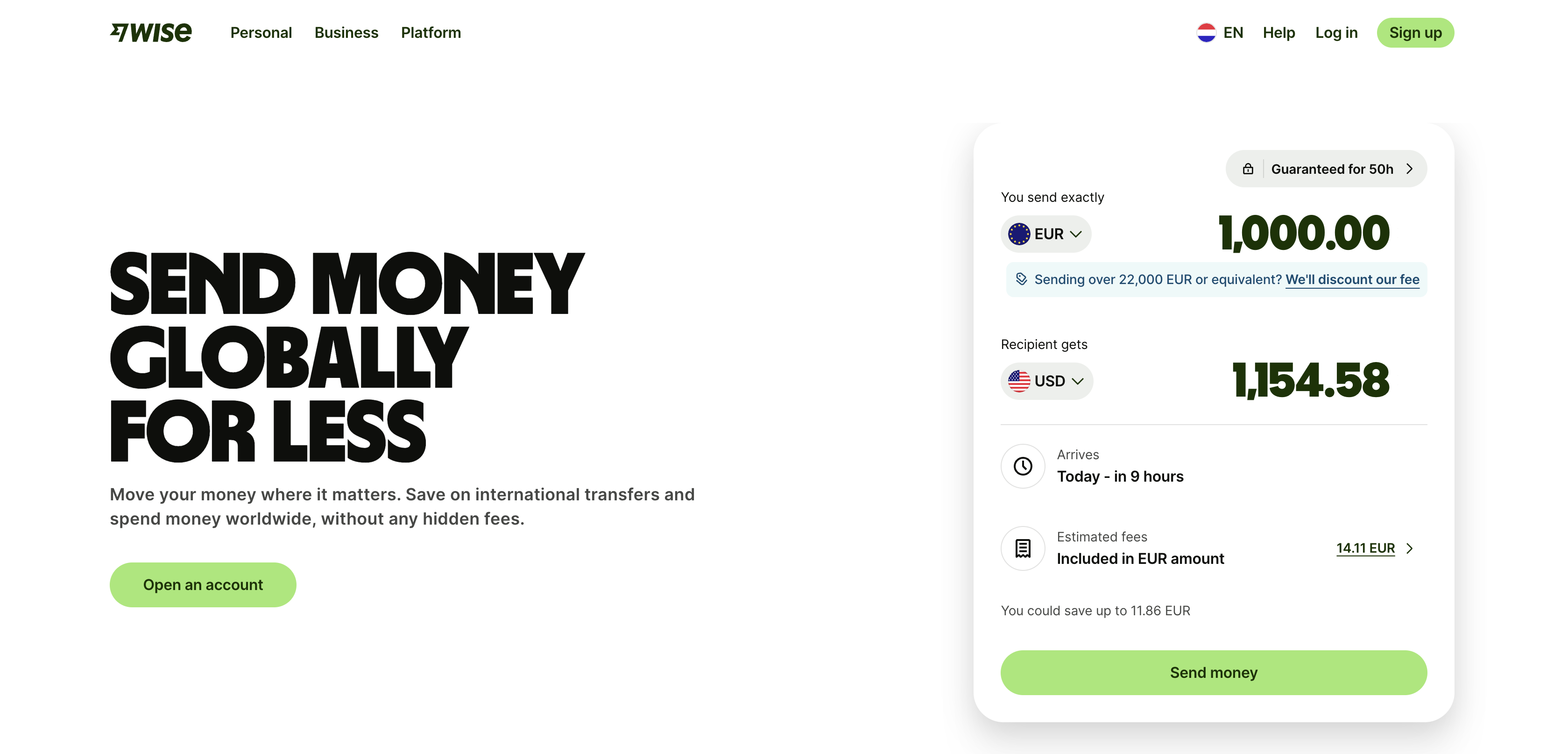
Taavet Hinrikus had a problem that was embarrassingly simple to describe and maddeningly hard to solve. He was one of Skype's first employees, living in London and getting paid in euros while his bills were in pounds. Every month he was losing money to bank fees and exchange rate markups that his bank never disclosed upfront. Kristo Käärmann, a Deloitte consultant, had the same problem in reverse. In 2011 they sat down, compared rates, and started swapping money directly between each other's bank accounts — bypassing the banks entirely. Then they thought: what if anyone could do this? That informal arrangement became TransferWise, launched in London in January 2011 with a straightforward promise that banks had been making impossible for decades: the real exchange rate, with fees shown upfront before you commit to a transfer. The early pitch was almost deliberately confrontational — the founders publicly compared bank exchange rate markups to theft, took out billboard ads outside banks, and built a campaign around showing customers exactly how much they were being overcharged. It worked. TransferWise rebranded to Wise in 2021, the same year it listed directly on the London Stock Exchange — bypassing the traditional IPO process in a move consistent with a company that had spent a decade bypassing traditional financial processes. The listing valued the business at around £9 billion and gave it public-company discipline without the fanfare of a conventional float. The product has expanded well beyond the original currency transfer use case. Wise now offers multi-currency accounts supporting over 40 currencies, a debit card, a business product for SMEs and freelancers managing cross-border payments, and a platform business that lets banks and other fintechs embed Wise's infrastructure into their own products. By June 2025, the platform had 15.6 million active customers processing £145 billion in cross-border volume annually — up 23% year on year. Revenue crossed £1 billion in 2024, with profit of £354 million. The most significant recent development is structural: shareholders voted in July 2025 to move Wise's primary listing from London to a US exchange, with the transfer expected by early 2026. It's a pragmatic decision — the US is a large and growing market, the company has money-transmission licences in 48 states, and American institutional investors have historically valued fintech companies at higher multiples than London's market has. Wise employs around 5,500 people and operates across more than 70 countries. Both founders remain involved — Käärmann as CEO, Hinrikus having stepped back from the board in recent years. The core offer is deceptively simple. Wise operates its own network rather than renting access to SWIFT, which means it can cut out the middlemen taking cuts at every stage. You send pounds, it converts at the mid-market rate (the one you see on Google), and your recipient gets euros without the usual 3-5% tax that banks quietly extract. The company issues multi-currency accounts and cards that work globally, positioning itself as infrastructure for anyone whose life doesn't fit neatly into a single currency zone. In the European market, Wise has become synonymous with cross-border reality. While traditional banks still talk about "international banking solutions," Wise customers are already sending money to fifteen countries from their phone without a second thought. The company went public in 2021, which paradoxically made it less of a fintech insurgent and more of an established player—but the underlying model hasn't changed: transparency and efficiency where opacity used to be profitable. Wise represents a particular kind of fintech maturity: the startup that solved a specific, universal problem well enough that it became essential infrastructure for millions of people operating across borders. Its role in the European landscape is that of the pragmatist, proving that you don't need regulatory capture or cross-subsidization to build a sustainable business in payments.
Founded 2011
Monzo
Monzo
Wealth
The founding team that built Monzo had all worked together before — at Starling Bank, another challenger bank startup that didn't survive its internal conflicts. Tom Blomfield, Gary Dolman, Jonas Huckestein, Jason Bates, and Paul Rippon left Starling together in 2015 and started again. The product they built was initially a prepaid card — a coral-coloured piece of plastic that became one of the most recognisable objects in British fintech — before becoming a fully licensed current account in 2017. The early user community was unusual for a bank. Monzo ran community forums, published public blog posts about its engineering decisions, and invited customers into beta programmes for new features. When it broke the world record for the fastest crowdfunding raise in 2016 — £1 million in 96 seconds — it wasn't just raising money; it was building an identity. People felt ownership of the product in a way that no high street bank had ever managed to create. That emotional connection became a genuine competitive advantage. The product has matured considerably since then. Monzo now offers current accounts, joint accounts, savings pots, personal loans, overdrafts, and investment products, all wrapped in the real-time notification experience and transaction categorisation that made its early reputation. Revenue reached £1.23 billion in 2024, up 40% year on year, with net income of £95 million — the second consecutive year of profitability after years of growth-first losses. The customer base reached 12.1 million by end of 2024, making Monzo the UK's largest digital bank by customer count. Customer deposits stood at £16.6 billion. The business is still private — the much-discussed IPO has not yet happened, and internal disagreements about where to list (the former CEO TS Anil favoured the US, the board preferred London) contributed to Anil's departure in October 2025. Diana Layfield took over as CEO with a mandate focused on international expansion before any public listing. The company is valued at approximately $5.9 billion following a 2024 secondary sale backed by Alphabet's GIC and StepStone. In December 2025 Monzo announced it had agreed to acquire Habito, the digital mortgage broker, pending regulatory approval — a move that extends the product into one of the last major financial products it didn't yet offer. With 3,821 employees and a loan book growing rapidly, Monzo has evolved from a prepaid card experiment into a bank with genuine scale and a growing claim on being the primary financial account for a generation of UK consumers.
Founded 2015
Starling Bank
Starling Bank
Digital Banking
Starling Bank is a British challenger bank that stripped away the friction of traditional banking and rebuilt it around what modern customers actually need: instant notifications, real-time spending insights, and accounts you can open in minutes without stepping into a branch. Founded in 2014, it operates as a fully regulated bank with its own banking license, not just a wrapper around legacy infrastructure. The platform serves both consumers and SMEs, offering straightforward current accounts, savings pots, and increasingly sophisticated business banking tools. Unlike neobanks reliant on partnerships, Starling owns its core infrastructure, which means faster iteration and tighter product control. The company has built a reputation for no-nonsense transparency: no hidden fees, no overdraft tricks, and clear communication about what you're getting. In the crowded UK digital banking space, Starling stands apart through consistent execution and a focus on solving real problems rather than chasing hype. It's profitable, self-sufficient, and treated by legacy banks as a genuine competitor rather than a novelty. For European fintechs, Starling represents the successful blueprint: regulated, capital-efficient, and genuinely preferred by millions of users who value simplicity over flashiness. As the fintech landscape matures, Starling exemplifies the shift from disruption theater to sustainable banking infrastructure—a reminder that the most radical innovation often looks deceptively simple.
Founded 2014
Pockit
Pockit
Digital Banking
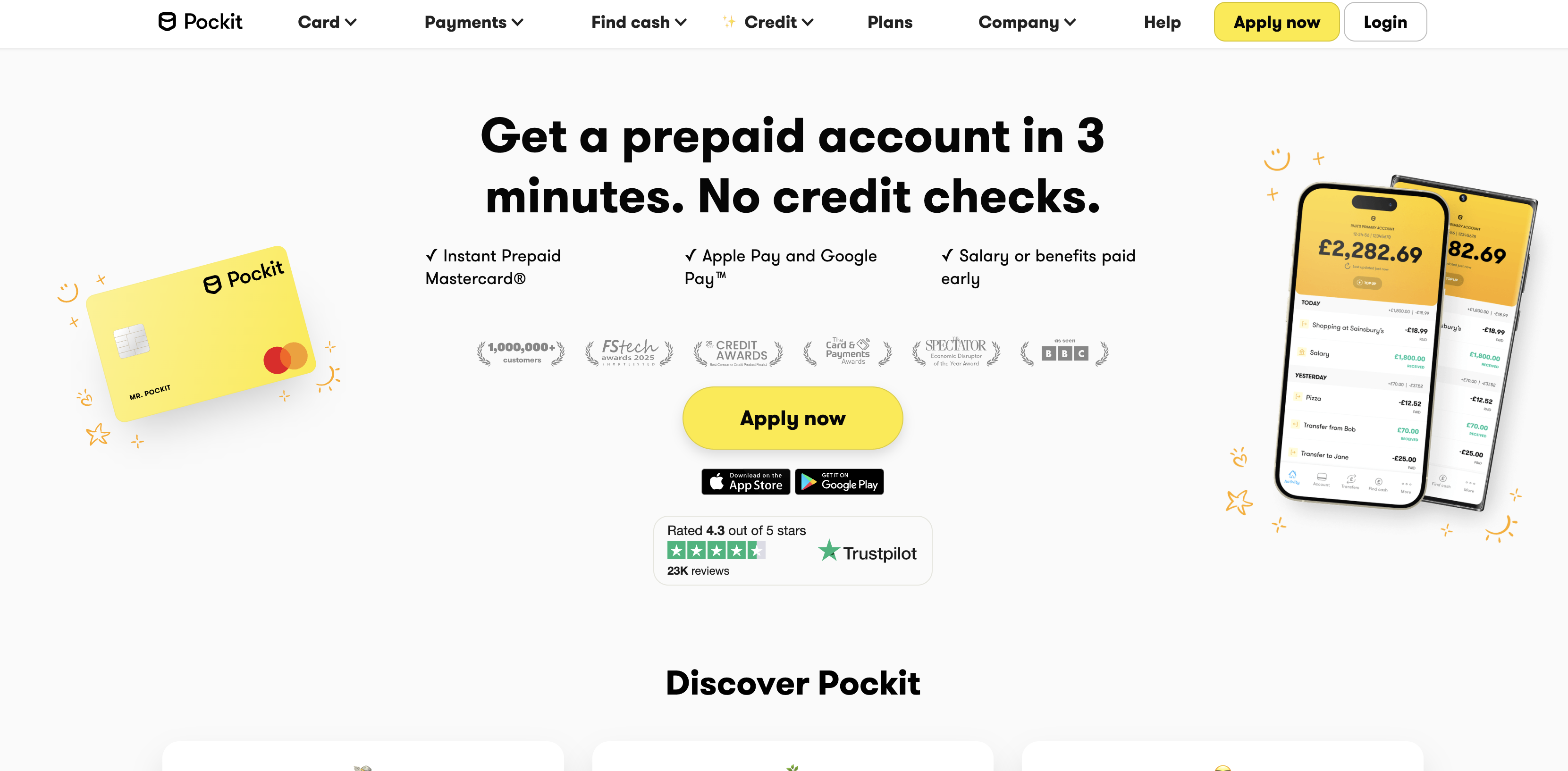
Pockit is a mobile-first financial platform designed for people who've been locked out of traditional banking. Rather than chasing the affluent, Pockit focuses on the underbanked—those without access to a current account, credit history, or the documentation banks demand. The app serves as a genuine alternative to brick-and-mortar banking, offering digital accounts, card payments, and money management tools entirely through your phone. What sets Pockit apart is its commitment to financial inclusion without the gatekeeping. You don't need a credit score or payslip to open an account. Instead, the platform builds trust through usage patterns and behavioral data, creating pathways for people traditionally rejected by high street banks. This shifts the relationship from one of suspicion to one of genuine access. The company operates across the UK and Europe, proving that underserved segments aren't just a niche—they're a substantial market. Pockit's mission is radical in its simplicity: banking shouldn't require jumping through hoops or having the right background. It's a challenger in the truest sense, not because it offers flashy features, but because it solves a real problem for millions of people who simply want to participate in the financial system.
Founded 2015
Lendable
Lendable
Financial Infrastructure
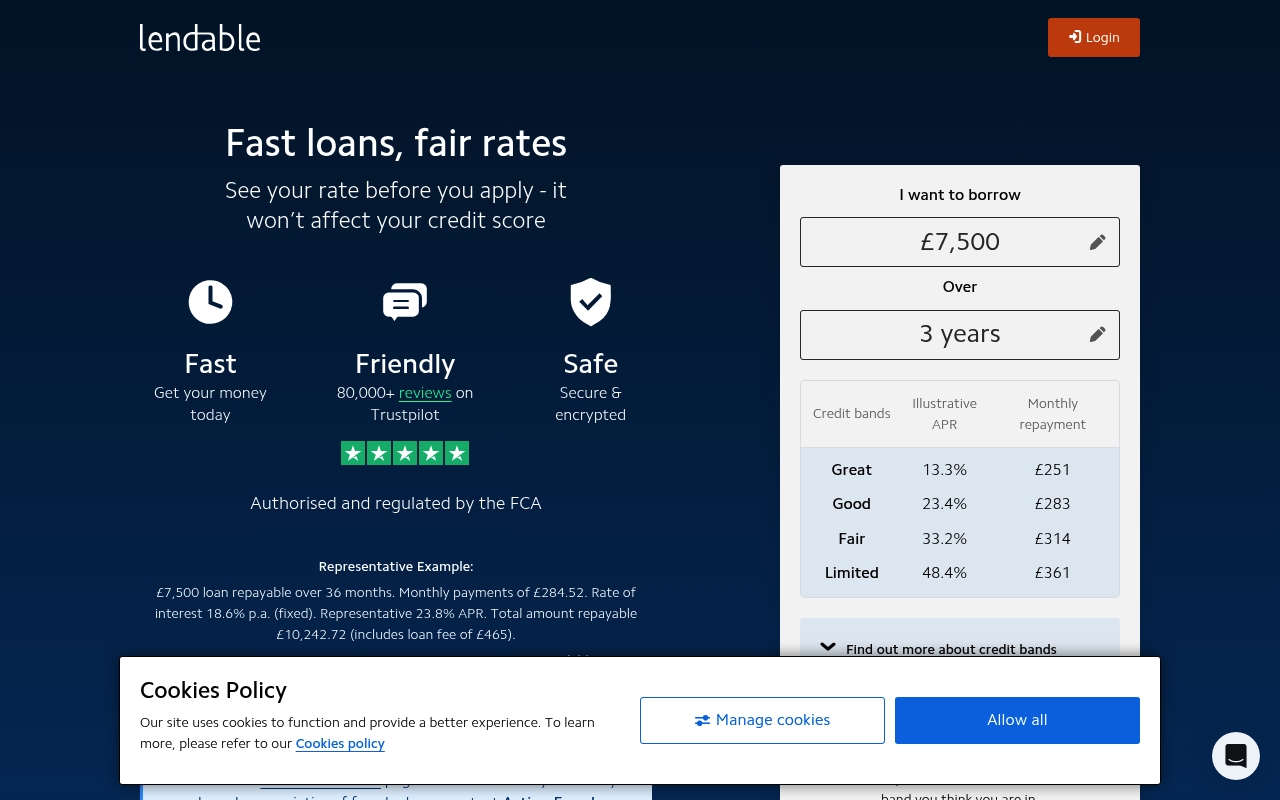
Lendable sits at the intersection of institutional finance and algorithmic credit. It's a platform that connects alternative lenders—think peer-to-peer platforms, fintechs, and non-bank lenders—with institutional capital markets. Rather than originating loans itself, Lendable acts as a market infrastructure layer, securitizing consumer and SME loan portfolios and selling them to institutional investors hungry for yield in an era of low rates. The company essentially democratized access to capital markets for non-traditional lenders. Before Lendable, a mid-sized P2P lender or online SME lender couldn't easily tap into the deep-pocketed institutional buyers that banks routinely access. Lendable changed that by building the plumbing—origination APIs, portfolio management tools, and securitization infrastructure—that lets alternative lenders scale without warehousing risk on their own balance sheets. In the European fintech landscape, Lendable represents a specific but growing category: the infrastructure play that enables other fintechs to thrive. It's not a consumer app; it's the backbone that lets consumer-facing lenders actually fund their ambitions. The platform has processed billions in loan assets and works with some of Europe's most recognizable fintech names. Lendable's role in the broader ecosystem is that of a bridge—connecting the new world of distributed lending with the old world of institutional capital. It's quietly important infrastructure, the kind of thing that doesn't grab headlines but fundamentally reshapes how credit flows.
Founded 2013
GoHenry
GoHenry
Payments
GoHenry gives children and teens prepaid cards with parental controls.
Founded 2012
Zepz
Zepz
Payments
Zepz powers international money transfers through WorldRemit and Sendwave.
LemFi
Payments
LemFi provides money accounts and remittances for immigrant communities.
Checkout.com
Checkout.com
Embedded Finance
Checkout.com is a global payments infrastructure company that builds the plumbing beneath the surface of e-commerce. While most payment processors still operate like legacy banking rails, Checkout.com has constructed a single API that connects directly to card networks, acquiring banks, and alternative payment methods—eliminating the middlemen that slow everything down. The platform processes payments in over 150 currencies across 195 countries, handling everything from straightforward card transactions to complex multi-currency settlements for merchants operating at scale. What sets it apart in Europe and beyond is its refusal to be a typical payment gateway: instead of asking merchants to adapt to the network, Checkout.com adapts the network to the merchant. Founded in 2012 by Guillermo Gutiérrez García-Ceballos, the company has grown from a London-based startup into a critical piece of infrastructure for enterprises, fintechs, and marketplaces that need orchestration at the transaction level. It competes with traditional acquirers and modern payment platforms by combining the reliability of legacy banking with the speed and flexibility developers expect. In the fragmented European payments landscape, Checkout.com has become indispensable for companies that refuse to compromise on latency, coverage, or control. The company represents a fundamental shift in how payments should work: less about choosing between payment methods and more about making payments invisible.
Founded 2012
Funding Circle
Funding Circle
Lending
Funding Circle sits at the intersection of institutional capital and small business ambition. The platform connects SMEs with investors—funds, banks, and individuals—who want returns tied to real economic activity rather than abstract asset classes. It's fundamentally a marketplace, but one that's spent years learning how to assess credit risk at scale, price loans competitively, and move money across borders without the friction traditional finance demands. The company operates across multiple geographies, though Europe remains central to its strategy. It handles everything from loan origination and underwriting through to servicing and portfolio management, meaning it's built real infrastructure rather than just matching borrowers to lenders. This matters because it allows institutional investors to actually understand what they're funding. Funding Circle competes in a space where traditional banks have historically been absent—the mid-market lending gap where a £50,000 loan isn't big enough for a relationship manager but too important for a business to ignore. Alternative lenders have crowded this space, but Funding Circle's institutional backing and regulatory maturity give it a structural advantage. It's moved from pure peer-to-peer model toward a more hybrid approach, partnering with regulated lenders to expand reach while maintaining its marketplace credibility. The company represents a fundamental rethinking of how capital reaches productive SMEs—not through gatekeepers, but through platforms that make risk transparent and pricing efficient.
Founded 2010
Abound
Abound
Open Banking
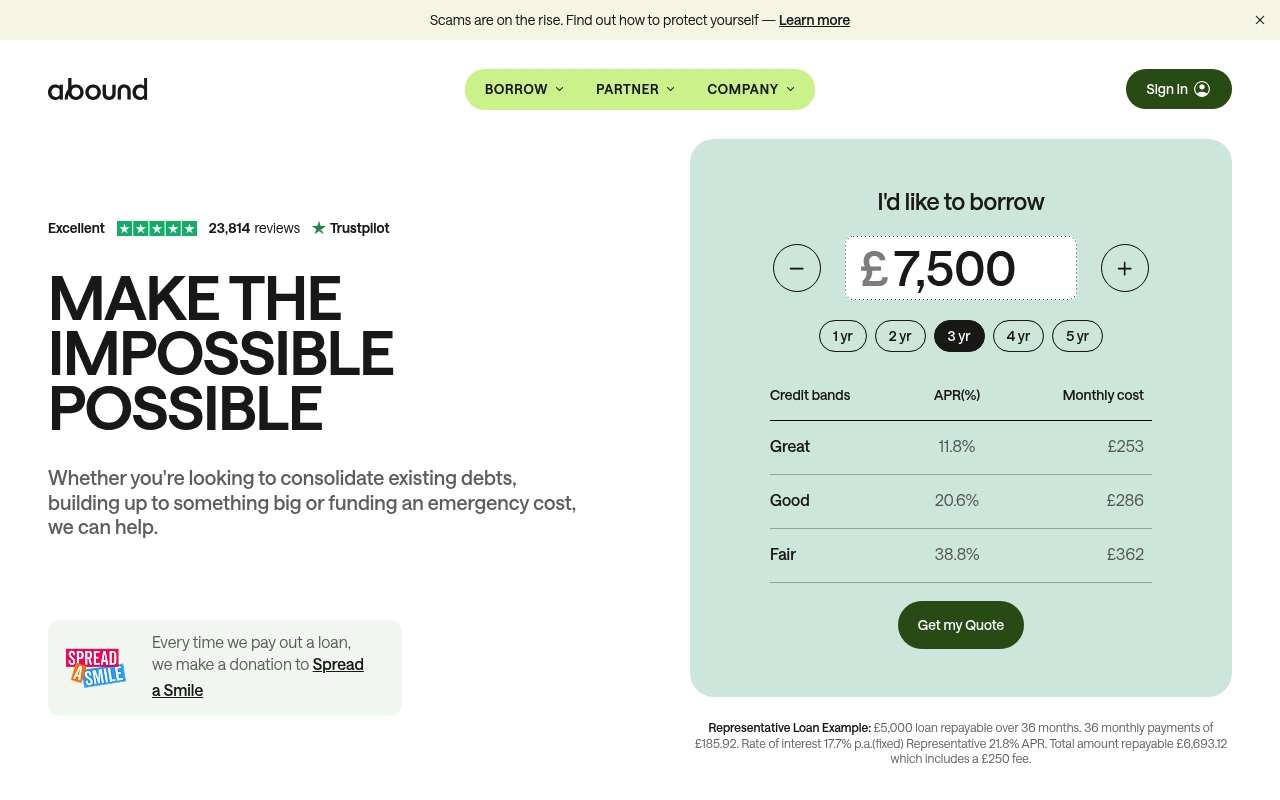
Abound uses open banking data to make consumer lending decisions more personal.
Credit Spring
Credit Spring
Lending
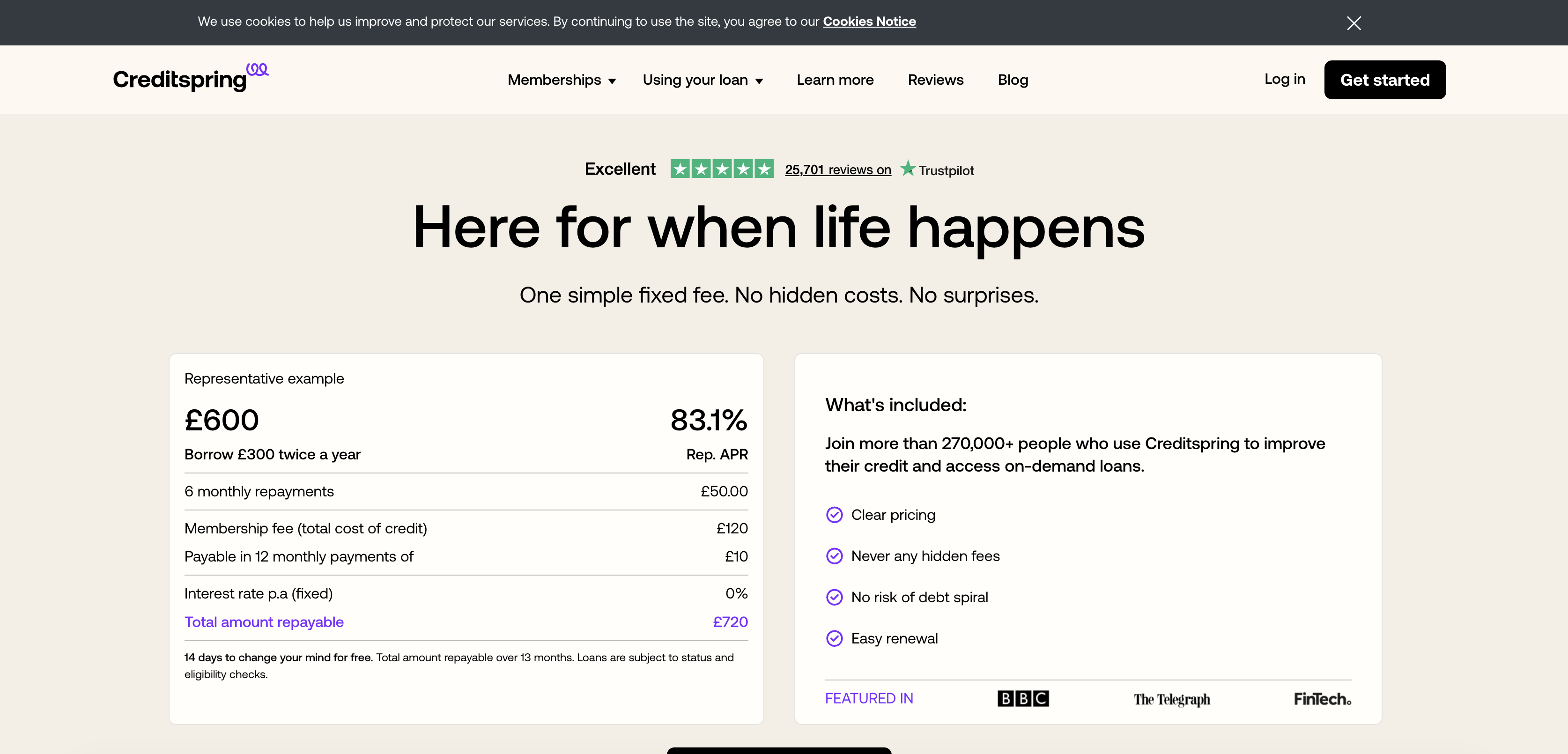
Credit Spring is a UK-based fintech that treats financial distress like a health problem—one that deserves diagnosis and treatment, not judgment. Rather than simply offering credit, the company combines short-term loans with financial coaching and debt management tools, recognizing that a quick cash injection without context is often a band-aid on a bigger problem. The platform helps borrowers understand their spending patterns and rebuild their financial foundation, not just patch a temporary shortfall. It's a provocative stance in a market crowded with BNPL and payday lenders that rarely ask why someone needs money in the first place. Credit Spring targets people in the credit-vulnerable segment—those with poor or limited credit histories who'd normally be shut out of mainstream lending. Instead of algorithmic rejection, the company uses alternative data and behavioral insights to assess creditworthiness beyond traditional scoring. For users, this means faster access to reasonable credit at transparent rates. For the market, it signals a shift toward lending that acknowledges financial fragility as a temporary state, not a permanent condition. The company represents a broader move within fintech to attach financial wellness services to credit products, treating lending as an entry point to deeper financial health rather than a transaction.
Founded 2016
ClearBank
ClearBank
Embedded Finance
ClearBank provides cloud-based clearing, accounts, and embedded banking infrastructure.
Founded 2015
Payhip
Payhip
Embedded Finance
Payhip lets creators and small businesses sell directly to their audience without the usual gatekeeping. It's a all-in-one commerce platform that handles digital products, physical goods, subscriptions, and memberships—essentially a Shopify alternative built for creators who want simplicity and fair pricing. The platform lives in that sweet spot between marketplace and self-hosted store. You upload your product, set your price, share a link, and start selling. No approval process, no middleman deciding what you can or can't do. Payhip takes a percentage of each sale rather than charging upfront fees, which resonates with bootstrapped creators and solopreneurs who don't have predictable revenue yet. What sets Payhip apart is its lightness. While traditional payment processors demand integration work and setup headaches, Payhip is deliberately frictionless—you can be live within minutes. It also gives sellers control over their own affiliate networks and customer relationships, something most platforms charge extra for or restrict. In the crowded world of creator monetization tools, Payhip occupies the pragmatic middle: more powerful than a simple payment link, simpler than a full ecommerce platform, and designed specifically for people who want to sell without becoming a software engineer. It's quietly influential in how independent creators think about direct sales.
Founded 2010
ION Group
ION Group
Financial Infrastructure
ION Group is a sprawling financial software empire that has quietly become one of Europe's most comprehensive infrastructure plays. The company operates across trading, risk management, and post-trade processing—the unsexy but absolutely critical backbone that powers global capital markets. Unlike flashy fintech startups chasing consumer adoption, ION builds the invisible plumbing that institutional traders, hedge funds, and investment banks depend on every single day. Its portfolio spans front-office platforms, market data aggregation, clearing and settlement systems, and regulatory reporting tools. ION serves as a counterweight to the purely consumer-focused fintech narrative, proving there's enormous value in solving problems for professionals who move billions. The company's strength lies in its ability to connect disparate financial systems, providing what amounts to a unified operating system for institutional finance. For European financial institutions, ION represents a trusted partner in an increasingly complex regulatory landscape, offering solutions that integrate seamlessly with legacy infrastructure while modernizing workflows. Its acquisition-driven growth strategy—picking up niche specialists and consolidating them into a cohesive platform—mirrors the broader consolidation happening across enterprise fintech. ION's market position underscores a fundamental truth about fintech: the biggest opportunities often lie in B2B infrastructure rather than consumer apps.
Founded 2005
Moneyhub
Moneyhub
Wealth
Open banking's promise — that financial data, properly used, can help people make better decisions — has been articulated by hundreds of companies. Moneyhub has spent longer than most actually delivering it. Founded in Bristol in 2014, it built one of the UK's first and most comprehensive open banking platforms, aggregating financial accounts, pension data, and property values into a unified financial picture that gives users — and the institutions serving them — a genuinely complete view of financial health. Its B2B platform powers the open banking and financial wellness features of major UK employers, financial advice firms, and pension providers, white-labelling its data aggregation and analytics capabilities under their brands. The pensions integration is particularly significant — Moneyhub connects to pension providers alongside bank accounts, giving users visibility into their retirement savings alongside their current financial position. That breadth of financial data coverage — beyond the current account focus of most open banking platforms — is a genuine differentiator. In the UK open banking ecosystem, where the FCA's consumer duty requirements are pushing financial institutions to demonstrate they understand their customers' broader financial circumstances, Moneyhub's comprehensive data view is becoming infrastructure rather than a nice-to-have.
Founded 2014
Small World FS
Small World FS
Payments
Remittances are one of the most economically important payment categories in the world — hundreds of billions of pounds flow annually from migrants in wealthy countries to family members in their countries of origin. The market has historically been dominated by Western Union and MoneyGram, both of which extract significant fees from the people least able to afford them. Small World Financial Services was founded in London in 2005 to compete in that market with a model focused on competitive pricing and trusted local distribution in the receiving countries. Its network covers over 90 countries with a combination of bank deposits, mobile wallet delivery, and physical cash pickup options that match how recipients actually want to receive funds — particularly important in markets where bank account penetration is low but mobile wallets are universal. Small World has built a particular following among the African and Latin American diaspora communities in Europe, segments that traditional banks serve poorly and that need the trust of a specialised remittance provider. In the European remittance market, where Wise and Remitly compete aggressively, Small World's depth in specific corridors and its dual physical and digital distribution remain genuine differentiators for the customer segments where physical pickup remains essential.
Founded 2005
Currencies Direct
Currencies Direct
Payments
Long before Wise existed, there was a generation of UK companies serving the British expatriate community with foreign exchange services that were better than what banks offered, even if they still required phone calls and forms. Currencies Direct was founded in London in 1996 — making it ancient by fintech standards — and built one of the longest-running international payment businesses in Europe by serving exactly that market. Its core customer base has historically been British expatriates buying property abroad, sending pensions overseas, and managing the cross-border financial complexity of living in one country with assets and obligations in another. The company has evolved with the digital era, building online platforms while maintaining the relationship-based service model that its core customers valued — and continue to value, even as younger demographics have moved to app-based alternatives. Currencies Direct has expanded into broader international payment services for SMEs and individuals, processing billions in cross-border transfers annually. In the UK FX landscape, Currencies Direct represents the established alternative — older, more relationship-driven, and serving customer segments that the venture-backed fintechs sometimes overlook in their focus on digital-native users. Three decades of FX service is not nothing.
Founded 1996
MoonPay
MoonPay
Embedded Finance
MoonPay sits at the intersection of crypto and traditional finance, offering on and off-ramps that let people move money between their bank account and crypto wallets with minimal friction. Founded in 2018, the London-based company has quietly become one of Europe's most important infrastructure plays in the emerging crypto economy, handling billions in transactions across more than 150 countries. What sets MoonPay apart is its unglamorous but essential positioning: it's not trying to be a crypto exchange or a trading platform. Instead, it's the plumbing layer that makes crypto accessible to ordinary people. You buy crypto through MoonPay the same way you'd buy a digital service—seamless, compliant, and fast. The company operates with full EU regulation, holding licenses across multiple jurisdictions while maintaining the kind of compliance rigor that traditional banks expect. MoonPay's API-first approach means startups, wallets, and even traditional fintech apps can embed crypto purchasing directly into their user experience. This white-label capability has attracted partnerships with everyone from music platforms to gaming studios. The company has raised substantial funding and is valued at over a billion dollars, a testament to how critical crypto infrastructure has become. In a market obsessed with trading speculation and yield farming, MoonPay represents something more fundamental: the normalization of crypto as a payment asset class. It's doing for cryptocurrency what Stripe did for online payments—removing the technical and regulatory barriers that kept it confined to specialists.
Founded 2018
Freetrade
Freetrade
Wealth
Freetrade is a London-based investing app that stripped away the gatekeepers between everyday Europeans and the stock market. Founded on the principle that trading shouldn't cost you a fortune in fees, it lets you buy fractional shares of thousands of stocks and ETFs for zero commission—something that would have seemed impossible a decade ago. The app democratizes retail investing by making it accessible, transparent, and genuinely affordable. While traditional brokers buried fees in spreads and commissions, Freetrade charges nothing for trades and offers a refreshingly straightforward pricing model. You get real-time data, a clean mobile interface, and the ability to build diversified portfolios without watching fees erode returns. In a European market where retail investing was often treated as a luxury product for the wealthy, Freetrade positioned itself as the alternative—serious investing without the pretense or the price tag. The platform appeals to younger investors who want to own individual stocks and ETFs but were previously priced out or intimidated by legacy brokers. Today, Freetrade represents a shift in how Europeans think about stock ownership: not as something reserved for the financially elite, but as a fundamental right. It's embedded itself in the broader fintech movement toward dematerializing finance and making capital markets participation the default rather than the exception.
Founded 2017
Zego
Zego
InsurTech
Zego sells insurance built for the gig economy—a category that barely existed five years ago and now moves faster than traditional underwriting can handle. The London-based insurtech operates in a space where traditional insurers still treat gig workers as afterthoughts, bundling them into outdated categories. Zego flips this. It offers flexible, pay-as-you-go coverage for delivery riders, couriers, and other flexible workers across Europe, with pricing that reflects actual usage rather than punishing people for working on their own terms. The product feels native to how gig workers actually live. Rather than forcing annual commitments or minimum coverage periods, Zego lets users activate insurance by the hour or day, paying only for what they use. The claims process is digital and friction-light—something traditional insurers have promised but rarely delivered. Behind the interface sits real underwriting AI that prices risk dynamically, allowing Zego to write policies that make sense for both the worker and the business. In Europe's fragmented insurance market, Zego stands apart from pure distribution plays and legacy brokers by owning the underwriting function. It's not an aggregator slapping a UI on existing products; it's a real insurer rethinking the fundamentals. The company has grown quickly because it identified a timing mismatch: millions of people already working in the gig economy waiting for insurance that matched their reality, not their employment status. Zego represents the emerging pattern in European insurtech: not trying to replace all insurance, but dominating one slice deeply and building unit economics that work. It's carved out a defensible position in a category that traditional players still don't quite understand.
Founded 2016
FairFX
FairFX
Payments
International money transfers and travel money used to be one of the most opaque and most expensive parts of consumer banking — bank exchange rates that included undisclosed margins, fees layered on fees, and a deliberate obscurity about how much consumers were actually paying to convert one currency to another. FairFX was founded in London in 2007 to bring transparency and competitive pricing to that market. Its multi-currency prepaid card and money transfer service let consumers and businesses lock in exchange rates and access foreign currency at significantly better rates than high street banks offered. The company expanded across consumer and business segments, building a particular following among UK consumers travelling internationally and SMEs making cross-border payments. FairFX became part of Equals Group, broadening into a wider international payments and corporate FX platform serving both retail and B2B customers. In the European consumer FX market, where Wise and Revolut have built dominant positions through better products and clearer pricing, FairFX represented an earlier wave of disruption — companies that proved consumers would switch from banks for FX if the alternative was meaningfully better. That proof of concept paved the way for the larger fintechs that followed.
Founded 2007
TrueLayer
TrueLayer
Financial Infrastructure
TrueLayer is a payments and open banking infrastructure platform that lets fintech companies, payment processors, and traditional banks access real-time financial data and initiate payments directly from consumer bank accounts across Europe. Rather than building APIs from scratch or waiting months for bank integrations, developers plug into TrueLayer's unified network and immediately get access to payment initiation, account aggregation, and transaction data from thousands of financial institutions. The company operates as a critical middleware layer in European fintech. While most payment infrastructure still relies on cards or legacy rails, TrueLayer routes transactions through bank-grade open banking rails, making transfers faster, cheaper, and less friction-heavy. Its API-first approach means a startup launching in five countries gets the same clean integration experience as an enterprise player. In the competitive open banking space, TrueLayer stands out through breadth of coverage and developer experience. The platform supports payments in 17+ European countries and has built integrations with hundreds of banks—not through partnerships alone, but through technical depth in handling regional quirks and regulatory complexity. Its customer base spans neobanks like Wise and Revolut, major payment processors, and traditional banks replatforming their operations. TrueLayer essentially democratized access to Europe's banking infrastructure at a moment when open banking regulations made that access possible but still technically demanding. For any fintech building on the continent, it's become a foundational piece of modern payment architecture.
Founded 2016
Blockchain.com
Blockchain.com
Financial Infrastructure
Blockchain.com is one of the oldest and most-visited crypto infrastructure platforms in the world, operating as a bridge between traditional finance and digital assets. The company runs a full-stack crypto ecosystem—a blockchain explorer that millions use to track transactions, a self-custody wallet that puts users in control of their private keys, and a suite of institutional-grade services for serious players. Where most crypto platforms treat blockchain as a trading venue, Blockchain.com treats it as infrastructure. The platform serves retail users seeking transparency and control, developers building on-chain applications, and institutions entering crypto with proper compliance frameworks. The company has maintained a distinctly crypto-native stance while gradually building enterprise services that acknowledge regulatory reality. Its wallet remains one of the most downloaded in the space, offering both simplicity for newcomers and advanced features for power users. Blockchain.com sits at an interesting inflection point in fintech—old enough to have survived multiple market cycles, serious enough to work with regulators, yet still fundamentally aligned with decentralized principles. The platform's role in the broader landscape is foundational: it enables crypto participation across the entire user spectrum, from curious individuals to multinational corporations managing digital asset reserves.
Founded 2011
OpenWrks
OpenWrks
RegTech
OpenWrks was the UK's first FCA regulated AIS Open Banking platform. In 2020 OpenWrks was acquired by Tink. Credit decisions have historically been made on backward-looking data — credit files that reflect what happened years ago rather than what a person's financial life looks like today. OpenWrks was founded in London in 2017 to change that with open banking data. Its platform uses transaction data from bank accounts to generate real-time financial insights — income verification, affordability assessments, and cash flow analytics — that lenders, debt advisors, and financial services companies can use to make better decisions about the people they serve. The focus on affordability and debt support is deliberate — OpenWrks has built particular depth in the debt advice sector, providing tools that help debt charities and money guidance services understand their clients' financial situations with precision and speed that paper-based assessments cannot match. Its work with the Money and Pensions Service and other UK debt support organisations reflects a commitment to using open banking data for financial inclusion rather than purely commercial lending optimisation. In the open banking ecosystem, where most data applications focus on acquisition and credit origination, OpenWrks' orientation toward debt support and financial wellbeing is a distinctive positioning that has built genuine trust with the organisations that serve financially vulnerable people.
Founded 2017
ComplyAdvantage
ComplyAdvantage
Fraud & Security
Compliance has become the unglamorous backbone of fintech, and ComplyAdvantage is the infrastructure that makes it actually work. The London-based company builds AI-powered screening and monitoring systems that help banks, fintechs, and payment platforms stay ahead of regulatory demand without drowning in noise. Rather than bombarding clients with false positives, ComplyAdvantage's platform learns from transaction patterns and risk signals to flag what actually matters—sanctions evasion, money laundering, terrorist financing, and the shadier corners of global finance. It's compliance automation that doesn't feel like compliance automation. The company serves everyone from established banks tightening their KYC processes to crypto platforms that desperately need credibility with regulators. In a landscape where AML failures cost institutions hundreds of millions in fines, ComplyAdvantage occupies the unglamorous but essential role of making sure your compliance team can actually sleep. The platform has become foundational across Europe and beyond, trusted by institutions that can't afford to miss a single regulatory trick. In the broader fintech stack, ComplyAdvantage represents the maturation of compliance—from spreadsheet-driven checklist to intelligent, real-time risk machine.
Founded 2014
Ravelin
Ravelin
Fraud & Security
Ravelin is a fraud prevention and risk intelligence platform built for the modern payment landscape. Rather than relying on outdated blacklists and rule engines, the company uses behavioral analytics and machine learning to distinguish legitimate transactions from fraudulent ones in real time. The platform sits between merchants and payment processors, analyzing transaction patterns, user behavior, and contextual signals to catch fraud before it hits the books. Ravelin's approach acknowledges a fundamental tension in fintech: overly aggressive fraud screening kills conversions, while loose controls breed chargebacks. The company's API-first architecture means it integrates directly into checkout flows without requiring merchants to rebuild their payments infrastructure. What sets Ravelin apart is its focus on the nuance between fraud risk and business risk. Many competitors offer binary accept-or-decline decisions; Ravelin surfaces risk scores and behavioral indicators, letting merchants make informed decisions about which transactions to challenge, approve, or send to manual review. This flexibility matters especially for high-value or unusual transactions where false positives hurt revenue. Ravelin operates primarily in the B2B space, serving mid-market and enterprise merchants across e-commerce, travel, and fintech. The company competes in a crowded fraud detection market dominated by established players, but gains ground through superior machine learning models and a merchant-centric product philosophy. As payment volumes continue to surge across Europe and digital fraud becomes increasingly sophisticated, Ravelin's technology sits at a critical chokepoint in the transaction flow.
Founded 2014
Yapily
Yapily
Embedded Finance
Yapily sits at the intersection of open banking and embedded finance, building the plumbing that lets fintech companies and enterprises tap into banking data and payments without reinventing the wheel. Founded in 2016, the London-based company operates as an API infrastructure layer—connecting to banks across Europe and beyond to unlock account information, payment initiation, and consent management at scale. What makes Yapily different is how it abstracts away the complexity of working with hundreds of banks and their inconsistent technical standards. Rather than forcing developers to build individual integrations for each bank's API, Yapily provides a unified interface that normalizes everything. It's the translator between your app and the messy reality of legacy banking infrastructure. The company operates in the B2B2C space, partnering with fintechs, neobanks, and enterprise software providers who need banking connectivity but lack the resources to build it themselves. Their customer base spans lending platforms, wealth apps, accounting software, and payment orchestration layers—essentially anyone whose product benefits from real-time access to customer bank accounts or the ability to initiate payments. Yapily's positioning is deliberately unsexy: they're infrastructure, not consumer-facing. But that's precisely the point. In a landscape crowded with consumer fintechs chasing headlines, Yapily has built a quiet, profitable business serving the builders themselves. They're to open banking what Stripe is to payments—the backbone that lets innovation happen faster.
Founded 2016
Token
Token
Financial Infrastructure
Token is a London-based open banking platform that sits at the intersection of infrastructure and consumer experience, making API-driven financial connectivity feel less like plumbing and more like a natural part of how money moves. Rather than asking users to log into their banks manually or hand over passwords, Token handles account aggregation and payment initiation through direct bank connections—the infrastructure most fintech apps and traditional banks should have built themselves but didn't. The company's core insight is that open banking is only useful if it actually works across borders, across device types, and across the chaos of fragmented financial systems. Token's platform standardizes this mess, letting fintechs, banks, and payment companies offer seamless experiences without getting bogged down in regional variations or legacy bank APIs that still feel like they were written in 2003. What sets Token apart in the European market is its focus on developer experience without sacrificing enterprise-grade security and compliance. While competitors offer raw API access or clunky consent flows, Token treats the entire interaction—from user authentication to transaction confirmation—as a product problem, not just a technical one. They're essentially the connective tissue that lets modern financial products actually work at scale. Token's role in fintech infrastructure means it powers an invisible layer: the moment you authorize a payment or link an account in an app that "just works," Token's orchestration is likely running underneath. That's the kind of foundational utility the ecosystem desperately needs.
Founded 2014
Thought Machine
Thought Machine
Financial Infrastructure
Thought Machine builds the operating system for modern banking. Its Vault platform is a cloud-native core banking system that replaces the legacy infrastructure most banks still depend on—the kind that was written when personal computers were novel and the internet was optional. Rather than patching decades-old mainframes with band-aids, Vault lets banks modernize from the ground up, moving away from monolithic systems toward modular architecture that can actually adapt to change. The platform serves as the nervous system for digital banking, payment processing, and lending at scale, handling everything from transactions to regulatory compliance in real time. Thought Machine competes directly against vendors like Temenos and Finastra, but with a fundamentally different philosophy: born in the cloud, designed for APIs, built for speed. The company works with tier-one banks and ambitious challengers alike, essentially selling them the technical freedom to compete in fintech's pace rather than their legacy system's glacial timeline. In the broader European fintech ecosystem, Thought Machine represents the infrastructure layer that makes everything else possible—without modern core banking, the rest of the fintech revolution stays locked in legacy constraints.
Founded 2014
Moneybox
Moneybox
Wealth
Moneybox is a British savings and investment app that treats money management like a habit rather than a chore. It rounds up your everyday card purchases to the nearest pound and automatically invests the spare change, turning small moments of spending into genuine wealth-building opportunities. The app sits somewhere between a savings account and an investment platform, democratizing retail investing for people who'd otherwise struggle to find the discipline or capital to start. What makes Moneybox different is its behavioral psychology angle. Rather than asking users to set aside cash manually, it leverages the friction-free nature of mobile payments to make investing feel frictionless and even invisible. Your coffee costs £3.50? It rounds to £4, and that 50p joins a growing pot invested in a diversified portfolio matched to your risk tolerance. Launched in 2016, Moneybox has spent the better part of a decade refining this approach across the UK market. It's accrued millions of users precisely because it removes two of the biggest barriers to retail investing: the psychological burden of cutting back elsewhere, and the paralysis of deciding where to actually put your money. The app integrates with your everyday banking, making wealth-building feel less like a separate financial task and more like an automatic consequence of how you already spend. Moneybox represents a category-defining shift in European fintech: proving that small, consistent nudges—powered by smart design and behavioral insights—can genuinely shift how people relate to money. In an era of headline-grabbing mega-rounds and complex financial engineering, Moneybox's insight is almost defiantly simple: make investing as easy as spending.
Founded 2016
Monese
Monese
Payments
Monese is a mobile-first digital bank built for people outside the traditional banking system. Launched over a decade ago, it's carved out a distinct niche: helping migrants, freelancers, and the underbanked access basic financial services without the gatekeeping of legacy banks. The company operates across Europe with a particular focus on underserved demographics who struggle with conventional account opening or minimum balance requirements. At its core, Monese offers a straightforward value proposition—a fully digital account accessible via smartphone, with no credit history required and no minimum balances. Customers get a debit card, money transfers, and basic savings features. The company's original mission centered on migrant workers sending money home, and that identity still runs through the product. What sets Monese apart is its willingness to serve people traditional banks have written off. While challenger banks have become increasingly mainstream, Monese remained focused on financial inclusion rather than chasing the wealthy. The regulatory journey has been steady: it holds a UK banking license and operates under PSD2 across the EU, giving it real credibility as a proper bank, not just a wallet. Monese represents a quieter type of fintech success—less flashy than neobank unicorns, more durable than trend-chasing startups. It's a blueprint for what happens when you solve a genuine problem for a real, underserved market and stick with it.
Founded 2013
RateSetter
RateSetter
Lending
RateSetter is a peer-to-peer lending platform that cuts out the traditional bank middleman, connecting borrowers directly with retail investors seeking better returns. The London-based marketplace launched in 2010 and has processed billions in loans, operating on the principle that both sides deserve fairer terms than the high street offers. Rather than the opacity of conventional lending, RateSetter's model puts investors in control—they decide which loans to fund and at what rates, while borrowers get transparent pricing without the gatekeeping of legacy institutions. The platform has evolved beyond pure peer-to-peer lending into a more sophisticated investment marketplace, handling everything from personal loans to business finance. RateSetter positions itself as the thinking investor's alternative to savings accounts and bonds, offering yields that reflect real credit risk rather than central bank rates that punish savers. In the fragmented European lending landscape, where fintech platforms compete on transparency and speed, RateSetter remains one of the oldest and most credible players, having weathered multiple regulatory cycles and maintained investor confidence through market volatility. It represents a foundational model in the fintech revolution—the idea that technology and data can democratize finance better than institutional gatekeeping ever could.
Founded 2010
CEX.IO
CEX.IO
Crypto & Blockchain
CEX.IO is a cryptocurrency exchange that's been operating since 2013, making it one of Europe's older players in the digital asset space. The platform lets users buy, sell, and trade Bitcoin, Ethereum, and a growing roster of altcoins through a web interface and mobile app. It's positioned itself as a regulated exchange with fiat on-ramps, meaning you can fund your account with euros or other currencies through bank transfers and cards, then move into crypto—a crucial bridge that separates real exchanges from purely peer-to-peer platforms. The company operates across multiple jurisdictions and maintains compliance frameworks that matter to retail traders in Europe who want institutional-grade infrastructure without the complexity of decentralized exchanges. CEX.IO doesn't reinvent fintech architecture; instead, it focuses on being reliable, regulated, and accessible for mainstream users discovering cryptocurrency. In the fragmented European crypto landscape, where regulation remains patchy and trust is everything, CEX.IO represents the pragmatic middle ground between full decentralization and traditional finance's gatekeeping.
Founded 2013
SeedLegals
SeedLegals
RegTech
Legal documents are one of the largest hidden costs of running a startup. Founders spend tens of thousands of pounds with law firms producing the term sheets, shareholder agreements, employee option schemes, and funding round paperwork that every growing company needs but few founders understand well enough to procure efficiently. SeedLegals was founded in London in 2016 to bring that legal infrastructure online. Its platform automates the creation of startup legal documents — fundraising agreements, employee equity, board resolutions, EMI option schemes — through a guided interface that produces lawyer-quality documents in hours rather than weeks, at a fraction of the cost. The product is grounded in genuine legal expertise — SeedLegals works with law firms and corporate lawyers to ensure the documents it produces meet the standards of the funds and investors that ultimately need to sign them. SeedLegals has become deeply embedded in the UK startup ecosystem, processing a significant share of EIS and SEIS funding rounds and supporting thousands of UK companies through their early-stage equity events. In the European startup infrastructure landscape, where regulatory and legal complexity varies significantly between markets, SeedLegals' UK depth represents the most mature example of legal automation for early-stage companies — a model that is gradually expanding to other European jurisdictions.
Founded 2016
eToro
eToro
Wealth
eToro has spent two decades building what amounts to a social layer on top of financial markets. You follow traders the way you'd follow accounts on Instagram, copy their portfolios automatically, and learn from their moves—or at least you try to. The platform democratized retail investing long before it became fashionable, letting anyone trade stocks, ETFs, and crypto with fractional shares and competitive spreads. What still sets it apart is the community angle: the assumption that retail investors learn better together than alone. eToro operates across desktop and mobile with a focus on ease of use, though opinions split sharply on whether copying real traders is genuine investment education or a shortcut that breeds overconfidence. The company has regulatory licenses across multiple jurisdictions and serves millions of users globally, making it one of Europe's most recognizable trading and investing platforms. In the fractured world of retail trading—where commission-free brokers and app-based competitors have multiplied—eToro remains differentiated by its social-first DNA and broader asset classes under one roof.
Founded 2007
Mintus
Mintus
Wealth
Mintus democratizes access to alternative investments by letting everyday investors buy into private equity and hedge funds that were once the exclusive domain of institutional players and ultra-high-net-worth individuals. The platform strips away the gatekeeping and minimums that have long defined wealth management, making it possible to own fractional stakes in professionally managed funds with as little as a few hundred euros.
Founded 2016
Callsign
Callsign
Fraud & Security
Fraud prevention and digital identity verification have become the unglamorous but critical backbone of modern fintech. Callsign approaches this from an angle most security vendors miss: behavioral biometrics and real-time risk assessment that happen silently in the background, rather than tripping up legitimate users with friction-heavy verification steps. The London-based company combines device intelligence, behavioral patterns, and contextual analysis to spot fraudsters and authenticate users without making them jump through hoops. Where traditional identity verification often feels like airport security—exhausting and necessary—Callsign's approach is more like a doorman who knows your face. It's built for financial services, payments processors, and regulated platforms that need to balance security with user experience. The company works across account opening, transaction authentication, and ongoing monitoring, meaning it can catch both the obvious fraud attempts and the sophisticated ones that look almost legitimate. In a landscape crowded with point solutions, Callsign stands out by offering something closer to continuous, intelligent risk assessment than binary yes-or-no identity checks. For European fintechs growing fast and handling real money, this kind of frictionless security is no longer a nice-to-have—it's becoming the baseline expectation.
Founded 2012
Wealthify
Wealthify
Wealth
Investing in the UK has historically required either enough money to interest a private bank or enough financial confidence to navigate a self-directed brokerage account — neither of which describes the typical UK saver with a few thousand pounds set aside who would benefit from being invested rather than holding cash in a low-interest savings account. Wealthify was founded in Cardiff in 2015 to serve that customer with a robo-advisory platform that accepted investments from £1, used a short questionnaire to determine risk profile, and managed diversified portfolios automatically. The proposition was deliberately accessible: no minimum investment, transparent fees, no jargon, and an interface designed to make investing feel approachable rather than intimidating. Wealthify was acquired by Aviva in 2017 — one of the UK's largest insurance companies — providing it with both distribution and the institutional credibility that helps newer investment platforms attract conservative savers. The Cardiff-based team has continued operating with significant autonomy as part of Aviva's wealth offering. In the UK robo-advisory landscape — which has been smaller and more fragmented than the US equivalent — Wealthify built a particularly accessible position for first-time investors, and its acquisition by Aviva represents one of the cleaner examples of a robo-advisor finding a strategic home with a major financial services group rather than struggling to build sustainable scale independently.
Founded 2015
Capdesk
Capdesk
Capital Markets
Equity management for private companies has historically been a mess of spreadsheets, lawyer markup, and reconciliation errors that compound silently until a fundraising round forces everyone to discover that the cap table reality differs from the cap table on file. Capdesk was founded in Copenhagen and grew up in London from 2015, building equity management software for private companies — a single source of truth for share allocations, option grants, vesting schedules, and shareholder communications. The product targets the gap between an Excel spreadsheet and a full-blown share registry: too small for the latter, too important to entrust to the former. Capdesk has built a strong client base across UK and European startups and scaleups, becoming one of the more trusted equity management platforms in Europe. The company was acquired by US-based Carta in 2023, consolidating the European equity management market under the umbrella of one of its largest global players. The acquisition reflects a broader pattern in private market infrastructure — the platforms that manage equity, fundraising, and investor relations are consolidating around a small number of comprehensive solutions. For European companies that built on Capdesk, the Carta acquisition brings them into a global platform with broader functionality at the cost of the local independence that some clients valued.
Founded 2015
OneFor
OneFor
Lending
OneFor is a European fintech platform that reimagines how SMEs access and manage working capital. Rather than treating finance as a transactional afterthought, OneFor embeds cash flow tools, invoice financing, and dynamic credit solutions directly into the workflows where small business owners actually work. The platform pulls together accounts data, payment history, and real-time transaction flows to offer instant access to capital without the friction of traditional bank applications. What sets OneFor apart is its positioning as a cash flow operating system rather than just another lending product. It serves companies that traditional banks have largely abandoned—the messy middle of European small business—by automating the visibility and accessibility of working capital. While legacy banks still demand spreadsheets and weeks of underwriting, OneFor delivers decisions in hours using behavioral data and API connections to accounting software. The company operates across Western Europe with particular traction in the UK and Nordics, building a loyal following among founders who've grown tired of juggling multiple finance tools. Its integration-first approach means OneFor sits comfortably alongside existing business software stacks, making it feel less like switching banks and more like upgrading your CFO's toolkit. In a crowded SME finance space, OneFor's bet is that speed, transparency, and embedded simplicity will ultimately win over traditional lending relationships.
Founded 2020
Credit Benchmark
Credit Benchmark
Financial Infrastructure
Credit Benchmark sits at the intersection of market transparency and institutional risk management. Founded to solve a specific problem—banks and asset managers couldn't easily benchmark their credit exposures against the broader market—it's evolved into a critical infrastructure play in the institutional credit space. The platform aggregates anonymized credit opinions from major financial institutions, creating a real-time view of how the world's largest investors see credit risk. Rather than relying on traditional ratings agencies or proprietary models, Credit Benchmark lets institutions see how their views stack up against peers, identify outliers, and stress-test assumptions across thousands of corporates and sovereigns. This crowdsourced intelligence has become essential for risk committees, portfolio managers, and regulators navigating an increasingly complex credit landscape. The company operates quietly but with significant reach—used by central banks, pension funds, and major corporates to understand systemic credit risk. In a world where traditional credit signals lag reality, Credit Benchmark offers something rare: a real-time consensus view built on the opinions of sophisticated investors who have real money at stake. It's infrastructure for an industry that desperately needed transparency on how credit risk is actually perceived, not how it's officially rated.
Founded 2011
Zopa
Zopa
Lending
Zopa rewrote the lending playbook by putting people before profit margins. Founded in 2005, it was the original peer-to-peer lending platform in the UK—a marketplace where ordinary people could lend to one another, bypassing the bank middleman entirely. That ethos still runs through everything it does, though the model has evolved considerably. Today, Zopa operates as a digital lender offering personal loans and credit products directly to consumers, backed by institutional funding rather than peer capital. It's stripped away the complexity traditional lenders love and built something genuinely transparent: you get a real interest rate upfront, no hidden fees, and a lending decision in minutes rather than days. The platform targets people with thin credit histories or subprime scores—segments that banks treat with suspicion and expensive rates. What separates Zopa from the noise is its refusal to play the conventional credit game. Most lenders obscure terms or rely on manipulative affordability checks. Zopa's approach feels almost quaint by comparison: fair pricing, straightforward underwriting, and a genuine attempt to lend responsibly. It's positioned itself as the anti-bank lender in a market cluttered with me-too fintechs chasing the same high-income borrowers. In Europe's competitive lending landscape, Zopa represents a maturing fintech that's learned to balance mission with sustainability—proof that there's still room for players who refuse to compromise on transparency.
Founded 2005
iwoca
iwoca
Lending
iwoca is a British fintech that turns the SME lending game upside down. Instead of sitting in a bank branch explaining cashflow statements to a skeptical manager, small business owners can get funded in days—sometimes hours—through a slick online platform. The company uses AI and open banking data to assess creditworthiness, stripping away the gatekeeping that's long defined traditional lending. Founded in 2012, iwoca has become one of the few alternative lenders that actually feels like it was built in the 21st century, not retrofitted from a 1995 spreadsheet. The core pitch is deceptively simple: connect your business bank account, let the algorithm run, and get a decision without the theater. Most UK banks still treat SMEs like supplicants; iwoca treats them like customers. Loans range from a few thousand pounds to over £100,000, flexibly structured to match actual business needs rather than the lender's comfort zone. The speed is the real differentiator—traditional invoice financing can take weeks; iwoca's paperless approach cuts that to days. The algorithm isn't a black box either; transparency around how decisions are made matters when you're asking entrepreneurs to trust a machine over a handshake. In the crowded European alternative lending space, iwoca has managed to feel both established and scrappy, which is rare. The company works with institutional capital partners (including the British Business Bank, which treats it almost like a quasi-public utility at this point), so you're not betting your growth on a startup's runway. That institutional backing combined with actual product design separates iwoca from the dozens of me-too players that launched in its wake and either pivoted or died. It's become a fixture in the UK's alternative lending ecosystem—the rare fintech that solved a real problem without needing a TikTok audience to prove it.
Founded 2012
Thincats
Thincats
Lending
Thincats operates in a corner of fintech that most ignore: connecting small businesses with alternative lenders through a streamlined platform. Rather than chasing venture capital headlines or consumer wallet share, Thincats has built infrastructure that lets SMEs access non-bank funding—invoice financing, merchant cash advances, and working capital lines—without the eight-week application gauntlet traditional banks impose. The platform acts as a marketplace, matching borrowers with lenders who actually want to move fast. For businesses stuck between outgrowing their bank line and being too risky for institutional capital, Thincats solves a real problem. Most fintech either targets individuals drowning in consumer debt or targets enterprises with nine-figure balance sheets. Thincats sits in the profitable, often overlooked middle. The company has quietly built meaningful scale in the UK and Australian markets, processing billions in lending volume. Its real innovation isn't technological flash—it's operational: turning SME lending from a six-month negotiation into a process that works at the speed business actually moves. In a landscape dominated by robo-advisors and app-based checking accounts, Thincats represents a different breed of fintech: unglamorous, profitable, and deeply embedded in how actual businesses access capital.
Founded 2012
Form3
Form3
Financial Infrastructure
Payment processing infrastructure at the scale that banks and fintechs actually operate is a different problem from payment processing for individual transactions. At millions of transactions per day, the reliability, latency, and regulatory compliance requirements of the underlying infrastructure become as important as the feature set. Form3 was founded in London in 2016 to build cloud-native payment infrastructure specifically for financial institutions — banks, payment processors, and fintechs that need the reliability of enterprise infrastructure without the cost and complexity of building it in-house. Its platform provides direct connectivity to payment schemes including Faster Payments, BACS, CHAPS, SEPA, and TARGET2, with a resilient architecture designed for the uptime requirements of financial institutions that cannot afford downtime. Form3 serves some of the UK and Europe's largest financial institutions, providing the payment rails infrastructure that underlies a significant share of European electronic payments. In the payment infrastructure market, Form3 occupies the institutional end of the spectrum — not a product for SMEs or consumer fintechs, but foundational infrastructure for the organisations that process payments at the scale where custom-built solutions are no longer viable and where the cost of failure is measured in regulatory fines and reputational damage.
Founded 2016
Curve
Curve
Payments
Curve sits at the intersection of payment practicality and modern banking convenience. The London-based fintech lets you consolidate all your cards and bank accounts into a single card and app, eliminating the friction of managing multiple payment methods across Europe. Rather than forcing you to choose between a credit card, debit card, and travel account, Curve sits on top of your existing financial life and intelligently routes transactions, offering real-time currency conversion, fraud protection, and transaction insights in one unified interface. What makes Curve different is its approach to payment routing—the app learns your spending patterns and automatically decides which underlying card to use based on rewards, exchange rates, and cashback opportunities. You control the rules, but Curve does the heavy lifting. The platform supports cards and accounts from traditional banks, but also increasingly integrates with newer fintech providers, making it a natural gateway for anyone juggling multiple financial relationships. It's not a neobank replacement, but rather a layer above your existing banking infrastructure that makes managing money across borders and multiple institutions feel seamless. In the wider fintech ecosystem, Curve represents a growing category of unified banking experiences that acknowledge the reality of modern financial life—most people don't want one bank, they want all their banks working in sync.
Founded 2015
Trustpayments
Trustpayments
Payments
Modern enterprise payment infrastructure for the omnichannel era. Trustpayments sits at the intersection of commerce and financial services, handling the plumbing that lets retailers, marketplaces, and platforms accept payments across every surface—online checkouts, physical stores, subscription models, invoices, you name it. Rather than stitching together five different providers, enterprises get a unified orchestration layer that routes transactions intelligently, manages recurring billing without friction, and gives finance teams visibility they actually want. The company targets the complexity that emerges when scale matters. A retailer with a chain of 200 stores, an e-commerce platform with dozens of payment methods, or a SaaS company billing in 15 currencies—these are the problems Trustpayments solves. It's a European alternative to the Adyens and Stripes of the world, though with particular strength in enterprise clients who need sophistication without the overhead of custom integration. Trustpayments competes on transparency and control. While many payment processors obscure the mechanics, Trustpayments gives merchants the ability to orchestrate payment flows, customize retry logic, and access real-time settlement data. It's the operating system for payments rather than just a processor. In the broader fintech landscape, Trustpayments represents the European push to regionalize critical infrastructure. Payment processing has long been dominated by American-born giants, and companies like this are shifting the conversation—proving that European enterprises can build the complexity-handling platforms multinationals actually need.
Founded 2014
Rapyd
Rapyd
Embedded Finance
Rapyd is a global fintech infrastructure company that lets businesses accept payments and move money across 170+ countries without needing local banking relationships. Rather than forcing companies to navigate fragmented payment ecosystems country by country, Rapyd abstracts away the complexity—providing a single API that connects to local payment methods, wallets, and bank accounts everywhere from Southeast Asia to Latin America. The platform handles the unglamorous but essential work: acquiring local licenses, managing compliance, and integrating with hyperlocal payment rails so a startup in Berlin can charge a customer in Lagos as easily as one in London. For merchants and platforms operating globally, this means ditching the spreadsheet of payment processors and compliance frameworks. Instead of cobbling together 15 different providers to cover emerging markets, they get one dashboard, one contract, one API. Rapyd has positioned itself as the plumbing for the next wave of global commerce—the infrastructure layer that makes it possible for any business to think globally from day one, not after they've scaled. In a fintech landscape dominated by Western-centric payment networks, Rapyd's bet on true geographic diversity and local payment methods feels like a deliberate counterweight, making it an essential piece of the infrastructure for companies serious about serving the rest of the world.
Founded 2018
Worldpay
Worldpay
Embedded Finance
Worldpay is one of Europe's most established payment infrastructure plays, handling transactions at the backbone of commerce across the continent. The company processes payments for retailers, e-commerce merchants, and financial institutions, sitting at the critical intersection where customer intent becomes settled value. Rather than chasing consumer attention, Worldpay operates in the plumbing layer—orchestrating card payments, merchant acquiring, and real-time settlement across borders with the quiet efficiency of infrastructure that's been stress-tested for decades. It's the kind of company most Europeans have never heard of but rely on every time they buy something online or in-store. What sets Worldpay apart in a crowded acquiring space is its scale and geographic reach. While newer fintech challengers chase flashy use cases, Worldpay manages the unglamorous work of connecting merchants to banks, processing disputes, and maintaining 99.9% uptime across payment rails that move billions. The company has evolved from a pure processor into a platform, offering tools for payment orchestration, subscription billing, and omnichannel commerce support. Its strength lies not in disruption but in resilience and reach—it powers payments for everything from corner shops to multinational retailers. In the European fintech ecosystem, Worldpay represents institutional financial infrastructure: old enough to be trusted, large enough to absorb regulatory change, and integrated deeply enough that replacing it would be prohibitively complex for most businesses.
Founded 1989
Ebury
Ebury
Payments
Ebury is a London-based fintech that's quietly become one of Europe's most ambitious cross-border payment platforms for small and mid-sized businesses. Built for founders and finance teams who spend too much time juggling currency conversions, hedging risk, and waiting days for international transfers, Ebury strips away the friction that traditional banks left behind. The platform handles the full spectrum of what mid-market companies actually need: sending money across borders at better rates, managing foreign exchange exposure without needing a treasury team, collecting payments in dozens of currencies, and—increasingly—accessing working capital tied to those flows. It's not a flashy consumer app; it's infrastructure that makes international growth less exhausting. Unlike the volume-chasing payment processors or the idealistic startups that oversimplified cross-border payments, Ebury positioned itself as the pragmatic middle ground. It embedded deep relationships with regional banks while building technology that works at scale. The company has expanded beyond its British roots into major European markets, growing a client base that ranges from e-commerce sellers to manufacturing firms that actually need sophisticated FX management, not just cheaper wires. Ebury represents a maturing fintech category: the infrastructure play that's neither a bank nor a simple API, but rather a new kind of financial operating system for companies doing serious international business.
Founded 2012
Currency Cloud
Currency Cloud
Financial Infrastructure
Currency Cloud powers cross-border payments for fintechs, banks, and platforms that move money internationally. Rather than building payment rails from scratch, companies plug into Currency Cloud's infrastructure to send, receive, and manage multi-currency transactions at scale. The platform handles the compliance complexity, FX pricing, and settlement logistics that make global payments so difficult. What sets Currency Cloud apart is its positioning as the backbone rather than the front-end. While fintech darlings grab headlines with sleek consumer apps, Currency Cloud quietly powers payments behind the scenes for hundreds of financial services companies across Europe, Asia, and beyond. The company works with everyone from neobanks to traditional institutions to embedded finance platforms, letting them offer international payments without the headache of building their own infrastructure. The European fintech scene has become increasingly reliant on infrastructure layers like this one—companies that solve the hard infrastructure problems so others can focus on customer experience and product innovation. Currency Cloud sits in that crucial middle tier, handling the pipes while others decorate the storefronts. It's a less visible kind of power, but arguably more fundamental to how modern fintech works.
Founded 2012
Assetz Capital
Assetz Capital
Lending
Assetz Capital runs a peer-to-peer lending platform that connects individual investors with small and medium-sized businesses seeking growth capital. Rather than routing deals through traditional bank gatekeepers, the platform lets investors browse vetted SME borrowers, assess risk directly, and earn returns by funding loans. It's a middle ground between passive savings accounts and active equity investing, appealing to investors tired of rock-bottom deposit rates and businesses frustrated by bank credit committees. The platform handles the heavy lifting: borrower vetting, loan servicing, and portfolio management. Investors can diversify across dozens of loans, while businesses get faster access to capital than traditional lenders typically offer. Returns vary by loan grade, giving investors choices between conservative and aggressive lending strategies. Assetz Capital occupies a distinct niche in the UK fintech landscape. While equity crowdfunding platforms democratize startup investment and traditional banks control the SME lending market, P2P sits in between—offering real asset backing, regulatory oversight, and returns that reflect genuine credit risk rather than venture speculation. It's become a proving ground for how alternative finance can scale without abandoning prudence.
Founded 2013
Skrill
Skrill
Financial Infrastructure
Skrill is a digital wallet and payments platform that lets you send money across borders, pay online, and manage multiple currencies without the usual banking friction. Founded in the mid-2000s as an early player in the fintech space, it's built a loyal following among freelancers, gamers, and anyone who moves money internationally and wants to skip the traditional bank queues. The platform handles card payments, e-wallet transfers, and cross-border remittances with a mobile-first approach that feels genuinely modern compared to legacy competitors. Skrill operates in a crowded market alongside Wise, PayPal, and newer entrants, but has carved out particular strength in emerging markets and gaming communities where its speed and accessibility matter most. It's part of Paysafe, a larger payments infrastructure group, which gives it backing while maintaining its distinct brand identity. For European users especially, Skrill represents the kind of alternative financial service that emerged when traditional banks couldn't move fast enough—a bridge between casual online spending and serious international money movement.
Founded 2001
Admiral Group
Admiral Group
InsurTech
Admiral Group is a UK-based financial services firm that has quietly built one of Europe's most distributed insurance operations, spanning car insurance, travel, pet, and home coverage across multiple markets. Rather than chasing the neobank hype cycle, Admiral has focused on what it does exceptionally well: underwriting consumer risk at scale while maintaining lean digital operations. The group operates through a portfolio of brands—including Admiral itself, Diamond, elephant, and others—each targeting distinct customer segments and geographies. Its core strength lies not in flashy mobile apps but in genuine pricing sophistication, data-driven risk assessment, and the operational discipline to make insurance work profitably in competitive markets. What sets Admiral apart in the European fintech landscape is its refusal to pretend insurance is something it isn't. It doesn't gamify claims, rebrand itself every quarter, or chase venture capital at the expense of underwriting discipline. Instead, Admiral has evolved into a genuinely multi-market insurer with operations spanning the UK, Europe, and beyond, proving that boring execution and customer profitability matter more than narrative hype. The group's role in fintech is that of a grounded, mature operator proving that traditional insurance—when run with modern data practices and digital efficiency—remains a defensible, profitable business in a landscape obsessed with disruption.
Founded 1993
SoFi
SoFi
Wealth
SoFi is a digital financial services platform that started as a student loan refinancer but has evolved into something closer to a full-stack neobank for millennials and Gen Z. The company stripped away the traditional bank playbook—no branches, no legacy systems, no pretense—and built a mobile-first experience that handles everything from checking accounts and investment accounts to personal loans and mortgages under one app. What sets SoFi apart in the crowded American fintech space is its willingness to own the entire financial relationship rather than acting as a middleman between users and traditional banks. This ownership model means SoFi can offer competitive rates and a genuinely integrated experience, though it also comes with regulatory responsibility that most fintech startups avoid. The company pivoted from pure lending into wealth management, adding stock and crypto trading, robo-advisory services, and banking products through a mix of partnerships and eventually acquiring its own banking license. For European fintech observers, SoFi represents the American template: vertical integration, brand-first positioning, and relentless expansion into adjacent financial categories once the core product achieves scale. It's a cautionary tale and a playbook simultaneously—efficient at customer acquisition but perpetually unprofitable, betting that network effects and cross-product penetration will eventually justify its burn rate. SoFi remains the reference point for what a truly integrated consumer fintech platform can look like, even as it struggles to prove that model profitable.
Founded 2011
Prodigy Finance
Prodigy Finance
Lending
Prodigy Finance sits at the intersection of emerging market ambition and global financial access. It's built for a specific, underserved slice of the world: talented graduates from developing nations who want to study abroad but can't access traditional financing. Rather than treat emerging market borrowers as a credit risk to avoid, Prodigy inverted the problem entirely, becoming the leading international education lender for students from Africa, Asia, Latin America, and the Middle East. The platform uses alternative data and behavioral assessment—not just credit scores—to evaluate borrowers whose traditional financial footprint barely exists. What sets Prodigy apart is its global reach and local insight. It doesn't just approve loans; it builds relationships with universities, education agents, and financial institutions across multiple continents, embedding itself into the student journey from application through graduation and repayment. Most education finance remains dominated by legacy institutions built for developed markets; Prodigy operates in the messy, complex reality of cross-border student mobility. The company essentially reimagined credit scoring for a generation of young professionals with high earning potential but minimal historical credit data. Its model proves that emerging market borrowers, when properly assessed and supported, represent exceptional credit quality—a thesis that challenges decades of risk-averse banking orthodoxy. By solving for students, Prodigy created a durable, recurring revenue engine backed by demographic tailwinds: rising global education demand, growing middle-class mobility in emerging markets, and persistent financing gaps that traditional banks continue to ignore. It's financial inclusion wrapped in genuine impact.
Founded 2010
Paddle
Paddle
Financial Infrastructure
Selling software globally sounds straightforward until you encounter the reality of VAT compliance across 50 jurisdictions, the complexity of handling subscriptions across multiple payment methods, and the operational overhead of managing refunds, chargebacks, and payment failures at scale. Paddle was founded in London in 2012 as a merchant of record for software companies — taking on the legal and tax liability of selling software globally so that the software company doesn't have to. Rather than acting as a payment processor, Paddle actually buys the software from the vendor and resells it to the customer, making it responsible for tax collection, compliance, and financial reporting in every market where the sale occurs. That model — unusual in the payments landscape — removes an enormous operational burden from software companies that want to sell globally without building a compliance team. Paddle has grown into one of the most significant infrastructure providers for the European and global software industry, serving thousands of software companies from indie developers to enterprise SaaS businesses. Its acquisition of ProfitWell in 2022 added subscription analytics and revenue optimisation tools to the platform, turning it from a payment infrastructure provider into a broader revenue management platform for software companies.
Founded 2012
Atom Bank
Atom Bank
Digital Banking
Atom Bank is a British digital bank that strips away the branch infrastructure and legacy systems weighing down traditional lenders. Launched in 2015, it operates as a fully licensed bank—not a fintech wrapper around someone else's platform—meaning it controls its own destiny in a way most digital challengers cannot. The business model is straightforward: mortgages and savings products delivered through mobile and web, with no physical locations to maintain. Atom positions itself as the thinking person's alternative to high street banks, catering to customers who've already abandoned branch visits and prefer rates that reflect efficiency rather than marble foyers. What distinguishes Atom from the crowded challenger space is its focus on residential mortgages rather than chasing the broadest possible customer base. While most UK digital banks splinter their attention across current accounts, payments, and investing, Atom has doubled down on what it knows—lending and savings—building deeper expertise in those channels. The company serves a particular demographic: digitally native British homebuyers and savers who value transparency and competitive pricing over brand heritage. In the European fintech landscape, Atom represents a different approach than the pan-European payment processors or API-first infrastructure plays; it's a genuine bank competing on execution and simplicity rather than disruption theater. That positioning has proven durable enough to weather a competitive market and regulatory scrutiny that has claimed flashier rivals.
Founded 2015
Kriya
Kriya
Embedded Finance
Kriya sits at the intersection of commerce and credit, rethinking how European merchants access working capital. Rather than the traditional bank lending playbook—lengthy applications, months of waiting, opaque terms—Kriya embeds financing directly into the payment flow. When a business processes a transaction through Kriya, the platform instantly evaluates creditworthiness based on real transaction data, not balance sheets. The result is faster access to capital at the moment merchants need it most. The platform works seamlessly with merchant acquiring, allowing small and mid-sized businesses to blend payment processing with financing. Instead of juggling separate vendors, merchants get a unified experience: payments infrastructure plus flexible credit lines that scale with their sales velocity. Kriya's approach treats transaction history as the ultimate credit signal, moving beyond the gatekeeping that has historically excluded smaller retailers. In a European market where SME access to working capital remains fragmented and slow, Kriya represents a material shift in how commerce and finance interlock. By embedding lending into the payment layer, the company removes friction at exactly the point where merchants are most motivated to borrow. This positions Kriya as infrastructure for the next generation of merchant finance—where creditworthiness is determined by data, not bureaucracy.
Founded 2011
GoCardless
GoCardless
Embedded Finance
GoCardless began as an Oxford University side project. Hiroki Takeuchi, Tom Blomfield, and Matt Robinson were trying to solve a mundane problem — splitting bills among housemates without the awkwardness of chasing people for cash — and kept running into the same wall: bank payments were inaccessible to developers, buried behind banking relationships and legacy infrastructure that assumed you were a large corporation. Their solution became a company. Blomfield would later leave to co-found Monzo, but Takeuchi stayed and built GoCardless into one of Europe's most significant payments businesses. The product sits in an unglamorous but essential corner of the payments market: direct debit and bank-to-bank transfers for recurring payments. Card payments get most of the attention in fintech, but the plumbing of subscription billing, utility direct debits, and B2B invoice collection runs on bank payment rails — and those rails are fragmented across Europe in ways that make simple problems genuinely complex. GoCardless built the abstraction layer that makes it invisible. A SaaS company or utility in the UK, France, Germany, or Australia connects once to the GoCardless API and gains access to the local direct debit scheme in each market, without having to navigate each scheme independently. The platform processes over $130 billion in payments annually for more than 100,000 businesses, including significant enterprise clients. Revenue reached £126.8 million in FY2024, up 38% year on year. The company has not yet reached sustained profitability — it reported a pre-tax loss of £34.5 million for FY2024, though the loss had halved from the prior year — and cut staff by around 20% as part of a restructuring aimed at reaching breakeven. The most significant development in GoCardless's recent history is also the most consequential for its independence: in December 2025, Dutch payments company Mollie agreed to acquire GoCardless for approximately $1.1 billion. The deal, expected to complete in mid-2026 pending regulatory approval, brings together Mollie's card payment infrastructure for 250,000 SME merchants with GoCardless's bank payment and recurring billing capabilities — creating a combined entity serving over 350,000 businesses with a more complete European payments stack. The acquisition values GoCardless below its $2.1 billion peak valuation from its 2022 Series G round, reflecting both the company's ongoing losses and the broader compression of fintech valuations since 2022. For Takeuchi — who returned to lead GoCardless through rapid international expansion after a cycling accident in 2015 left him paralysed from the waist down — the deal represents a substantial exit and a new chapter for the infrastructure he spent fourteen years building.
Founded 2011
Ragapay
Ragapay
Payments
Ragapay is a payment infrastructure platform built for merchants and platforms that need to move money fast across Europe. Rather than juggling multiple payment processors and settlement systems, Ragapay unifies card acquiring, payouts, and bank transfers into a single API—clean enough for developers, flexible enough for enterprises. The company positions itself against the fragmentation that still defines European payments. Most platforms cobble together different providers for different problems: Stripe for cards, Wise for transfers, PayPal for payouts. Ragapay cuts through that friction by offering a consolidated orchestration layer that speaks to multiple rails simultaneously. The result is faster reconciliation, lower operational overhead, and the ability to optimize routes dynamically based on cost and speed. What sets Ragapay apart is its focus on the messy middle—not the massive fintech platforms with billions under management, but the ambitious growth-stage companies that have outgrown single-provider setups yet can't afford proprietary infrastructure. They've built for the European market specifically, where fragmented banking relationships and cross-border complexity remain everyday problems. Ragapay represents the kind of boring-but-necessary infrastructure that quietly powers modern commerce. In a landscape crowded with consumer-facing apps and venture-backed disruption narratives, they're solving the plumbing problem that no one talks about until it breaks.
Founded 2019
Paymentsense
Paymentsense
Payments
Paymentsense is a UK-based payments processor that handles card transactions for small and mid-sized businesses, from independent retailers to hospitality venues. The company provides point-of-sale solutions, online payment gateways, and mobile card readers—essentially the infrastructure that lets a corner shop or restaurant accept card payments without building their own payment stack. Founded in the late 2000s, Paymentsense grew by targeting the underserved SME market, offering straightforward pricing and integrated solutions rather than the fragmented, opaque fee structures that dominated the market. They operate across the UK and Europe, processing billions in transaction value annually through a network of acquiring partners and direct merchant relationships. In a crowded field of payment processors, Paymentsense sits between the legacy providers (with their byzantine fee schedules) and the newer fintech darlings (which often focus on e-commerce). They've maintained relevance by staying practical: decent integration, reliable infrastructure, and merchant support that doesn't require a finance degree to understand. The company was acquired by Ingenico (now Worldline) in 2019, giving it institutional backing while preserving its merchant-focused positioning. As consolidation reshapes European payments, Paymentsense represents the pragmatic middle ground—not revolutionary, but essential infrastructure for thousands of businesses that need to process cards without the complexity.
Founded 2008
Onfido
Onfido
Identity & KYC
Opening a bank account used to mean walking into a branch with a passport and a utility bill. The digital version of that process — uploading documents, waiting for manual review, sometimes failing for reasons that were never explained — wasn't much better. Onfido was founded in Oxford in 2012 to make identity verification actually work at scale. Its platform uses AI to verify identity documents and match them against biometric data — a selfie or a short video — in seconds rather than days. It's the infrastructure behind the onboarding flows of hundreds of financial services companies, from challenger banks to crypto exchanges to insurance platforms. Onfido went through a significant moment in 2024 when it merged with Entrust, combining its AI-driven verification with Entrust's broader identity and security platform. The deal reflected a broader consolidation happening in the identity verification market, where the cost of fraud and the complexity of global compliance are driving demand for more integrated solutions. For any financial product that requires knowing who your customer is — which is all of them — Onfido is part of the infrastructure that makes digital-first onboarding possible.
Founded 2012
TransferGo
TransferGo
Payments
TransferGo sits at the intersection of remittance and fintech, building a mobile-first money transfer service aimed at the growing diaspora of Eastern and Central European workers sending money home. Where traditional remittance corridors rely on sluggish correspondent banking networks and opaque pricing, TransferGo cuts through with competitive exchange rates, transparent fees, and speed—most transfers land within hours, not days. The platform operates across 120+ countries and has processed billions in transfers, positioning itself as a genuine alternative to Western Union and MoneyGram for a demographic that's fundamentally digital-native and skeptical of legacy operators. What sets TransferGo apart in a crowded corridor is its ruthless focus on emerging market remittance flows, where customers care less about marketing and more about getting money to family at the best possible rate. The company pairs its consumer app with partnerships to embed transfers into other fintech platforms, creating network effects around the emerging-market corridor. It's not flashy, but it's effective—and in the remittance space, reliability and speed still win.
Founded 2012
Soldo
Soldo
SME Finance
Corporate spending has always been a point of friction between finance teams who want control and employees who need flexibility. Company credit cards solve the flexibility problem but create a reconciliation nightmare. Expense claims solve the reconciliation problem but create a cash flow problem for employees. Soldo was founded in London in 2014 to resolve that tension with a multi-user spending platform — prepaid Mastercards for employees, with real-time spending controls and automatic expense capture built into the same system. The finance team sets spending rules per employee or team, employees spend within those rules, and receipts are captured automatically through the app — eliminating the month-end expense report process that everyone finds painful. Soldo has expanded across Europe and built a significant user base among SMEs and mid-market companies that need more control than a company credit card provides but more flexibility than a traditional purchase order process allows. Its product sits at the intersection of card issuing, expense management, and finance automation — a combination that has attracted strong customer retention because the pain it solves is felt daily rather than occasionally. In the European corporate spend management market, where Pleo and Moss compete directly, Soldo has built a particularly strong position in the UK and Italian markets.
Founded 2014
Paysafe
Paysafe
Embedded Finance
Paysafe is a global payments and digital wallet platform that processes transactions across every channel—online, mobile, and in-store. Built for merchants who need to move money faster and reach customers everywhere, it combines payment processing, merchant acquiring, and digital wallet technology into a single operating system that handles cards, digital wallets, bank transfers, and alternative payment methods across 190+ countries. The company operates at the intersection of consumer preference and merchant necessity. While most traditional payment processors optimize for a single channel or region, Paysafe bundles acquiring, processing, and risk management into an integrated stack. This means merchants—from mid-market retailers to enterprise platforms—don't juggle multiple vendors; they get a unified dashboard, consistent fraud controls, and seamless settlement across geographies. Paysafe stands apart through its operating model: it owns its own processing infrastructure and acquiring licenses in key markets, giving it speed and control that pure software plays can't match. The company serves mid-market and enterprise merchants across North America, Europe, and Asia-Pacific, processing billions in transaction volume annually. Its digital wallet product, PaysafeCard, is a trusted brand in Europe for prepaid payments and alternative payment methods. In the crowded fintech landscape, Paysafe represents the "infrastructure as competitive advantage" thesis—a reminder that sometimes the fastest way to scale payment innovation is to own the pipes, not just the software layer on top of them.
Founded 2000
ANNA Money
ANNA Money
Business admin is the part of running a company that nobody starts a business to do. Invoicing, tax filing, expense management, and the general administrative overhead of being a legitimate business entity in the UK are simultaneously essential and relentlessly time-consuming for the freelancers and small business owners who have to deal with them. ANNA Money was founded in London in 2017 — the name stands for Absolutely No Nonsense Admin — with a direct mandate to automate as much of that overhead as possible. Its business account combines a Mastercard, invoicing tools, tax estimation, expense categorisation, and a smart assistant that handles routine admin tasks, targeting the sole traders and micro-businesses who are the most underserved segment of the UK business banking market. The tone is deliberately irreverent — the brand uses a cat as its mascot and communicates in a register that is the opposite of corporate banking language. That positioning is not just aesthetic; it reflects a genuine product philosophy that the administrative burden on small businesses should be reduced, not monetised. In the UK business banking market, where Monzo Business, Tide, and Revolut Business compete for the same customers, ANNA has carved out a distinctive position through product depth in the admin automation layer.
Founded 2017
Cashplus
Cashplus
Digital Banking
Not everyone can get a bank account. Credit history requirements, identity verification hurdles, and the commercial indifference of major banks to low-income customers create a significant population of UK adults who are either unbanked or relying on basic accounts that don't serve their needs. Cashplus was founded in London in 2005 to serve that underserved segment with a prepaid current account that didn't require a credit check, offered a Mastercard debit card, and provided the banking functionality that most people take for granted — direct debits, standing orders, online banking. The product was designed for people the system had written off: those with poor credit histories, recent bankrupts, and the self-employed with irregular income. Cashplus subsequently received a full UK banking licence in 2021, becoming Cashplus Bank — one of the few fintechs to have navigated from a prepaid product to a fully licensed bank. That transition gave it the ability to offer savings products and business accounts alongside its core financial inclusion proposition. In the UK financial inclusion landscape, Cashplus's evolution from a prepaid workaround to a licensed bank is one of the more complete journeys in European fintech — a company that started by serving the people banks rejected and ended up becoming one.
Founded 2005
Neteller
Neteller
Financial Infrastructure
Neteller is a digital payments platform that lets you move money across borders and manage funds with the speed of a startup and the infrastructure of an established player. Born in the early days of online payments, it's evolved into a multi-currency wallet and transfer service that appeals to freelancers, remote workers, and anyone tired of waiting five days for a bank wire. The platform handles card payments, money transfers, and currency exchange without the theatrical overhead of traditional banking. Where most incumbents still treat international transfers like a bureaucratic ordeal, Neteller compresses the friction—you can fund accounts, withdraw to cards, and send money globally from a mobile app. It's part of the Paysafe group, which means institutional backing without the institutional slowness. For users in emerging markets or anyone juggling multiple currencies for work, Neteller represents the pragmatic middle ground between crypto's volatility and banks' glacial timelines. It's not revolutionary, but it's genuinely useful for the people who need it most.
Founded 1999
Defacto
Defacto
Embedded Finance
Defacto is a supply chain financing platform built for the digital age, targeting the gap between small suppliers and the large enterprises that depend on them. Rather than waiting 30, 60, or 90 days for payment, suppliers can access capital immediately based on their invoices and purchase orders—turning cash flow from a bottleneck into a competitive advantage. The platform connects directly to procurement systems, automating the approval and funding process with minimal friction. What sets Defacto apart is its focus on transparency and speed. Traditional supply chain finance has always been opaque, expensive, and slow. Defacto strips that away, offering suppliers a straightforward alternative to bank loans or factoring arrangements that drain margins. For corporates, it becomes a working capital tool that improves supplier relationships while unlocking liquidity across the supply chain. The company operates in an increasingly crowded space, but its emphasis on automation and real-time data integration—pulling directly from ERP and procurement systems—gives it operational efficiency competitors struggle to match. In the broader fintech landscape, Defacto represents a shift toward embedded finance solutions that solve real business problems rather than chasing consumer attention. It's helping reshape how money flows through global supply chains, one invoice at a time.
Founded 2018
Monavate
Monavate
Financial Infrastructure
Card programme management sits in the technical layer between a card issuing processor and the businesses that want to offer branded payment cards to their customers or employees. It is unglamorous, compliance-heavy, and essential. Monavate was founded in London in 2013 to provide card programme management and issuing infrastructure to fintechs, challenger banks, and enterprises building card-based financial products. Its platform handles the operational complexity of running a card programme — BIN sponsorship, card personalisation, transaction processing, fraud management, and the regulatory requirements of card issuance — allowing clients to focus on product and distribution rather than payment infrastructure. Monavate operates as a Principal Member of both Visa and Mastercard, giving it the network relationships needed to issue cards across both schemes without clients needing their own membership. In the European card issuing infrastructure market — where Marqeta, Thredd, and Enfuce compete for the same fintech clients — Monavate's UK and European focus and its direct network membership give it a positioning that is particularly relevant for clients who value direct relationships over intermediated infrastructure.
Founded 2013
Countingup
Countingup
Digital Banking
Sole traders and micro-businesses in the UK spend a disproportionate share of their working time on financial administration — bookkeeping, invoicing, VAT returns, self-assessment — tasks that add no value to the business but carry real consequences if done incorrectly. Countingup was founded in London in 2017 to eliminate that administrative burden with a business current account that has bookkeeping built directly into the product. Rather than connecting a bank account to a separate accounting app, Countingup combines them from the start — transactions are automatically categorised, VAT is tracked in real time, and tax estimates are updated continuously based on actual income and expenses. The integration removes the synchronisation problems, subscription costs, and manual reconciliation that define the experience of running a separate bank account and accounting product. Countingup targets the UK's five million sole traders and micro-businesses — a segment that has been chronically underserved by both traditional banks and accounting software companies that design for businesses larger than they are. In the UK SME fintech landscape, where Tide, ANNA, and Starling Business compete for the same customers, Countingup's vertical integration of banking and accounting is a product differentiator that is difficult to replicate without rebuilding both layers simultaneously.
Founded 2017
Equals Money
Equals Money
Payments
B2B international payments live in an awkward gap between the consumer apps that have made cross-border transfers easy for individuals and the corporate banking products designed for treasury teams at multinational corporations. Equals Money — the rebranded successor to FairFX's business operations — was built specifically for that gap. Its platform serves SMEs and mid-market companies that need international payment capability with the user experience of a consumer fintech but the controls and reporting of a business product. Equals Money offers multi-currency accounts, mass payments, FX hedging, and expense management cards under a single platform, with pricing that is transparent and significantly more favourable than the international payment fees that high street banks charge their business customers. The Equals Group structure consolidates the FairFX consumer brand alongside the Equals Money B2B platform and other group products, giving it the scale to compete with both consumer transfer services and traditional corporate banking. In the European B2B cross-border payment market — where Wise Business, Airwallex, and Revolut Business compete aggressively for the same customers — Equals Money's UK depth and integrated product suite make it a particularly relevant option for British SMEs trading internationally.
Founded 2005
Earthport
Financial Infrastructure
Cross-border payment infrastructure for banks has been one of the longest-running unfinished projects in financial services. Banks need to make international payments for their customers but maintaining direct correspondent relationships in every market is uneconomic. SWIFT solves part of the problem but introduces its own costs and delays. Earthport was founded in London in 1997 to provide an alternative — a payment network that connected banks directly to local clearing systems across multiple countries, enabling lower-cost, faster cross-border payments without traditional correspondent intermediaries. The company built a global network covering over 90 countries and served major banks and money transfer operators as the wholesale infrastructure underlying their consumer-facing international payment products. Earthport was acquired by Visa in 2019 — a deal that integrated its real-time payment network into Visa Direct, dramatically expanding Visa's cross-border push payment capabilities. The acquisition reflected the strategic value of a global payment network at a moment when real-time international payments were becoming a competitive battleground. For the European fintech ecosystem, Earthport's trajectory — from independent payment innovator to Visa-owned infrastructure — illustrates how the most valuable cross-border payment infrastructure ultimately gets absorbed by the card networks whose own businesses depend increasingly on global reach.
Founded 1997
Clearpay
Clearpay
Embedded Finance
Buy now, pay later has become the default move for a generation of online shoppers, but most BNPL solutions feel bolted on—clunky checkouts, rigid payment schedules, zero personality. Clearpay flips that script by embedding itself seamlessly into the checkout experience, letting customers split purchases into four interest-free instalments without the friction. The platform works with major retailers across fashion, electronics, and home goods, treating payment flexibility as something that should feel as natural as the shopping itself. What sets Clearpay apart in the crowded BNPL space is its focus on the merchant side: brands get instant funding, flexible integration, and customer loyalty tools baked in, while shoppers enjoy a genuinely frictionless experience that doesn't feel like they're applying for a credit product. It's BNPL stripped of complexity and pretension. The company operates across the UK, Australia, and New Zealand, building regional dominance rather than chasing global scale. Clearpay has become one of Europe's most recognizable BNPL platforms precisely because it treats payments as something that should disappear into the shopping experience, not dominate it. In an increasingly crowded fintech landscape, it represents the shift toward embedded finance that doesn't announce itself.
Founded 2013
Lenvi
Lenvi
Real Estate Finance
Lenvi is a European proptech lender that specializes in financing for residential real estate professionals and investors. The platform cuts through the friction of traditional mortgage underwriting by automating credit decisions for property developers, house flippers, and buy-to-let investors who operate at speed and don't fit neatly into conventional banking boxes. The company targets borrowers who need capital quickly—think property professionals funding renovations or acquiring new stock—and offers them streamlined, data-driven lending decisions instead of the opaque bureaucracy of high street banks. Lenvi's underwriting combines automated scoring with rapid turnaround, letting borrowers close deals while competitors are still gathering paperwork. In a market where most lenders still favor pristine employment histories and predictable income profiles, Lenvi has built its underwriting around property-specific metrics: project value, equity position, asset-backed security. This positioning matters because it reflects a fundamental shift in how fintech approaches risk—not as static credit scores, but as dynamic, transaction-specific assessments. Lenvi sits at the intersection of proptech and fintech, bridging the gap between traditional real estate finance and the speed-obsessed dynamics of modern property markets. For borrowers tired of 8-week mortgage timelines, it represents a genuinely different approach to real estate lending across Europe.
Founded 2021
Modulr
Modulr
Embedded Finance
Modulr is a financial infrastructure platform built for businesses that need to move money faster and smarter. Rather than building clunky integrations with legacy banks, Modulr gives companies a direct line to real-time payments, instant settlements, and granular transaction control through a single API. The platform sits in that critical space between your application and the banking system—handling everything from card issuing to cross-border transfers to merchant acquiring. It's designed for speed: transactions that would take days through traditional channels move in seconds. For fintechs, embedded finance platforms, and ambitious SMEs, this means less time wrestling with banking infrastructure and more time building products. Unlike the legacy payment orchestration players cluttered with outdated protocols and ancient UIs, Modulr's infrastructure-first approach means developers actually want to integrate it. The company has positioned itself as the backbone for anyone building financial products—whether that's a neobank, a BNPL provider, or a B2B platform that needs embedded payments. In the increasingly crowded European fintech infrastructure space, Modulr stands out by obsessing over both speed and reliability. It's become essential plumbing for a new generation of finance platforms that refuse to accept the constraints of banking's past.
Founded 2014
Chip
Chip
Digital Banking
Chip is a savings app that treats your money like it's on autopilot. Rather than asking you to manually set aside cash each month, Chip uses machine learning to analyze your spending patterns and automatically moves small amounts into a separate savings pot whenever it detects you can afford it. Think of it as a financial safety net that works in the background—no willpower required, just consistent, painless saving. The app integrates with your main bank account and learns your habits over time, adjusting how much it saves as your circumstances change. It's designed for people who want to build a financial cushion but struggle with the discipline of traditional budgeting. Chip democratizes financial discipline by removing the human friction from saving. Most savings apps ask you to commit upfront or rely on manual contributions; Chip does the thinking for you. The platform has become a trusted companion for UK consumers looking to pad their emergency fund without the guilt of underspending or oversaving. In the broader fintech landscape, Chip represents a shift toward behavioral finance—using technology and psychology to nudge people toward better financial habits rather than relying on willpower alone.
Founded 2016
Silvr
Silvr
Digital Banking
Silvr is a digital banking platform built specifically for the self-employed and freelance economy. The company targets creators, gig workers, and independent professionals who fall through the cracks of traditional banking—people running legitimate businesses but operating outside conventional employment structures. Rather than forcing them into generic business bank accounts designed for SMEs, Silvr offers tailored financial tools that actually reflect how modern independent work operates. The platform combines a business current account with integrated financial management features: invoicing, expense tracking, tax planning, and automated bookkeeping. Silvr handles the friction points that plague freelancers—irregular income patterns, complex tax obligations, cash flow volatility—by building visibility and automation directly into the banking layer. It's not a neobank trying to be all things to all people; it's purpose-built around the specific financial rhythm of self-employment. In a market dominated by legacy banks treating freelancers as afterthoughts and generic challenger banks treating them as just another customer segment, Silvr occupies a distinct position. It understands that the self-employed need different banking primitives, not just a prettier interface. The company sits at the intersection of business banking, fintech, and the creator economy—a segment the traditional sector has largely ignored. Silvr represents a broader fintech trend toward hyper-segmentation and behavioral specificity. Rather than chasing scale through mass-market appeal, it's building moat through deep product fit with an underserved but economically significant cohort.
Founded 2021
Boku
Boku
Financial Infrastructure
Boku operates at the intersection of payments and identity, offering a platform that lets people pay for digital goods and services using their mobile phone number instead of a card. The company's core insight is simple: identity and payment are intertwined, and most of the world prefers mobile to plastic. Rather than forcing users through traditional card flows, Boku taps into carrier billing and direct carrier integration, making checkout faster and less friction-prone. This matters enormously in emerging markets where card penetration is low but mobile adoption is nearly universal, and equally in developed markets where friction kills conversions. Boku's platform connects merchants and digital content providers—from gaming and streaming to app stores and software—with billions of consumers via the mobile operator network. The company handles the complexity of routing payments through hundreds of carriers across dozens of countries, abstracting away the technical and regulatory chaos that normally makes global payments hair-raising. Where most payment platforms optimize for card-first markets, Boku flips the script: it treats mobile and carrier billing as the primary rails, with cards as a fallback. This positioning has made the company indispensable to companies trying to reach users in Southeast Asia, Latin America, Africa, and beyond. Boku essentially became the operating system for alternative payment methods at a moment when the industry finally stopped pretending that cards would work everywhere. In the broader fintech and payments landscape, Boku represents the shift toward local and context-aware payment infrastructure—the recognition that one-size-fits-all global payments don't actually work, and that understanding regional payment preferences isn't a nice-to-have, it's existential.
Founded 2010
Zilch
Zilch
Embedded Finance
Zilch is a British fintech that's rewritten the BNPL playbook for European shoppers. Rather than the traditional point-of-sale model where you commit to splits at checkout, Zilch lets you buy now and decide how to pay later—giving you the flexibility to go interest-free across instalments, or simply pay in full whenever you want. It's a fundamentally different pitch: less about forcing structured payment plans, more about giving you breathing room at the till without the heavy-handed commitment. The platform lives in your digital wallet, turning your phone into a flexible payment method that works both online and in physical stores. Zilch handles the merchant acquiring on its side, working with retailers while you keep the freedom to choose your repayment terms. This inversion of control—making the customer the decider rather than the payment schedule—has won them a significant foothold across the UK and Europe, particularly among younger shoppers who value autonomy. Zilch sits at the intersection of embedded lending and card payments, neither pure BNPL nor pure checkout financing, but something more fluid. In a category increasingly commoditised by competitors with identical feature sets, Zilch's strategic positioning around choice rather than compulsion gives it genuine narrative distinction. It's become a credible third force in the BNPL space, proving that flexibility—not rigid instalments—is where the market's actually heading.
Founded 2020

PensionBee
PensionBee
Wealth
PensionBee is a UK-based platform that lets you consolidate fragmented pension pots from old employers into a single, manageable account. Rather than leaving retirement savings scattered across multiple providers—a common situation in the UK job market—PensionBee offers a digital dashboard where you can track everything in one place and choose from a range of investment options. The platform serves as a middleman between you and the underlying pension infrastructure, simplifying what has traditionally been a confusing and friction-filled process. You connect your old pensions, confirm your details, and PensionBee handles the consolidation legwork with former employers and providers. Once consolidated, you gain visibility and control over how your money is invested, from cautious to growth-oriented portfolios. What sets PensionBee apart in the UK retirement tech space is its focus on accessibility and transparency. While traditional pension advisors cater to high-net-worth individuals, PensionBee democratizes retirement planning for ordinary workers with modest pension pots. The fee structure is flat and simple—no hidden charges buried in fine print. It's the kind of product that makes you wonder why pension consolidation wasn't this straightforward decades ago. The company sits at the intersection of wealth management and personal finance tooling, filling a gap between passive pension administration and full-service wealth advisory. As workplace pensions become more fragmented and people change jobs more frequently, PensionBee's core mission—making scattered pensions visible and manageable—resonates with increasingly restless European workforces.
Founded 2014
Vodeno
Vodeno
Embedded Finance
Vodeno is a European fintech building the infrastructure layer for embedded finance—letting any company slip banking and lending directly into their product without the complexity of traditional integrations. The platform abstracts away the operational headaches of regulatory compliance, bank connectivity, and fund management that typically come with embedding financial services, making it possible for non-financial businesses to offer credit, accounts, and payments to their users almost as easily as adding a API call. What sets Vodeno apart is its focus on the operational backbone rather than the customer-facing experience. While most embedded finance platforms emphasize sleek user flows, Vodeno solves the unglamorous but critical problem: how do you actually manage the banking, settlement, and risk infrastructure when you're issuing credit to thousands of users across multiple jurisdictions? They handle the plumbing that traditional banks spent decades building. The company targets both B2B2C platforms and B2B software providers looking to monetize their customer relationships through financial products. It competes in a growing category alongside players like Marqeta and Unit, but Vodeno's European roots give it a natural advantage in navigating the continent's fragmented regulatory landscape and banking infrastructure. As embedded finance reshapes how non-financial companies interact with their customers, platforms like Vodeno are becoming essential infrastructure—sitting invisibly in the background, making finance work at speed.
Founded 2021
Finastra
Finastra
Financial Infrastructure
Finastra is a London-based financial software giant that powers the plumbing behind modern finance. Rather than chasing consumers with flashy apps, Finastra builds the invisible infrastructure that banks, investment firms, and capital markets players depend on to operate. Think of it as the operating system for institutional finance—the sort of company most people have never heard of but whose systems process trillions in transactions daily. The company's portfolio spans core banking systems, treasury management platforms, capital markets solutions, and lending technology. Finastra operates at the intersection of legacy finance and digital transformation, helping traditional institutions modernize their backend without scrapping decades of accumulated complexity. For banks and brokers, Finastra's software is often indispensable—the kind of vendor you can't easily replace once integrated into your operations. In the European market, Finastra competes with other heavyweight infrastructure players but stands out for its broad coverage across retail, corporate, and capital markets segments. The company has grown partly through acquisition, absorbing competitors and bolt-on technologies to expand its ecosystem. It's not the startup disrupting finance from the margins; it's the entrenched platform that established institutions lean on to survive and scale.
Founded 2008
Landbay
Landbay
Real Estate Finance
Landbay is a UK-focused digital mortgage lender that cuts through the friction of traditional property finance. Founded on the premise that buying land or building a home shouldn't require a months-long odyssey through spreadsheets and bureaucracy, Landbay serves the underserved corner of the British property market: self-builders, developers, and those financing unconventional properties. The platform streamlines what was once exclusively the domain of specialist brokers and regional lenders. You apply online, upload documents, and get a decision in days rather than weeks. Landbay handles construction mortgages, bridging finance, and standard residential mortgages for properties banks traditionally shy away from. The company has built a reputation for actually understanding bespoke property scenarios instead of forcing every applicant through a one-size-fits-all algorithm. In a market still dominated by high street players with Byzantine approval processes, Landbay represents a genuine alternative. It's not a neobank trying to be everything—it's a focused operator doing one thing better. The company focuses entirely on property lending, which means deep expertise in an area where traditional banks offer little more than a shrug. For self-builders and property developers navigating the gaps in mainstream finance, Landbay has become the obvious first port of call. Within the broader fintech landscape, Landbay exemplifies the specialist challenger model: tackling a real pain point in an underserved segment rather than chasing consumer wallet share.
Founded 2015
Bought by Many
Bought by Many
InsurTech
Bought by Many has carved out a distinctive corner in European insurance by treating group buying as a genuine force for better coverage and fairer prices. Rather than simply aggregating premiums, the platform lets users band together around shared needs—pet insurance, travel, gadget protection—to collectively negotiate with insurers. The result feels less like a comparison site and more like a buyers' union that happens to live on your phone. What separates Bought by Many from the insurance broker playbook is its transparency around group leverage. Users can see exactly how many people are buying a policy, watch the group grow in real time, and understand that their collective voice is pushing insurers toward better terms. It's crowdsourced negotiation dressed up in modern fintech clothing. The company operates across Western Europe with particular strength in the UK, where it launched, and has expanded into France and Germany. Most competitors in the insurance space still rely on algorithm-driven pricing or traditional agent networks. Bought by Many flips the script by making the group itself the product—the more members, the more negotiating power, the better the deal. In a landscape where insurance feels transactional and opaque, Bought by Many has found something genuine: a mechanism to give ordinary people actual leverage with massive insurers. It's not revolutionary in what insurance does, but it's genuinely different in how it gets bought.
Founded 2012
Bricklane
Bricklane
Digital Banking
Bricklane is a London-based property management platform that strips away the friction from rental investing. The company handles everything from tenant screening and rent collection to maintenance coordination and compliance reporting, turning property ownership from a logistical nightmare into something actually manageable. Rather than juggling spreadsheets, emails, and contractors across multiple platforms, landlords and property managers get a unified dashboard with real-time insights into their portfolio. What sets Bricklane apart in the increasingly crowded proptech space is its operational ruthlessness. While competitors get distracted by flashy features, Bricklane focuses relentlessly on the stuff that actually matters: making sure rent arrives on time, repairs get scheduled without a dozen phone calls, and the regulatory mountain of UK rental law stays manageable. The platform integrates with accounting software and mortgage lenders, which means less manual data entry and fewer reconciliation headaches. The company sits at an interesting intersection of fintech and real estate infrastructure. It's not quite a lender, but it enables property financing by making the assets themselves easier to manage and therefore more attractive to institutional investors. For individual landlords drowning in admin, Bricklane represents a different kind of fintech: one that acknowledges property is less about disruption and more about efficiency. In the UK rental market, where compliance complexity and tenant friction are endemic, that focus on unglamorous operational excellence is genuinely radical.
Founded 2017
Darktrace
Darktrace
Fraud & Security
Darktrace is a British artificial intelligence company that weaponizes self-learning algorithms against cyber threats in real-time. Founded in 2013 by mathematicians and former Cambridge scholars, it operates at the intersection of enterprise security and AI—teaching machines to recognize the fingerprint of normal behavior, then catching deviation before damage happens. The platform works differently from traditional cybersecurity. Rather than relying on threat signatures or static rules, Darktrace's core AI engine learns what "normal" looks like inside an organization's network—every user, device, and data flow. When something deviates fundamentally from that baseline, it triggers. This approach has made it essential infrastructure for financial institutions, healthcare operators, and multinational enterprises handling sensitive data. What separates Darktrace from older guard security providers is speed and scope. While competitors still operate on vulnerability lists and known-bad signatures, Darktrace catches unknown threats in motion. It's become the gold standard for enterprises that treat security as an ongoing conversation with AI, not a compliance checkbox. In the broader fintech and enterprise tech landscape, Darktrace represents a generation of AI-native security companies that don't just react to attacks—they learn, predict, and evolve. For financial services and regulated industries, this autonomous intelligence has become non-negotiable.
Founded 2013
GSS Rose
GSS Rose
Fraud & Security
GSS Rose sits at the intersection of compliance and commerce, solving a problem that's plagued financial institutions for years: how to screen transactions and customers against sanctions lists without breaking the user experience. The company has built a sanctions screening platform that processes transactions in real time, flagging high-risk activity while keeping the friction minimal. It's the kind of unglamorous but essential work that keeps regulated entities awake at night. What sets GSS Rose apart is its focus on speed and accuracy. Rather than treating sanctions screening as a box-ticking exercise, the platform uses advanced matching algorithms and data enrichment to catch actual threats while minimizing false positives that block legitimate transactions. This matters more than it sounds—banks waste enormous resources on alert fatigue, and GSS Rose's approach cuts through the noise. The company serves financial institutions, payment processors, and fintechs operating across Europe and beyond. In a regulatory environment that only tightens, GSS Rose has positioned itself as infrastructure for the compliance-first fintech era, handling the messy technical work that regulators demand but customers never see.
Primary Bid
Primary Bid
Wealth
Primary Bid sits at the intersection of investment access and market fairness. For years, retail investors have watched from the sidelines while institutional players get first crack at hot IPO allocations. Primary Bid flips that script, letting everyday people invest in initial public offerings directly, cutting out the traditional gatekeepers that have hoarded these opportunities. The platform operates as a digital intermediary between retail investors and companies going public, democratizing access to what was once a VIP-only event. It's not just about fairness—it's about giving ordinary Europeans the chance to participate in wealth creation at the most exciting moment in a company's lifecycle. Unlike traditional investment banks that cherry-pick their favored clients, Primary Bid opens the IPO window to anyone with a UK brokerage account. This challenges the old model where your wealth determined your access. The company essentially rebuilds the IPO process for the internet age, stripping away exclusivity and replacing it with transparency and scale. In the broader fintech landscape, Primary Bid represents a quiet but powerful shift toward democratized capital markets—proving that retail investors aren't just traders chasing memes, but serious participants worthy of institutional-quality opportunities.
Founded 2012
Plum
Plum
Personal Finance
Plum is a savings app that turns the friction out of putting money aside. Built on the principle that most people want to save but struggle with the discipline, Plum uses behavioral economics and gentle nudges to make automatic saving feel effortless rather than punishing. The app connects to your bank account and uses AI to analyze your spending patterns, identifying money you're unlikely to miss. It then rounds up purchases, sweeps spare change, or sets aside a calculated percentage of income—all without requiring you to think about it. The interface is deliberately simple: no endless menus, no gamification, just periodic notifications showing you've hit a new savings milestone. In a market crowded with aspirational fintech, Plum takes a different angle. It doesn't try to make you feel guilty about spending or celebrate every pound saved like you've won the lottery. Instead, it acknowledges that real people live complicated financial lives and builds around that reality rather than against it. The company operates across the UK and EU, serving hundreds of thousands of users who've collectively saved hundreds of millions. Plum is carving out a distinct position in personal finance by solving for the one thing most savings apps miss: making it genuinely stick.
Founded 2016
SmartKYC
SmartKYC
Fraud & Security
Know-your-customer compliance has always been a bottleneck—slow, expensive, and prone to human error. SmartKYC automates the entire identity verification and AML screening process for financial institutions, fintechs, and payment providers across Europe. The platform combines document verification, biometric checks, and real-time sanctions screening into a single, seamless API that integrates directly into onboarding flows. What sets SmartKYC apart is its focus on speed without sacrificing accuracy. While most KYC solutions force customers through lengthy verification journeys, SmartKYC's technology delivers results in seconds, with decision-making powered by machine learning models trained on millions of real-world verifications. The platform handles everything from passport and ID document validation to liveness checks and continuous AML monitoring. The company positions itself as a middle ground between expensive legacy compliance vendors and low-cost but unreliable automated solutions. It's built for the modern fintech landscape—API-first, developer-friendly, and designed to scale across different regulatory jurisdictions without manual intervention. SmartKYC serves both consumer-facing companies that need frictionless onboarding and B2B platforms managing compliance at scale. In a market increasingly focused on regulatory precision and user experience, SmartKYC represents the practical answer: regulatory rigor that doesn't feel like friction.
Founded 2018
Primer
Primer
Financial Infrastructure
Primer is a payment orchestration platform that sits between your commerce stack and the global payments infrastructure, quietly making transactions work across borders, currencies, and payment methods without breaking a sweat. Rather than cobbling together integrations with dozens of payment providers—Visa, Mastercard, local bank transfers, digital wallets—you connect once to Primer and it handles the complexity behind the scenes. The company positions itself as the intelligent middleman, routing each transaction to whichever payment rail is cheapest, fastest, or most likely to succeed, all while maintaining a single interface for developers. What sets Primer apart in an increasingly crowded orchestration space is its focus on European merchants and its pragmatic approach to complexity. While competitors often emphasize flexibility through customization, Primer leans into simplicity—giving teams prebuilt components for checkout flows, tokenization, and recurring billing that work out of the box. The platform integrates with leading e-commerce systems like Shopify and WooCommerce, making it accessible to merchants beyond the enterprise cohort. With strong European roots and a growing presence across North America and beyond, Primer represents the infrastructure layer that payments companies need but rarely want to build themselves. It's the kind of business that doesn't get headline attention but quietly powers millions of transactions daily.
Founded 2020
Allica Bank
Allica Bank
Digital Banking
Allica Bank is a UK-based digital lender built from the ground up for small businesses that traditional high street banks have largely abandoned. Rather than forcing entrepreneurs into generic, slow-moving accounts designed for consumers, Allica created a platform built around how SMEs actually work—from invoicing integration to real-time cash flow visibility. The bank launched with a focus on term lending and business accounts, but has evolved into a full-stack operating platform where borrowing and banking flow together seamlessly. What sets Allica apart isn't just its digital-first approach, but its stubborn focus on the underserved mid-market. While fintechs often chase either the smallest solopreneurs or the largest corporates, Allica targets businesses with £2–50m turnover—companies with real complexity that still get treated like afterthoughts by legacy banks. The platform combines lending decisioning powered by live business data with a modern account structure, meaning a growing firm can access credit without jumping through months of paperwork. In the crowded SME finance space, Allica competes by refusing the thin-margin race that defines much of challenger banking. Instead, it's built a lending-first model where technology and data integration create better underwriting, lower cost of capital, and faster deployment. For businesses tired of relationship managers and quarterly reviews, it feels almost shockingly direct. Allica represents a broader shift in how challenger banks think about SME banking—not as a feature add-on to consumer products, but as a category deserving its own infrastructure, its own compliance footprint, and its own business logic.
Founded 2016
Griffin
Griffin
Financial Infrastructure
Griffin sits at the intersection of banking infrastructure and regulatory compliance, offering a modern approach to the unglamorous work of moving money safely. The London-based company builds banking-as-a-service platforms and payment rails designed for fintechs and regulated institutions that need to move fast without cutting corners on compliance. Rather than forcing customers to navigate the labyrinth of legacy banking systems, Griffin abstracts away the complexity, offering API-first access to real-time payments, account management, and embedded compliance tooling. It's the plumbing that lets newer financial services companies focus on their customers instead of wrestling with outdated bank infrastructure. In a market flooded with point solutions, Griffin's bet is that the future belongs to platforms that integrate banking, payments, and compliance from the ground up. The company operates quietly compared to flashier consumer fintech brands, but its impact ripples through the European fintech ecosystem where speed and regulatory certainty are non-negotiable. Griffin represents a shift toward infrastructure-first thinking: the recognition that solid banking foundations, not clever marketing, separate winners from regulatory casualties. Its position in the stack means it works with both institutional players and next-generation fintechs, each seeking to either modernize their operations or bypass legacy constraints entirely.
Founded 2015
Cleo
Cleo
Personal Finance
Cleo is a financial wellness app that meets you where you actually live: in your phone. Rather than another banking dashboard or budgeting spreadsheet, Cleo uses conversational AI to help you understand your money in real time, spot spending patterns you'd otherwise miss, and make better decisions without the friction of traditional finance apps. The platform works as an intelligent money assistant embedded directly in your messaging apps—think of it as having a no-judgment financial coach in your pocket. It analyzes your transactions as they happen, flags unusual spending, alerts you to bills you might forget, and helps you save by automating small deposits when you have breathing room in your account. The experience feels less like finance and more like having a smart friend who actually knows your money. Cleo operates in a crowded personal finance space, but its conversational, AI-first approach sets it apart from traditional budgeting apps that rely on charts and dashboards. Where most money apps treat finance as a problem to be solved with data visualization, Cleo treats it as a conversation. The company has built significant traction across Europe and North America by making financial management feel natural and accessible rather than intimidating. In a fintech landscape increasingly built on APIs and automation, Cleo represents the human side of the equation—proving that sometimes the best financial tool is the one that feels less like a tool and more like advice from someone who gets it.
Founded 2015
BVNK
BVNK
Financial Infrastructure
BVNK is a digital asset infrastructure company built for the institutional world. Founded to bridge traditional finance and crypto, it provides custody, settlement, and liquidity services for digital assets across multiple blockchain networks. Rather than positioning itself as a trading platform or exchange, BVNK operates as plumbing—a behind-the-scenes infrastructure layer that lets banks, payment processors, and fintech companies add digital asset capabilities to their existing systems. The platform handles the technical and regulatory complexity that kept institutions out of crypto, offering institutional-grade security and compliance tooling alongside access to decentralized finance. In a market flooded with retail-focused crypto products, BVNK targets the institutional infrastructure gap. It serves as the counterparty settlement layer and liquidity provider for financial institutions that want to offer digital assets without building their own custody and execution infrastructure. The company counts major payment networks and banking infrastructure providers among its early customers, positioning itself as the connective tissue between traditional finance rails and blockchain networks. BVNK reflects a maturation in crypto infrastructure—less about speculation and retail adoption, more about institutional plumbing that will quietly power the next generation of financial services.
Founded 2021
Kroo
Kroo
Digital Banking
Kroo is a UK digital bank built around current accounts and social money features.
Founded 2016
Token.io
Payments
Token.io provides account-to-account payment infrastructure for open banking use cases.
Tandem Bank
Tandem Bank
Digital Banking
Tandem Bank provides savings, loans, and green home finance products in the UK.
OpenGamma
OpenGamma
Financial Infrastructure
OpenGamma builds the computational backbone for how financial institutions price, value, and manage complex derivatives and fixed-income securities. In a world where legacy risk systems still demand custom Excel spreadsheets and manual reconciliation, OpenGamma delivers cloud-native valuation and risk analytics that run at scale—processing millions of trades in real time without the infrastructure headaches. The platform combines market data ingestion, advanced pricing models, and scenario analysis into a single integrated stack. Banks and asset managers use it to replace fragmented point solutions, cut operational risk, and accelerate the pace at which they can launch new products. Think of it as the plumbing beneath modern capital markets trading desks: invisible, but critical. OpenGamma's strength lies in its technical depth. The company targets sophisticated buy-side and sell-side institutions that need institutional-grade accuracy and auditability—not merely dashboards for non-experts. It competes against entrenched in-house systems and specialized vendors by offering flexibility and speed of deployment that rivals neither legacy providers nor lightweight startups can match. In Europe's push toward regulatory standardization and operational resilience, OpenGamma has positioned itself as infrastructure for the next generation of risk management, where transparency, speed, and compliance are no longer separate concerns but engineered into the same platform.
Founded 2009