← Back to Primer
Alternatives
Alternatives to Primer
Explore 12 European fintech companies similar to Primer — operating in Payments.
12 alternatives to Primer
Sorted by similarity and popularityRevolut
WealthPaymentsDigital BankingPersonal Finance
🇱🇹 Lithuania
Nik Storonsky was born in Dolgoprudny, Russia, and moved to London in 2006 to work as an equity derivatives trader, first at Lehman Brothers and later at Credit Suisse. Vlad Yatsenko was a software engineer who'd spent years building financial systems. In 2015 they sat down and asked a question that should have occurred to banks years earlier: why does spending money abroad still cost so much?
The answer they built was Revolut — initially a prepaid card with no foreign exchange fees, then a multi-currency account, then a trading platform, then an insurance product, then a business banking offering, then something that's increasingly hard to describe as anything other than a full financial operating system. Revolut didn't unbundle banking so much as rebuild it from scratch for people who found the existing version frustrating and expensive.
The numbers now are genuinely striking for a company that started with two people and a card. Revenue reached £4.5 billion in 2025, up 46% year on year, with pre-tax profit rising 57% to £1.7 billion. The customer base has passed 75 million retail users, plus 767,000 businesses. The company employs more than 12,000 people and operates in more than 40 markets. In July 2026, a secondary share sale valued Revolut at $115 billion — up from $75 billion just eight months earlier, and more than the market capitalisation of Barclays. It remains Europe's most valuable private technology company by a wide margin.
The milestone that mattered most arrived in March 2026: a full UK banking licence from the Prudential Regulation Authority, ending a five-year application process that had become one of the most-watched regulatory sagas in European fintech. The licence means Revolut can now protect UK deposits up to £120,000, offer authorised consumer credit, and compete directly with high street banks for mortgage and lending business. It's the piece that transforms Revolut from a very successful payments app into a regulated bank.
The global licensing map is filling in quickly, with one persistent gap. In July 2026 Revolut became the first global fintech granted a full Australian Deposit-taking Institution licence by APRA — a regulator whose capital requirements have defeated several domestic neobanks — and launched Revolut Bank Australia. In August it secured a French banking licence, a significant step given that France is its largest European market outside the UK and that holding a local licence rather than passporting from Lithuania changes how it can compete there on lending and deposits. It has also opened its first bank outside Europe, in Mexico. The exception is the United States, where a banking charter application filed in 2024 remains pending — in a period when the OCC has rejected applications from both Wise and bunq.
Around the licences, the product keeps widening past banking: private markets access for European retail customers through funds from Apollo, Ares and Partners Group; a partnership with OpenAI bringing ChatGPT Go to premium tiers; eSIM data plans; and an airport lounge network starting in Copenhagen. The original thesis — that banking could be cheaper, faster, and simpler — hasn't changed. What has changed is that Revolut is no longer only selling banking.
Founded 2015
View profile →
Adyen
Embedded FinancePayments
🇳🇱 Netherlands
Pieter van der Does and Arnout Schuijff had already built and sold one payments company when they sat down in 2006 to start again. The result was Adyen — the name literally means "start over" in Surinamese — and the premise was simple: instead of stitching together the same fragmented payment infrastructure everyone else was using, they would build the whole thing themselves from scratch.
That decision, made in an Amsterdam office nearly two decades ago, is still the reason Adyen is different. Most payment companies are assemblers — they buy a gateway here, a processor there, bolt them together and hope for the best. Adyen owns its own technology stack end to end, which means a merchant integrating once gets access to card processing, local payment methods, point-of-sale terminals, and real-time settlement data through a single platform. No middle layers, no reconciliation headaches, no finger-pointing between vendors when something breaks.
The client list tells you everything about where Adyen sits in the market. McDonald's, Spotify, Microsoft, LVMH, H&M — these are companies with serious payment volumes and zero appetite for systems that don't work. Adyen became the default choice for enterprises that had outgrown the limitations of traditional payment stacks and needed something that could handle global scale without buckling.
Since going public on Euronext Amsterdam in 2018, Adyen has grown into one of Europe's most valuable technology companies, with around 4,300 employees across 23 countries and net revenue of just under €2 billion in 2024. It remains headquartered in Amsterdam and consistently profitable — a combination that's rarer in fintech than it should be.
For businesses that treat payments as infrastructure rather than an afterthought, Adyen is the benchmark everything else gets measured against.
Founded 2006
View profile →
Klarna
Embedded FinancePaymentsDigital BankingBNPL
🇸🇪 Sweden
Three Stockholm School of Economics students pitched an idea at a university entrepreneurship competition in 2005: let shoppers receive goods before they pay, and put the credit risk on the merchant side. The pitch finished last. They built it anyway.
Sebastian Siemiatkowski, Niklas Adalberth, and Victor Jacobsson launched what was originally called Kreditor, later renamed Klarna, and spent the next two decades turning that rejected idea into one of Europe's most recognised fintech brands. The core insight held up: millions of people would rather split a purchase into three instalments than reach for a credit card, and merchants would pay for the privilege of offering that option because it reduces cart abandonment and increases average order values.
Klarna grew from a Swedish checkout button into something considerably more complex. It now holds a banking licence in Sweden, offers savings accounts, issues its own card, and operates across more than 45 markets with around 93 million active consumers and 675,000 merchant partners at the end of 2024. The US, which Klarna entered in 2015, has become its largest market by revenue, a fact the company underlined by listing on the New York Stock Exchange in September 2025 under the ticker KLAR, raising $1.37 billion at IPO.
The financial trajectory has been bumpy. Klarna reported net income of $21 million in 2024, a return to profitability after a bruising 2022 that included an 85% valuation cut and significant layoffs that reduced headcount from over 7,000 to around 3,400. What survived the restructuring was a leaner company with $2.81 billion in revenue and a clearer strategic direction: AI. Klarna's partnership with OpenAI produced a customer service assistant it claims handles the equivalent of 700 full-time agents, and generative AI now manages roughly two-thirds of customer chats.
The honest assessment of where Klarna sits today: it's no longer purely a BNPL provider and it's not quite a bank. It's somewhere in between, a consumer finance platform that knows more about your shopping behaviour than your bank does, and is betting that's worth a lot.
Founded 2005
View profile →
Wise
PaymentsDigital Banking
🇬🇧 United Kingdom
Kristo Käärmann and Taavet Hinrikus were two Estonians living in London with the same annoying problem in opposite directions — one paid in pounds needing euros, the other the reverse — and the same discovery that their banks were charging them for the privilege while quoting an exchange rate that wasn't the real one. Their fix was a private arrangement between themselves. Formalised as TransferWise in 2011, it became one of the most genuinely useful ideas in European fintech: don't send money across borders at all. Hold accounts in each country, match inbound and outbound flows domestically, and charge a transparent fee for the matching. No SWIFT chain, no correspondent banks, no hidden spread. The company built its brand on publishing the true cost of the alternative, and for over a decade that transparency was the product.
The business it became is substantial. Wise moves tens of billions of pounds across borders annually for consumers and businesses, has been consistently profitable, and operates Wise Platform — infrastructure sold to banks and fintechs that want cross-border capability without building it. In May 2026 the company moved its primary listing from the London Stock Exchange to Nasdaq under the ticker WSE, a decision that drew a great deal of comment in the UK about the attractiveness of London as a venue for technology companies.
Then 2026 turned difficult, and the honest version of that story is heavier than the headlines suggested. In June, the Brussels Public Prosecutor's Office was reported to be investigating Wise Europe — the Belgian subsidiary through which the group runs its European Economic Area operations — over roughly €500 million in suspicious transactions, with alleged links to fraud, corruption, and drug trafficking. Prosecutors had reportedly noticed Wise accounts appearing in hundreds of cross-border judicial assistance requests from more than 30 European countries. Shares fell sharply. In July, the US Office of the Comptroller of the Currency denied Wise's application for a national trust bank charter, and the language of the decision was unusually direct: the application presented "significant supervisory and compliance concerns," and proposed management and directors had demonstrated a "persistent inability" to manage money-laundering and terrorist-financing risk. The OCC's letter also cited state regulatory actions against Wise — a July 2025 multi-state consent order requiring Wise's US arm to pay $4.2 million and overhaul its Bank Secrecy Act and AML programmes. A proposed securities class action followed in the Southern District of New York at the end of July.
Wise denies wrongdoing, says it is cooperating with the authorities, and told the market its compliance programmes have evolved significantly since the original application was filed. It intends to submit a new charter application under the GENIUS Act framework. All of that is fair to state, and none of the allegations has been established: an investigation is not a finding, and securities class actions follow share price falls as a matter of routine. But two things are already true regardless of outcome. The denial was a rare public rejection from a regulator that had spent the preceding months approving trust charters for Circle, Ripple, Paxos, Coinbase, and others — meaning it was a judgement about Wise specifically rather than a closed door in general. And the charter's absence has a concrete cost: without it, Wise has no direct Federal Reserve access and continues routing US dollar flows through partner banks, which is exactly the dependency and margin leakage the application was meant to remove.
The honest read is uncomfortable for a company whose entire brand is built on being the straightforward one. Wise remains a profitable, well-run business with genuinely better economics than the incumbents it disrupted, and its consumer proposition is unaffected. But the compliance findings now recur across multiple entities, jurisdictions, and regulators — the same control domains each time, over several years — and the OCC has escalated what could have been read as a subsidiary problem to an enterprise-level one. For every European fintech queuing behind Wise for a US charter, Revolut included, the bar just became visible and it is higher than expected.
Founded 2011
View profile →
N26
PaymentsDigital Banking
🇩🇪 Germany
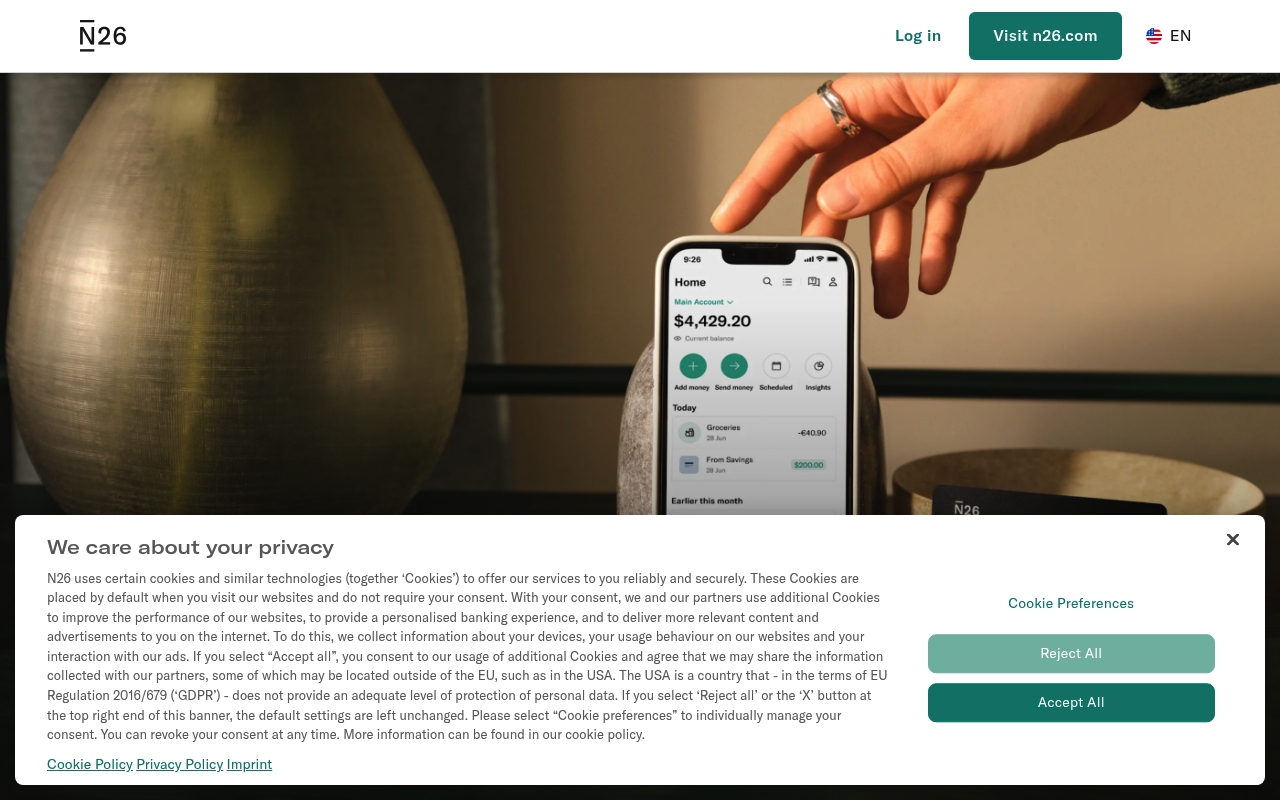
Valentin Stalf and Maximilian Tayenthal started in Vienna in 2013 with a product that sounds strange now and sounded stranger then: a prepaid card for teenagers, controlled by their parents through an app. The pivot came quickly. What they had actually built was a mobile-first banking interface, and the teenagers were incidental. Relaunched as N26 and relocated to Berlin, it became the first of the European neobanks to look genuinely modern — instant push notifications on every transaction, sign-up in minutes by video identification, an interface that made incumbent German banking apps look like they had been designed by a committee, which they had. In 2016 N26 received its own full German banking licence from BaFin, three years after founding, an unusually fast route to becoming a real bank.
Growth followed, and then the growth became the problem. BaFin, which had granted the licence, concluded that N26's controls had not scaled with its customer base. In 2021 the regulator imposed a growth cap limiting the bank to roughly 50,000 new customers per month — a restriction with no real precedent for a German bank — alongside a special monitor and fines relating to late suspicious activity reports. The cap was lifted in 2024 after substantial investment in compliance, financial crime prevention, and internal controls, but it cost N26 the better part of three years at exactly the moment Revolut and Monzo were compounding. The company also withdrew from the UK after Brexit and exited the US, narrowing to its European core.
The company that emerged is a different one, and its leadership reflects that. Both founders have stepped back from executive roles, with Mike Dargan — previously group technology head at UBS — appointed chief executive. In August 2026 the refresh reached the rest of the C-suite: CFO Arnd Schwierholz, who steered the bank through the BaFin period, announced he is stepping away with a search under way for a successor, while N26 hired Nathalie Picquot from Santander as Chief Growth and Marketing Officer and Marcin Pakulnicki from ING as Chief Technology Officer. The pattern is unmistakable and increasingly common among mature neobanks: the executives now being recruited come from the incumbent banks the challengers were built to replace, because the problems have changed from product-market fit to regulatory scale.
N26 serves millions of customers across the eurozone with a product set that has broadened well past the original current account — savings, investments including ETFs and crypto, insurance, and a subscription tier structure that has been the company's answer to interchange-dependent economics since long before that became fashionable. Its onboarding runs on Fourthline's identity verification, one of several European fintech supply-chain relationships this directory tracks. The strategic position is coherent but no longer leading: N26 is the eurozone-native neobank, strongest in Germany, Austria, France, Italy, and Spain, competing against a Revolut that is now valued at $115 billion and licensed on three continents, and a Monzo generating £1.7 billion in revenue from a single market. The three years spent fixing what BaFin found were three years not spent building, and the current chapter is about whether an institutionally rebuilt N26 can convert regulatory soundness back into growth.
Founded 2013
View profile →
Mollie
Payments
🇳🇱 Netherlands
Adriaan Mol built Mollie's first backend while living with his parents in the Netherlands in 2004. No investors, no office, no team — just a founder and an idea that small businesses deserved a payment integration that didn't require a team of lawyers and a six-month setup process. He bootstrapped it for over fifteen years before taking outside funding in 2019. By then, Mollie had already grown into one of the most important payment platforms in European e-commerce, entirely on the back of a product that developers actually liked using.
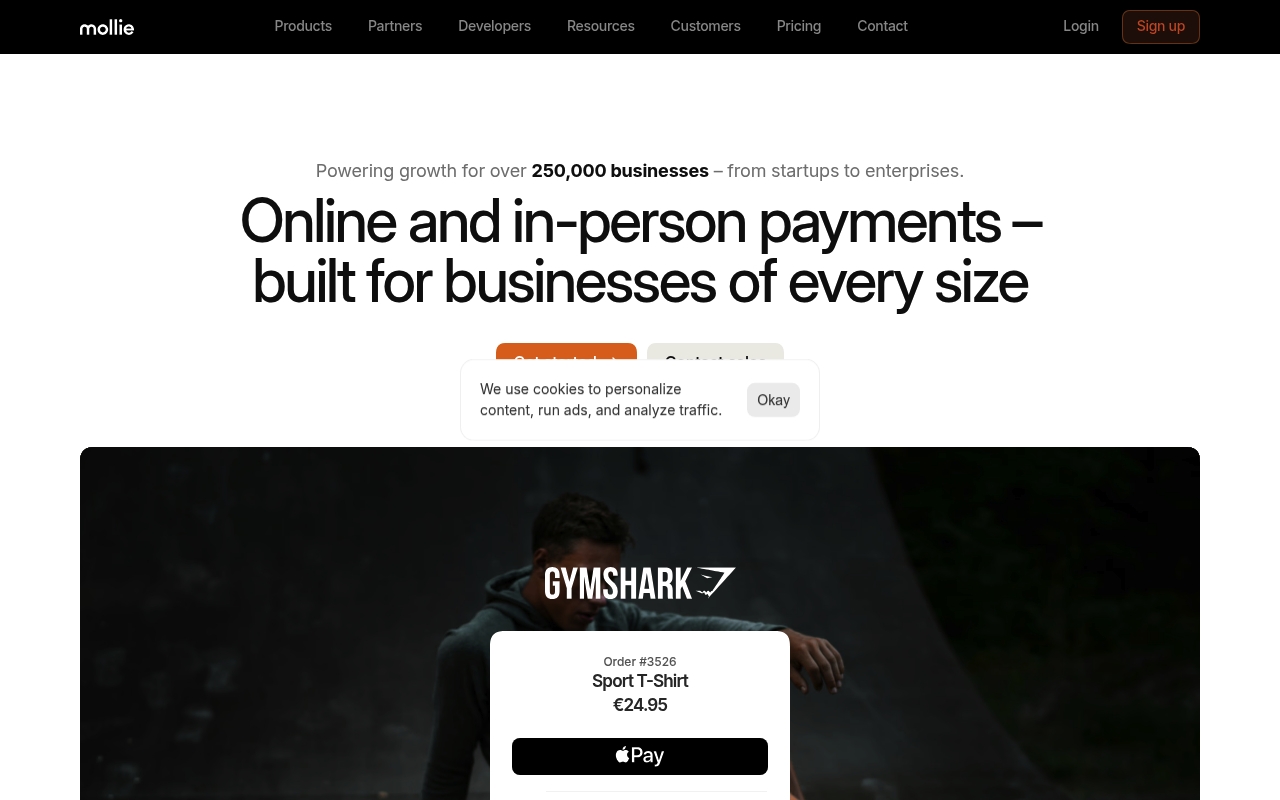
The proposition is straightforward: one API, one dashboard, and access to the payment methods that actually matter across Europe. That means iDEAL in the Netherlands, Bancontact in Belgium, Klarna and SEPA Direct Debit everywhere, alongside cards, Apple Pay, and a growing list of local methods that would otherwise require separate integrations and separate acquirer relationships. Mollie handles the compliance, the fraud monitoring, and the settlement complexity. Merchants get a clean interface and a single invoice.
For the 250,000 businesses using Mollie today — ranging from Gymshark and Wild to local bakeries and market stalls, as CEO Koen Köppen regularly points out — the appeal is less about feature lists and more about what they don't have to think about. European payments are fragmented by design. Every country has its preferred methods, its own regulatory quirks, its own consumer habits. Mollie's job is to make that invisible.
The numbers from 2024 reflect a company that has found its model. Revenue reached €214 million, up 28% year on year, with gross profit growing 30% to €115 million and the company returning to positive EBITDA for the first time since 2018. Mollie raised a total of $940 million in funding and was valued at $6.5 billion following its 2021 Series C led by Blackstone.
The most significant recent development is the acquisition of GoCardless in December 2025 — bringing the UK-based direct debit specialist into the Mollie group and substantially expanding its recurring payments and bank transfer capabilities across Europe. Combined, the two companies cover a considerable share of European e-commerce payment infrastructure.
Mollie is still headquartered in Amsterdam, with around 900 employees across offices in Ghent, London, Lisbon, Munich, Milan, Paris, and beyond.
Founded 2004
View profile →
SumUp
PaymentsDigital BankingSME Finance
🇩🇪 Germany
SumUp is a payments company built for the merchants traditional providers never bothered with. Founded in 2012 and headquartered in London, it sells low-cost card readers and point-of-sale hardware to small businesses — market traders, cafés, hairdressers, tradespeople — who could never justify the monthly fees, multi-year contracts, and cumbersome terminals that legacy processors demanded. The core proposition has barely changed since launch: buy a card reader outright for a modest one-off price, pay a small percentage per transaction, and sign nothing.
That model has scaled a long way past its origins. SumUp now serves more than 4 million merchants across roughly 35 markets, employs around 4,000 people, and was valued at about €8 billion in a 2022 round led by Bain Capital. In 2024 it raised a €1.5 billion private credit facility led by Goldman Sachs, and it has been weighing a stock market listing that could value it as high as $15 billion.
The more significant shift is that SumUp is no longer a card reader company. Through a run of acquisitions — Payleven, the e-commerce platform Shoplo, the core banking provider Paysolut, POS software firm Tiller, and the US loyalty startup Fivestars — it has assembled a full financial stack for micro-businesses: a business account and card, invoicing, an online store, loyalty tools, self-service kiosks, and SDKs for developers who want to embed card acceptance in their own products. The ambition is to be the only software a small merchant needs to run their business.
That leaves SumUp in an unusual competitive position. On hardware and in-person payments it faces Square, Zettle, and Dojo; as a broader business platform it edges toward Stripe, Mollie, and Revolut Business. Its defensibility rests on the segment most of the industry finds too small to serve properly — the micro and nano merchants that make up the long tail of European commerce.
Founded 2012
View profile →
Tinaba
WealthPaymentsDigital Banking
🇮🇹 Italy
Tinaba offers mobile banking, payments, and investment services in Italy.
View profile →
Qonto
PaymentsDigital BankingLendingSME Finance
🇫🇷 France
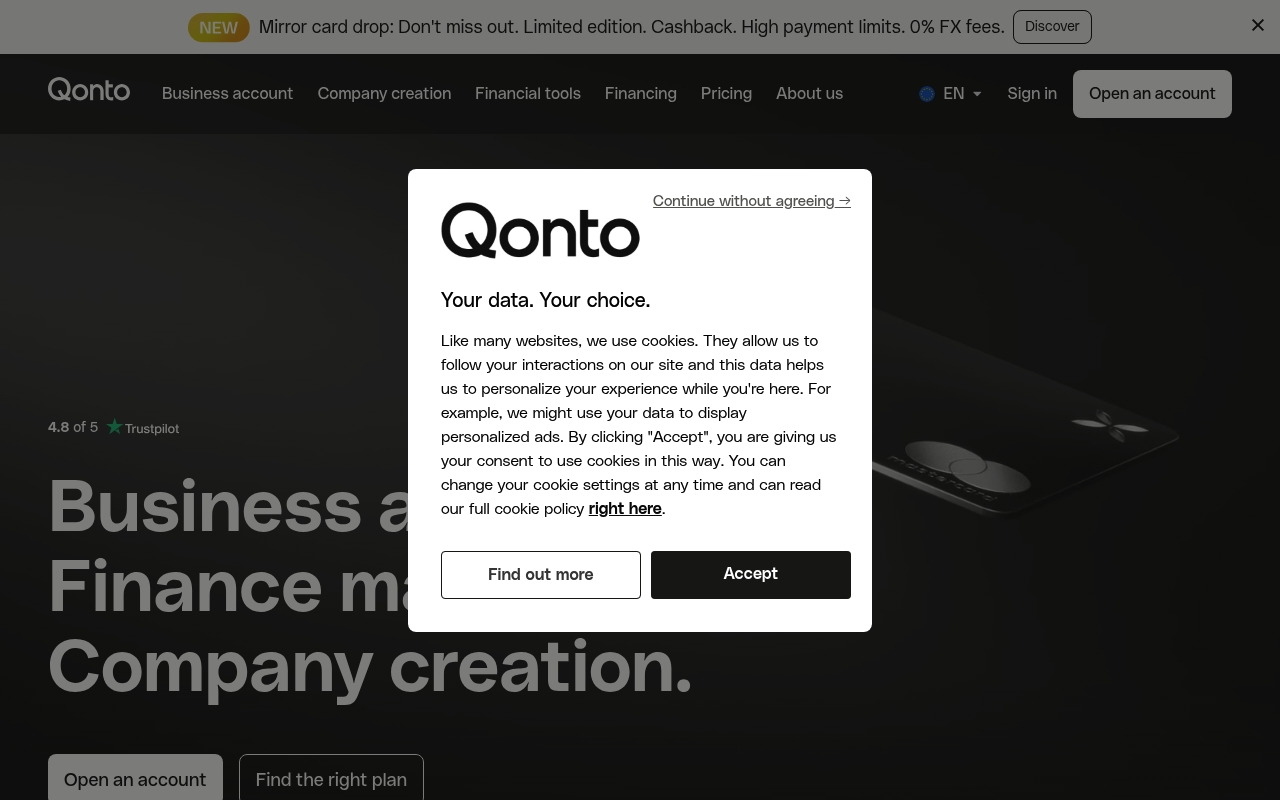
Qonto is a French business banking platform for freelancers and SMEs — though, strictly speaking, it isn't a bank. It has operated since 2018 under a payment institution licence from France's ACPR, with customer funds safeguarded at Crédit Mutuel Arkéa, and only filed for a full French banking licence in July 2025. The distinction matters more than it sounds: that licence is the thing standing between Qonto and the lending, savings, and investment products it wants to sell directly.
Founded in 2016 by Alexandre Prot and Steve Anavi — Prot the son of Baudouin Prot, former chairman of BNP Paribas, which gives the challenger story a certain symmetry — the company set out to build the business account the founders wished they'd had. The product wraps a business account around the admin that surrounds it: invoicing, expense management, bookkeeping automation, cash flow forecasting, sub-accounts, and accounting integrations. Prot's own pitch is that customers save roughly two hours a week on paperwork.
That has scaled into the leading position in European B2B banking. Qonto passed 600,000 customers across eight markets — France, Germany, Italy, Spain, Austria, Belgium, the Netherlands, and Portugal — employs around 1,600 people, and has been profitable since 2023. It raised a $552 million Series D in 2022 at a $5 billion valuation and hasn't needed to raise since; profitability means even the banking licence push can be funded from what it already holds. Two acquisitions shaped it: German rival Penta in 2022, which brought 50,000 customers and a real German footprint, and accounting automation platform Regate in 2024, which opened up accountants and accounting firms as a new customer segment.
The direction of travel is credit. Qonto has launched a Pay Later product, financing from €150 to €50,000, and added its first business credit card and overdraft facilities in January 2026 — all currently dependent on partnerships. A full banking licence would let it do that lending on its own account, which is the entire point of the application and the foundation of its stated goal of two million customers by 2030. Its competitive set is the European business banking cohort: Revolut Business, Tide, Holvi, Pennylane, and the incumbent banks it was built to route around.
Founded 2016
View profile →
GoHenry
PaymentsPersonal Finance
🇬🇧 United Kingdom
GoHenry created a category. When Louise Hill and her co-founders launched it in the UK in 2012, financial products for six-to-eighteen-year-olds essentially did not exist beyond a savings account and a paper passbook. GoHenry paired a prepaid debit card with parental controls and an app built for both sides of the relationship: children learn to earn through chores and tasks, spend within limits their parents set, save toward goals, give to charity, and work through gamified money lessons, while parents monitor transactions in real time and guide the decisions.
The business model was as deliberate as the product. Rather than offering the card free and earning interchange on children's spending — which would have meant profiting from kids spending more — GoHenry charged parents a monthly subscription. That alignment is the reason the brand earned the trust it did: more than two million young people have used the app since 2012, and it holds a net promoter score of +58, exceptional for any financial product and remarkable for one sold to parents.
The ownership has changed twice in three years. In April 2023, GoHenry was acquired by Acorns, the US micro-investing app, in an all-equity deal that also brought in Pixpay, the French competitor GoHenry had itself acquired — giving Acorns a European foothold and a combined six million subscribers. Then in June 2026, Barclays agreed to acquire the GoHenry UK business from Acorns for a reported £180 million, with completion expected in Q4 2026 subject to regulatory approval. Acorns retains the US business, now operating as Acorns Early, and Pixpay in Europe.
The Barclays deal is more interesting than its size suggests. A major high street bank buying a children's money app is lifecycle banking made explicit: win the child at eight, keep the relationship through the first current account, the first mortgage and the pension. Barclays has said GoHenry will continue as its own brand and app rather than being folded into the bank. For this directory, the practical position is that GoHenry is a UK fintech that pioneered youth financial education, is currently owned by a US parent, and is in the process of becoming part of Barclays — no longer independent, but still operating, and still the reference product in its category.
Founded 2012
View profile →
Biller
PaymentsBNPLSME Finance
🇳🇱 Netherlands
Biller provides B2B buy-now-pay-later and invoice payment solutions.
View profile →
Zepz
Payments
🇬🇧 United Kingdom
Ismail Ahmed spent years as a compliance advisor to the United Nations Development Programme working on remittances, which meant he understood better than almost anyone what the industry cost the people using it — and that the cost fell hardest on migrants sending money to the countries least able to absorb the loss. He founded WorldRemit in London in 2010 with Catherine Wines and Richard Igoe to move that transaction online, cutting out the cash-agent networks that had defined remittances since Western Union.
The company today is a group rather than a brand. WorldRemit acquired Sendwave — a mobile-first remittance company focused on transfers to African and Asian mobile wallets, founded in 2014 by Drew Durbin and Lincoln Quirk — and reorganised in 2021 under the Zepz parent, with both brands operating separately. Combined, they serve more than 11 million customers, send from around 50 countries to more than 130, and operate over 5,000 transfer corridors. Both are fully digital on the sending side; on the receiving end, money lands in bank accounts, mobile wallets, or for cash pickup, depending on what the corridor supports.
The financial history is more turbulent than the mission suggests, and an honest profile has to include it. Zepz was valued at $5 billion in an August 2021 round of $292 million led by Accel. A planned US listing at up to $6 billion was shelved in 2022 while the company resolved what it described as accounting difficulties, amid senior management turnover. Three rounds of layoffs followed — 420 people (26% of staff) in 2023, a smaller round later that year, and around 200 more in early 2025 as it closed operations in Poland and elsewhere. Mark Lenhard, formerly COO of Bill.com, has led the group since 2022, with Ahmed remaining as non-executive chairman. Capital has continued to arrive: $267 million in a Series F in October 2024 led by Accel with LeapFrog, TCV and the IFC, and $165 million in growth financing from HSBC Innovation Banking in April 2025.
The strategic position is genuinely valuable and genuinely difficult. Digital remittances serve a market of enormous social importance — global remittance flows exceed development aid by a wide margin — with structurally thin margins, heavy compliance costs in exactly the corridors that matter most, and competition from both incumbents like Western Union and newer entrants including Wise, Remitly and LemFi. Zepz reached profitability in 2022 and has spent the years since removing the cost duplication that the WorldRemit–Sendwave combination created. Whether the $5 billion mark from 2021 bears any relation to what the business is worth today is unknown; no round since has published a valuation.
Founded 2010
View profile →