Market data Companies in Europe
Market data platforms collect, normalise, and distribute the real-time and historical price, volume, and reference data that financial market participants depend on for trading decisions, risk management, and compliance reporting. The quality, latency, and breadth of market data has become a competitive differentiator, particularly for algorithmic trading firms and quantitative investment strategies.
European Market data companies in our database
Notable market data companies include DEGIRO, Credit Benchmark, SIX Group, Eilla AI and eToro.
DEGIRO is a Dutch discount broker built on a single observation: the marginal cost of executing a stock trade is software and settlement, not human labour — so the fees European retail investors were paying bore little relation to what a trade actually cost. Founded in Amsterdam in 2008 by former BinckBank employees, it started as an institutional broker, opened to retail investors in 2013, and undercut the incumbents by a wide enough margin to expand across the continent within a few years. The product is deliberately unglamorous. No gamification, no social feed, no notification congratulating you on a €5 deposit. DEGIRO offers direct access to dozens of exchanges across Europe and the US, real market data, and low per-trade pricing, and it assumes you already know what you want to buy. That utilitarian positioning has aged well as the novelty of investing apps has faded and European retail investors have matured past the onboarding experience into simply wanting to invest efficiently. DEGIRO is no longer independent. German broker flatex AG agreed to acquire it for around €250 million in December 2019, with the legal merger into flatexDEGIRO Bank completing in May 2021. The combined group trades on the Frankfurt Stock Exchange, joined the MDAX in March 2025, and converted from an AG to a European Company (SE) at the end of 2025. It now runs three brands — DEGIRO for international European markets, flatex for Germany and Austria, and ViTrade for active traders — together serving more than 3.5 million customers across 16 countries, with over €95 billion in assets under custody and more than 75 million transactions a year. Group revenue reached €559.8 million in 2025 with net income of €160.4 million, up from €71.9 million in 2023. The regulatory record is less tidy than the pricing story. The Dutch AFM fined the bank €2 million in 2022 over late and inaccurate reporting of unusual transactions, reduced to €797,500 on appeal in 2025. BaFin has issued a series of penalties: €1.05 million in 2023 for breaches of banking supervisory rules, accompanied by additional capital requirements and a special representative appointed to oversee remediation; €560,000 in December 2025 for advertising free investment services without clearly disclosing that a processing fee applied; and €1 million in April 2026 for failing to publish inside information promptly. Leadership has churned alongside it — CEO Frank Niehage resigned in 2024 after a public dispute with founder and major shareholder Bernd Förtsch, and former Morgan Stanley Europe CEO Oliver Behrens took over that October.
Credit Benchmark sits at the intersection of market transparency and institutional risk management. Founded to solve a specific problem—banks and asset managers couldn't easily benchmark their credit exposures against the broader market—it's evolved into a critical infrastructure play in the institutional credit space. The platform aggregates anonymized credit opinions from major financial institutions, creating a real-time view of how the world's largest investors see credit risk. Rather than relying on traditional ratings agencies or proprietary models, Credit Benchmark lets institutions see how their views stack up against peers, identify outliers, and stress-test assumptions across thousands of corporates and sovereigns. This crowdsourced intelligence has become essential for risk committees, portfolio managers, and regulators navigating an increasingly complex credit landscape. The company operates quietly but with significant reach—used by central banks, pension funds, and major corporates to understand systemic credit risk. In a world where traditional credit signals lag reality, Credit Benchmark offers something rare: a real-time consensus view built on the opinions of sophisticated investors who have real money at stake. It's infrastructure for an industry that desperately needed transparency on how credit risk is actually perceived, not how it's officially rated.
SIX is what happens when a country's banks decide to own their own plumbing. Formed in 2008 from the merger of the SWX Swiss Exchange, SIS and Telekurs, SIX Group Ltd is owned by around 120 Swiss and international financial institutions — the same banks that use it — and operates the infrastructure on which the Swiss financial centre runs: the stock exchange, securities settlement and custody, interbank payment processing, and the financial data that prices everything else. The name stands for Swiss Infrastructure and Exchange, and the ownership structure explains the strategy. A consortium-owned utility optimises for reliability and long-term position rather than for quarterly earnings, which is why SIX has been able to make acquisitions that took years to pay off. The largest of those reshaped the company. SIX acquired Bolsas y Mercados Españoles — the operator of the Spanish stock exchange — in 2020, giving a Swiss, non-EU company a substantial regulated presence inside the European Union, and it followed in 2025 with the acquisition of the UK's Aquis Exchange. The strategic direction is explicitly pan-European: SIX has said it intends to combine SIX x-clear with BME to create a unified multi-asset central counterparty across Europe, and the stated ambition is to be a genuinely European infrastructure provider rather than a Swiss one with foreign subsidiaries. The group runs four business units — Exchanges, Securities Services, Financial Information, and Banking Services — with roughly 4,000 employees. Operationally, 2025 was the strongest year in the company's history and the accounts still showed a loss. Net operating income rose 4.7% to CHF 1,496.5 million, EBITDA excluding transformation costs jumped 22.2% to CHF 542.3 million, and adjusted group net profit reached CHF 247.2 million, up 20.9%. The reported group result was a loss of CHF 313.7 million — entirely because of CHF 560.9 million in value adjustments on the Worldline stake. That holding is the residue of the 2018 sale of SIX's card business to Worldline, paid for in shares, and it has been written down repeatedly as Worldline's price collapsed: roughly CHF 862 million in 2023, CHF 168 million in 2024, and CHF 561 million in 2025. In November 2025 SIX reclassified the participation from an associate to a financial investment and declined to take part in Worldline's capital increase, accepting dilution from 10.5% to roughly 1.3%. The stake can no longer materially damage the accounts, which is the point. Bjørn Sibbern, the Danish former Nasdaq and OMX executive who became CEO on 1 January 2025 succeeding Jos Dijsselhof, is running a group-wide programme called Scale Up 2027 targeting an EBITDA margin above 40% by the end of 2027. The part of SIX most relevant to fintech buyers is Financial Information, a business with over a thousand staff and around CHF 418 million in revenue whose roots run back to Ticker AG in 1930. It supplies reference data, pricing, indices, and — increasingly — regulatory and tax services, competing with Bloomberg, LSEG and SIX's own owners' internal capabilities. Within that unit sits a product worth noting because it addresses a compliance gap that the mainstream AML vendors mostly don't: the Sanctioned Securities Monitoring Service, which screens securities, issuers and investment restrictions rather than individuals and entities. Most sanctions screening in this directory — ComplyAdvantage, World-Check and their peers — answers the question of whether a person is sanctioned. Whether a specific ISIN is caught by an investment prohibition, or whether an issuer's ownership structure triggers a restriction, is a different data problem, and one that got considerably harder after 2022 as sanctions regimes moved from named individuals to sectoral and securities-level prohibitions. It is the kind of unglamorous, high-consequence dataset that a 95-year-old financial data business is well placed to maintain.
AI for finance has moved quickly from experimental capability to genuine product opportunity, and the early movers building specialised AI tools for financial workflows have a chance to define how the technology integrates with the way finance professionals actually work. Eilla AI was founded in Tallinn in 2022 to apply large language models and AI agents to investment research and financial analysis workflows. Its platform helps investment professionals — analysts, portfolio managers, due diligence teams — process the enormous volume of unstructured information that financial decisions depend on: company filings, transcripts, market reports, news, alternative data sources. The product targets the specific bottleneck that AI is well-suited to address: the time-consuming work of synthesising large amounts of text into the structured insights that human analysts need to make decisions. The Estonian fintech ecosystem has produced a disproportionate number of internationally relevant companies, and Eilla represents the AI-native generation of European fintech infrastructure. In the broader landscape of AI applied to finance, where every major institution is experimenting with internal AI tools, specialist external platforms like Eilla have to demonstrate that their product depth and ongoing model development justify their use over generalist AI tools that everyone has access to.
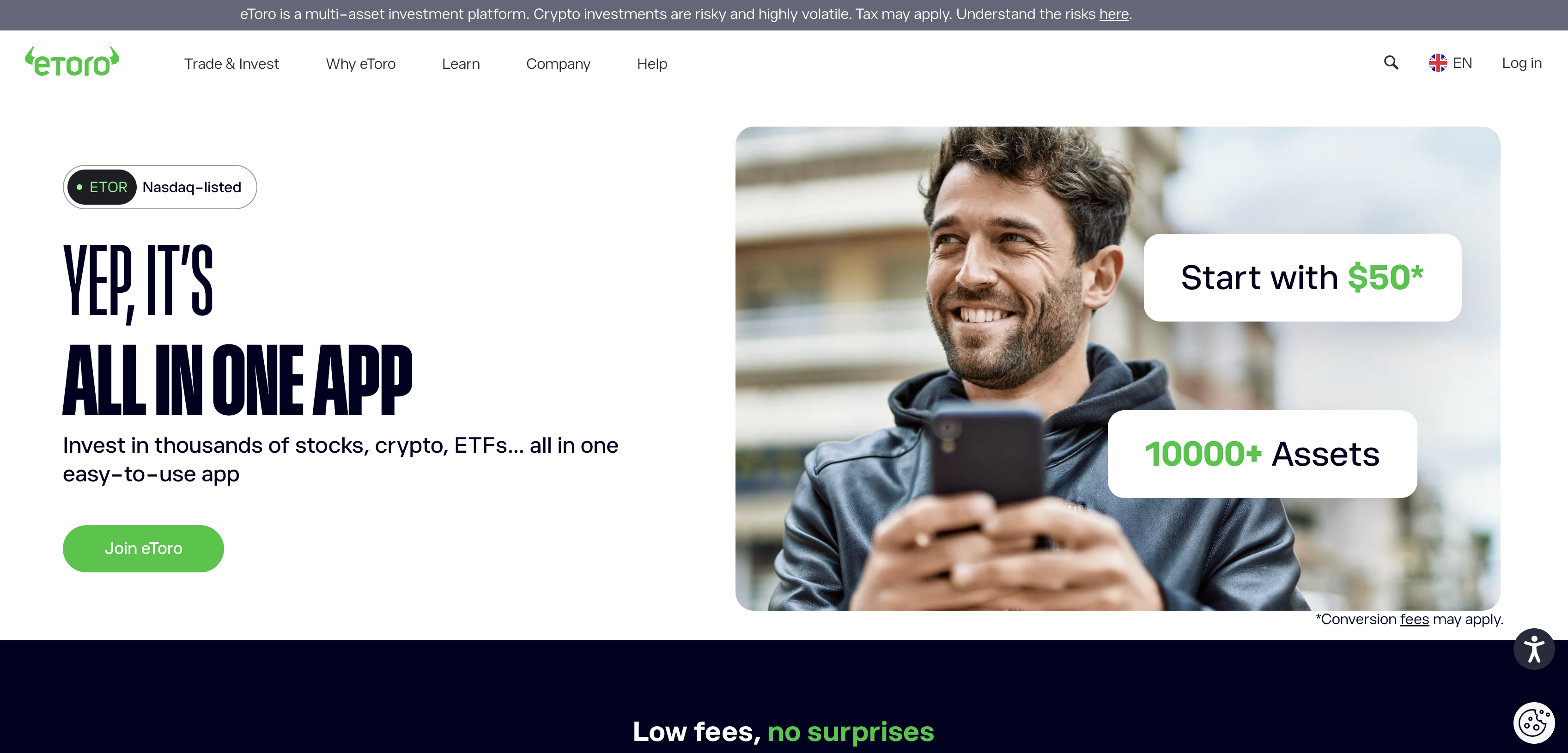
eToro is a social trading and multi-asset investment platform built on a simple, contested premise: that retail investors do better when they can see and copy what other investors are doing. Founded in Tel Aviv in 2007 as RetailFX by brothers Yoni and Ronen Assia with David Ring, it launched OpenBook in 2010 — introducing the copy trading feature that still defines it, where you follow other traders and their positions replicate automatically in your own portfolio. The platform spans stocks, ETFs, commodities, currencies, crypto, and CFDs, with fractional shares and commission-free stock trading. It reports around 40 million registered users across 75 countries, though the more meaningful figure is 3.81 million funded accounts holding $18.5 billion in assets under administration — a gap that says a good deal about how social platforms accumulate signups versus customers. After a $10.4 billion SPAC merger collapsed in 2022, eToro went public the traditional way, listing on the Nasdaq under the ticker ETOR on 14 May 2025. Shares priced at $52, above the expected range, raised roughly $620 million, and closed the first day valuing the company at about $5.4 billion. The business is solidly profitable — net income of $216 million in 2025, after $192 million in 2024 and just $15 million in 2023 — but the volatility of that trajectory exposes the underlying dependency: eToro's fortunes track the crypto cycle closely, with crypto volumes tripling to $12 billion in 2024 before investors rotated back toward equities. Its European position rests on regulatory infrastructure rather than origin. eToro is an Israeli company headquartered near Tel Aviv, operating in Europe through a CySEC-regulated entity that secured a MiCA permit for crypto services in February 2025, alongside FCA-authorised UK operations. The copy trading model itself remains genuinely contested — whether it constitutes investor education or a mechanism for propagating overconfidence is an open argument — and in 2024 the company paid $1.5 million to settle SEC allegations that it had operated as an unregistered broker in the US, restricting its American crypto offering.
Invao is a platform that turns alternative data into investment insights for institutional investors. Rather than relying solely on traditional financial statements, Invao aggregates non-traditional signals—from supply chain activity to hiring patterns to real estate movements—and converts them into actionable intelligence for portfolio managers and hedge funds. The platform appeals to investors tired of conventional analysis, offering a faster, more granular view of how companies actually operate beneath the surface of published reports. What sets Invao apart in the European alternative data space is its focus on operational intelligence rather than sentiment analysis. While competitors chase social media signals and news sentiment, Invao digs into the physical and behavioral data that precedes market moves. The company works with institutional clients who need edge in competitive markets, providing APIs and dashboards that integrate seamlessly into existing investment workflows. Invao represents a broader trend: the professionalization of alternative data investing, where institutional capital is moving beyond gut calls and into systematic, data-driven decision-making. The platform sits at the intersection of market infrastructure and information asymmetry—those who can process alternative data faster and more accurately gain an advantage. For serious institutional investors, Invao is becoming part of the essential toolkit.