Identity fraud detection Companies in Europe
Identity fraud detection focuses specifically on the fraud typologies that exploit identity — synthetic identities (fabricated personas combining real and fake data), stolen identities (using another person's credentials), account takeover (gaining unauthorised access to a legitimate account), and first-party fraud (a real person misrepresenting themselves). Identity fraud detection uses document verification, biometric checks, device intelligence, behavioural signals, and cross-reference against fraud databases to catch these patterns at onboarding and throughout the customer lifecycle.
European Identity fraud detection companies in our database
Notable identity fraud detection companies include Feedzai, Ravelin, ComplyAdvantage, Callsign and SEON.

Feedzai is a fraud detection and financial crime prevention platform that works behind the scenes for banks, payment processors, and fintech companies across Europe and beyond. The company uses machine learning to spot suspicious transactions in real time, flagging fraud before it costs institutions millions while keeping legitimate customers from being blocked unnecessarily. Unlike legacy fraud systems that rely on rigid rules and lag behind new attack patterns, Feedzai's approach adapts continuously, learning from emerging threats across its network of financial institutions. The platform handles everything from card fraud and money laundering to synthetic identity schemes and account takeover attempts. It's become a critical layer of defense for institutions managing enormous transaction volumes, where manual review is impossible and false positives destroy customer experience. In the European market, Feedzai competes alongside more traditional risk vendors but stands out through its speed and sophistication. Banks increasingly rely on AI-driven systems rather than rule-based gatekeepers, and Feedzai has positioned itself as the intelligent alternative that doesn't just block transactions—it understands behavior. The company serves everyone from global systemically important banks to smaller regional players, offering both real-time decisioning and historical analytics. Feedzai represents a broader shift in how financial institutions approach security: from reactive policing to predictive intelligence.
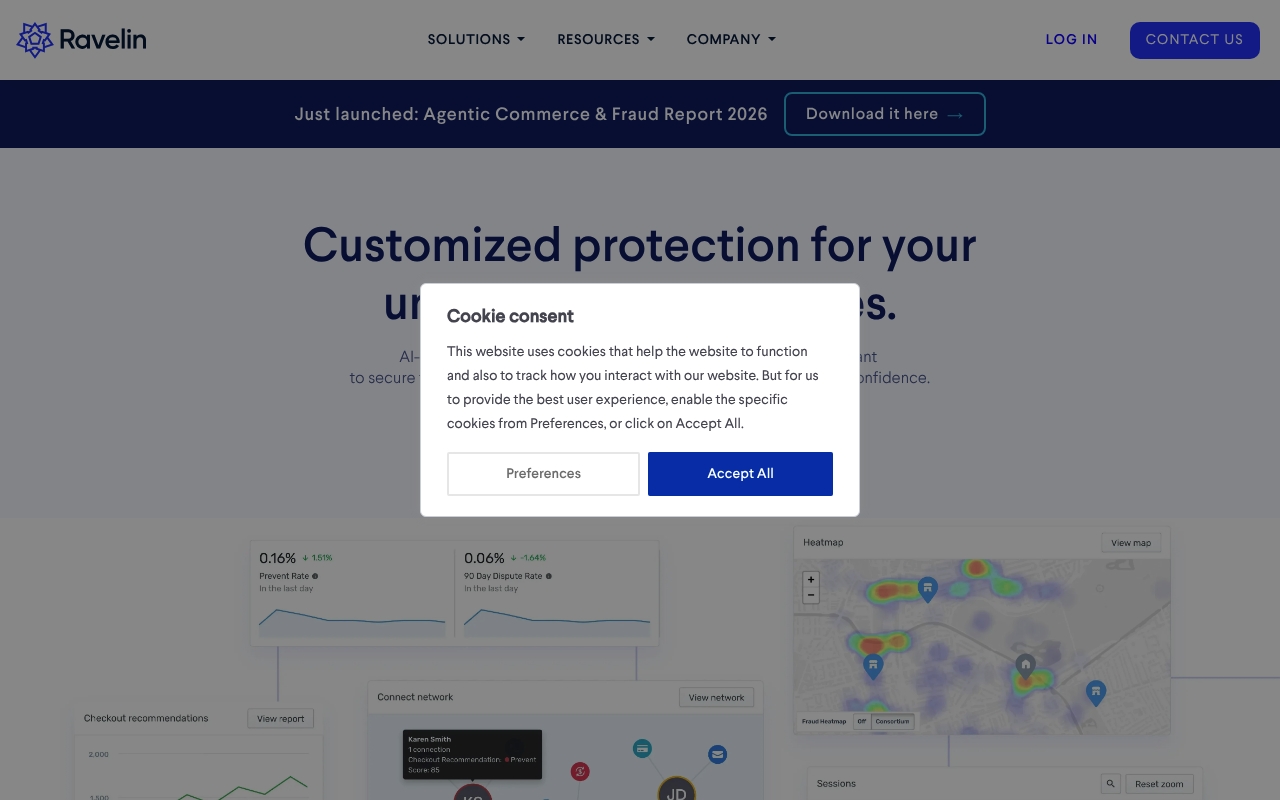
Ravelin is a fraud prevention and risk intelligence platform built for the modern payment landscape. Rather than relying on outdated blacklists and rule engines, the company uses behavioral analytics and machine learning to distinguish legitimate transactions from fraudulent ones in real time. The platform sits between merchants and payment processors, analyzing transaction patterns, user behavior, and contextual signals to catch fraud before it hits the books. Ravelin's approach acknowledges a fundamental tension in fintech: overly aggressive fraud screening kills conversions, while loose controls breed chargebacks. The company's API-first architecture means it integrates directly into checkout flows without requiring merchants to rebuild their payments infrastructure. What sets Ravelin apart is its focus on the nuance between fraud risk and business risk. Many competitors offer binary accept-or-decline decisions; Ravelin surfaces risk scores and behavioral indicators, letting merchants make informed decisions about which transactions to challenge, approve, or send to manual review. This flexibility matters especially for high-value or unusual transactions where false positives hurt revenue. Ravelin operates primarily in the B2B space, serving mid-market and enterprise merchants across e-commerce, travel, and fintech. The company competes in a crowded fraud detection market dominated by established players, but gains ground through superior machine learning models and a merchant-centric product philosophy. As payment volumes continue to surge across Europe and digital fraud becomes increasingly sophisticated, Ravelin's technology sits at a critical chokepoint in the transaction flow.

Charles Delingpole had already built two companies before this one — The Student Room, the UK's largest student community, started when he was sixteen, and MarketInvoice, the invoice finance platform he co-founded after Cambridge. It was at MarketInvoice that he met the problem that became ComplyAdvantage: every regulated financial business is legally required to screen its customers against sanctions lists, politically exposed persons registers, and adverse media — and the databases everyone relied on for this were built by armies of analysts manually copying names into lists. The data was stale, the false-positive rates were punishing, and compliance teams spent their days clearing alerts on people who shared a name with someone on a watchlist. In 2014 he founded ComplyAdvantage in London on a simple inversion: instead of selling software that queries someone else's manually curated lists, build the risk database itself — with machine learning, from primary sources, updating in real time. That database is the product. ComplyAdvantage continuously processes millions of structured and unstructured data points a day — sanctions updates, regulatory notices, court records, news in dozens of languages — into risk profiles on more than 150 million entities, surfacing tens of thousands of new risk events daily. On top of the data layer sit the tools regulated firms actually deploy: customer screening at onboarding, ongoing monitoring as risk profiles change, payment and transaction screening, and — since 2023 — a fraud detection product that extends the platform from "who is this customer" to "what is this customer doing." The strategic position is precise: this is the data layer of financial crime compliance, sold as an API, competing directly with Dow Jones Risk & Compliance, LSEG's World-Check, and LexisNexis — incumbents whose core asset is exactly the manual process ComplyAdvantage was built to obsolete. The customer base is over 500 enterprises across 75 countries, weighted toward the businesses that grew up alongside it: fintechs, payment companies, crypto platforms, and digital banks that needed compliance infrastructure as programmable as the rest of their stack. Named clients have included Gemini and TransferMate, with partnerships spanning blockchain analytics (Elliptic) and Banking-as-a-Service (Raisin Bank). The company was selected as a World Economic Forum Technology Pioneer, employs around 480 people, and has raised over $150 million from Balderton Capital, Index Ventures, Ontario Teachers' Pension Plan, and Goldman Sachs. In December 2023 it acquired Golden, the a16z-backed knowledge-graph startup, folding structured entity data and its engineering team into the core database. Leadership formalised the company's second act in early 2023: Delingpole moved to executive chairman and Vatsa Narasimha — previously CEO of the trading platform OANDA, and ComplyAdvantage's COO through its scaling years — took over as chief executive. The regulatory backdrop since has run entirely in the company's favour. AMLD6 and the EU's new AML Authority raise screening and monitoring obligations across the continent from 2027, and every expansion of the compliance perimeter — crypto under MiCA, instant payments with sanctions screening at ten-second settlement speeds — enlarges the addressable market for exactly what ComplyAdvantage sells. The honest read is about the market's direction. Financial crime and identity infrastructure is consolidating fast — Featurespace went to Visa, Fourthline is merging with Veridas, World-Check sits inside LSEG — which leaves ComplyAdvantage as one of the few independent, at-scale data players left standing. That independence is a genuine selling point for customers wary of buying compliance data from a card network or an exchange group, and it simultaneously makes the company one of the most obvious acquisition targets in European regtech. The other open question is the arms race it chose: the same generative AI that makes screening sharper is making the launderers' synthetic identities and shell structures cheaper to produce. ComplyAdvantage's bet since 2014 has been that the detection side compounds faster. So far, the market has agreed.
Fraud prevention and digital identity verification have become the unglamorous but critical backbone of modern fintech. Callsign approaches this from an angle most security vendors miss: behavioral biometrics and real-time risk assessment that happen silently in the background, rather than tripping up legitimate users with friction-heavy verification steps. The London-based company combines device intelligence, behavioral patterns, and contextual analysis to spot fraudsters and authenticate users without making them jump through hoops. Where traditional identity verification often feels like airport security—exhausting and necessary—Callsign's approach is more like a doorman who knows your face. It's built for financial services, payments processors, and regulated platforms that need to balance security with user experience. The company works across account opening, transaction authentication, and ongoing monitoring, meaning it can catch both the obvious fraud attempts and the sophisticated ones that look almost legitimate. In a landscape crowded with point solutions, Callsign stands out by offering something closer to continuous, intelligent risk assessment than binary yes-or-no identity checks. For European fintechs growing fast and handling real money, this kind of frictionless security is no longer a nice-to-have—it's becoming the baseline expectation.
SEON exists because its founders ran a cryptocurrency exchange that was being defrauded. Tamás Kádár and Bence Jendruszák built an internal system in 2016–2017 that scored users on their digital footprint — feed it an email, phone number or IP, and it returns what social accounts that email is registered on, how old the number is, what the device looks like, and dozens of other signals correlated against fraud outcomes. They then realised the anti-fraud system was worth more than the exchange, wound the exchange down, and launched SEON as software in 2017 in Budapest. The digital footprint approach is the differentiator. Where Featurespace and Sardine emphasise behavioural biometrics and Feedzai sells enterprise transaction decisioning, SEON's core signal is enrichment: whether a person leaves the digital residue a real person leaves, returned in around 200 milliseconds. It layers AML screening and transaction monitoring on top, positioning as a single command centre for fraud and compliance. More than 5,000 businesses use it, including Wise and Revolut, and the company claims 15 million transactions secured daily. The funding history is the clearest marker of Hungarian fintech's arrival. SEON's 2021 Series A of €10 million was the largest in Hungary's history — with angels including founders of N26, SumUp, Tide, Onfido and ComplyAdvantage — followed by a $94 million Series B led by IVP in 2022 at a $500 million valuation, and an $80 million Series C led by Sixth Street Growth in September 2025. Total funding stands at $187 million. The honest caveat for a European directory: SEON's headquarters is now Austin, Texas, with Budapest as its engineering base and London also in the mix. It is a Hungarian-founded company that has followed its growth market to the US, which is worth stating plainly rather than glossing.

Fraud detection and prevention used to be reactive—companies would build rule engines and hope for the best, watching transactions after they happened. Nethone inverts that. The platform spots fraudsters before they strike, using behavioral analytics and device intelligence to identify bad actors in real time across payments, lending, and marketplaces. It's not just rule-based flagging; Nethone learns from every interaction, continuously adapting to new fraud tactics as they emerge. The company serves mid-market and enterprise clients across Europe, particularly in Poland and the broader Central European market, where it's become trusted infrastructure for preventing losses. Unlike generic fraud tools that rely on blacklists and static rules, Nethone combines machine learning with behavioral signals—how someone moves their mouse, types their password, navigates your app—to build a detailed risk picture. This approach catches both account takeovers and credential stuffing before legitimate users even realize something's wrong. In a market crowded with legacy fraud solutions and newer point tools, Nethone stands apart through device-centric intelligence and a focus on reducing false positives. Most fraud platforms block too much; Nethone aims for precision. For fintech companies, lenders, and payment networks that need fraud prevention without friction, it offers a middle ground between being too permissive and too paranoid. It's become a standard choice for European fintechs building trust at scale.