Credit scoring Companies in Europe
Credit scoring platforms assess the creditworthiness of individuals and businesses using data models that predict the likelihood of repayment. Traditional credit scoring relies heavily on bureau data — payment history, outstanding debt, credit utilisation. Alternative credit scoring uses open banking transaction data, accounting records, behavioural signals, and machine learning to assess borrowers who lack traditional credit histories, expanding access to credit for underserved segments.
European Credit scoring companies in our database
Notable credit scoring companies include Wayflyer, Credolab, Powens, 4finance and Ferratum.
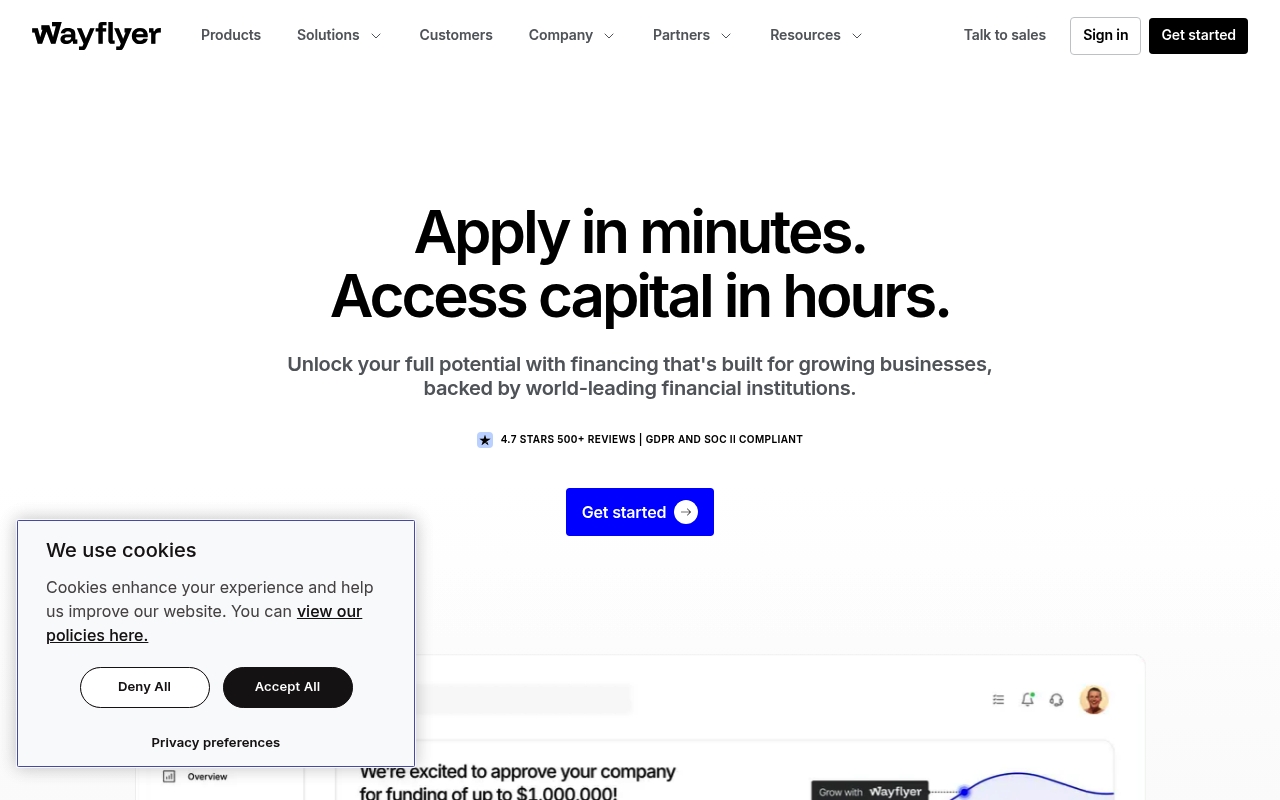
Wayflyer is an Irish fintech that solves a peculiar problem in e-commerce: founders who sell online often can't access the capital they need because traditional banks don't understand their business model. The company uses real-time sales data from platforms like Shopify and Amazon to underwrite credit decisions in minutes rather than months, offering flexible funding with repayment terms tied directly to daily revenue. What makes Wayflyer different is its willingness to lend to merchants that legacy finance overlooks—lower-revenue sellers, newer businesses, international operators. While traditional lenders fixate on collateral and personal credit scores, Wayflyer looks at transaction flows, growth trajectory, and actual business performance. The underwriting is algorithmic, the approval is fast, and the cost is transparent. You don't need perfect credit or three years of accounts. You need sales data. In the crowded world of e-commerce financing, most players focus either on micro-loans or venture-scale rounds. Wayflyer operates in the messy middle—typically funding between €5,000 and €500,000 for merchants generating €30,000+ monthly revenue. It competes with Shopify Capital in North America but has built particular strength across Europe, where merchant fragmentation is higher and credit access more constrained. The company represents a broader shift in fintech: away from point solutions toward platforms that integrate data, credit decisioning, and cash flow management. Wayflyer isn't just lending; it's becoming infrastructure for the digital commerce economy, particularly for the thousands of small sellers who power e-commerce but remain invisible to traditional finance.
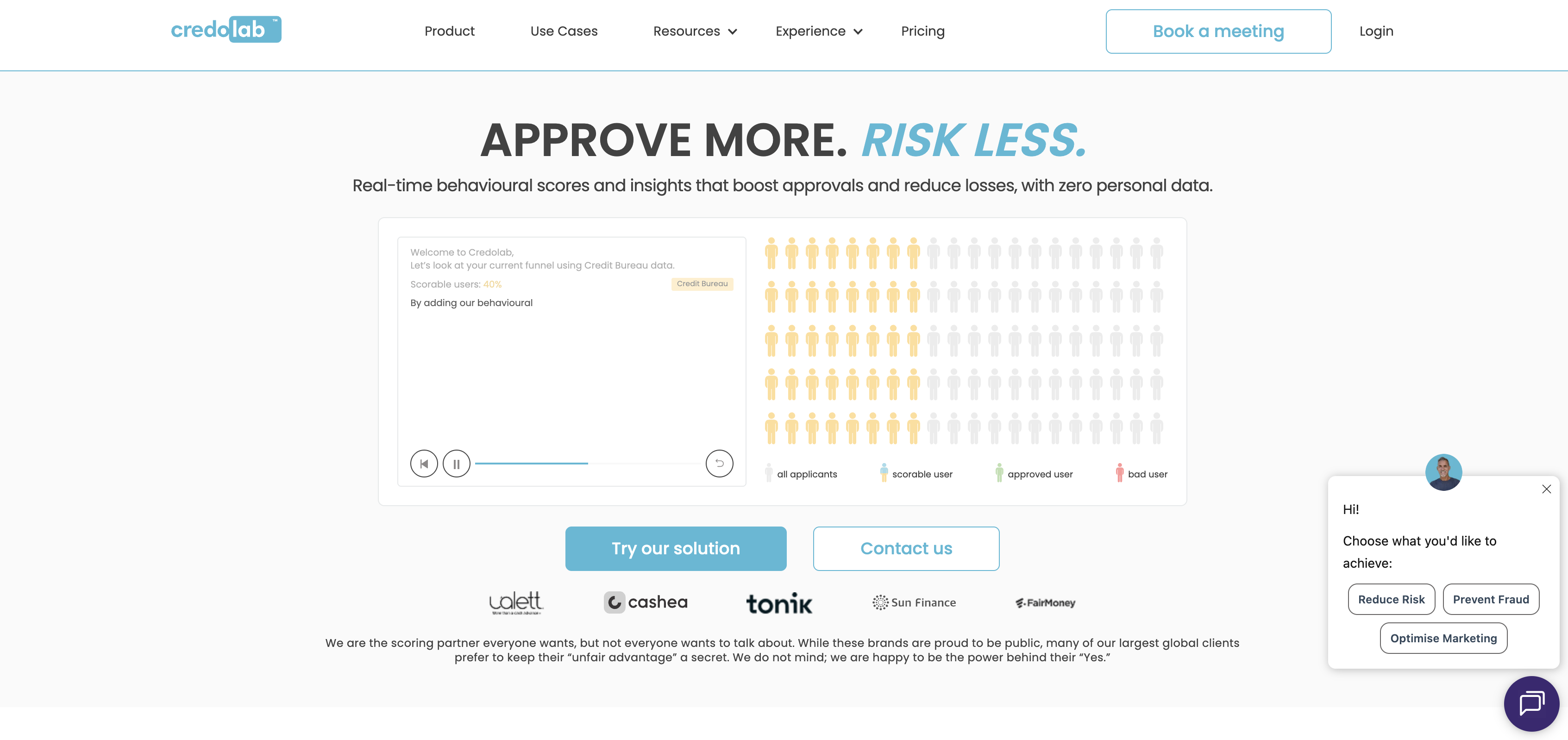
Credit decisions in markets without comprehensive credit bureau coverage have always been hard. The traditional underwriting model relies on credit history, income verification, and identity documents that significant portions of the global population either don't have or can't easily produce. Credolab was founded in 2016 with operations across Asia and Europe to address that gap with an unconventional data source — smartphone metadata. Its platform analyses behavioural patterns from a mobile device — without accessing personal content — to generate credit scores for consumers who have no traditional credit history. The data points are surprisingly predictive: how someone manages their phone storage, the pattern of their app usage, the regularity of their device behaviour all correlate with credit risk in ways that traditional underwriting misses. Credolab serves lenders, telcos, and digital platforms across emerging markets where credit bureau coverage is thin and the demand for digital credit is growing rapidly. In the alternative credit data landscape, where companies are competing to find the data sources that will define the next generation of underwriting, Credolab's behavioural smartphone approach is one of the more distinctive — and one that addresses a genuinely large unmet need in markets where billions of people remain credit-invisible to traditional financial systems.
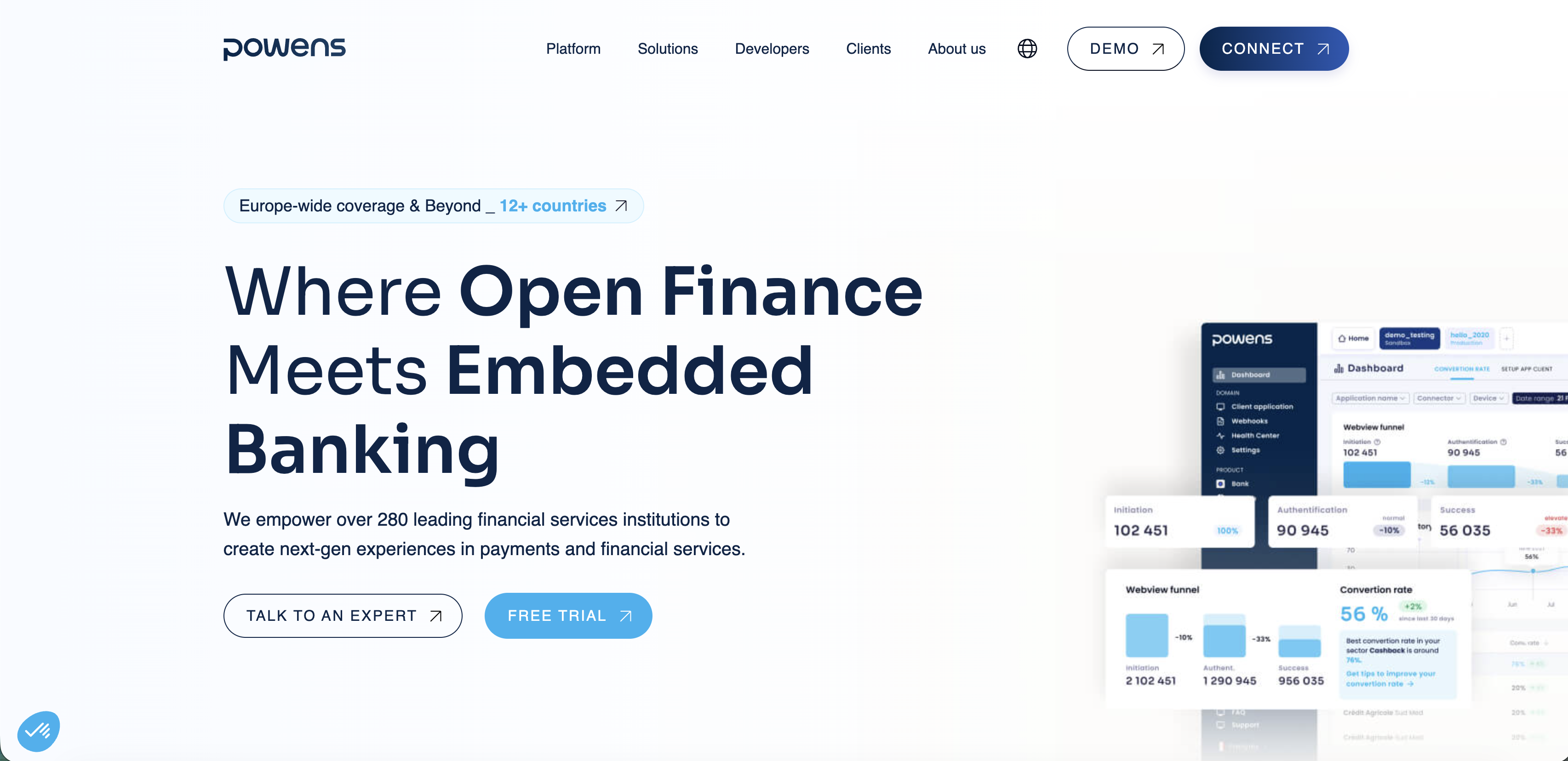
Powens sits at the intersection of open banking and financial data aggregation, helping European fintechs and traditional banks make sense of the fragmented payment and account landscape. Rather than building another me-too aggregator, the company positions itself as the connective tissue between institutions and the data they need to move capital efficiently and securely. Their platform ingests transaction data, payment initiation flows, and account information from thousands of financial institutions across Europe, surfacing clean, standardized intelligence to power lending decisions, fraud detection, and embedded finance experiences. What sets Powens apart is its focus on the continental European market—where open banking adoption is uneven and legacy banking infrastructure still dominates. While UK and US aggregators have enjoyed first-mover advantage, Powens saw an opportunity to build native expertise in Germany, France, Spain, and Benelux, where regulatory tailwinds and fragmented banking systems created genuine demand. The company works with both consumer-facing fintechs and institutional clients, meaning they've learned to navigate the messy reality of building infrastructure that talks to both sleek fintech apps and stuffy corporate banking platforms. This dual-sided approach has become their competitive moat—they understand both the user experience expectations of modern fintech and the compliance complexity of traditional finance. In the broader European fintech stack, Powens functions as a critical middleware layer, solving the unglamorous but essential problem of data connectivity that powers everything downstream—from embedded lending to fraud prevention to wealth management.

Consumer credit at scale across emerging European markets has been one of the more controversial and one of the larger businesses in European fintech. 4finance was founded in Riga in 2008 and grew into one of the largest digital consumer lenders in Europe, operating in over a dozen markets including Latvia, Lithuania, Poland, Spain, Czech Republic, Slovakia, Romania, Bulgaria, Denmark, Sweden, and beyond. Its product range includes short-term loans, instalment loans, and credit lines, distributed entirely through digital channels. The company's scale — billions in loans originated, millions of customers served — has made it both a significant financial institution and a frequent subject of regulatory and consumer protection scrutiny. The business has navigated the tightening regulation of consumer credit across multiple European jurisdictions, repositioning its product range and pricing as different markets have implemented caps on short-term lending costs. 4finance is owned by funds and operates with the operational scale of a substantial bank without holding traditional banking licences in most of its markets. In the broader European consumer fintech landscape, 4finance represents a category that exists outside the venture-backed startup conversation but processes meaningful credit volume across markets where formal banking remains less accessible than digital alternatives.

Mobile-first consumer lending was a genuinely novel concept in 2005, the year that Ferratum was founded in Helsinki. The company built one of Europe's earliest digital consumer credit businesses, offering small short-term loans through SMS and later through mobile apps — long before smartphone banking became universal. Its initial product targeted the gap between bank credit and informal lending, providing small loans quickly to consumers who needed flexibility that banks didn't offer. Ferratum expanded across more than 20 markets, received a Maltese banking licence, and rebranded to Multitude as it broadened from short-term consumer lending into a more diversified consumer banking business including a digital mobile bank. The transition from short-term lender to licensed bank reflects the broader maturation of European consumer fintech — companies that started with specific lending products evolving toward fuller-service banks as their licences and customer relationships justified the broader product range. Multitude is publicly listed on the Frankfurt Stock Exchange, making it one of the few publicly traded pan-European consumer fintechs. In the European consumer credit landscape, the company's two-decade trajectory illustrates both the original opportunity in mobile-first lending and the strategic logic of evolving toward a licensed banking model as the regulatory environment for short-term credit has tightened.

Debt collection is the part of the credit lifecycle nobody wants to look at. It is also where the reputational damage happens: a lender spends years building a brand and then outsources the hardest conversations its customers will ever have to an agency paid on recovery, working from scripts, sending anonymous letters. Audun's pitch is that this arrangement is a design failure rather than an inevitability — that most of what collections agents do is busywork an AI can run properly, and the small remainder is exactly the part that needs a human with full context. Its tagline, "a calmer way to settle things," is doing real strategic work: the company is selling recovery rates and reputational safety to creditors, on the argument that those stopped being a trade-off once the outreach could be personalised at scale. The described workflow follows the escalation ladder deliberately. Before anything becomes a collection case, the system sends timed reminders on whichever channel a person actually uses, aiming to settle invoices at the pre-collection stage. Where a debt does age, it negotiates a payment plan sized to the person's month rather than the creditor's preference, then logs and schedules it. And where a case needs judgement — a dispute, a customer flagging financial hardship, anything that doesn't fit a script — the automation pauses and hands off to a named human case handler with the full conversation history attached. Creditors get an operator console showing every stage. The stated design principle, that the machine should know when to step back, is the interesting one, because it is precisely where this category has attracted criticism. That context belongs in any honest assessment. AI collections is a well-populated YC category — Y Combinator has incubated roughly six debt collection and settlement startups in six years, including Altur, CollectWise, and Domu, the last of which reported its agents hitting tens of millions of connected calls a month. It is also the subject of active scrutiny: WIRED reported in May 2026 on AI collection agents pursuing debts that had already been settled, with consumers unable to escalate to a human. Audun's architecture reads as a direct answer to those failure modes rather than an example of them, and its Nordic starting point cuts the same way — Norwegian and Swedish debt collection are licensed activities with statutory codes of conduct and capped fees, among the strictest regimes in Europe. Building for that market first is a meaningful constraint to accept voluntarily. Beyond that, Audun is genuinely early and the public record is thin. It is Y Combinator-backed, which is real third-party validation, and its own writing suggests unusual domain depth — a July 2026 essay arguing that credit models inherit a dependency on the servicing and collections policy under which their training data was generated, making a change in collections policy a source of model risk rather than model error. That is a practitioner's argument, not content marketing. But the company has not published its founders, legal entity, licence status, headcount, or funding; the debtor-facing self-serve portal is still marked as coming; and the product screenshots use illustrative data. What exists is a credible team with a sharp thesis attacking a category that deserves attacking, at a stage where almost nothing is verifiable from outside.