DatabaseCategoriesServicesCountriesArticlesNewsletterRequest listing
← Categories

Treasury Companies in Europe

23 companies·12 countries·Updated August 2026

Treasury companies build the software corporate finance teams use to manage a company's cash, payments, and financial risk — bank connectivity platforms that pull balances from every account a company holds, cash management and liquidity forecasting tools, FX management for companies trading across currencies, and corporate payments infrastructure. It's a category that exists because a mid-sized or large company's cash doesn't sit in one place: it's spread across multiple banks, currencies, and entities, and treasury teams need a single view to avoid being cash-rich in one account while borrowing expensively in another.

Instant payments are reshaping what "real-time treasury" actually means in practice. The EU's Instant Payments Regulation now requires SEPA banks and payment providers to send and receive euro payments within ten seconds, and the accompanying rollout of the ISO 20022 messaging standard is giving those payments far richer structured data than the old formats carried — both of which treasury technology has to be built around, not bolted onto afterward.

Bank connectivity is the unglamorous foundation everything else depends on

Before a treasury team can forecast cash flow or manage FX exposure, it needs reliable, real-time visibility into every bank account the company holds — which is harder than it sounds when a company banks with a dozen institutions across multiple countries, each with different connectivity standards and reporting formats. Bank connectivity platforms exist to normalise this into a single feed, and the quality of everything built on top of a treasury stack — forecasting, payments, FX — depends on how good that underlying connectivity actually is.

Liquidity forecasting is becoming a real-time discipline

Cash flow forecasting used to be a periodic exercise — a spreadsheet updated weekly or monthly. With instant payments now settling in seconds rather than days, and bank connectivity providing near-real-time balance data, liquidity forecasting is shifting toward continuous, automated models rather than static reports, since a forecast built on last week's data is increasingly out of step with how fast money can actually move.

FX and corporate payments are converging with the connectivity layer

FX management used to be a largely separate function — hedging currency exposure through a bank relationship or a specialist FX platform, disconnected from day-to-day payment execution. That's converging: treasury platforms increasingly combine bank connectivity, payment execution, and FX conversion into a single workflow, partly because companies trading internationally want to convert and pay in one motion rather than moving money through separate systems for each step.
Subcategories
Bank connectivity (7)Cash management (11)FX management (13)Corporate payments (14)Liquidity forecasting (5)
Bank connectivity:
Bank connectivity platforms provide the technical infrastructure that allows businesses and fintechs to connect to multiple banks simultaneously — accessing account data, initiating payments, and managing cash positions across different banking relationships through a single integration.
Cash management:
Cash management platforms help treasury teams and finance departments optimise the management of liquid assets — deciding how much cash to hold in which accounts, where to invest surplus cash for short-term returns, and how to structure banking relationships to minimise idle balances and maximise interest income.
FX management:
FX management platforms help businesses that operate across currencies understand, hedge, and reduce their foreign exchange exposure — providing exposure tracking, hedging analytics, and the ability to execute forward contracts and options to lock in exchange rates for future currency requirements.
Corporate payments:
Corporate payment solutions manage the complex payment needs of mid-market and enterprise companies — bulk payment processing, multi-currency payments, supplier payments, intercompany transfers, and the reconciliation infrastructure that connects payments to financial records.
Liquidity forecasting:
Liquidity forecasting platforms help businesses predict their future cash positions — projecting inflows from receivables, outflows from payables, and the resulting net liquidity across future days, weeks, and months.
How to choose

How to choose

Check bank connectivity coverage for your specific banking relationships before anything else. A treasury platform is only as useful as its ability to connect to the banks you actually use — confirm direct support for your specific banks and countries, not just a general claim of "global connectivity."

For liquidity forecasting, ask how the model handles irregular cash flows, not just steady-state ones. Forecasting accuracy is easy to demonstrate on predictable, recurring cash flows and much harder on the lumpy, irregular ones that often matter most — ask for a forecast test against your own historical data if you can.

FX management pricing should be compared on total cost, not just the headline spread. Some providers make the visible FX spread look competitive while recovering margin elsewhere — ask for an all-in cost comparison against your current banking relationship on a representative set of trades.

Ask specifically how a platform supports instant payments and ISO 20022, not just SEPA Credit Transfer. Treasury platforms vary in how completely they've adopted instant payments and the richer ISO 20022 data standard — a platform still built primarily around older batch payment rails will increasingly lag on both speed and data quality.

For smaller finance teams, weigh an all-in-one platform against best-of-breed tools. A combined bank-connectivity-plus-forecasting-plus-payments platform reduces integration work but can mean compromising on any one function; larger, more complex treasury operations often still assemble best-of-breed tools instead.

European Treasury companies in our database

Notable treasury companies include Kyriba, Salv, ION Group, Kantox and Agicap.

Kyriba
Kyriba🇫🇷
Est. 2000

Kyriba is a cloud-native treasury and finance platform that sits at the intersection of corporate finance operations and intelligent automation. Rather than patching together spreadsheets and legacy systems, Kyriba consolidates cash management, liquidity forecasting, and working capital visibility into a single operating system for finance teams. Think of it as the command center for CFOs who are tired of fragmented data and manual workflows. The platform handles everything from multi-currency cash positioning to FX hedging and supply chain financing, all orchestrated through APIs that plug into banks and accounting systems. It's built for mid-market to enterprise companies that move serious money across borders and need to know exactly where every dollar sits at any given moment. Kyriba doesn't try to be a banker or a startup darling—it's an industrial-grade tool that speaks the language of corporate treasurers. In the European treasury space, Kyriba competes with legacy software vendors but with a modern cloud architecture that actually scales. It's the kind of platform that gets adopted quietly but becomes mission-critical once companies realize how much time their finance teams get back. The market for treasury automation remains sticky and consolidating, but Kyriba has built a defensible position by solving the unglamorous but essential work of helping large corporations optimize their balance sheets and reduce financial risk.

Salv
Salv🇪🇪
Est. 2021

Salv is a European treasury and payments platform designed for the modern finance team. Rather than juggling spreadsheets and legacy banking interfaces, Salv consolidates cash visibility, liquidity forecasting, and cross-border payments into a single, intuitive interface. The platform connects directly to a company's bank accounts—whether across Europe or globally—and gives CFOs and controllers real-time insight into cash positions, pending transactions, and upcoming obligations. What sets Salv apart is its focus on simplicity without sacrificing depth. While enterprise treasury software often demands armies of consultants and months of implementation, Salv gets finance teams operational in days. The platform handles multi-currency cash management, automates reconciliation, and streamlines payment execution—all critical functions that most midmarket companies currently manage through error-prone manual processes or expensive legacy systems. In a market dominated by entrenched enterprise players like Kyriba and Treasurit, Salv targets the overlooked middle: growth companies and mid-sized enterprises that have outgrown basic banking but don't need Fortune 500-grade complexity. It's positioned as the cash management tool for teams that want control without the headache, and it reflects a broader European fintech trend toward pragmatic, cloud-native alternatives to traditional treasury solutions. For finance leaders tired of workarounds, Salv represents the kind of infrastructure redesign that turns scattered processes into streamlined workflow.

ION Group
ION Group🇬🇧
Est. 1999

Andrea Pignataro founded ION in London in 1999, after leaving a trading role at Salomon Brothers with a conviction that the software running global markets was held together with too much manual process. Over the following two and a half decades he built ION into one of the largest, most acquisitive players in capital-markets technology — absorbing dozens of specialist vendors, including Fidessa and Broadway Technology, and folding them into a single group. The core business is still the unglamorous plumbing of institutional finance: trading platforms across equities, fixed income, foreign exchange, and cleared derivatives; risk management; post-trade processing; clearing and settlement; and market data. Investment banks, hedge funds, and corporate treasuries run parts of their daily operations on ION's systems, often without their own customers ever knowing it. Less visible is ION's regulatory technology line. Products including ION LookOut and Fidessa Surveillance handle trade surveillance, market-abuse detection, and regulatory reporting across multiple jurisdictions, and ION's compliance tools have placed in FinTech Global's RegTech 100 list for three consecutive years. It's a smaller part of the business than the trading and post-trade platforms, but a genuine one — which is why ION appears under both Capital Markets and RegTech in this directory, rather than just one. The company is headquartered in London, employs more than 13,000 people across over 50 offices worldwide, and remains privately held under Pignataro's control — a scale most consumer-facing fintechs never approach, built almost entirely on customers who are themselves in finance.

Kantox
Kantox🇪🇸
Est. 2009

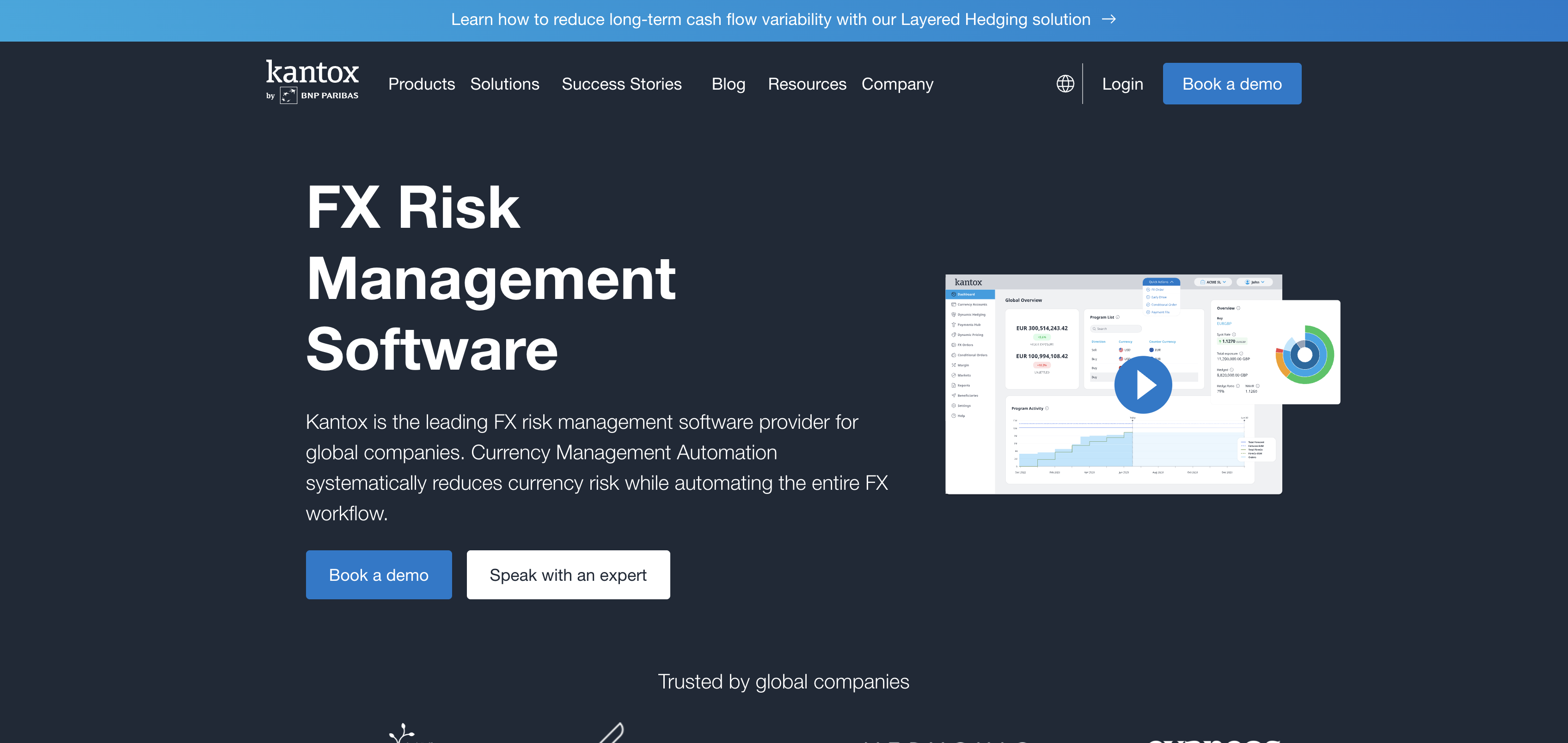
Kantox sits at the intersection of corporate finance and fintech, solving a problem that has plagued treasurers and CFOs for decades: the cost and complexity of managing foreign exchange. Rather than forcing companies through the byzantine world of traditional banks or crude hedging tools, Kantox built a platform that lets businesses buy and sell currency with transparency, speed, and intelligence. The platform aggregates liquidity from multiple sources—banks, non-bank liquidity providers, and peer matching—and surfaces the best rates in real time. No more vendor lock-in, no more opaque spreads, no more waiting. A mid-market company can execute a multi-million euro FX trade in minutes, seeing exactly what they're paying and why. What sets Kantox apart in a crowded treasury tech space is its refusal to abstract away the mechanics. The platform shows you the market, then lets you trade. It's designed for finance professionals who know what they're doing and want control back from intermediaries. The company has built serious depth in emerging markets and supply chain currencies, which most legacy providers still treat as afterthoughts. Kantox represents a broader shift in European fintech: the recognition that some of the most valuable problems live in the unglamorous corners of corporate finance, where even small improvements in execution cost save companies millions annually. In that sense, it's doing for FX what more visible fintechs have done for payments—stripping away friction and opacity from a process that should have been digital decades ago.

Agicap
Agicap🇫🇷
Est. 2014

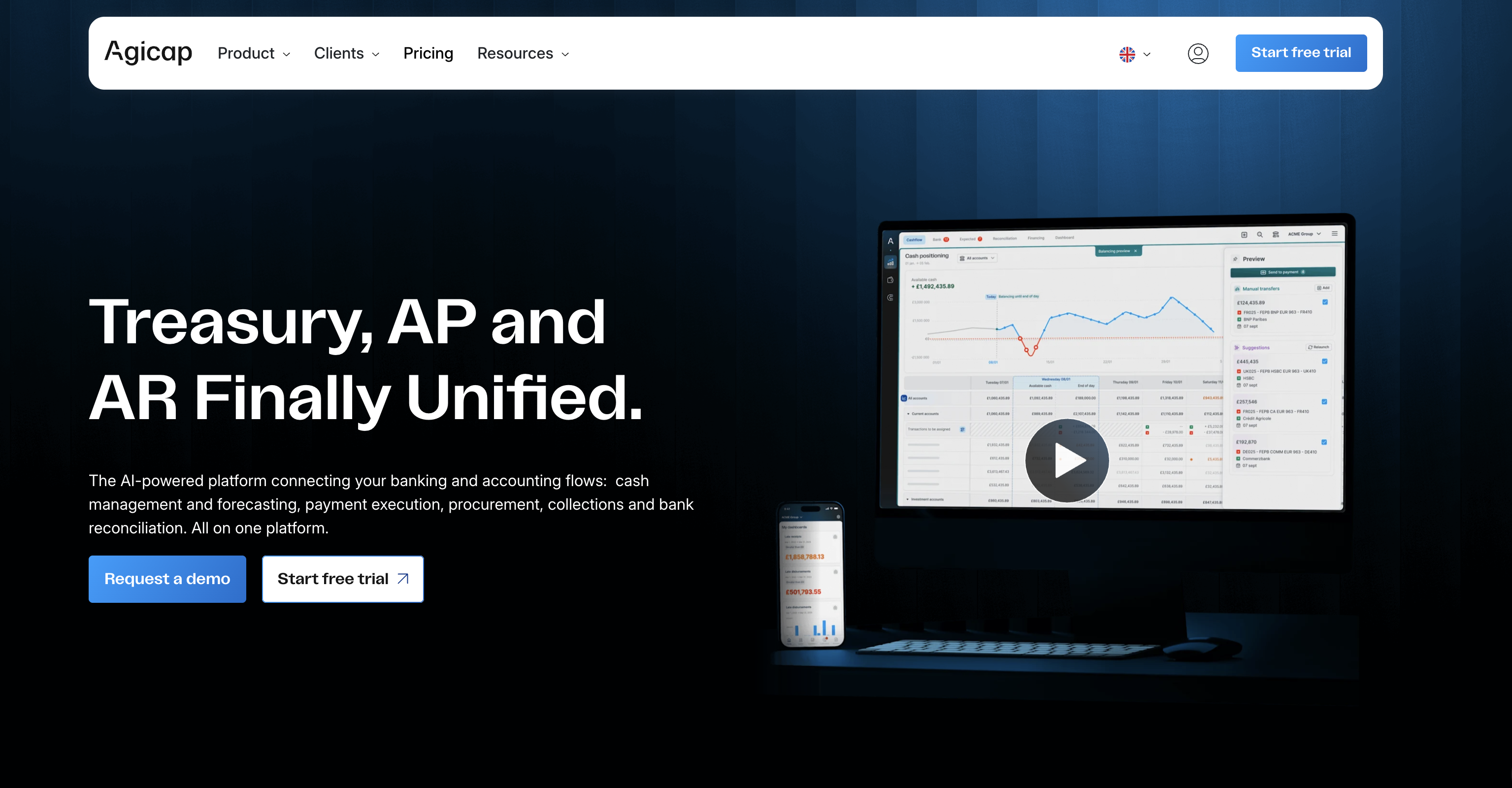
Cash flow forecasting for mid-market companies is a constant headache. Finance teams spend weeks building Excel models, updating bank balances by hand, and scrambling when surprises hit. Agicap strips away the manual drudgery with a platform that pulls real-time bank data, forecasts cash positions, and alerts teams to shortfalls before they become crises. The platform connects directly to corporate bank accounts across Europe, aggregating transactions and balances in a single dashboard. Finance teams can forecast weeks or months ahead, model different scenarios, and plan borrowing or investment with confidence. It's built for the CFO or finance manager at a growing company—someone managing millions but not yet running a treasury department. In a crowded space of cash management tools, Agicap distinguishes itself through simplicity and breadth of bank connectivity. Where some competitors focus on large enterprises or niche workflows, Agicap targets the mid-market sweet spot: companies that have outgrown spreadsheets but aren't yet ready to deploy enterprise software. The platform's strength lies in its ease of setup and integration with French, German, and UK banking networks. Agicap sits at the intersection of SME finance and treasury, filling a gap for companies that need working capital visibility without the complexity or cost of traditional corporate treasury platforms.

Mooncard
Mooncard🇫🇷
Est. 2016

Mooncard is a French-born corporate card platform that treats company spending like it actually matters. Built for mid-market businesses tired of expense report theatre, it combines physical and virtual cards with real-time spend visibility and automated compliance—no more spreadsheets, no more manual reconciliation, no more explanations that take longer than the purchase itself. The platform issues cards to employees while maintaining absolute control at the center. Managers see transactions as they happen, approval workflows happen instantly, and accounting teams get data that's actually usable. It's less about giving employees freedom and more about giving finance teams their sanity back. Unlike American corporate card incumbents that charge per card and treat integration like a favour, Mooncard pricing is transparent and the API connects to your actual accounting system. In Europe, where regulatory requirements and multi-currency complexity are facts of life, that matters. It's particularly resonant in France and across Western Europe, where the mid-market had essentially given up on tools that work. The company sits in a competitive space—Brex and others are moving downmarket, while legacy corporate card providers are finally waking up. But Mooncard's positioning is distinctly European: designed for how mid-sized companies actually spend money here, not adapted from American assumptions. That localised approach has made it one of the few European fintech companies that's actually winning on its home turf.

View all 23 Treasury companies →

Frequently asked questions

How many Treasury companies are there in Europe?
The fintechdatabase.eu directory lists 23 Treasury companies across 12 European countries.
What are the biggest Treasury companies in Europe?
The most popular Treasury companies in the directory are Kyriba, Salv and ION Group.
Which European countries have the most Treasury companies?
United Kingdom, Germany and France have the most Treasury companies in Europe.
How many treasury companies are there in Europe?
The directory currently tracks around 22 treasury companies, spanning bank connectivity, cash management, FX management, corporate payments, and liquidity forecasting.
What is corporate treasury technology used for?
It gives a company's finance team a consolidated view of cash across multiple bank accounts, currencies, and entities, and helps them manage liquidity, execute payments, and hedge currency risk — functions that become genuinely difficult to do manually once a company banks with more than a handful of institutions.
How does the EU's Instant Payments Regulation affect corporate treasury?
It requires SEPA banks and payment providers to send and receive euro payments within ten seconds, which is pushing treasury technology toward real-time cash visibility and forecasting rather than the batch, once-a-day payment and reporting cycles most systems were originally built around.
What's the difference between cash management and liquidity forecasting?
Cash management is largely about visibility and control of cash a company currently holds. Liquidity forecasting is predictive — projecting future cash positions based on expected inflows and outflows, which matters most for avoiding a shortfall before it happens.
Do small businesses need treasury technology, or is it only for large corporates?
Historically it was mostly large corporates, but treasury-style bank connectivity, cash flow forecasting, and multi-currency tools have become increasingly accessible to smaller businesses too, often bundled into the broader SME finance and business banking tools rather than sold as standalone enterprise treasury software.

Related: Capital Markets, SME Finance and Financial Infrastructure companies. Browse fintechs by country.