← All services
2 European companies
Embedded Insurance Providers in Europe
Embedded insurance integrates insurance products into the purchase or usage journey of non-insurance platforms — flight cancellation cover at a travel checkout, device insurance alongside a purchase, or injury cover within a gig economy app. Distribution at the point of need dramatically increases insurance uptake compared to standalone insurance marketing, and partner data often enables more accurate underwriting.
Typically offered by
European fintech companies offering embedded insurance
Paysafe
Embedded Finance🇬🇧 United Kingdom
Paysafe is a global payments and digital wallet platform that processes transactions across every channel—online, mobile, and in-store. Built for merchants who need to move money faster and reach customers everywhere, it combines payment processing, merchant acquiring, and digital wallet technology into a single operating system that handles cards, digital wallets, bank transfers, and alternative payment methods across 190+ countries.
The company operates at the intersection of consumer preference and merchant necessity. While most traditional payment processors optimize for a single channel or region, Paysafe bundles acquiring, processing, and risk management into an integrated stack. This means merchants—from mid-market retailers to enterprise platforms—don't juggle multiple vendors; they get a unified dashboard, consistent fraud controls, and seamless settlement across geographies.
Paysafe stands apart through its operating model: it owns its own processing infrastructure and acquiring licenses in key markets, giving it speed and control that pure software plays can't match. The company serves mid-market and enterprise merchants across North America, Europe, and Asia-Pacific, processing billions in transaction volume annually. Its digital wallet product, PaysafeCard, is a trusted brand in Europe for prepaid payments and alternative payment methods.
In the crowded fintech landscape, Paysafe represents the "infrastructure as competitive advantage" thesis—a reminder that sometimes the fastest way to scale payment innovation is to own the pipes, not just the software layer on top of them.
Founded 2000
Qover
Embedded Finance🇧🇪 Belgium
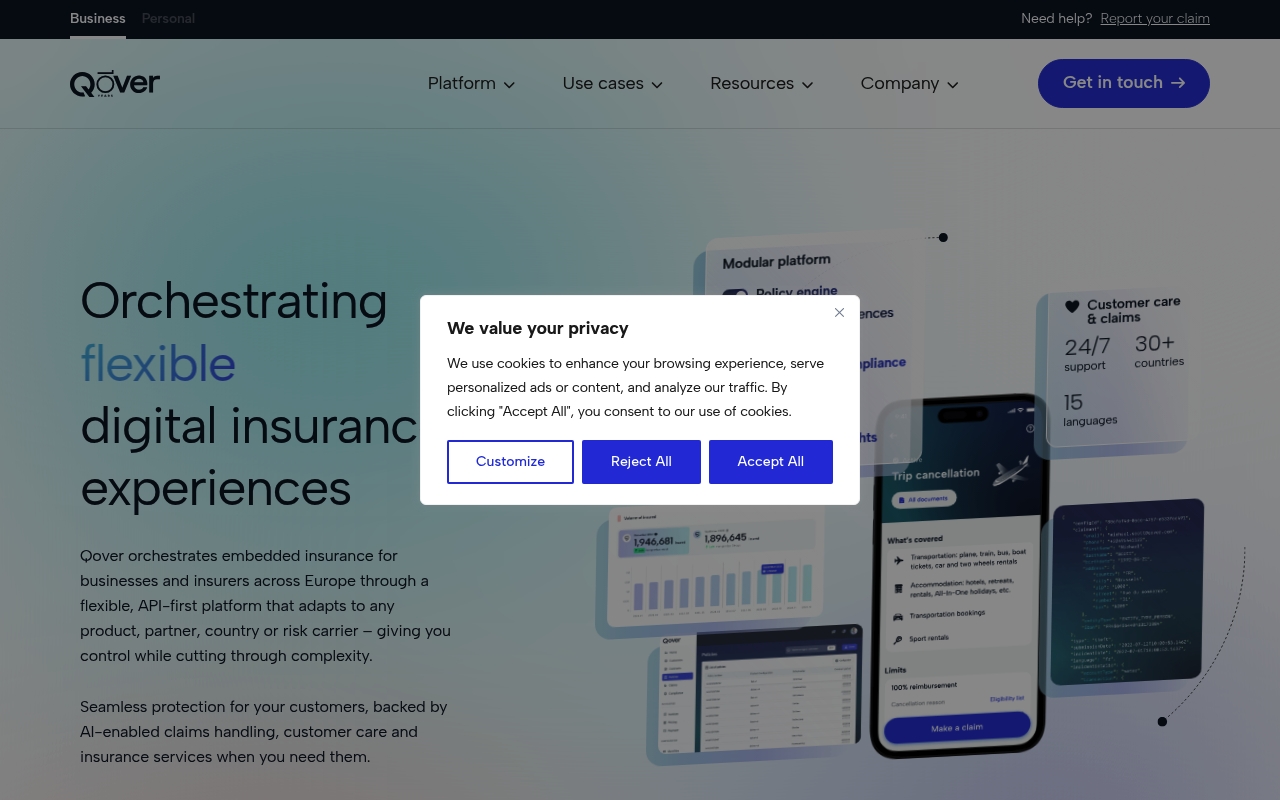
Qover sits in the gap between insurance carriers, who have capital and licences but poor distribution, and consumer brands, who have millions of engaged users but no interest in becoming insurers. Founded in Brussels in 2016 by Quentin Colmant — previously a senior figure at Allianz Benelux — and Jean-Charles Velge, it built an API-first orchestration platform that lets a company embed insurance as a native feature of its own product, with Qover handling the regulatory, carrier and lifecycle complexity underneath.
The partner list is the argument. Qover powers embedded insurance programmes for Revolut, Monzo, bunq, Mastercard, BMW, Deliveroo, Canyon, Cowboy and Trust Travel (a TUI brand), across more than 32 countries. Those are wildly different use cases — travel cover inside a banking app, device protection alongside a purchase, injury cover for gig workers — running on the same orchestration layer, which is the point: the platform's value is that cross-border insurance distribution becomes a configuration problem rather than a licensing project in every market.
Ten years in, the numbers are respectable rather than explosive: around 15 million people protected, over $173 million in gross written premiums, revenue tripled over four years, and total funding past $100 million. The most recent raise, in March 2026, is itself informative — a $12 million growth capital facility from CIBC Innovation Banking rather than an equity round, which is what a company does when it wants runway without dilution and believes its economics support debt. The stated targets are ambitious to the point of requiring scrutiny: 55 million people protected by the end of 2026, up from 15 million, and 100 million by 2030. That trajectory depends almost entirely on a small number of very large partners rolling out programmes on schedule — which is both the strength and the concentration risk of the orchestration model.
Founded 2016