Data enrichment Companies in Europe
Data enrichment platforms enhance raw financial data — transaction records, company information, or customer data — with additional context that makes it more useful for analysis, underwriting, or product decisions. Transaction enrichment converts raw bank transaction strings into clean merchant names, categories, and spending insights. Company data enrichment adds firmographic information, financial metrics, and risk signals to business records. Enriched data produces better underwriting decisions, more accurate categorisation, and more useful financial products.
European Data enrichment companies in our database
Notable data enrichment companies include OpenWrks, Inxy, Powens, Yodlee and Open Banking.
OpenWrks was the UK's first FCA regulated AIS Open Banking platform. In 2020 OpenWrks was acquired by Tink. Credit decisions have historically been made on backward-looking data — credit files that reflect what happened years ago rather than what a person's financial life looks like today. OpenWrks was founded in London in 2017 to change that with open banking data. Its platform uses transaction data from bank accounts to generate real-time financial insights — income verification, affordability assessments, and cash flow analytics — that lenders, debt advisors, and financial services companies can use to make better decisions about the people they serve. The focus on affordability and debt support is deliberate — OpenWrks has built particular depth in the debt advice sector, providing tools that help debt charities and money guidance services understand their clients' financial situations with precision and speed that paper-based assessments cannot match. Its work with the Money and Pensions Service and other UK debt support organisations reflects a commitment to using open banking data for financial inclusion rather than purely commercial lending optimisation. In the open banking ecosystem, where most data applications focus on acquisition and credit origination, OpenWrks' orientation toward debt support and financial wellbeing is a distinctive positioning that has built genuine trust with the organisations that serve financially vulnerable people.
Inxy is a European open banking platform that lets businesses tap into customer financial data through APIs, turning fragmented banking relationships into a single source of truth. Rather than asking customers to manually upload statements or reconnect accounts every few months, Inxy maintains a live, permission-based link to real bank data—making it effortless for fintechs, lenders, and SaaS platforms to build smarter underwriting, risk assessment, and financial insights on top of their core products. The platform sits squarely in the infrastructure layer, designed for teams building financial experiences rather than consumers managing their own money. What sets Inxy apart in a crowded open banking space is its focus on simplicity and reliability. While competitors often require technical gymnastics or lengthy integrations, Inxy's API is direct and frictionless. It handles the complexity of PSD2 compliance, account connectivity, and data standardization behind the scenes. The result: lenders can make faster, more informed decisions; embedded finance platforms can offer instant credit lines; accounting tools can automatically reconcile transactions. Inxy is fundamentally changing how financial data moves between banks and the applications that need it most, making it an essential building block for modern European fintech.
Powens sits at the intersection of open banking and financial data aggregation, helping European fintechs and traditional banks make sense of the fragmented payment and account landscape. Rather than building another me-too aggregator, the company positions itself as the connective tissue between institutions and the data they need to move capital efficiently and securely. Their platform ingests transaction data, payment initiation flows, and account information from thousands of financial institutions across Europe, surfacing clean, standardized intelligence to power lending decisions, fraud detection, and embedded finance experiences. What sets Powens apart is its focus on the continental European market—where open banking adoption is uneven and legacy banking infrastructure still dominates. While UK and US aggregators have enjoyed first-mover advantage, Powens saw an opportunity to build native expertise in Germany, France, Spain, and Benelux, where regulatory tailwinds and fragmented banking systems created genuine demand. The company works with both consumer-facing fintechs and institutional clients, meaning they've learned to navigate the messy reality of building infrastructure that talks to both sleek fintech apps and stuffy corporate banking platforms. This dual-sided approach has become their competitive moat—they understand both the user experience expectations of modern fintech and the compliance complexity of traditional finance. In the broader European fintech stack, Powens functions as a critical middleware layer, solving the unglamorous but essential problem of data connectivity that powers everything downstream—from embedded lending to fraud prevention to wealth management.
Yodlee sits at the intersection of consumer financial data and the platforms that depend on it. Since the early 2000s, it's been quietly aggregating transaction history and account information across tens of thousands of financial institutions worldwide—the kind of unglamorous but essential infrastructure that powers everything from personal finance apps to enterprise banking systems. The company has evolved from a pure data aggregator into something more architecturally ambitious: a full-stack fintech operating system that connects consumers, their financial data, and the financial institutions and fintechs that need access to it. The core proposition remains unchanged: connect to your bank, credit card, or investment account once, and Yodlee's network knows what you own, what you owe, and where your money flows. But the modern Yodlee is less about being a consumer brand and more about being the invisible backbone. It powers embedded finance experiences, drives decisioning for lenders who need to verify income or assess creditworthiness in real time, and provides the data layer that newer fintech competitors rely on to compete with legacy banks. What separates Yodlee from point-solution competitors is its scale and exhaustiveness. Coverage matters in financial data aggregation—the difference between 95 percent and 99 percent institutional reach is the difference between a useful tool and a platform financial institutions trust. Yodlee operates at the latter level, serving banks, insurers, wealth managers, and a constellation of fintech challengers across North America, Europe, and Asia-Pacific. In a crowded landscape of open banking APIs and PSD2-enabled competitors, Yodlee remains relevant because financial data aggregation remains hard at scale. It's the kind of infrastructure business that rarely makes headlines but never really goes out of fashion.
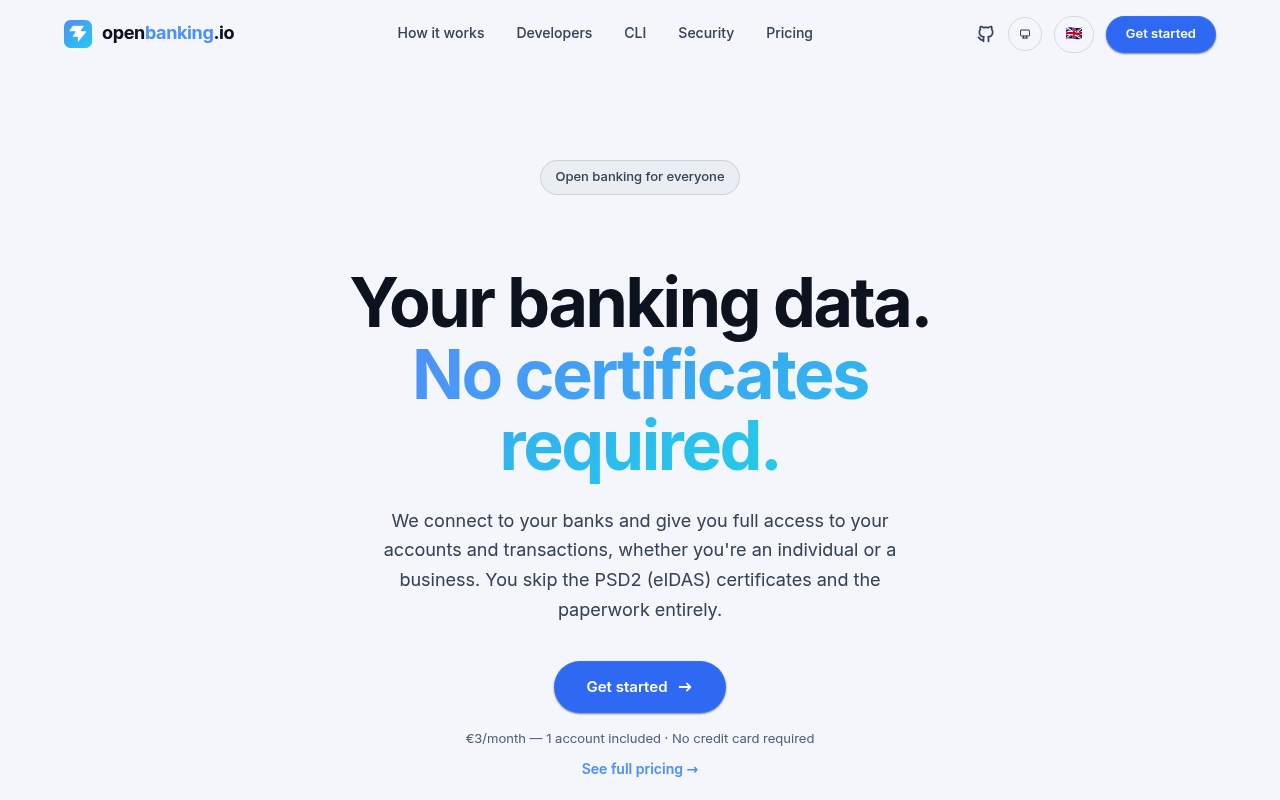
PSD2 was supposed to open European bank data to everyone. In practice it opened it to organisations that could afford to become an Account Information Service Provider — a national regulatory registration plus eIDAS certificates, a QWAC and a QSEALC, that cost money and take months to obtain. The result is that open banking in Europe is realistically available to funded startups and enterprises buying through aggregators on quote-based contracts. An individual who wants their own transaction history in a spreadsheet, or a two-person SaaS that needs bank data for a single feature, has no practical route in. open-banking.io is a direct attempt at that gap, and it is candid about how it works. The company does not hold its own AIS authorisation. Bank connectivity runs through Enable Banking, the Espoo-based aggregator registered as an Account Information Service Provider and supervised by Finland's FIN-FSA, so the regulated activity that touches bank APIs sits under Enable Banking's licence. What open-banking.io adds on top is packaging: a web app, a command-line tool, open-source client libraries, a server-to-server API, and a price — €3 per month including one account, €1 per additional account, no credit card to start — aimed at customers the licensed providers have never gone after. The encryption architecture is the more distinctive piece. The key is generated on the user's device and never leaves it; open-banking.io holds only the public key, enough to encrypt incoming data but not to read it. Bank credentials pass directly to the bank and are never stored. That is a materially different posture from aggregators that hold customer financial data in readable form as a matter of course, and it is a coherent answer to the obvious objection about routing bank data through a very small company. And it is a very small company. open-banking.io is operated by Tatic ApS, a Danish entity based in Hadbjerg, and run by a single founder, John Frandsen. The GitHub organisation and first SDKs shipped in June 2026 with the public beta following weeks later, which makes this one of the newest listings in the database. The supporting material tracks the audience precisely — self-hosting documentation, a CLI, and a guide for Beancount, the plain-text accounting format used by a small and technical population. For personal finance tooling, bookkeeping automation, and internal scripts, it removes a barrier that otherwise makes open banking inaccessible entirely.