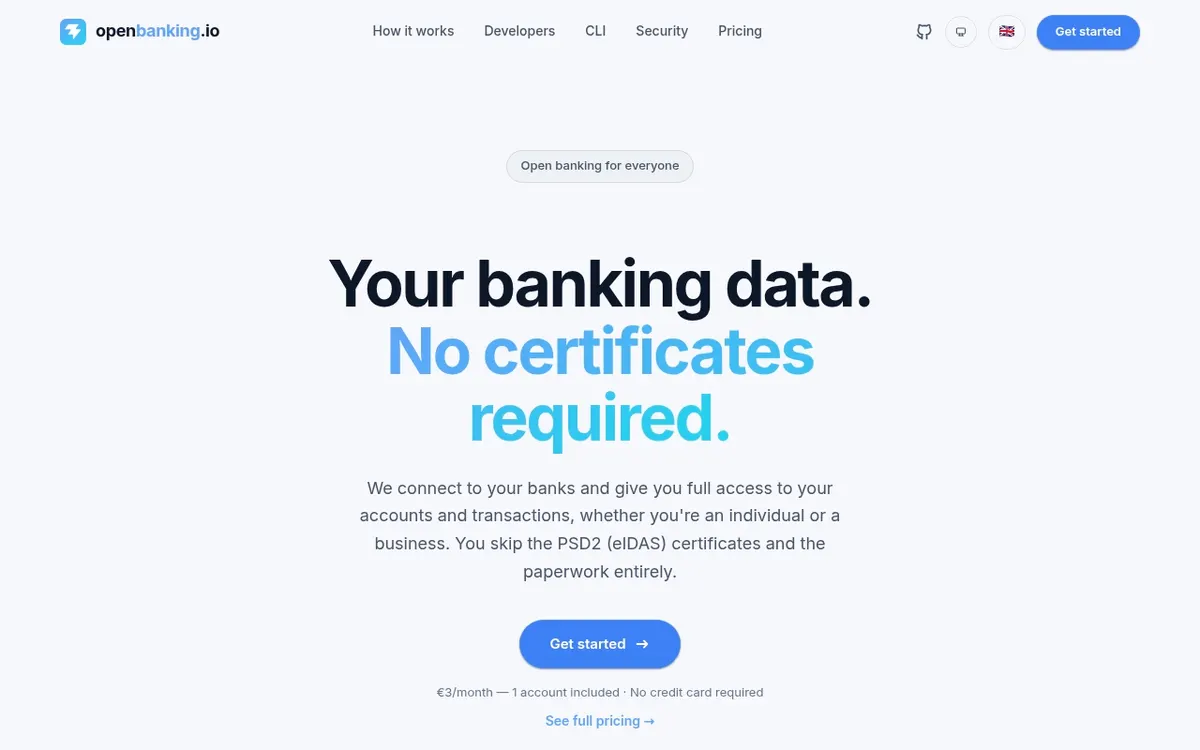
PSD2 was supposed to open European bank data to everyone. In practice it opened it to organisations that could afford to become an Account Information Service Provider — a national regulatory registration plus eIDAS certificates, a QWAC and a QSEALC, that cost money and take months to obtain. The result is that open banking in Europe is realistically available to funded startups and enterprises buying through aggregators on quote-based contracts. An individual who wants their own transaction history in a spreadsheet, or a two-person SaaS that needs bank data for a single feature, has no practical route in.
open-banking.io is a direct attempt at that gap, and it is candid about how it works. The company does not hold its own AIS authorisation. Bank connectivity runs through Enable Banking, the Espoo-based aggregator registered as an Account Information Service Provider and supervised by Finland's FIN-FSA, so the regulated activity that touches bank APIs sits under Enable Banking's licence. What open-banking.io adds on top is packaging: a web app, a command-line tool, open-source client libraries, a server-to-server API, and a price — €3 per month including one account, €1 per additional account, no credit card to start — aimed at customers the licensed providers have never gone after.
The encryption architecture is the more distinctive piece. The key is generated on the user's device and never leaves it; open-banking.io holds only the public key, enough to encrypt incoming data but not to read it. Bank credentials pass directly to the bank and are never stored. That is a materially different posture from aggregators that hold customer financial data in readable form as a matter of course, and it is a coherent answer to the obvious objection about routing bank data through a very small company.
And it is a very small company. open-banking.io is operated by Tatic ApS, a Danish entity based in Hadbjerg, and run by a single founder, John Frandsen. The GitHub organisation and first SDKs shipped in June 2026 with the public beta following weeks later, which makes this one of the newest listings in the database. The supporting material tracks the audience precisely — self-hosting documentation, a CLI, and a guide for Beancount, the plain-text accounting format used by a small and technical population. For personal finance tooling, bookkeeping automation, and internal scripts, it removes a barrier that otherwise makes open banking inaccessible entirely.