← All services

14 European companies
Fintech SaaS Providers in Europe
Fintech SaaS provides software-as-a-service products specifically designed for financial services companies — compliance tools, risk management platforms, customer onboarding systems, and financial analytics. Unlike horizontal SaaS that serves all industries, fintech SaaS is built around the specific regulatory, operational, and technical requirements of financial institutions and regulated fintechs.
Typically offered by
European fintech companies offering fintech SaaS
Enable Banking
Financial Infrastructure🇫🇮 Finland
Most open banking aggregators want your data. That is the business model: connect to the banks, pull the transactions, store them, enrich them, and sell the enriched product back. Enable Banking built the opposite. The company describes itself as the postman of your data — it moves financial information from the bank to the customer's application and does not retain, process, or build models on what passes through. For a fintech that considers its transaction data a competitive asset, or a customer with strict data residency requirements, that neutrality is the entire pitch.
Joonas Tomperi and Fedor Tyurin founded the company in Espoo in 2019, at the point where PSD2 had legally opened European bank APIs but had not made them usable. Each bank interpreted the standard differently, each shipped its own authentication quirks, and each updated on its own schedule. The regulation created the right; someone still had to build the plumbing. Enable Banking started with Finland and the Nordics and expanded outward, and now connects to more than 2,700 banks across 30 European countries through a single PSD2-compliant API — account information from all of them, and payment initiation from over 1,500.
What makes the company genuinely unusual is its scale relative to that coverage. Enable Banking has raised roughly €600,000 in total, in a single seed round in 2022 led by Wellstreet and Forward VC, and employs somewhere between fourteen and seventeen people distributed across seven countries. Tink sold to Visa for €1.8 billion with 500 employees. TrueLayer has raised hundreds of millions. Enable Banking is covering comparable European ground with a team that would fit around one table, which says something about how much of open banking infrastructure is disciplined engineering rather than capital.
The company holds its own Account Information Service Provider registration, supervised by Finland's FIN-FSA — which means other companies can build on top of its licence rather than obtaining their own. That is the model behind open-banking.io, the Danish developer tool that resells Enable Banking access at €3 per month without customers needing eIDAS certificates. It is also why Enable Banking's no-data-retention architecture matters structurally: because the platform never holds readable customer data, the companies building on it can make stronger privacy guarantees than they otherwise could.
Two smaller details are revealing about who this is built for. Enable Banking runs a balanced split between business and consumer accounts — roughly half of its ten million monthly API calls come from each, where most early open banking providers targeted consumer accounts only and treated corporate banking as an afterthought. And it offers a live production environment for testing without requiring a contract, which is a small thing that tells you the company expects developers to evaluate it by using it rather than by booking a call. Tomperi now chairs the board of Fintech Finland, the national industry association.
Founded 2019
Vodeno
Embedded Finance🇧🇪 Belgium
Vodeno is a European fintech building the infrastructure layer for embedded finance—letting any company slip banking and lending directly into their product without the complexity of traditional integrations. The platform abstracts away the operational headaches of regulatory compliance, bank connectivity, and fund management that typically come with embedding financial services, making it possible for non-financial businesses to offer credit, accounts, and payments to their users almost as easily as adding a API call.
What sets Vodeno apart is its focus on the operational backbone rather than the customer-facing experience. While most embedded finance platforms emphasize sleek user flows, Vodeno solves the unglamorous but critical problem: how do you actually manage the banking, settlement, and risk infrastructure when you're issuing credit to thousands of users across multiple jurisdictions? They handle the plumbing that traditional banks spent decades building.
The company targets both B2B2C platforms and B2B software providers looking to monetize their customer relationships through financial products. It competes in a growing category alongside players like Marqeta and Unit, but Vodeno's European roots give it a natural advantage in navigating the continent's fragmented regulatory landscape and banking infrastructure. As embedded finance reshapes how non-financial companies interact with their customers, platforms like Vodeno are becoming essential infrastructure—sitting invisibly in the background, making finance work at speed.
Founded 2021
Enity
Embedded Finance🇩🇪 Germany
Enity sits at the intersection of embedded finance and merchant payments, letting businesses embed lending directly into their checkout flows. Rather than forcing customers to apply for credit elsewhere, Enity's API lets companies offer point-of-sale financing instantly—think Buy Now, Pay Later but more flexible and customizable. The platform handles underwriting, decisioning, and funding, meaning merchants don't carry the credit risk themselves. It's the kind of infrastructure that makes sense as e-commerce and marketplaces mature beyond simple transaction processing. Enity works across Europe, tapping into fragmented credit markets where unified APIs for embedded finance remain rare. The company positions itself against both traditional BNPL providers—which often dictate terms to merchants—and against the friction of integrating multiple lenders. Its real edge is speed and developer experience: getting live takes days, not months. For merchants handling high-value transactions or B2B sales, Enity's underwriting engine and multi-lender orchestration solve a genuine pain point. The rise of embedded lending means platforms like this will become table stakes for any serious commerce infrastructure player.
Founded 2020
finleap
Embedded Finance🇩🇪 Germany
finleap is Berlin's answer to a question the European fintech scene keeps asking: how do you build world-class financial companies at scale? Rather than chase unicorn valuations, finleap builds them. The holding company operates as a fintech factory, incubating and scaling financial startups from day one with institutional backing, operational expertise, and a network that spans regulators, banks, and investors across the continent.
What sets finleap apart is the architecture itself. It's not an accelerator or a VC fund—it's a purpose-built engine for creating and nurturing fintech companies. Each portfolio company gets access to finleap's infrastructure, compliance playbooks, and go-to-market templates, which compresses timelines and eliminates the friction that typically derails early-stage fintechs. The model works: companies like Wayfair-backed Finn, B2B payments platform Foxpay, and lending marketplace Evala have all emerged from the finleap stable.
Internally, finleap operates across payments, lending, wealth, and embedded finance—categories where the European market remains genuinely underpenetrated compared to the US. The company's thesis is straightforward: identify white space in financial services, build products faster than traditional banks can move, and create defensible market positions through technology and user experience. It's less about disruption theater and more about pragmatic value creation.
Finleap sits at an interesting intersection in the European fintech landscape: large enough to command resources and regulatory relationships, independent enough to move quickly, and structured in a way that lets founders maintain autonomy while tapping institutional muscle. For a continent that produces good fintech companies but struggles with scaling, finleap represents a new playbook.
Founded 2014
Unblu
Financial Infrastructure🇨🇭 Switzerland
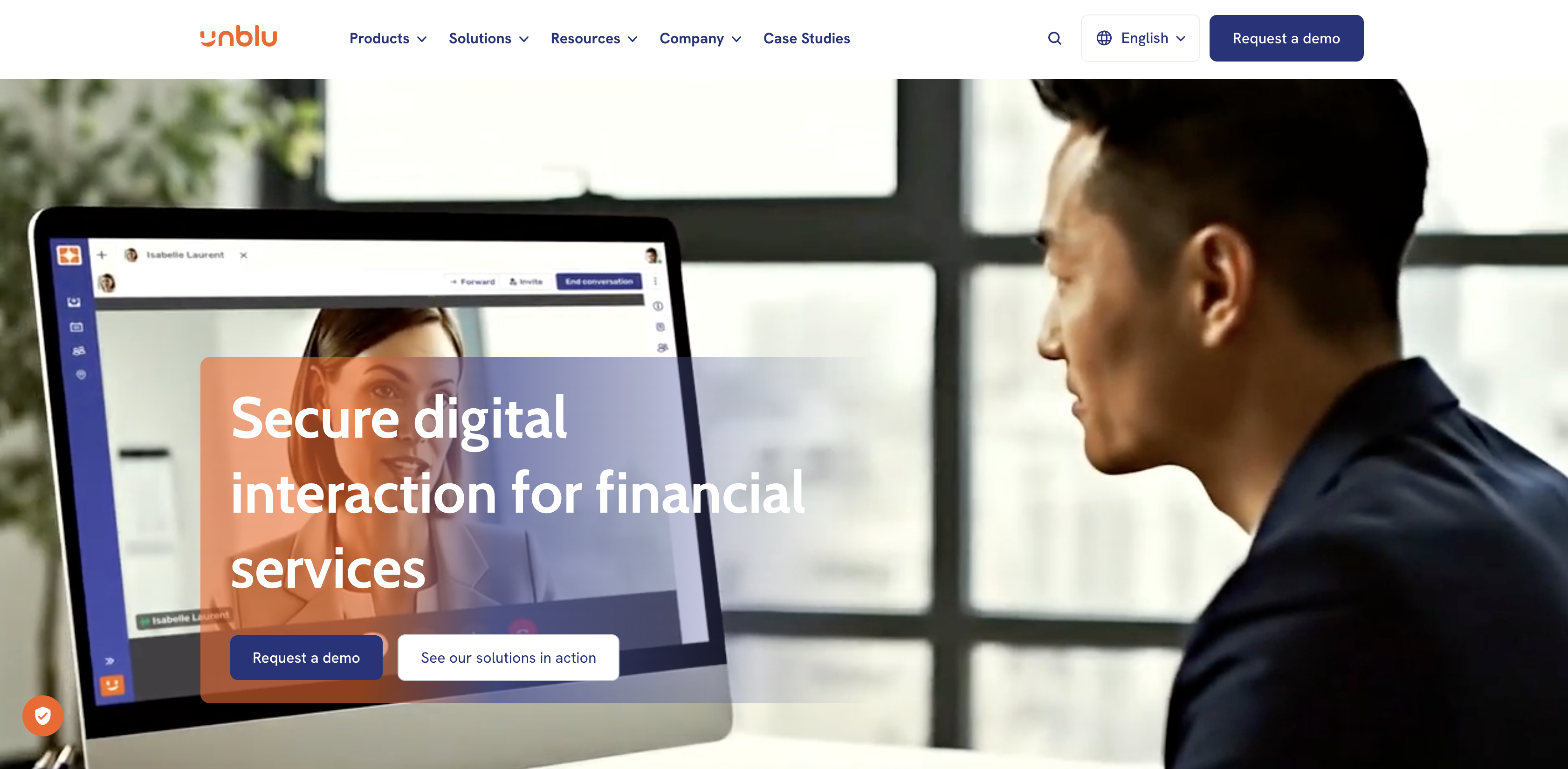
Unblu operates in the unglamorous but essential territory where financial services meet customer service—the moment a bank customer needs live help and picks up their phone instead of abandoning their application. Rather than building another chatbot, Unblu created a platform that lets banks embed co-browsing and real-time video conversations directly into their digital channels, turning web pages and apps into collaborative workspaces where advisors and customers can actually see what the other is doing.
The company targets financial institutions tired of losing conversions because their digital experiences feel abandoned. Unblu's platform sits between your app and your customer, enabling seamless handoffs from self-service to human guidance without the friction of traditional call centers. A user can be filling out a mortgage application, hit a question, and instantly video-call a specialist who sees their screen and can annotate, guide, and help in real time.
What distinguishes Unblu in the European fintech infrastructure space is its focus on regulated financial use cases. Banks don't need another Silicon Valley-style collaboration tool; they need compliance-first interactions that work within PSD2, open banking, and data protection frameworks. Unblu has embedded this rigor into its platform rather than bolting it on afterward.
The company serves a specific but high-value niche: banks and financial institutions that want to reduce abandonment rates, increase conversion, and do it through genuine human connection rather than algorithmic band-aids. In a landscape obsessed with APIs and automation, Unblu's bet is that sometimes the best digital experience is one that knows when to hand you a human.
Founded 2010
Inpay
Embedded Finance🇸🇪 Sweden
Inpay operates in the increasingly crowded space of embedded payments, but with a particular focus on marketplaces and platforms that need to move money between multiple parties. The company essentially builds the financial plumbing that allows non-fintech businesses—think e-commerce platforms, service marketplaces, and SaaS products—to handle payments, payouts, and settlement without building infrastructure from scratch.
What sets Inpay apart is its emphasis on operational simplicity for platforms managing complex payment flows. Rather than forcing partners to integrate with a dozen different providers, Inpay consolidates payment processing, merchant acquiring, and payout capabilities into a single API layer. This means a marketplace can focus on growth without getting bogged down in the mechanics of moving money.
The company operates across Europe, with particular strength in Western Europe, and positions itself as an alternative to larger, more bureaucratic payment infrastructure providers. It's the kind of business that doesn't grab headlines but quietly powers transactions across hundreds of platforms. Inpay sits firmly in the infrastructure category, enabling fintech and non-fintech companies alike to monetize their platforms through embedded payments without the friction of traditional payment processors.
Founded 2014
Unzer
Embedded Finance🇩🇪 Germany
Unzer is a European payment orchestration platform that handles the complexity merchants typically wrestle with when accepting payments across channels and geographies. Rather than forcing businesses to juggle multiple payment processors, gateways, and local acquiring partners, Unzer consolidates the fragmented landscape into a single integration point. The company powers everything from card transactions and bank transfers to digital wallets and regional payment methods—essentially acting as a translator between merchants and the chaotic ecosystem of payment rails that vary wildly across Europe.
What sets Unzer apart is its willingness to treat payments infrastructure as genuinely complex. Where many competitors offer simplified interfaces that hide the complexity, Unzer acknowledges that mid-market and enterprise merchants need control and transparency. The platform provides detailed analytics, customizable routing logic, and native support for emerging payment types that traditional acquiring networks still treat as afterthoughts. This positions Unzer not as a simplified alternative to legacy systems, but as a more sophisticated replacement.
The company operates in a crowded space—Stripe, Adyen, and others already dominate—but Unzer has carved out credibility by focusing on European specifics rather than chasing global scale. It's the kind of infrastructure play that rarely gets consumer attention but proves invaluable once merchants realize how much operational friction they can eliminate. For the European fintech ecosystem, Unzer represents a pragmatic approach to one of finance's most unglamorous but essential challenges: making payment processing actually work across borders and business models.
Founded 2007
June
Financial Infrastructure🇫🇷 France
June is a product analytics platform built for B2B SaaS companies that want to understand user behavior without the engineering overhead. Founded on the principle that analytics shouldn't require data science degrees, it connects directly to your product database and transforms raw events into actionable insights through an intuitive interface. The platform emphasizes simplicity—no SQL required, no data warehouse setup, no weeks of implementation. It's designed for product teams, marketers, and founders who need to answer questions about user engagement, retention, and conversion velocity without waiting for engineers to run queries. June positions itself as the anti-complexity analytics tool in a space dominated by expensive enterprise platforms and code-heavy DIY solutions. Where Amplitude demands technical expertise and Mixpanel requires careful event planning, June lets non-technical users slice, dice, and visualize their product data in minutes. The company appeals to early-stage and growth-stage SaaS founders who recognize that understanding their users is fundamental to building products people actually want. In the broader fintech context, June serves as critical infrastructure for fintech and embedded finance platforms that need to track user adoption, feature usage, and revenue metrics across their product surface.
Founded 2021
Fonoa
RegTech🇭🇷 Croatia
Tax compliance has long been the tedious, error-prone side of fintech—the regulatory checkbox that slows down growth. Fonoa automates indirect tax (VAT, GST, sales tax) for digital businesses operating across multiple jurisdictions, turning what used to be a spreadsheet nightmare into API-driven accuracy.
The platform handles tax calculation, compliance reporting, and filing across more than 200 territories, meaning a SaaS company or marketplace doesn't need a dedicated tax accountant just to stay legal. Fonoa integrates directly with billing systems and payment processors, capturing transaction data and determining tax obligations in real time.
What sets Fonoa apart is its focus on the messy reality of cross-border digital commerce. While traditional tax software still assumes you're filing locally, Fonoa was built for companies that sell globally by default—the kind of businesses that would otherwise need to hire lawyers and accountants in every market they touch.
In the broader European fintech stack, Fonoa occupies the unsexy-but-critical layer between payment platforms and accounting systems. It's the kind of infrastructure that enables other fintechs to scale without regulatory friction, making it essential backbone software for anyone processing payments across borders.
Founded 2019
Access Pay
Embedded Finance🇬🇧 United Kingdom
Access Pay sits at the intersection of payroll and financial wellness, giving employees real-time control over their earned wages before payday. The platform lets workers access portions of their salary as soon as they've earned it—no loans, no debt, no interest—fundamentally reframing how people relate to their cash flow between traditional pay cycles. Unlike most fintech that chases venture capital drama, Access Pay solves a quietly persistent problem: the gap between earning money and accessing it.
The company operates as infrastructure for employers and financial institutions, embedding earned wage access directly into payroll and HR systems. This is less about building consumer app addiction and more about making the financial calendar less brutal for hourly and gig workers who live paycheck to paycheck. Think of it as the antidote to payday lending—a way to smooth out cash flow without predatory interest rates.
Across Europe, Access Pay has positioned itself as the pragmatic alternative to traditional consumer finance and loan products. Rather than convincing people they need credit, the company simply lets them access money they've already earned. It's regulatory-friendly, employer-friendly, and increasingly popular with enterprises looking to support workforce financial health without bearing the credit risk themselves.
In the broader fintech landscape, Access Pay represents a shift toward embedded financial products that solve real problems for real people, not manufactured needs designed to maximize engagement metrics.
Founded 2016
Upvest
Embedded Finance🇩🇪 Germany
Every fintech that decides to add investing discovers the same thing: the interface is the easy part. Behind a "buy" button sits brokerage licensing, custody, order routing, settlement, corporate actions, tax reporting and regulatory permissions across every market you operate in — years of work, most of it invisible to the customer. Upvest, founded in Berlin in 2017, sells that entire stack as an API.
The proposition is a single modular integration covering stocks, ETFs, mutual funds and fractional shares, with brokerage, trading, custody and settlement included and the necessary licences held by Upvest rather than the client. A neobank or a savings app can launch investing without becoming a broker. The infrastructure reportedly reaches more than 50 million end-users through client applications and processes over a million trades a week, with revenue growing at around 25% month-on-month during 2024.
Funding reflects the capital intensity of regulated infrastructure: a €105 million Series C in December 2024 brought total raised to roughly €198 million, at a reported valuation in the $420–630 million range. That's a meaningful gap between money in and valuation, which is normal for licensed infrastructure businesses and worth understanding — the licences and the balance sheet requirements consume capital that a pure software company wouldn't need.
Strategically, Upvest sits in the same layer as Swan and Solaris but for investing rather than banking, and it benefits from the same structural trend: European retail investing participation is rising from a low base, and the apps capturing that demand overwhelmingly prefer to buy the infrastructure rather than build it. The competitive pressure comes from both directions — neobrokers like Scalable Capital and Trade Republic that built their own stacks and could licence them out, and the incumbent custodians whose businesses this disintermediates. The dependency risk runs the other way too: as with any infrastructure provider, a small number of large clients can represent a large share of volume.
Founded 2017
Open Banking
Financial Infrastructure🇩🇰 Denmark
PSD2 was supposed to open European bank data to everyone. In practice it opened it to organisations that could afford to become an Account Information Service Provider — a national regulatory registration plus eIDAS certificates, a QWAC and a QSEALC, that cost money and take months to obtain. The result is that open banking in Europe is realistically available to funded startups and enterprises buying through aggregators on quote-based contracts. An individual who wants their own transaction history in a spreadsheet, or a two-person SaaS that needs bank data for a single feature, has no practical route in.
open-banking.io is a direct attempt at that gap, and it is candid about how it works. The company does not hold its own AIS authorisation. Bank connectivity runs through Enable Banking, the Espoo-based aggregator registered as an Account Information Service Provider and supervised by Finland's FIN-FSA, so the regulated activity that touches bank APIs sits under Enable Banking's licence. What open-banking.io adds on top is packaging: a web app, a command-line tool, open-source client libraries, a server-to-server API, and a price — €3 per month including one account, €1 per additional account, no credit card to start — aimed at customers the licensed providers have never gone after.
The encryption architecture is the more distinctive piece. The key is generated on the user's device and never leaves it; open-banking.io holds only the public key, enough to encrypt incoming data but not to read it. Bank credentials pass directly to the bank and are never stored. That is a materially different posture from aggregators that hold customer financial data in readable form as a matter of course, and it is a coherent answer to the obvious objection about routing bank data through a very small company.
And it is a very small company. open-banking.io is operated by Tatic ApS, a Danish entity based in Hadbjerg, and run by a single founder, John Frandsen. The GitHub organisation and first SDKs shipped in June 2026 with the public beta following weeks later, which makes this one of the newest listings in the database. The supporting material tracks the audience precisely — self-hosting documentation, a CLI, and a guide for Beancount, the plain-text accounting format used by a small and technical population. For personal finance tooling, bookkeeping automation, and internal scripts, it removes a barrier that otherwise makes open banking inaccessible entirely.
Founded 2026
Showing 12 of 14 companies. View all in the directory →