← All services
13 European companies
Transaction Categorization Providers in Europe
Transaction categorisation automatically classifies financial transactions into meaningful spending or income categories — groceries, transport, utilities, salary — using machine learning and merchant data. Accurate categorisation is the foundation of useful personal finance management, business bookkeeping, and open banking-powered credit assessment. The quality of categorisation directly affects the usefulness of every product built on top of transaction data.
Typically offered by
European fintech companies offering transaction categorization
Tink
Embedded Finance🇸🇪 Sweden
Daniel Kjellén and Fredrik Hedberg didn't set out to build infrastructure. Tink started in Stockholm in 2012 as a consumer personal finance app — an attempt to give Swedish bank customers a cleaner view of their money across multiple accounts. It was a reasonable idea that ran into an unreasonable obstacle: getting reliable, consistent data out of European banks was extraordinarily hard. The technical problem turned out to be more interesting than the consumer product. In 2018 they pivoted, shifted focus entirely to the B2B layer, and started selling the very infrastructure they'd been forced to build for themselves.
That pivot proved prescient. The EU's PSD2 directive, which came into full effect in 2019, legally required banks to open their data to authorised third parties — creating the regulatory foundation that open banking platforms needed to operate at scale. Tink had spent years building exactly those bank connections. When the regulation arrived, the company was ready.
The platform Kjellén and Hedberg built connects to more than 3,400 banks and financial institutions across Europe, reaching over 250 million bank customers. Through a single API integration, banks, fintechs, and merchants can access aggregated account data, initiate payments directly from customer bank accounts, verify account ownership, and enrich transaction data — without maintaining their own connections to hundreds of separate banking systems with different technical standards and update schedules. Clients include Klarna, PayPal, NatWest, ABN AMRO, and BNP Paribas Fortis.
In March 2022, Visa completed the acquisition of Tink for €1.8 billion — one of the largest European fintech acquisitions of that year, and a clear signal of how seriously the global payments industry had come to take open banking infrastructure. Visa's strategic rationale was straightforward: it had failed to acquire Plaid, the US equivalent, after an antitrust challenge, and needed a European open banking capability. Tink gave it 500 employees, 18 European markets, and relationships with over 300 banks and fintechs built over a decade.
The founders stayed on as CEO and CTO through the transition, continuing to run Tink as a standalone Visa subsidiary from Stockholm. Both departed in 2025 — Kjellén and Hedberg announced they were building Freda, a new AI-driven legal and compliance technology startup, with the pair describing Tink as "now in better hands than ever." Francois Tornier, Visa's VP of Open Banking, took over as CEO. The product roadmap has continued under Visa ownership, including a 2024 expansion of Tink's open banking platform into the US market.
Founded 2012
Fintonic
Open Banking🇪🇸 Spain
Fintonic is a Spanish fintech that has spent the better part of a decade helping everyday Europeans understand what they're actually spending money on. Rather than reinvent banking from scratch, it acts as a layer on top of your existing accounts—aggregating transactions, categorizing expenses, and surfacing insights that most banks still bury in PDF statements. The app feels less like financial software and more like a personal finance companion that speaks plain language. You link your bank accounts, and Fintonic does the unglamorous work: tracking subscriptions you forgot about, highlighting spending patterns, flagging unusual transactions. It's deliberately unglamorous work, because the real value sits in simplicity. What sets Fintonic apart in a crowded personal finance space is its focus on the European user. The platform understands local banking infrastructure, multi-currency households, and the specific pain points of cross-border living. It's not trying to be your investment platform or your savings app or your lending provider—it's trying to be the one thing most people actually need: clarity on money that's already moving. For a generation that finds traditional banking UX infuriating, Fintonic occupies the pragmatic middle ground: minimal, useful, and genuinely designed for how Europeans actually manage money.
Founded 2011
Token
Financial Infrastructure🇬🇧 United Kingdom
Token is a London-based open banking platform that sits at the intersection of infrastructure and consumer experience, making API-driven financial connectivity feel less like plumbing and more like a natural part of how money moves. Rather than asking users to log into their banks manually or hand over passwords, Token handles account aggregation and payment initiation through direct bank connections—the infrastructure most fintech apps and traditional banks should have built themselves but didn't.
The company's core insight is that open banking is only useful if it actually works across borders, across device types, and across the chaos of fragmented financial systems. Token's platform standardizes this mess, letting fintechs, banks, and payment companies offer seamless experiences without getting bogged down in regional variations or legacy bank APIs that still feel like they were written in 2003.
What sets Token apart in the European market is its focus on developer experience without sacrificing enterprise-grade security and compliance. While competitors offer raw API access or clunky consent flows, Token treats the entire interaction—from user authentication to transaction confirmation—as a product problem, not just a technical one. They're essentially the connective tissue that lets modern financial products actually work at scale.
Token's role in fintech infrastructure means it powers an invisible layer: the moment you authorize a payment or link an account in an app that "just works," Token's orchestration is likely running underneath. That's the kind of foundational utility the ecosystem desperately needs.
Founded 2014
Inxy
Financial Infrastructure🇵🇱 Poland
Inxy is a European open banking platform that lets businesses tap into customer financial data through APIs, turning fragmented banking relationships into a single source of truth. Rather than asking customers to manually upload statements or reconnect accounts every few months, Inxy maintains a live, permission-based link to real bank data—making it effortless for fintechs, lenders, and SaaS platforms to build smarter underwriting, risk assessment, and financial insights on top of their core products. The platform sits squarely in the infrastructure layer, designed for teams building financial experiences rather than consumers managing their own money. What sets Inxy apart in a crowded open banking space is its focus on simplicity and reliability. While competitors often require technical gymnastics or lengthy integrations, Inxy's API is direct and frictionless. It handles the complexity of PSD2 compliance, account connectivity, and data standardization behind the scenes. The result: lenders can make faster, more informed decisions; embedded finance platforms can offer instant credit lines; accounting tools can automatically reconcile transactions. Inxy is fundamentally changing how financial data moves between banks and the applications that need it most, making it an essential building block for modern European fintech.
Founded 2020
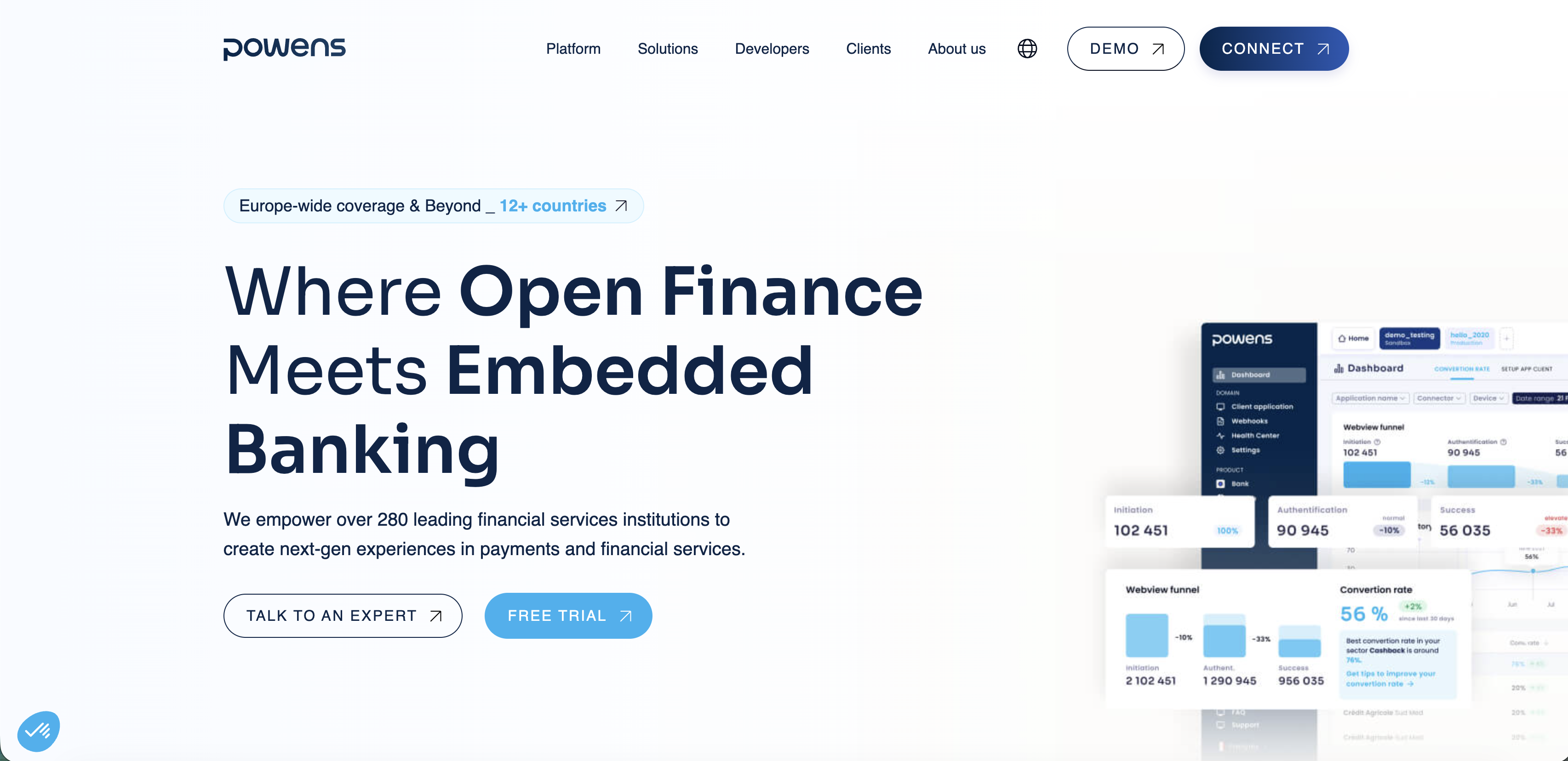
Powens
Fraud & Security🇫🇷 France
Powens sits at the intersection of open banking and financial data aggregation, helping European fintechs and traditional banks make sense of the fragmented payment and account landscape. Rather than building another me-too aggregator, the company positions itself as the connective tissue between institutions and the data they need to move capital efficiently and securely. Their platform ingests transaction data, payment initiation flows, and account information from thousands of financial institutions across Europe, surfacing clean, standardized intelligence to power lending decisions, fraud detection, and embedded finance experiences. What sets Powens apart is its focus on the continental European market—where open banking adoption is uneven and legacy banking infrastructure still dominates. While UK and US aggregators have enjoyed first-mover advantage, Powens saw an opportunity to build native expertise in Germany, France, Spain, and Benelux, where regulatory tailwinds and fragmented banking systems created genuine demand. The company works with both consumer-facing fintechs and institutional clients, meaning they've learned to navigate the messy reality of building infrastructure that talks to both sleek fintech apps and stuffy corporate banking platforms. This dual-sided approach has become their competitive moat—they understand both the user experience expectations of modern fintech and the compliance complexity of traditional finance. In the broader European fintech stack, Powens functions as a critical middleware layer, solving the unglamorous but essential problem of data connectivity that powers everything downstream—from embedded lending to fraud prevention to wealth management.
Founded 2015
Bridge
Payments🇫🇷 France
Bridge is an open banking API platform that sits between applications and financial institutions, making it trivially easy to connect customers' bank accounts and move money around. Rather than building direct integrations with hundreds of banks across Europe, developers plug into Bridge once and gain instant access to account aggregation, payment initiation, and transaction data across the continent's fragmented banking landscape.
The company emerged at the intersection of open banking regulation and developer frustration. PSD2 mandated that banks expose customer data via APIs, but the reality was messy—each bank implemented things differently, with varying speed and quality. Bridge standardized that chaos, translating dozens of regional banking protocols into a single, clean REST interface that developers actually want to use.
In the European fintech stack, Bridge occupies a crucial middle layer. While some competitors focus narrowly on payments or data, Bridge built a horizontal platform that covers the full spectrum: reading account balances, initiating payments, categorizing transactions, and handling the compliance overhead that comes with touching banking data. The company competes against both specialized point solutions and infrastructure players, but its strength lies in treating open banking as a genuine developer experience problem, not just a regulatory checkbox.
As fintech adoption accelerates across Europe and regulations like PSD2 spread globally, Bridge's role as a translator between app developers and banking infrastructure has become increasingly central to how modern financial services get built.
Founded 2017
Currency Cloud
Financial Infrastructure🇬🇧 United Kingdom
Currency Cloud powers cross-border payments for fintechs, banks, and platforms that move money internationally. Rather than building payment rails from scratch, companies plug into Currency Cloud's infrastructure to send, receive, and manage multi-currency transactions at scale. The platform handles the compliance complexity, FX pricing, and settlement logistics that make global payments so difficult.
What sets Currency Cloud apart is its positioning as the backbone rather than the front-end. While fintech darlings grab headlines with sleek consumer apps, Currency Cloud quietly powers payments behind the scenes for hundreds of financial services companies across Europe, Asia, and beyond. The company works with everyone from neobanks to traditional institutions to embedded finance platforms, letting them offer international payments without the headache of building their own infrastructure.
The European fintech scene has become increasingly reliant on infrastructure layers like this one—companies that solve the hard infrastructure problems so others can focus on customer experience and product innovation. Currency Cloud sits in that crucial middle tier, handling the pipes while others decorate the storefronts. It's a less visible kind of power, but arguably more fundamental to how modern fintech works.
Founded 2012
Blockpit
RegTech🇦🇹 Austria
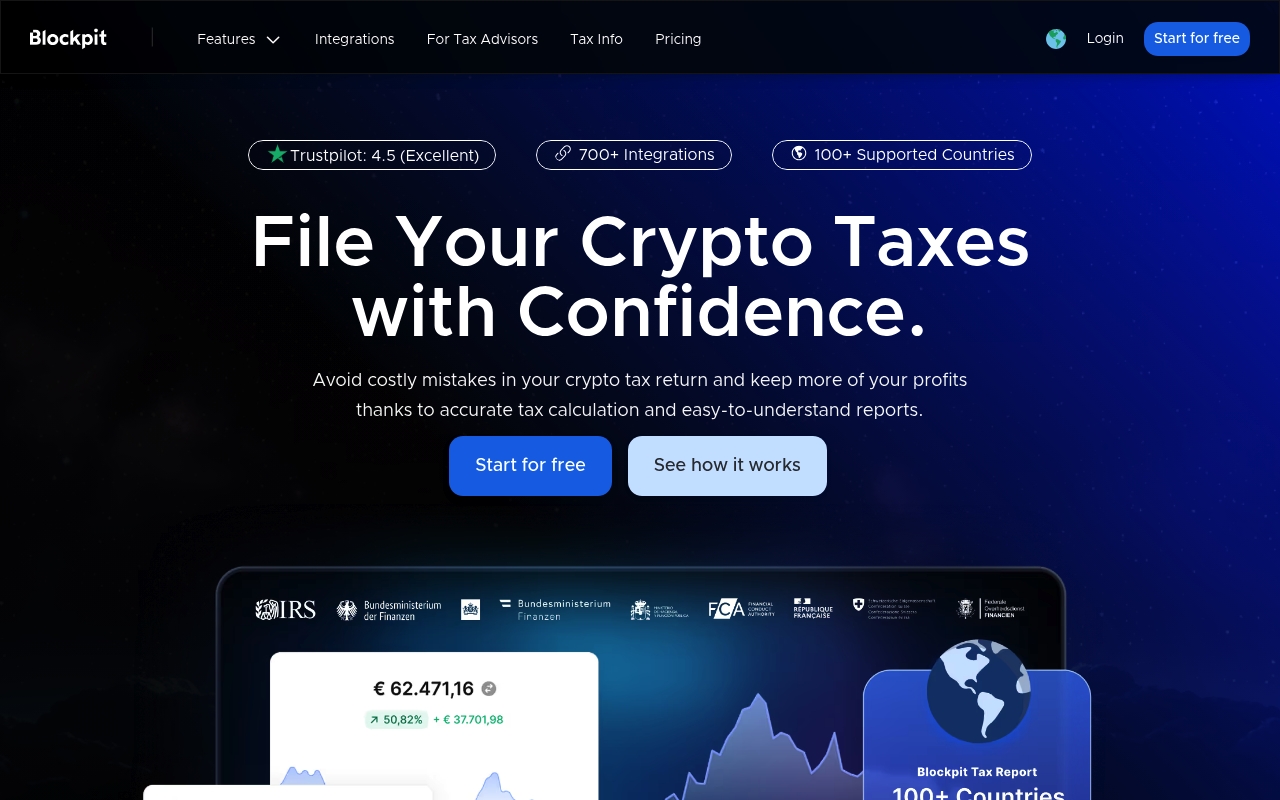
Crypto turned millions of Europeans into accidental tax risks. Every trade, swap, staking reward, and NFT sale is potentially a taxable event, scattered across exchanges, wallets, and chains that were never designed to produce anything a tax office would accept — and for years the gap between what the law required and what anyone could practically compute was where most crypto investors quietly lived. Blockpit was founded in Linz in 2017, by CEO Florian Wimmer and his co-founders, on the bet that this gap would close and that someone European should build the software for it. The compliance-first DNA was there from the start: a cooperation with KPMG to validate the tax logic, and TÜV Austria certification of the calculation engine in 2020 — credentials aimed at tax advisors and auditors, not just crypto Twitter.
The product is a portfolio tracker that ends in a tax report a local authority will actually accept. Users connect exchanges, wallets, and blockchains; Blockpit reconstructs the transaction history, classifies every event, and generates ready-to-file, country-specific reports across more than 100 jurisdictions. The differentiation is legal precision rather than chart polish: Germany's one-year holding-period exemption, Austria's 27.5% capital-income regime, France's specific rules — encoded per country, where the big US-born competitors historically produced generic exports and left the local law to the user. That focus made Blockpit the reference tool in the German-speaking world, voted best crypto tax calculator by the BTC-Echo community three years running from 2023 to 2025.
It also consolidated the European field with unusual decisiveness for a company its size. In 2020 Blockpit merged with CryptoTax, its German rival. In November 2023 it acquired Accointing — the Swiss competitor that Glassnode had bought only a year earlier — in an all-cash, multi-million deal financed through shareholder debt, shutting the Accointing platform within months and migrating its users. Wimmer was explicit about the reasoning: the deal was preparation for DAC8, the EU directive that changes what this entire category is for. Since 1 January 2026, crypto-asset service providers across the EU must report their customers' transaction data to tax authorities under DAC8 and the OECD's CARF framework. The era in which crypto taxes were a voluntary-compliance problem is over — tax offices now receive the data automatically, and the reconciliation burden lands on the individual. Blockpit spent five years positioning to be the consumer side of that equation.
The company profile behind this is strikingly lean: roughly 30 employees, profitability reached in 2024, and a $10 million Series A from 2021 led by MiddleGame Ventures — until March 2025, when Raiffeisen Bank International invested millions through its venture arm Elevator Ventures, the fund's first crypto investment. A major Austrian banking group buying into crypto tax compliance is itself a market signal: the institutional world expects enforced crypto transparency to be permanent infrastructure, not a cycle product. Blockpit has since been publicly flagged among Austrian startups exploring an eventual IPO. It sits within an Austrian crypto cluster that punches far above the country's size, alongside Bitpanda's licensed brokerage a train ride away in Vienna.
The honest read cuts both ways. The risks are real: demand breathes with the crypto cycle, exchanges could bundle good-enough tax reporting natively, and global competitors like Koinly fight for the same users. But the structural driver is a ratchet — regulation like DAC8 does not un-happen, every new reporting regime adds jurisdictions to the addressable market, and the moat in this category is the unglamorous one of encoding a hundred countries' tax law correctly and keeping it current. A profitable, thirty-person company that owns the DACH market, absorbed its two nearest rivals, and has a systemically important bank on its cap table is about as well-positioned for enforced transparency as a startup can be. Blockpit's founding bet was that crypto would eventually have to grow up and file its taxes. As of January 2026, that's no longer a bet.
Founded 2017
Spendee
Personal Finance🇨🇿 Czech Republic
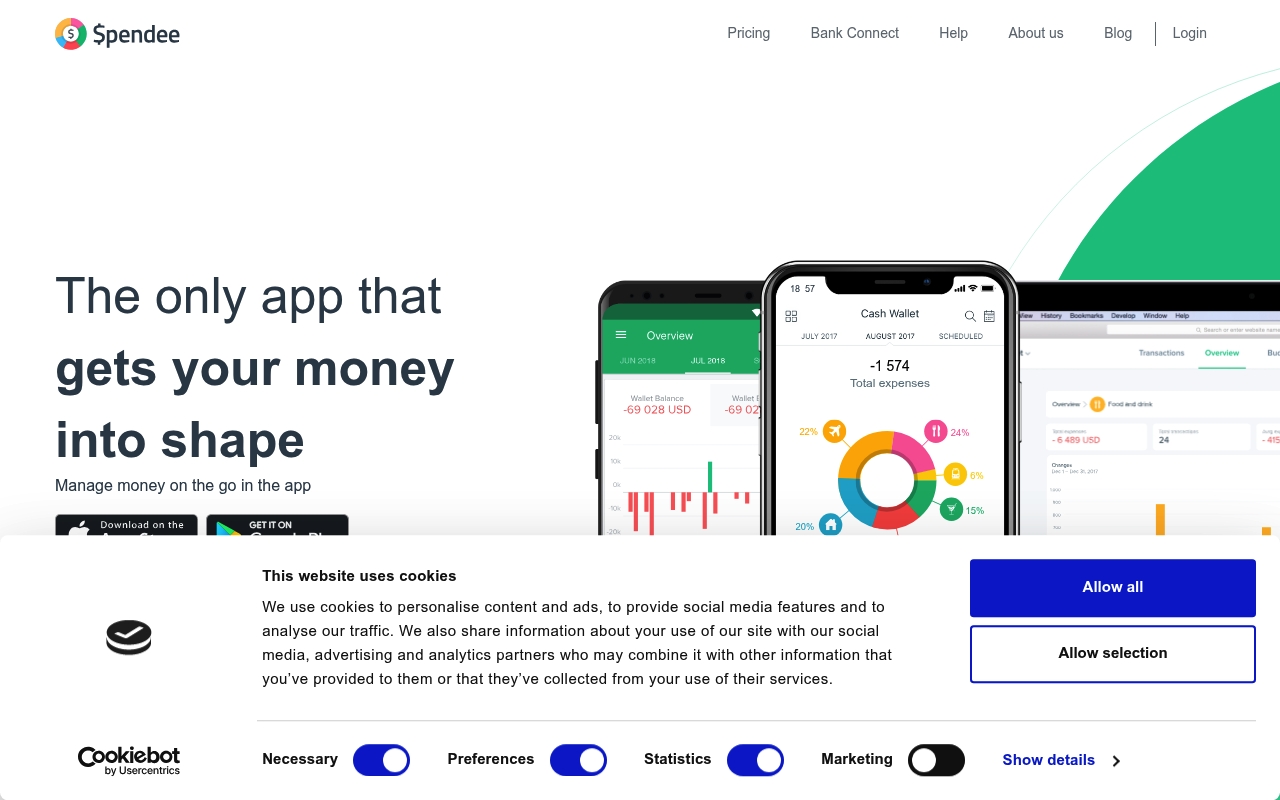
Spendee is a personal finance app built around the idea that tracking money shouldn't feel like work. It strips away the complexity of traditional budgeting tools and replaces it with a clean, visual interface that makes spending habits immediately visible. The app lets you categorize expenses on the fly, set budgets for different spending areas, and share finances with family members or partners—because for many people, money is a joint endeavor, not a solo sport.
What separates Spendee from the crowded budgeting space is its focus on simplicity and real-time visibility. Rather than burying insights in dashboards or overwhelming users with features they'll never use, it prioritizes the moment-to-moment clarity that actually changes behavior. You log a transaction, assign it to a category, and instantly see how it affects your monthly targets. Shared wallets are built in from the start, reflecting how couples and families actually manage money together.
The app operates in the personal finance layer where friction and poor UX have long been the norm. European fintech has matured significantly in recent years, but consumer budgeting apps remain fragmented and often unintuitive. Spendee's approach—thoughtful design, practical feature set, and a focus on the emotional side of money management—positions it as a genuinely useful tool rather than another abandoned app on a smartphone.
In the broader landscape of European fintech, Spendee represents the category of consumer-first tools that sit between pure neobanks and enterprise wealth platforms, addressing the everyday reality that most people need to see where their money goes before they can make smarter decisions about where it should go.
Founded 2013
Open Banking
Financial Infrastructure🇩🇰 Denmark
PSD2 was supposed to open European bank data to everyone. In practice it opened it to organisations that could afford to become an Account Information Service Provider — a national regulatory registration plus eIDAS certificates, a QWAC and a QSEALC, that cost money and take months to obtain. The result is that open banking in Europe is realistically available to funded startups and enterprises buying through aggregators on quote-based contracts. An individual who wants their own transaction history in a spreadsheet, or a two-person SaaS that needs bank data for a single feature, has no practical route in.
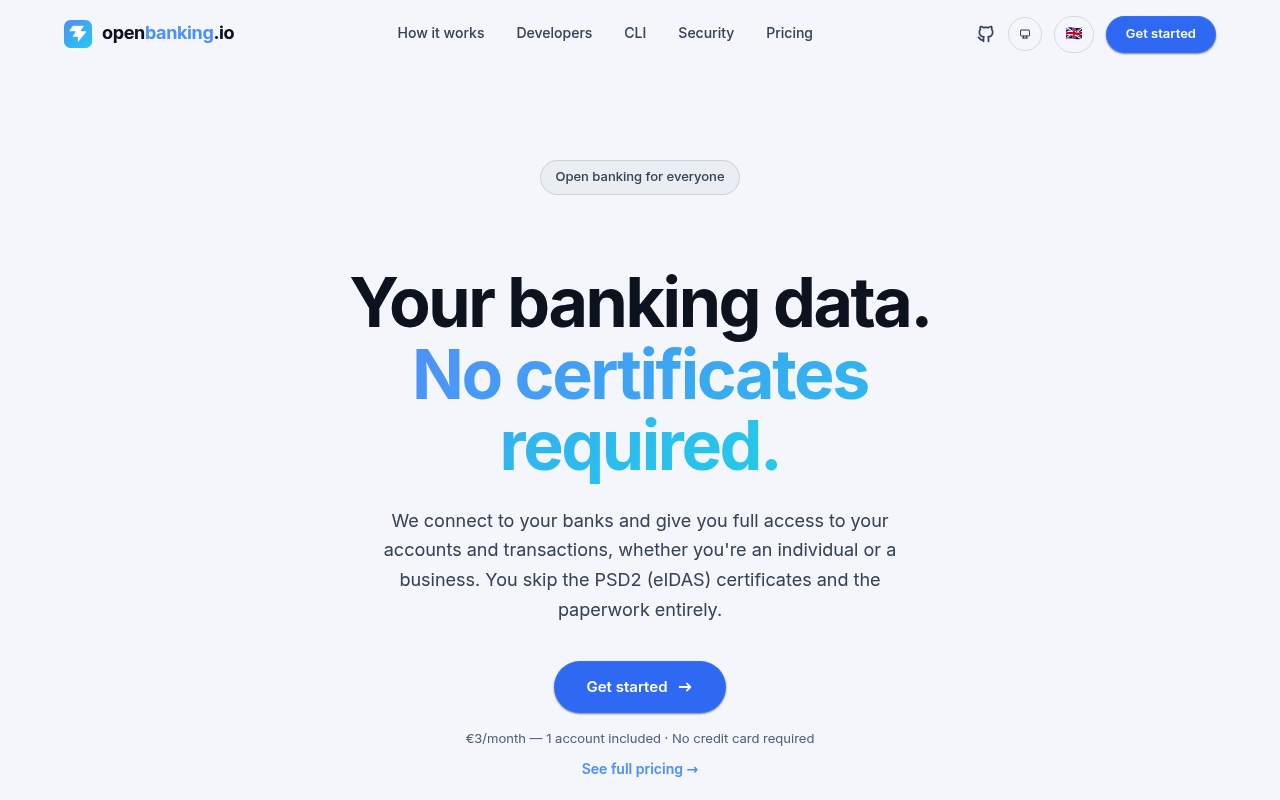
open-banking.io is a direct attempt at that gap, and it is candid about how it works. The company does not hold its own AIS authorisation. Bank connectivity runs through Enable Banking, the Espoo-based aggregator registered as an Account Information Service Provider and supervised by Finland's FIN-FSA, so the regulated activity that touches bank APIs sits under Enable Banking's licence. What open-banking.io adds on top is packaging: a web app, a command-line tool, open-source client libraries, a server-to-server API, and a price — €3 per month including one account, €1 per additional account, no credit card to start — aimed at customers the licensed providers have never gone after.
The encryption architecture is the more distinctive piece. The key is generated on the user's device and never leaves it; open-banking.io holds only the public key, enough to encrypt incoming data but not to read it. Bank credentials pass directly to the bank and are never stored. That is a materially different posture from aggregators that hold customer financial data in readable form as a matter of course, and it is a coherent answer to the obvious objection about routing bank data through a very small company.
And it is a very small company. open-banking.io is operated by Tatic ApS, a Danish entity based in Hadbjerg, and run by a single founder, John Frandsen. The GitHub organisation and first SDKs shipped in June 2026 with the public beta following weeks later, which makes this one of the newest listings in the database. The supporting material tracks the audience precisely — self-hosting documentation, a CLI, and a guide for Beancount, the plain-text accounting format used by a small and technical population. For personal finance tooling, bookkeeping automation, and internal scripts, it removes a barrier that otherwise makes open banking inaccessible entirely.
Founded 2026
Satchel
Payments🇱🇹 Lithuania
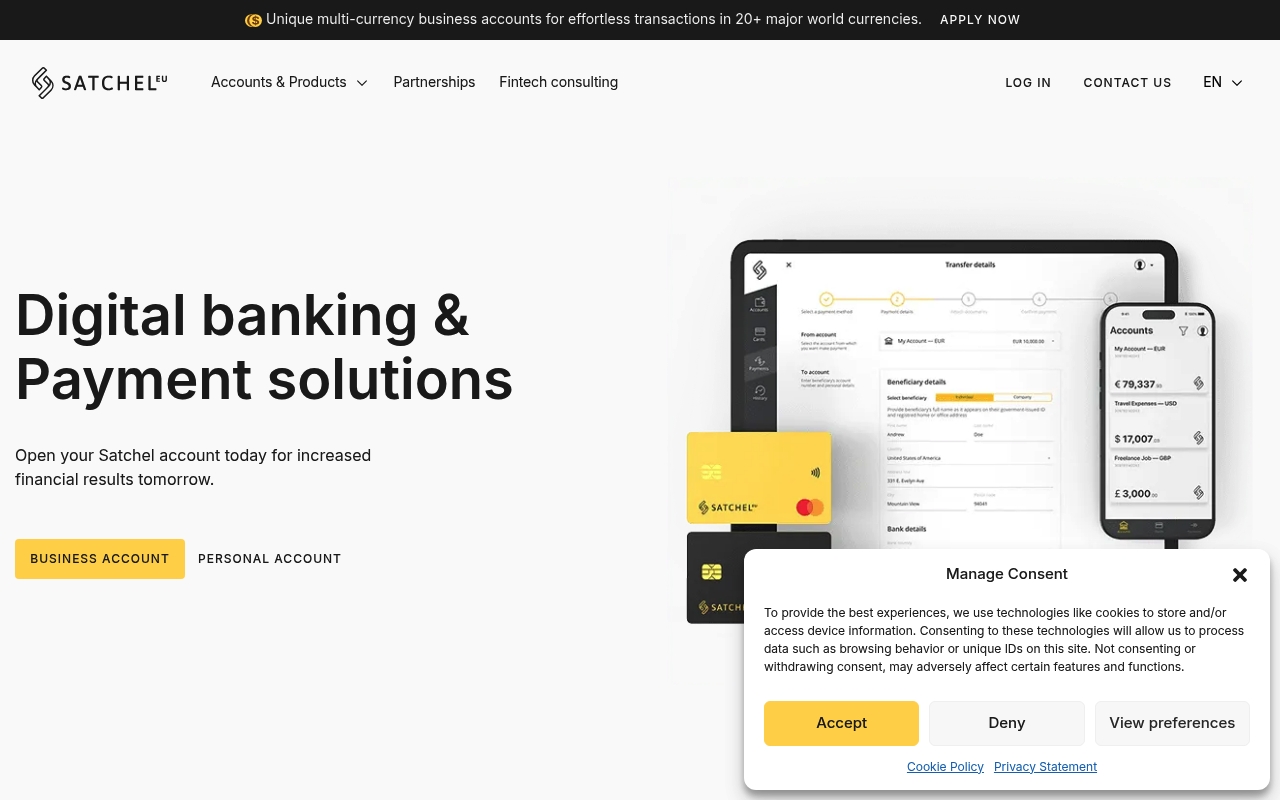
Satchel is a European fintech that transforms how SMEs and freelancers manage their money by cutting through the complexity of traditional banking and accounting. Rather than forcing users to juggle separate tools—a bank account here, an accountant there, spreadsheets everywhere—Satchel brings cash flow, invoicing, and compliance into one streamlined platform built for the realities of running a small business today.
The company positions itself as a modern alternative to the fragmented toolstack that small business owners have long tolerated. While legacy banks still treat SMEs as afterthoughts and accounting software remains clunky, Satchel builds workflows that actually fit how contemporary freelancers and small teams work: fast invoicing, real-time cash visibility, automatic categorization, and intelligent insights that help you understand where your money goes.
In the crowded European fintech landscape, Satchel differentiates through its focus on the friction points that matter most to working owners—not just payments or analytics in isolation, but the integrated experience of running a business without needing a CFO. Its design-forward approach and emphasis on clarity position it squarely in the modern banking movement, aimed at entrepreneurs who want simplicity without sacrificing control.
Satchel represents the shift toward integrated financial management for solopreneurs and SMEs across Europe, replacing outdated workflows with software that feels native to how modern businesses actually operate.
Founded 2017
Linxo
Open Banking🇫🇷 France
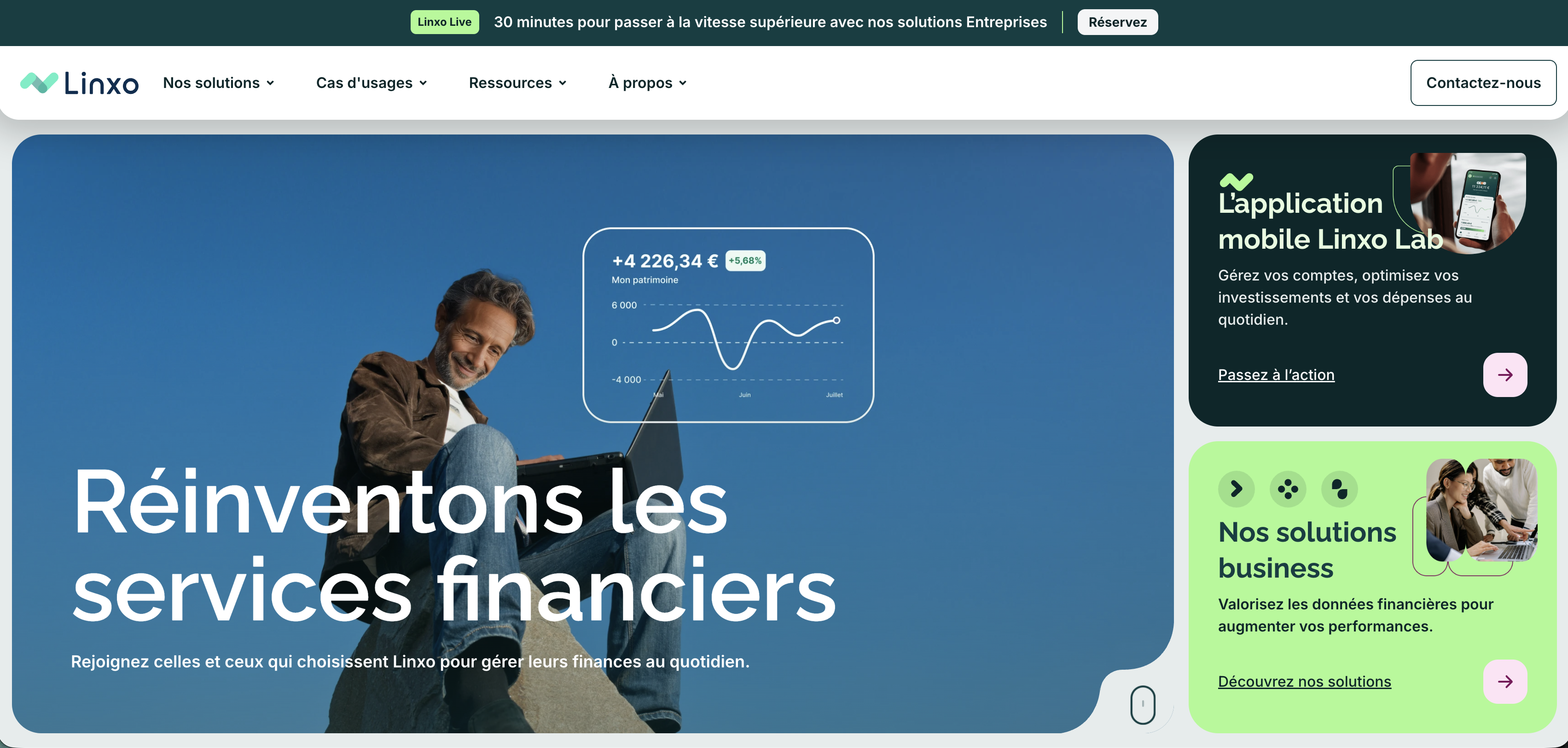
Linxo is a European personal finance platform that aggregates bank accounts, credit cards, and investments across multiple institutions into a single dashboard. Rather than asking users to switch banks entirely, the app pulls live data from existing accounts—a model that respects the European's pragmatic relationship with their primary bank while offering the insights and control they actually want. The company positions itself as the financial operating system for everyday money management, not a replacement for banking itself.
What sets Linxo apart in a crowded personal finance space is its focus on actionable intelligence. Beyond simple balance-checking, the platform categorizes spending automatically, alerts users to unusual transactions, and helps track progress toward financial goals—all without the paternalistic tone of many budgeting apps. It works across France, Spain, Germany, Italy, and Belgium, making it one of the few genuinely pan-European plays in a category often dominated by single-market apps.
Linxo has built its infrastructure on open banking standards, leveraging PSD2 APIs to connect securely to banking institutions rather than relying on screen-scraping. This approach gives it a technical moat while also keeping it aligned with regulatory trends. The company targets digitally-native adults who want visibility into their finances without the friction of traditional banking interfaces.
In the broader fintech landscape, Linxo represents a specific bet: that most people won't abandon their bank, but they will absolutely pay for—or accept advertising within—a tool that makes that bank easier to use. It's less disruptive than a neobank, more practical than an investment app, and more design-forward than legacy personal finance software.
Founded 2015
Showing 12 of 13 companies. View all in the directory →