Savings tools Companies in Europe
Savings tools help individuals build and manage savings through goal-setting, automated transfers, and progress tracking. They range from simple savings pot features within banking apps to dedicated savings platforms that route money to higher-rate accounts automatically. The most effective savings tools reduce the friction of saving through automation — round-ups, scheduled transfers, and rule-based saving triggers — so that saving happens without requiring ongoing conscious decisions from the user.
European Savings tools companies in our database
Notable savings tools companies include Monzo, Avanza, Moneybox, Wealthify and OneFor.
The founding team that built Monzo had all worked together before — at Starling Bank, another challenger startup that didn't survive its internal conflicts. Tom Blomfield, Gary Dolman, Jonas Huckestein, Jason Bates, and Paul Rippon left together in 2015 and started again. The product was initially a prepaid card — a coral-coloured piece of plastic that became one of the most recognisable objects in British fintech — before becoming a fully licensed current account in 2017. The early community was unusual for a bank: public engineering blogs, user forums, beta programmes, and a 2016 crowdfunding round that raised £1 million in 96 seconds, a world record. People felt ownership of the product in a way no high street bank had ever achieved, and that emotional connection became a durable competitive advantage. A decade on, the results have caught up with the mythology. For the year to March 2026, Monzo reported revenue of £1.71 billion, up 39%, with gross profit crossing £1 billion for the first time and a third consecutive year in the black — statutory pre-tax profit of £87.3 million, up 44%, or £172.6 million adjusted for restructuring charges and a roughly £21 million FCA fine over historical financial-crime control failings. The bank added a record three million customers to reach 15.2 million — one in five UK adults — with deposits up 55% to £25.7 billion, 1.6 million paying subscribers, and business banking growing 45% to 905,000 customers and 14% of revenue. Four separate income streams — current account balances, borrowing, payments, and wealth — each now clear £300 million. Half of active customers use Monzo as their primary bank, which shows up in the metric that anchors every valuation conversation: revenue per active personal customer of £167, against Revolut's £66. The gap is the difference between being someone's bank and being their travel card. Leadership and strategy both turned over during the year. Diana Layfield, a former Google executive, took over as CEO in February 2026 following TS Anil's departure — a transition shaped in part by board tensions over IPO venue and the company's UK concentration. Her first significant moves were decisive: Monzo closed its US operations entirely, and redirected the international ambition at Europe, where it secured a banking licence from the Central Bank of Ireland, launched in Ireland to a 100,000-person waitlist, and named Spain as the next market. The acquisition of digital mortgage broker Habito completed on 1 April 2026, giving the bank a capital-efficient route into mortgages — a product more than 550,000 customers were already tracking in the app. Costs rose with the ambition: the cost-to-income ratio ticked up to 74% as hiring and marketing accelerated. Monzo remains private, valued at approximately $5.9 billion in its 2024 secondary sale, and Layfield has told the FT she is "not in a hurry" to list. The strategic bet of this chapter is clear and genuinely contestable: that Monzo's deep-relationship, primary-bank model — expensive to build, lucrative per customer — can be exported to European markets where Revolut arrived a decade earlier with the opposite playbook. The UK numbers say the model works. Europe will say whether it travels.
Avanza is Sweden's largest independent online brokerage, a no-frills investment platform that democratized stock trading for Swedish retail investors two decades ago. What started as a scrappy alternative to traditional banks has become the go-to app for millennials and Gen Z who want to trade, invest, and save without paying legacy banking fees. The platform strips away unnecessary complexity—no advisors, no jargon, just direct market access at transparent prices. Avanza operates in that interesting middle ground between a neobank and a pure trading platform. It offers savings accounts, pension accounts, and investment accounts with a sharp focus on user experience and low costs. The company has built a cultural following in Sweden, becoming almost synonymous with retail investing for a generation that views traditional brokers as relics. Beyond just equities and funds, Avanza has expanded into savings products, retirement planning, and financial education—positioning itself as a genuine financial companion rather than just a transaction layer. Its dominance in the Nordic market reflects a broader European shift toward direct-to-consumer investment platforms that compete on transparency, speed, and mobile-first design. Avanza exemplifies how fintech can win by doing one thing exceptionally well and then expanding thoughtfully into adjacent categories. The company's influence extends beyond Sweden into a broader shift in how younger Europeans think about investing: without gatekeepers, without unnecessary fees, and entirely on their own terms.

Moneybox is a British savings and investment app that treats money management like a habit rather than a chore. It rounds up your everyday card purchases to the nearest pound and automatically invests the spare change, turning small moments of spending into genuine wealth-building opportunities. The app sits somewhere between a savings account and an investment platform, democratizing retail investing for people who'd otherwise struggle to find the discipline or capital to start. What makes Moneybox different is its behavioral psychology angle. Rather than asking users to set aside cash manually, it leverages the friction-free nature of mobile payments to make investing feel frictionless and even invisible. Your coffee costs £3.50? It rounds to £4, and that 50p joins a growing pot invested in a diversified portfolio matched to your risk tolerance. Launched in 2016, Moneybox has spent the better part of a decade refining this approach across the UK market. It's accrued millions of users precisely because it removes two of the biggest barriers to retail investing: the psychological burden of cutting back elsewhere, and the paralysis of deciding where to actually put your money. The app integrates with your everyday banking, making wealth-building feel less like a separate financial task and more like an automatic consequence of how you already spend. Moneybox represents a category-defining shift in European fintech: proving that small, consistent nudges—powered by smart design and behavioral insights—can genuinely shift how people relate to money. In an era of headline-grabbing mega-rounds and complex financial engineering, Moneybox's insight is almost defiantly simple: make investing as easy as spending.
Investing in the UK has historically required either enough money to interest a private bank or enough financial confidence to navigate a self-directed brokerage account — neither of which describes the typical UK saver with a few thousand pounds set aside who would benefit from being invested rather than holding cash in a low-interest savings account. Wealthify was founded in Cardiff in 2015 to serve that customer with a robo-advisory platform that accepted investments from £1, used a short questionnaire to determine risk profile, and managed diversified portfolios automatically. The proposition was deliberately accessible: no minimum investment, transparent fees, no jargon, and an interface designed to make investing feel approachable rather than intimidating. Wealthify was acquired by Aviva in 2017 — one of the UK's largest insurance companies — providing it with both distribution and the institutional credibility that helps newer investment platforms attract conservative savers. The Cardiff-based team has continued operating with significant autonomy as part of Aviva's wealth offering. In the UK robo-advisory landscape — which has been smaller and more fragmented than the US equivalent — Wealthify built a particularly accessible position for first-time investors, and its acquisition by Aviva represents one of the cleaner examples of a robo-advisor finding a strategic home with a major financial services group rather than struggling to build sustainable scale independently.
OneFor is a European fintech platform that reimagines how SMEs access and manage working capital. Rather than treating finance as a transactional afterthought, OneFor embeds cash flow tools, invoice financing, and dynamic credit solutions directly into the workflows where small business owners actually work. The platform pulls together accounts data, payment history, and real-time transaction flows to offer instant access to capital without the friction of traditional bank applications. What sets OneFor apart is its positioning as a cash flow operating system rather than just another lending product. It serves companies that traditional banks have largely abandoned—the messy middle of European small business—by automating the visibility and accessibility of working capital. While legacy banks still demand spreadsheets and weeks of underwriting, OneFor delivers decisions in hours using behavioral data and API connections to accounting software. The company operates across Western Europe with particular traction in the UK and Nordics, building a loyal following among founders who've grown tired of juggling multiple finance tools. Its integration-first approach means OneFor sits comfortably alongside existing business software stacks, making it feel less like switching banks and more like upgrading your CFO's toolkit. In a crowded SME finance space, OneFor's bet is that speed, transparency, and embedded simplicity will ultimately win over traditional lending relationships.
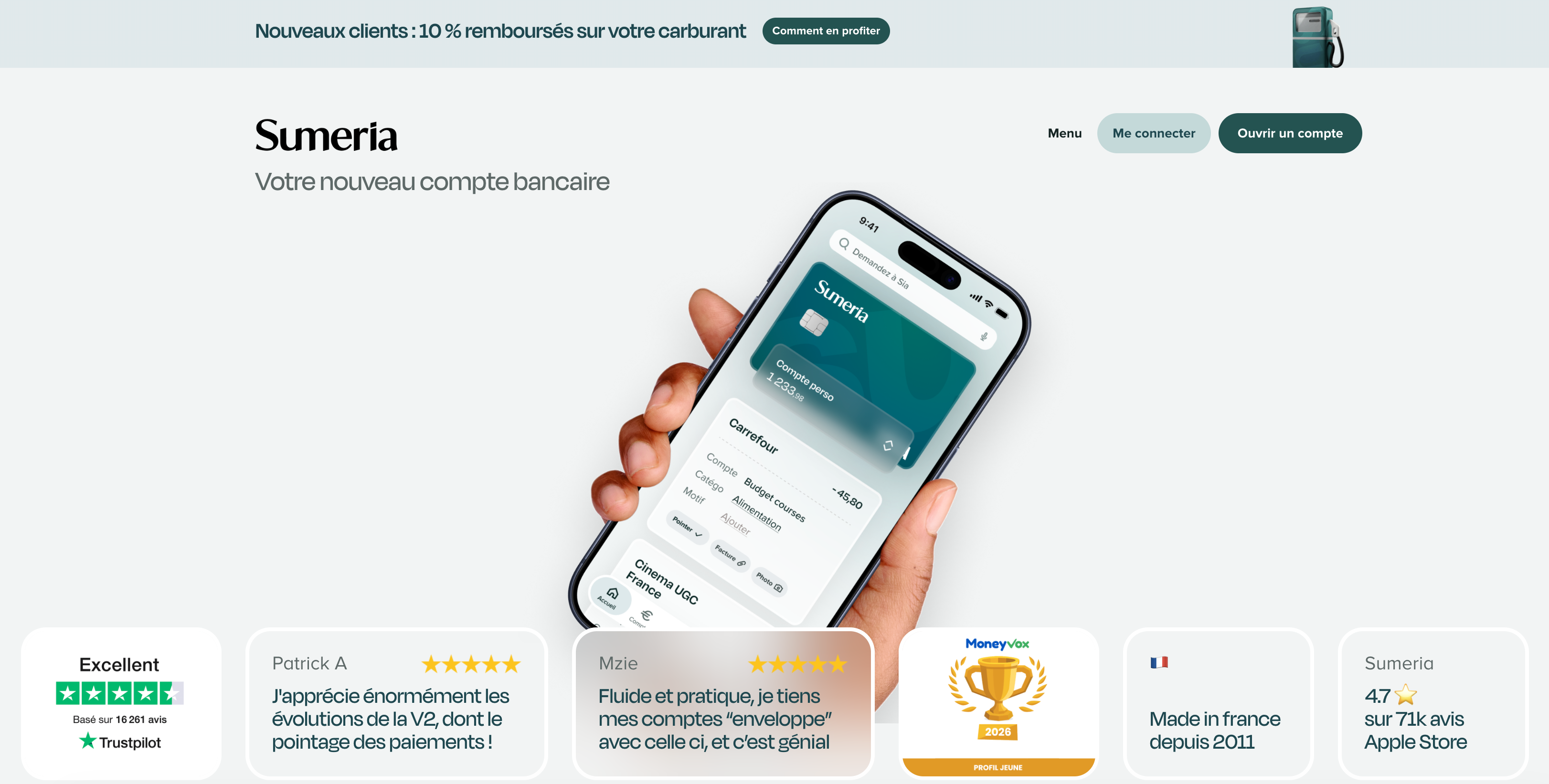
Splitting a restaurant bill used to involve a painful combination of mental arithmetic, someone forgetting their wallet, and a group negotiation about whether to ask for separate checks. Lydia was founded in Paris in 2013 to make that specific moment effortless — and in doing so, became the dominant peer-to-peer payment app in France. Its simple interface for sending and requesting money between contacts captured a generation of French users who had grown up with PayPal but wanted something faster and more mobile-native. Lydia expanded beyond P2P transfers into a broader financial platform, adding savings accounts, investment products, and consumer credit — the classic neobank expansion playbook, executed in a market where Revolut and N26 were competing aggressively for the same digitally native users. The company rebranded its premium offering as Sumeria in 2023, signalling an evolution from a payment utility into a full financial product. In the French fintech landscape, which has historically been dominated by the large banking groups, Lydia built something rare: a consumer brand with genuine affection from its users, built on the back of a product so simple that it spread without marketing.