← All services
5 European companies
Policy Issuance Providers in Europe
Policy issuance services handle the creation and delivery of insurance policy documents — generating policy schedules, certificates of insurance, and supporting documentation automatically from underwriting data. Fast, accurate policy issuance is important both for customer experience (particularly for instant insurance products) and for the legal validity of insurance contracts.
Typically offered by
European fintech companies offering policy issuance
Coverflex
Digital Banking🇵🇹 Portugal
Coverflex is rewriting how freelancers and gig workers access financial security in Europe. Instead of the traditional employment model, the platform bundles flexible work with genuine benefits—health insurance, pension contributions, and paid leave—creating a middle path between employment and total independence.
The company essentially flips the script on gig economy precarity. Workers stay independent contractors but gain access to protections that were previously locked behind 9-to-5 employment. Employers get a simpler way to hire flexible talent without managing traditional payroll complexity. It's a fundamentally different architecture for modern work.
Coverflex operates across multiple European markets and has built a B2B2C model where companies use the platform to offer benefits to their contractor workforce. The business combines insurance brokerage, financial services coordination, and workplace infrastructure into one interface.
In a landscape where gig work remains fragmented and precarious, Coverflex sits at the intersection of fintech and HR tech, solving a genuine gap in how Europe's growing contingent workforce accesses security and stability.
Founded 2020
Teylor
InsurTech🇩🇪 Germany
Teylor is building the infrastructure layer for European insurers who've spent decades trapped in legacy systems. Rather than asking them to rip and replace everything, Teylor plugs into their existing architecture as an API-first, cloud-native alternative—handling policy administration, billing, and customer management with the speed and flexibility that modern insurance demands.
The company targets mid-market and larger insurers across Europe who need to move faster but can't afford the operational risk of wholesale transformation. Teylor's approach is pragmatic: you don't need to become a fintech startup to compete like one. Instead, you layer in modern tools where they matter most and keep your proven processes intact.
In a market where InsurTech typically means either a scrappy direct-to-consumer challenger or a consulting-heavy legacy modernization play, Teylor sits in a more interesting middle ground—enterprise-grade software that actually feels like it was built in the last decade. For traditional insurers tired of vendor lock-in and staggering implementation timelines, it represents a credible path to digital without the existential risk.
Founded 2019
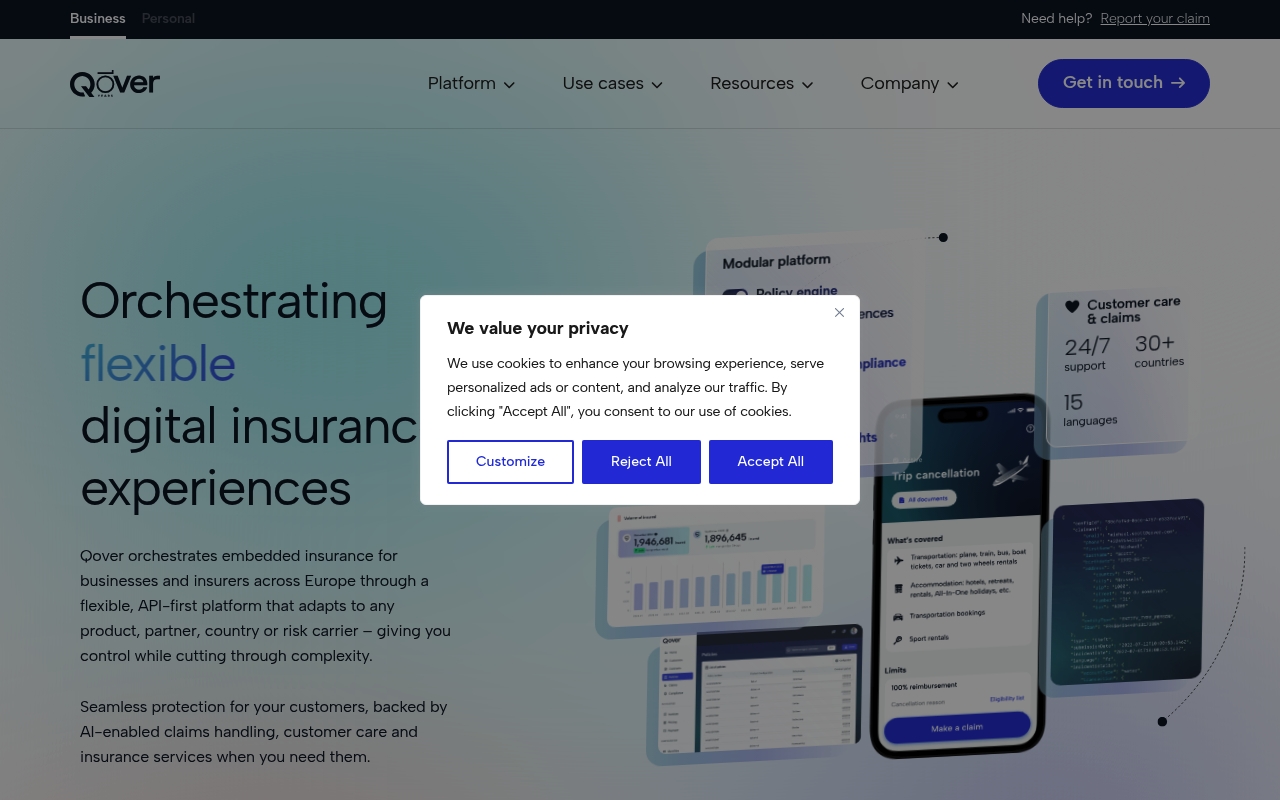
Qover
Embedded Finance🇧🇪 Belgium
Qover sits in the gap between insurance carriers, who have capital and licences but poor distribution, and consumer brands, who have millions of engaged users but no interest in becoming insurers. Founded in Brussels in 2016 by Quentin Colmant — previously a senior figure at Allianz Benelux — and Jean-Charles Velge, it built an API-first orchestration platform that lets a company embed insurance as a native feature of its own product, with Qover handling the regulatory, carrier and lifecycle complexity underneath.
The partner list is the argument. Qover powers embedded insurance programmes for Revolut, Monzo, bunq, Mastercard, BMW, Deliveroo, Canyon, Cowboy and Trust Travel (a TUI brand), across more than 32 countries. Those are wildly different use cases — travel cover inside a banking app, device protection alongside a purchase, injury cover for gig workers — running on the same orchestration layer, which is the point: the platform's value is that cross-border insurance distribution becomes a configuration problem rather than a licensing project in every market.
Ten years in, the numbers are respectable rather than explosive: around 15 million people protected, over $173 million in gross written premiums, revenue tripled over four years, and total funding past $100 million. The most recent raise, in March 2026, is itself informative — a $12 million growth capital facility from CIBC Innovation Banking rather than an equity round, which is what a company does when it wants runway without dilution and believes its economics support debt. The stated targets are ambitious to the point of requiring scrutiny: 55 million people protected by the end of 2026, up from 15 million, and 100 million by 2030. That trajectory depends almost entirely on a small number of very large partners rolling out programmes on schedule — which is both the strength and the concentration risk of the orchestration model.
Founded 2016
KBC
Wealth🇧🇪 Belgium
KBC is a large integrated financial services group headquartered in Belgium, offering retail banking, insurance, and investment services across Belgium, Czech Republic, Hungary, and Slovakia. Founded in 1998 through a merger, it operates as a universal bank serving millions of customers through its retail banking division, which provides checking accounts, savings products, mortgages, and personal loans alongside comprehensive insurance offerings and wealth management services. The group maintains a significant digital presence with mobile and online banking platforms, competing in a crowded European banking landscape where traditional universal banks are increasingly challenged by digital-native challengers and specialized fintech players. KBC represents the established institutional player—well-capitalized, heavily regulated, and built on decades of branch infrastructure—while navigating the shift toward digital-first customer expectations and open banking standards that are reshaping traditional banking economics across the continent.
Founded 1998
wefox
InsurTech🇨🇭 Switzerland
Wefox is a digital insurance broker that cuts through the noise of traditional insurance shopping. Rather than piecing together quotes from multiple providers, customers get personalized coverage recommendations through a streamlined mobile-first platform. The company bundles home, auto, and pet insurance into a single digital experience, handling everything from comparison to claims—no brokers in grey suits required.
What sets wefox apart in Europe's insurance landscape is its focus on simplicity. While legacy brokers still rely on phone calls and paperwork, wefox does the legwork algorithmically, comparing hundreds of policies in seconds and presenting only the relevant options. The interface feels less like insurance shopping and more like opening a fintech app.
The company operates across multiple European markets, building a tech-forward alternative to the tired insurance broker model. It's positioned as insurance for people who'd rather not think about insurance—until they need to claim. In the broader fintech ecosystem, wefox represents a straightforward play on distribution innovation: taking an opaque, offline-first industry and making it transparent, fast, and mobile-native.
Founded 2015