DatabaseCategoriesServicesCountriesArticlesNewsletterRequest listing
← Categories

Identity & KYC Companies in Europe

22 companies·12 countries·Updated August 2026

Identity and KYC companies verify who a customer is before a bank, fintech, or crypto platform lets them open an account or move money — combining document verification, biometric checks, digital onboarding flows, and the AML screening that happens alongside it. The category exists because Europe's AML rules require regulated firms to know their customer before onboarding them, and doing that manually doesn't scale past a handful of signups a day.

That verification layer is about to change shape. Every EU member state must offer a compliant European Digital Identity Wallet by the end of 2026, and from November 2027 banks, insurers, telecoms, and large online platforms are legally required to accept it as a form of identification — a shift toward user-held, selectively-disclosed credentials that today's document-scan-and-selfie flows weren't built around.

What identity and KYC platforms actually do

Onboarding a new customer used to mean a compliance officer manually checking a passport scan against a selfie and a sanctions list. Identity platforms automate each piece: document verification reads and validates a passport or ID card against security features and government databases, biometric ID matches a live selfie or video against the document photo, and digital onboarding flows stitch the whole sequence into a few minutes on a phone screen. Identity orchestration sits above all of this, routing a given signup to whichever combination of checks its risk level requires rather than applying the same heavyweight process to everyone.

AML screening runs alongside identity verification rather than after it — checking a new customer's name against sanctions lists, politically-exposed-person registers, and adverse media the moment they onboard, not as a separate later step. This is why identity-and-KYC and regtech overlap: the AML check itself is a regtech function, but for most fintechs it's triggered and experienced as part of the identity flow.

The EU Digital Identity Wallet changes the input, not just the process

Every European country has to offer citizens a compliant digital identity wallet by the end of 2026, and from November 2027 banks and other large regulated platforms are legally required to accept it. Practically, that means a customer could prove they're over 18, or that they hold a valid government-issued ID, without handing over a full document scan at all — a selective-disclosure model that today's identity platforms will need to support alongside, not instead of, traditional document checks, since adoption will be gradual and most onboarding will still happen the old way for years.
Subcategories
AML screening (15)Digital onboarding (16)Biometric ID (7)Document verification (12)Identity orchestration (6)
AML screening:
AML screening checks customers and transactions against watchlists of sanctioned individuals, politically exposed persons (PEPs), and adverse media sources.
Digital onboarding:
Digital onboarding platforms orchestrate the full customer onboarding journey for regulated financial products — identity verification, AML screening, risk scoring, document collection, terms acceptance, and account activation — within a single mobile-optimised workflow completing in under five minutes.
Biometric ID:
Biometric ID uses physical characteristics — facial features, fingerprints, iris patterns, or voice — to verify a person's identity during financial services onboarding or ongoing authentication.
Document verification:
Document verification is the automated analysis of identity documents — passports, national identity cards, driving licences, residence permits — to confirm their authenticity and extract structured data.
Identity orchestration:
Identity orchestration platforms manage the end-to-end identity verification workflow — coordinating multiple verification checks (document verification, biometrics, database lookups, AML screening) into a single coherent customer journey, with intelligent routing that adjusts the required checks based on risk level, product type, and jurisdiction.
How to choose

How to choose

Match the verification method to your risk level, not the cheapest option. A basic document-and-selfie check is enough for a low-value consumer account; a crypto exchange or a business account opening under enhanced due diligence needs identity orchestration that can escalate to more checks automatically. Buying the lightweight option for a high-risk use case is a compliance gap, not a cost saving.

For AML screening specifically, this page isn't the comparison you want. Choosing between AML or sanctions screening providers head-to-head is its own decision with real differences in list coverage and false-positive rates — see our AML screening providers guide and sanctions screening tools guide for that comparison.

Ask what happens when verification fails, not just when it succeeds. Document scans fail for legitimate reasons — poor lighting, an unfamiliar ID format, a worn passport — and a platform with no manual-review fallback either blocks real customers or quietly lowers its own bar. Ask what percentage of applicants need a human review step, and how long that takes.

Start planning for the EU Digital Identity Wallet now, even though full adoption is years away. The private-sector acceptance mandate lands in November 2027, and vendors are already building support for it. A platform with no roadmap for wallet-based verification is buying you a re-platforming project in two to three years.

Digital onboarding speed and drop-off are the metric that actually matters commercially. Every extra step in an onboarding flow loses a percentage of signups — ask a vendor for their actual completion-rate benchmarks, not just their stated verification accuracy.

European Identity & KYC companies in our database

Notable identity & kyc companies include Fourthline, Fenergo, IDnow, Evervault and ComplyAdvantage.

Fourthline
Fourthline🇳🇱
Est. 2017

Fourthline didn't start as a KYC company. It started as a payment institution. Krik Gunning and Chris van Straeten founded Safened in Amsterdam, licensed by the Dutch Central Bank as a regulated payment provider. As Safened onboarded its own customers, it built identity verification technology capable enough that other banks and fintechs started asking to use it directly. The demand was real and growing — digital financial services were expanding rapidly but compliance infrastructure hadn't kept pace. In 2019 Gunning and van Straeten spun the KYC operation out as a standalone company and renamed it Fourthline. The name refers to compliance being the fourth line of defence in financial crime prevention — after business operations, risk management, and internal audit. It's a deliberately serious framing for a company that treats KYC not as a box to tick but as a technical problem worth solving properly. While many identity verification providers offer generic document checks, Fourthline built its platform around the regulatory requirements of Europe's strictest financial supervisors — the kind of compliance depth that a neobank launching in Germany or a broker entering the Netherlands actually needs to satisfy its regulator, not just its legal team. The platform covers the full KYC and AML stack through a single API: document verification, biometric checks with liveness detection, AML and sanctions screening, risk scoring, proof of address, and ongoing customer monitoring throughout the customer lifecycle. The modular architecture means regulated institutions can pick the components they need rather than buying a fixed bundle — a practical advantage for fintechs that need identity verification at onboarding but different monitoring requirements at scale. The client list is a reasonable proxy for the quality of the product. Fourthline verifies identities for N26, Qonto, Trade Republic, flatexDEGIRO, Scalapay, Shine, and Bitpanda — regulated financial businesses across Europe that operate under strict supervisory scrutiny and cannot afford onboarding failures. The company employs around 225 people and has raised approximately $70 million in funding, primarily from Finch Capital. Leadership and structure have both shifted in 2026. In March, Fourthline appointed Paul Stoddart as CEO, with co-founder Krik Gunning moving into an advisory role after leading the company since its founding. Then in July came the bigger move: Fourthline and Veridas, the Spanish biometrics specialist, agreed to merge their identity platforms. The combination pairs Fourthline's KYC and AML compliance orchestration — built for Europe's strictest supervisors — with Veridas's facial and voice biometric technology, and extends the group's reach beyond Europe into Latin America, where Veridas has an established presence. The strategic logic tracks the regulatory calendar. The EU's new Anti-Money Laundering Regulation comes into force in July 2027, substantially raising compliance requirements for financial institutions across Europe and expanding the addressable market for exactly this kind of infrastructure. Identity verification is consolidating ahead of that wave — and scale matters when every regulated institution on the continent is about to need more of what you sell.

Fenergo
Fenergo🇮🇪
Est. 2008

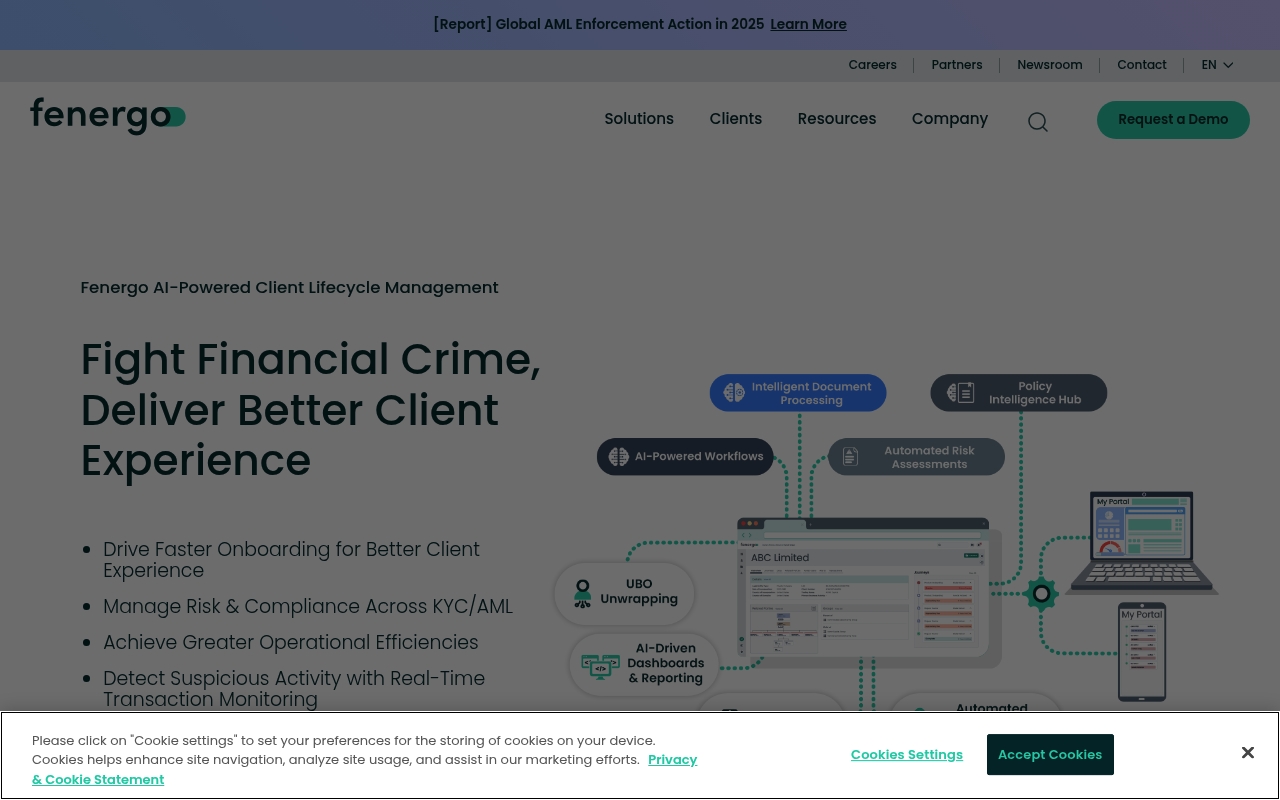
Compliance has long been the unglamorous backroom operation of financial services—heavy, expensive, and often painfully slow. Fenergo flips that script by turning regulatory friction into operational advantage. The Dublin-based software company automates the gruelling work of onboarding clients, managing their data, and staying compliant with an ever-shifting maze of regulations. What banks and investment firms once treated as a cost center, Fenergo repositions as competitive edge. At its core, Fenergo is a digital client lifecycle management platform. It consolidates onboarding, KYC, AML screening, sanctions checks, and ongoing regulatory monitoring into a single, integrated workflow. Rather than legacy institutions juggling multiple point solutions and manual spreadsheet cultures, Fenergo orchestrates the entire client journey—from first interaction through renewal—in a single intelligent system. The software ingests regulatory data, flags anomalies, and automates approvals where rules allow, freeing compliance teams to focus on judgment calls that actually require human expertise. What sets Fenergo apart in a crowded RegTech space is its disciplined focus on the regulated financial institution as customer, not the consumer. While plenty of fintechs chase sexy consumer-facing applications, Fenergo has built deep, sticky relationships with banks, asset managers, and brokers who need sophisticated, audit-proof compliance infrastructure. It operates at institutional scale—handling millions of client records, complex entity hierarchies, and regulatory jurisdictions spanning continents. In an era when regulatory fines have become nine-figure line items and reputational damage from compliance failures can tank a bank's stock price, Fenergo sits at the nerve center of institutional risk management. It's not the flashy side of fintech, but it's arguably the most essential.

IDnow
IDnow🇩🇪
Est. 2014

Knowing who your customer is has always been a regulatory requirement in financial services. Proving it, digitally, in real time, across dozens of jurisdictions with different document standards and compliance frameworks, is a genuinely hard engineering and operational problem. IDnow was founded in Munich in 2014 to solve it. Its identity verification platform offers a range of methods — video identification, automated AI-driven document checks, and eID integration — giving regulated businesses the flexibility to choose the right verification approach for their risk profile and customer base. The company has built particular depth in the German market, where video identification has a specific legal status under financial regulation, but has expanded across Europe serving banks, insurance companies, crypto platforms, and any business that needs to onboard customers with confidence. IDnow was acquired by Corsair Capital in 2021 and has continued expanding through partnerships and product development. In a regulatory environment where digital onboarding requirements are tightening and fraud is becoming more sophisticated, the identity verification layer is one of the most critical — and most contested — parts of the fintech stack.

Evervault
Evervault🇮🇪
Est. 2020

Evervault is a European cryptography company that lets developers encrypt sensitive data in transit and at rest without rearchitecting their systems. Rather than forcing teams to build custom encryption pipelines or rely on legacy HSM infrastructure, Evervault provides APIs and SDKs that integrate directly into applications—turning what was once a compliance headache into a developer experience problem. The company operates at the infrastructure layer, sitting between your database and your users. It handles encryption orchestration, tokenization, and secure computation without requiring you to manage keys or understand the underlying cryptography. This means your data stays encrypted in your own cloud account, your keys stay with you, and third-party vendors never see plaintext information. In a European market where data residency and privacy regulations have teeth, Evervault solves a real problem: companies need to protect customer data but can't afford to rebuild their entire tech stack. The platform works with existing databases, APIs, and infrastructure, making compliance less of an engineering ordeal. Evervault positions itself as the encryption layer for modern applications—not a database replacement, not a VPN, but the plumbing that makes data protection feel native to your code. It's particularly relevant for fintech companies handling payment cards, personal identifiers, and healthcare records across distributed systems. The company is helping reshape how European companies think about security: not as an afterthought, but as architecture.

ComplyAdvantage
ComplyAdvantage🇬🇧
Est. 2014

Charles Delingpole had already built two companies before this one — The Student Room, the UK's largest student community, started when he was sixteen, and MarketInvoice, the invoice finance platform he co-founded after Cambridge. It was at MarketInvoice that he met the problem that became ComplyAdvantage: every regulated financial business is legally required to screen its customers against sanctions lists, politically exposed persons registers, and adverse media — and the databases everyone relied on for this were built by armies of analysts manually copying names into lists. The data was stale, the false-positive rates were punishing, and compliance teams spent their days clearing alerts on people who shared a name with someone on a watchlist. In 2014 he founded ComplyAdvantage in London on a simple inversion: instead of selling software that queries someone else's manually curated lists, build the risk database itself — with machine learning, from primary sources, updating in real time. That database is the product. ComplyAdvantage continuously processes millions of structured and unstructured data points a day — sanctions updates, regulatory notices, court records, news in dozens of languages — into risk profiles on more than 150 million entities, surfacing tens of thousands of new risk events daily. On top of the data layer sit the tools regulated firms actually deploy: customer screening at onboarding, ongoing monitoring as risk profiles change, payment and transaction screening, and — since 2023 — a fraud detection product that extends the platform from "who is this customer" to "what is this customer doing." The strategic position is precise: this is the data layer of financial crime compliance, sold as an API, competing directly with Dow Jones Risk & Compliance, LSEG's World-Check, and LexisNexis — incumbents whose core asset is exactly the manual process ComplyAdvantage was built to obsolete. The customer base is over 500 enterprises across 75 countries, weighted toward the businesses that grew up alongside it: fintechs, payment companies, crypto platforms, and digital banks that needed compliance infrastructure as programmable as the rest of their stack. Named clients have included Gemini and TransferMate, with partnerships spanning blockchain analytics (Elliptic) and Banking-as-a-Service (Raisin Bank). The company was selected as a World Economic Forum Technology Pioneer, employs around 480 people, and has raised over $150 million from Balderton Capital, Index Ventures, Ontario Teachers' Pension Plan, and Goldman Sachs. In December 2023 it acquired Golden, the a16z-backed knowledge-graph startup, folding structured entity data and its engineering team into the core database. Leadership formalised the company's second act in early 2023: Delingpole moved to executive chairman and Vatsa Narasimha — previously CEO of the trading platform OANDA, and ComplyAdvantage's COO through its scaling years — took over as chief executive. The regulatory backdrop since has run entirely in the company's favour. AMLD6 and the EU's new AML Authority raise screening and monitoring obligations across the continent from 2027, and every expansion of the compliance perimeter — crypto under MiCA, instant payments with sanctions screening at ten-second settlement speeds — enlarges the addressable market for exactly what ComplyAdvantage sells. The honest read is about the market's direction. Financial crime and identity infrastructure is consolidating fast — Featurespace went to Visa, Fourthline is merging with Veridas, World-Check sits inside LSEG — which leaves ComplyAdvantage as one of the few independent, at-scale data players left standing. That independence is a genuine selling point for customers wary of buying compliance data from a card network or an exchange group, and it simultaneously makes the company one of the most obvious acquisition targets in European regtech. The other open question is the arms race it chose: the same generative AI that makes screening sharper is making the launderers' synthetic identities and shell structures cheaper to produce. ComplyAdvantage's bet since 2014 has been that the detection side compounds faster. So far, the market has agreed.

Scanye
Scanye🇵🇱

Scanye is a Polish fintech company that makes document verification and identity management accessible to European businesses. Instead of piecing together fragmented KYC solutions, companies get a unified platform that scans documents, verifies identities, and handles compliance in one place. The platform combines optical character recognition with AI-powered document analysis to catch forgeries and mismatches in real time, cutting the friction out of onboarding without the headaches of legacy compliance workflows. What sets Scanye apart in a crowded identity verification market is its focus on simplicity. While competitors layer complexity with API integrations and compliance jargon, Scanye abstracts away the technical noise. Banks, fintechs, and e-commerce platforms in Poland and neighboring markets use it to streamline customer verification without building custom solutions. The company operates at the intersection of friction reduction and regulatory necessity—solving the problem that most businesses grudgingly accept rather than one they're excited to tackle. Scanya sits squarely in the identity and KYC infrastructure layer that European fintechs depend on but rarely celebrate. It's become part of the plumbing that makes digital onboarding actually work, handling the verification step that determines whether a customer gets through the door or bounces away frustrated. For a region still maturing its fintech stack, that positioning is both practical and strategically sound.

View all 22 Identity & KYC companies →

Frequently asked questions

How many Identity & KYC companies are there in Europe?
The fintechdatabase.eu directory lists 22 Identity & KYC companies across 12 European countries.
What are the biggest Identity & KYC companies in Europe?
The most popular Identity & KYC companies in the directory are Fourthline, Fenergo and IDnow.
Which European countries have the most Identity & KYC companies?
United Kingdom, Germany and Switzerland have the most Identity & KYC companies in Europe.
How many identity and KYC companies are there in Europe?
The directory currently tracks around 20 identity and KYC companies, spanning document verification, biometric ID, digital onboarding, identity orchestration, and AML screening.
What's the difference between KYC and AML screening?
KYC (Know Your Customer) verifies who someone is — their identity document, their biometric match, their address. AML screening checks whether that verified identity appears on sanctions lists, politically-exposed-person registers, or adverse media. Most platforms run both together during onboarding, but they're technically distinct checks.
What is the EU Digital Identity Wallet and when does it launch?
It's an EU-wide digital identity credential every member state must make available to citizens by the end of 2026. From November 2027, banks, insurers, telecoms, and large online platforms are legally required to accept it as a form of identification, alongside traditional document verification.
Do all European fintechs need identity verification to be compliant?
Any regulated financial institution — banks, e-money institutions, payment institutions, crypto-asset service providers under MiCA — has a legal obligation to verify customer identity before onboarding them, as part of standard AML/KYC requirements.
What is identity orchestration?
It's a layer that routes each new customer to the specific combination of checks their risk level requires — a low-risk signup might only need a document scan, while a higher-risk one triggers biometric verification and enhanced AML screening — rather than applying the same process to every applicant.

Related: Fraud & Security, RegTech and Digital Banking companies. Browse fintechs by country, or read our guide KYC Fintechs in Europe.