DatabaseCategoriesServicesCountriesArticlesNewsletterRequest listing
← Categories

RegTech Companies in Europe

34 companies·15 countries·Updated August 2026

RegTech companies build the software that financial institutions use to meet regulatory obligations without doing it by hand — AML screening, audit trails, risk monitoring, regulatory reporting, and compliance analytics. In Europe specifically, the category exists because the compliance burden keeps expanding faster than in-house compliance teams can scale: DORA, MiCA, AMLR, and a new EU-wide AML supervisor have all added obligations within the past two years alone.

That last one is reshaping the category directly. The EU's new Anti-Money Laundering Authority (AMLA), headquartered in Frankfurt, began operating in mid-2025 and will directly supervise around 40 of the EU's highest-risk financial institutions from 2028 — a level of centralised, cross-border AML oversight that didn't exist in Europe before.

Why 2026 is a turning point for European regtech

Three regulatory tracks are converging on the same buying cycle. The Digital Operational Resilience Act (DORA) moved from law-on-paper to active enforcement, requiring financial institutions to map third-party technology risk and report ICT incidents on tight deadlines. AMLA is finalising the risk-assessment methodology it'll use to select which institutions it supervises directly from 2027 onward. And MiCA's transitional deadline is pushing crypto firms into the same compliance infrastructure banks have used for years. Vendors that can serve more than one of these requirements at once — mapping resilience, screening transactions, producing audit-ready evidence — are the ones seeing the fastest adoption.

AML compliance is being centralised, not just automated

AML compliance used to mean each institution built or bought its own screening and case-management stack, supervised loosely by national regulators with wildly different enforcement intensity. AMLA changes that for the largest, highest-risk institutions: instead of 27 different national interpretations of AML rules, a single EU authority will directly supervise compliance for firms it designates as high-risk, with a more consistent, examination-based approach than most national regulators have historically applied.

For everyone else — the institutions AMLA won't supervise directly — national regulators remain in charge, but under an EU rulebook that's converging rather than diverging, which is pushing regtech vendors to build once for EU-wide rules rather than maintaining country-specific compliance logic.

Beyond AML: audit, reporting, and risk monitoring

The category is broader than transaction screening. Audit tools automate evidence collection for internal and external audits rather than relying on manual document requests. Regulatory reporting automation turns the raw data a firm produces into the specific formats regulators require — a genuinely tedious task at scale, since formats and frequencies differ by regulator and rule. Risk monitoring tools sit closer to real-time, flagging operational, credit, or conduct risk as it emerges rather than at a quarterly review. All four sub-categories are converging on the same underlying need: producing evidence a regulator will accept, continuously, rather than assembling it under deadline pressure.

Subcategories
Audit tools (4)AML compliance (17)Regulatory analytics (5)Reporting automation (7)Risk monitoring (8)
Audit tools:
Audit tools help financial institutions and regulated businesses document, review, and evidence their compliance activities for internal and external auditors.
AML compliance:
AML compliance platforms provide the tooling financial institutions need to meet anti-money laundering obligations — customer risk scoring, PEP and sanctions screening, adverse media checks, ongoing monitoring, suspicious activity reporting, and AML programme management.
Regulatory analytics:
Regulatory analytics platforms process the large volumes of regulatory data, supervisory publications, and compliance reporting that financial institutions generate and receive.
Reporting automation:
Reporting automation platforms streamline the production of internal management reports, regulatory submissions, and external financial disclosures.
Risk monitoring:
Risk monitoring platforms provide continuous surveillance of the risk exposures that financial institutions and regulated businesses carry — credit risk, market risk, liquidity risk, operational risk, and compliance risk.
How to choose

Start with which regulation is actually forcing the purchase. DORA, AMLR/AMLA, and MiCA each create different obligations — a tool built primarily for ICT incident reporting under DORA isn't necessarily strong at transaction monitoring for AML, even if both get marketed under "compliance software." Buy for the specific obligation first, breadth second.

For AML and sanctions screening specifically, go deeper than this page. Choosing between AML or sanctions screening providers head-to-head is its own decision with real differences in coverage and false-positive rates — see our AML screening providers guide and sanctions screening tools guide for that comparison.

If AMLA might eventually supervise you directly, ask vendors about examination-readiness, not just automation. AMLA's direct supervision (from 2027–2028) will look more like a hands-on regulatory examination than the lighter-touch national supervision most firms are used to — a system built for producing an audit trail that satisfies an examiner is a different requirement than one built purely for internal efficiency.

Reporting automation tools live or die on format coverage. A regulatory reporting tool is only as useful as the specific reports it's actually configured to produce — confirm it covers your specific regulator and reporting regime before assuming "regulatory reporting" as a category label means your requirement is covered.

Smaller firms should weigh build-once-for-EU vendors over single-country specialists. As EU rules converge under AMLA and DORA, a vendor that's built its product around EU-wide rules rather than one country's interpretation is likely to age better as enforcement standardises.

European RegTech companies in our database

Notable regtech companies include Feedzai, Taxfix, Hawk, ION Group and Fenergo.

Feedzai
Feedzai🇵🇹
Est. 2010

Feedzai is a fraud detection and financial crime prevention platform that works behind the scenes for banks, payment processors, and fintech companies across Europe and beyond. The company uses machine learning to spot suspicious transactions in real time, flagging fraud before it costs institutions millions while keeping legitimate customers from being blocked unnecessarily. Unlike legacy fraud systems that rely on rigid rules and lag behind new attack patterns, Feedzai's approach adapts continuously, learning from emerging threats across its network of financial institutions. The platform handles everything from card fraud and money laundering to synthetic identity schemes and account takeover attempts. It's become a critical layer of defense for institutions managing enormous transaction volumes, where manual review is impossible and false positives destroy customer experience. In the European market, Feedzai competes alongside more traditional risk vendors but stands out through its speed and sophistication. Banks increasingly rely on AI-driven systems rather than rule-based gatekeepers, and Feedzai has positioned itself as the intelligent alternative that doesn't just block transactions—it understands behavior. The company serves everyone from global systemically important banks to smaller regional players, offering both real-time decisioning and historical analytics. Feedzai represents a broader shift in how financial institutions approach security: from reactive policing to predictive intelligence.

Taxfix🇩🇪
Est. 2016

Filing a tax return in Germany is a national ordeal. The forms assume knowledge most people don't have, the deadlines carry penalties, and millions of employees simply never file — leaving refunds unclaimed because claiming them requires understanding a system designed by and for specialists. Mathis Büchi and Lino Teuteberg founded Taxfix in Berlin in 2016 on the observation that this was a user-interface problem wearing a tax-law costume. The product replaces forms with a conversation. A dynamic questionnaire asks plain-language questions, skips everything irrelevant to the answers given, accepts a photograph of a payslip instead of manual data entry, and files directly with the tax office through Germany's ELSTER integration. The pricing was equally deliberate: a flat fee charged only when the refund exceeds a threshold, so the product is free to anyone it can't help. For customers who want more, an expert service hands the return to a tax adviser. The results are substantial — the company reports more than five million returns submitted and billions of euros in refunds returned to users. Taxfix reached unicorn status with a $220 million Series D in April 2022, led by Teachers' Venture Growth, part of the Ontario Teachers' Pension Plan, with Index Ventures, Valar Ventures, Creandum and Redalpine participating — taking total funding past $330 million at a valuation above $1 billion. Martin Ott is chief executive. Expansion has been through acquisition as much as organic growth: the company bought Steuerbot, a German competitor, and TaxScouts in 2024, and operates across Germany, Italy, Spain and the UK. That geography is the strategic crux. European tax filing is fragmented in a way that makes it both a large opportunity and a hard business — every market has its own rules, its own filing infrastructure, its own deadlines and its own advisory profession, so almost nothing built for Germany transfers to Spain beyond the interface philosophy. It's the same fragmentation that protects the business from a US entrant arriving with an existing product, and the same fragmentation that makes each new market a full build. The seasonality is unforgiving too — consumer tax filing generates most of its revenue in a few months of the year. Taxfix's answer, visible in the Instant Refund product that advances half a refund within a business day, is to widen from filing into adjacent financial services where the relationship can be year-round.

Hawk
Hawk🇩🇪
Est. 2019

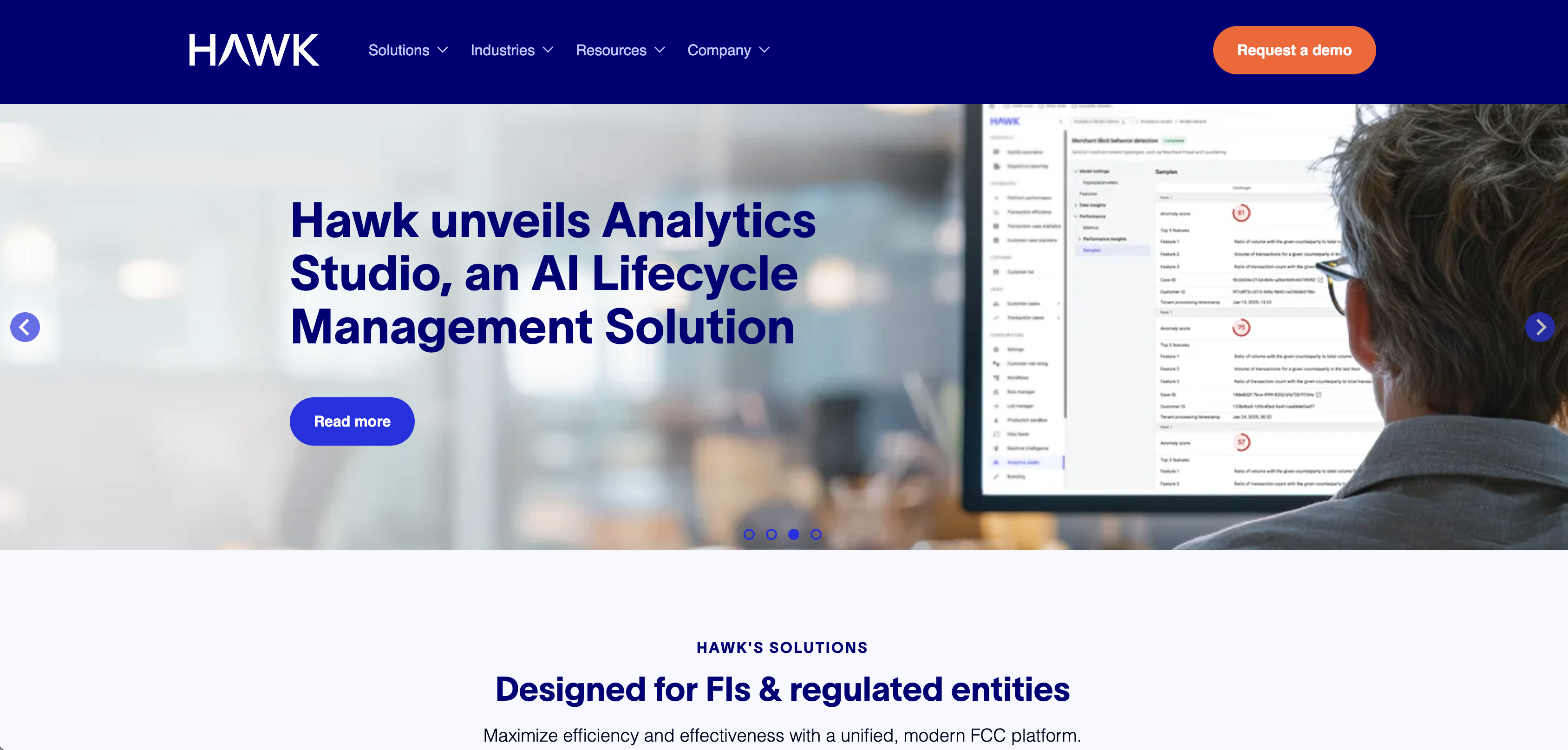
Hawk brings machine learning firepower to financial crime detection, sitting at the intersection of compliance and computational intelligence. Rather than relying on static rule sets that miss novel fraud patterns, Hawk deploys adaptive algorithms that learn from transaction behavior in real time, catching what traditional systems let slip through the cracks. The platform ingests transaction data across multiple channels—payments, transfers, accounts—and surfaces suspicious activity before it becomes a problem. For banks and fintechs drowning in false positives from legacy systems, Hawk promises a different approach: smarter, faster, less noise. Its technology sits on the boundary between compliance necessity and operational efficiency, helping institutions detect actual threats rather than gaming alert thresholds. In an environment where financial crime is increasingly sophisticated and regulatory pressure unrelenting, Hawk positions itself as the thinking alternative to checkbox compliance, offering institutions a genuine competitive edge in the race to stay ahead of bad actors.

ION Group
ION Group🇬🇧
Est. 1999

Andrea Pignataro founded ION in London in 1999, after leaving a trading role at Salomon Brothers with a conviction that the software running global markets was held together with too much manual process. Over the following two and a half decades he built ION into one of the largest, most acquisitive players in capital-markets technology — absorbing dozens of specialist vendors, including Fidessa and Broadway Technology, and folding them into a single group. The core business is still the unglamorous plumbing of institutional finance: trading platforms across equities, fixed income, foreign exchange, and cleared derivatives; risk management; post-trade processing; clearing and settlement; and market data. Investment banks, hedge funds, and corporate treasuries run parts of their daily operations on ION's systems, often without their own customers ever knowing it. Less visible is ION's regulatory technology line. Products including ION LookOut and Fidessa Surveillance handle trade surveillance, market-abuse detection, and regulatory reporting across multiple jurisdictions, and ION's compliance tools have placed in FinTech Global's RegTech 100 list for three consecutive years. It's a smaller part of the business than the trading and post-trade platforms, but a genuine one — which is why ION appears under both Capital Markets and RegTech in this directory, rather than just one. The company is headquartered in London, employs more than 13,000 people across over 50 offices worldwide, and remains privately held under Pignataro's control — a scale most consumer-facing fintechs never approach, built almost entirely on customers who are themselves in finance.

Fenergo
Fenergo🇮🇪
Est. 2008

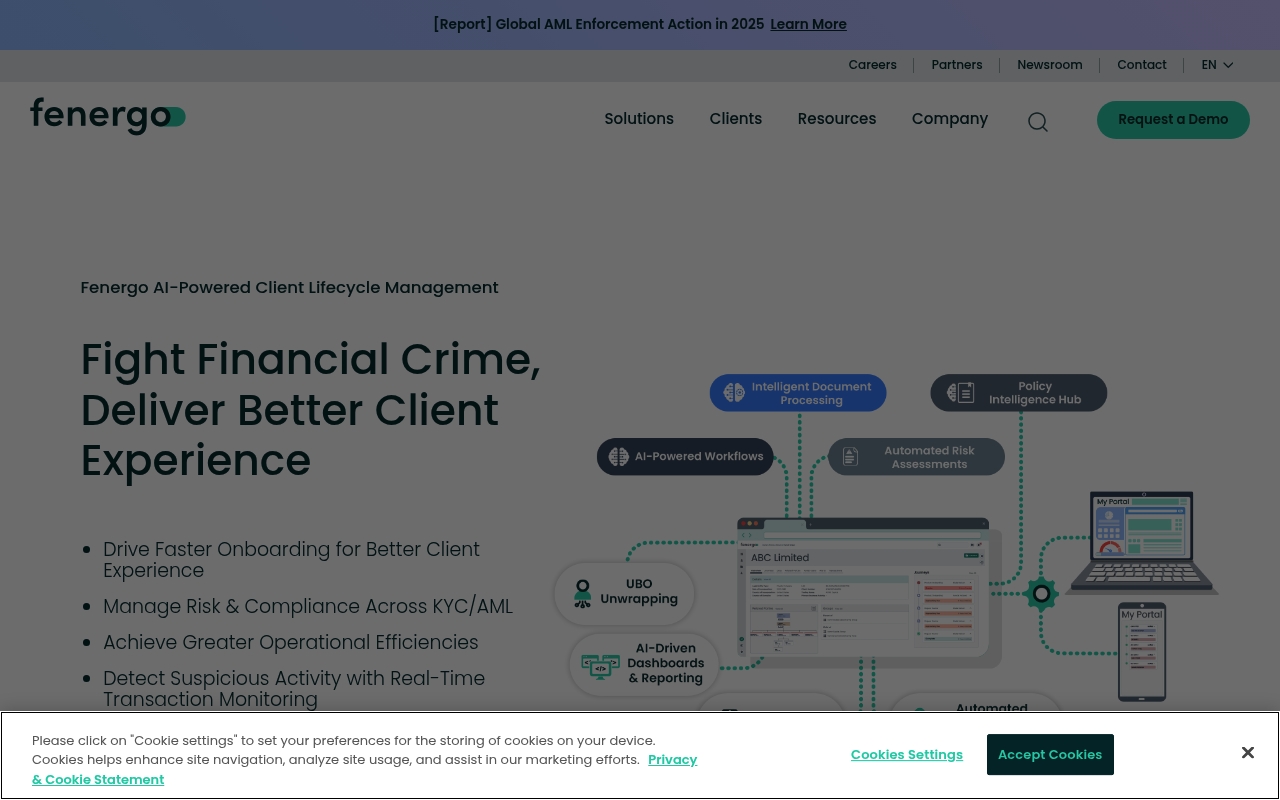
Compliance has long been the unglamorous backroom operation of financial services—heavy, expensive, and often painfully slow. Fenergo flips that script by turning regulatory friction into operational advantage. The Dublin-based software company automates the gruelling work of onboarding clients, managing their data, and staying compliant with an ever-shifting maze of regulations. What banks and investment firms once treated as a cost center, Fenergo repositions as competitive edge. At its core, Fenergo is a digital client lifecycle management platform. It consolidates onboarding, KYC, AML screening, sanctions checks, and ongoing regulatory monitoring into a single, integrated workflow. Rather than legacy institutions juggling multiple point solutions and manual spreadsheet cultures, Fenergo orchestrates the entire client journey—from first interaction through renewal—in a single intelligent system. The software ingests regulatory data, flags anomalies, and automates approvals where rules allow, freeing compliance teams to focus on judgment calls that actually require human expertise. What sets Fenergo apart in a crowded RegTech space is its disciplined focus on the regulated financial institution as customer, not the consumer. While plenty of fintechs chase sexy consumer-facing applications, Fenergo has built deep, sticky relationships with banks, asset managers, and brokers who need sophisticated, audit-proof compliance infrastructure. It operates at institutional scale—handling millions of client records, complex entity hierarchies, and regulatory jurisdictions spanning continents. In an era when regulatory fines have become nine-figure line items and reputational damage from compliance failures can tank a bank's stock price, Fenergo sits at the nerve center of institutional risk management. It's not the flashy side of fintech, but it's arguably the most essential.

IDnow
IDnow🇩🇪
Est. 2014

Knowing who your customer is has always been a regulatory requirement in financial services. Proving it, digitally, in real time, across dozens of jurisdictions with different document standards and compliance frameworks, is a genuinely hard engineering and operational problem. IDnow was founded in Munich in 2014 to solve it. Its identity verification platform offers a range of methods — video identification, automated AI-driven document checks, and eID integration — giving regulated businesses the flexibility to choose the right verification approach for their risk profile and customer base. The company has built particular depth in the German market, where video identification has a specific legal status under financial regulation, but has expanded across Europe serving banks, insurance companies, crypto platforms, and any business that needs to onboard customers with confidence. IDnow was acquired by Corsair Capital in 2021 and has continued expanding through partnerships and product development. In a regulatory environment where digital onboarding requirements are tightening and fraud is becoming more sophisticated, the identity verification layer is one of the most critical — and most contested — parts of the fintech stack.

View all 34 RegTech companies →

Frequently asked questions

How many RegTech companies are there in Europe?
The fintechdatabase.eu directory lists 34 RegTech companies across 15 European countries.
What are the biggest RegTech companies in Europe?
The most popular RegTech companies in the directory are Feedzai, Taxfix and Hawk.
Which European countries have the most RegTech companies?
United Kingdom, Germany and Switzerland have the most RegTech companies in Europe.
What is AMLA and which companies does it directly supervise?
The Anti-Money Laundering Authority (AMLA) is the EU's new, centralised AML supervisor, headquartered in Frankfurt and operational since mid-2025. From 2028, it will directly supervise around 40 of the EU's highest-risk financial institutions; everyone else remains under national regulator supervision, but within an increasingly harmonised EU rulebook.
What's the difference between DORA and AML regulation for regtech buyers?
DORA (Digital Operational Resilience Act) governs ICT and third-party technology risk — incident reporting, resilience testing, vendor risk mapping. AML regulation governs financial crime prevention — screening customers and transactions for money laundering and terrorist financing risk. They require different regtech tooling, even though both fall under "compliance."
Do smaller fintechs need the same regtech infrastructure as large banks?
Obligation scales with risk and size under most EU frameworks, but smaller regulated firms still need functioning AML and reporting processes — the difference is usually in the intensity of supervision (AMLA's direct oversight targets the highest-risk institutions specifically) rather than an exemption from the underlying rules.
Is regtech only relevant to banks, or does it apply to fintechs too?
Any regulated financial institution — banks, e-money institutions, crypto-asset service providers under MiCA, payment institutions — has AML, reporting, and increasingly operational-resilience obligations, so regtech applies just as directly to fintechs as it does to incumbent banks.
What's the difference between audit tools and risk monitoring tools in regtech?
Audit tools focus on producing and organising evidence for a specific audit, often periodic. Risk monitoring tools operate closer to real-time, flagging emerging risk as it happens rather than compiling a record after the fact. Larger compliance functions typically use both.

Related: Identity & KYC, Fraud & Security and Financial Infrastructure companies. Browse fintechs by country, or read our guide What Is RegTech? A European Fintech Guide.