AML compliance Companies in Europe
AML compliance platforms provide the tooling financial institutions need to meet anti-money laundering obligations — customer risk scoring, PEP and sanctions screening, adverse media checks, ongoing monitoring, suspicious activity reporting, and AML programme management. AMLD6, in force July 2027, significantly raises requirements across Europe.
European AML compliance companies in our database
Notable aml compliance companies include Feedzai, Hawk, Fenergo, ComplyAdvantage and Pliant.

Feedzai is a fraud detection and financial crime prevention platform that works behind the scenes for banks, payment processors, and fintech companies across Europe and beyond. The company uses machine learning to spot suspicious transactions in real time, flagging fraud before it costs institutions millions while keeping legitimate customers from being blocked unnecessarily. Unlike legacy fraud systems that rely on rigid rules and lag behind new attack patterns, Feedzai's approach adapts continuously, learning from emerging threats across its network of financial institutions. The platform handles everything from card fraud and money laundering to synthetic identity schemes and account takeover attempts. It's become a critical layer of defense for institutions managing enormous transaction volumes, where manual review is impossible and false positives destroy customer experience. In the European market, Feedzai competes alongside more traditional risk vendors but stands out through its speed and sophistication. Banks increasingly rely on AI-driven systems rather than rule-based gatekeepers, and Feedzai has positioned itself as the intelligent alternative that doesn't just block transactions—it understands behavior. The company serves everyone from global systemically important banks to smaller regional players, offering both real-time decisioning and historical analytics. Feedzai represents a broader shift in how financial institutions approach security: from reactive policing to predictive intelligence.
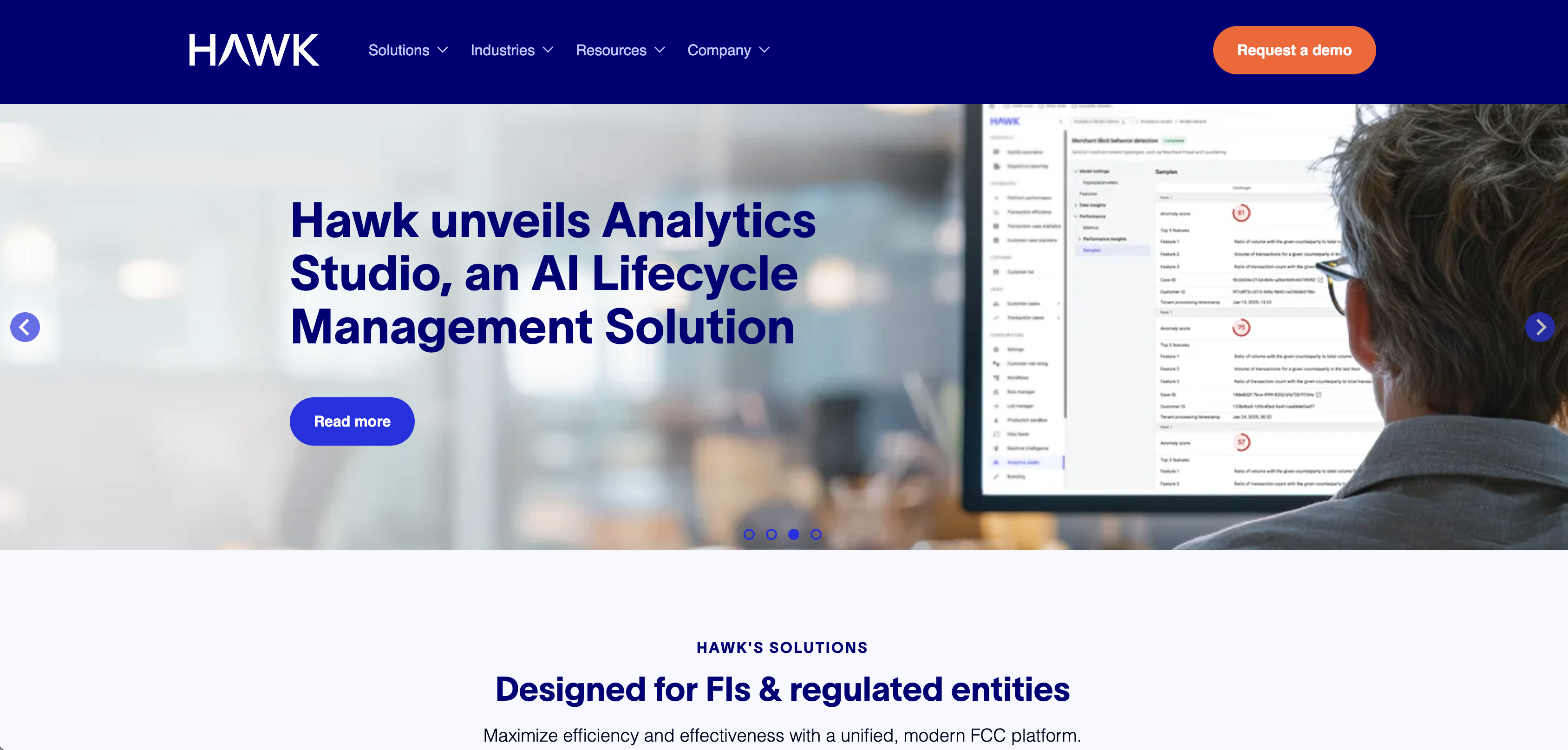
Hawk brings machine learning firepower to financial crime detection, sitting at the intersection of compliance and computational intelligence. Rather than relying on static rule sets that miss novel fraud patterns, Hawk deploys adaptive algorithms that learn from transaction behavior in real time, catching what traditional systems let slip through the cracks. The platform ingests transaction data across multiple channels—payments, transfers, accounts—and surfaces suspicious activity before it becomes a problem. For banks and fintechs drowning in false positives from legacy systems, Hawk promises a different approach: smarter, faster, less noise. Its technology sits on the boundary between compliance necessity and operational efficiency, helping institutions detect actual threats rather than gaming alert thresholds. In an environment where financial crime is increasingly sophisticated and regulatory pressure unrelenting, Hawk positions itself as the thinking alternative to checkbox compliance, offering institutions a genuine competitive edge in the race to stay ahead of bad actors.
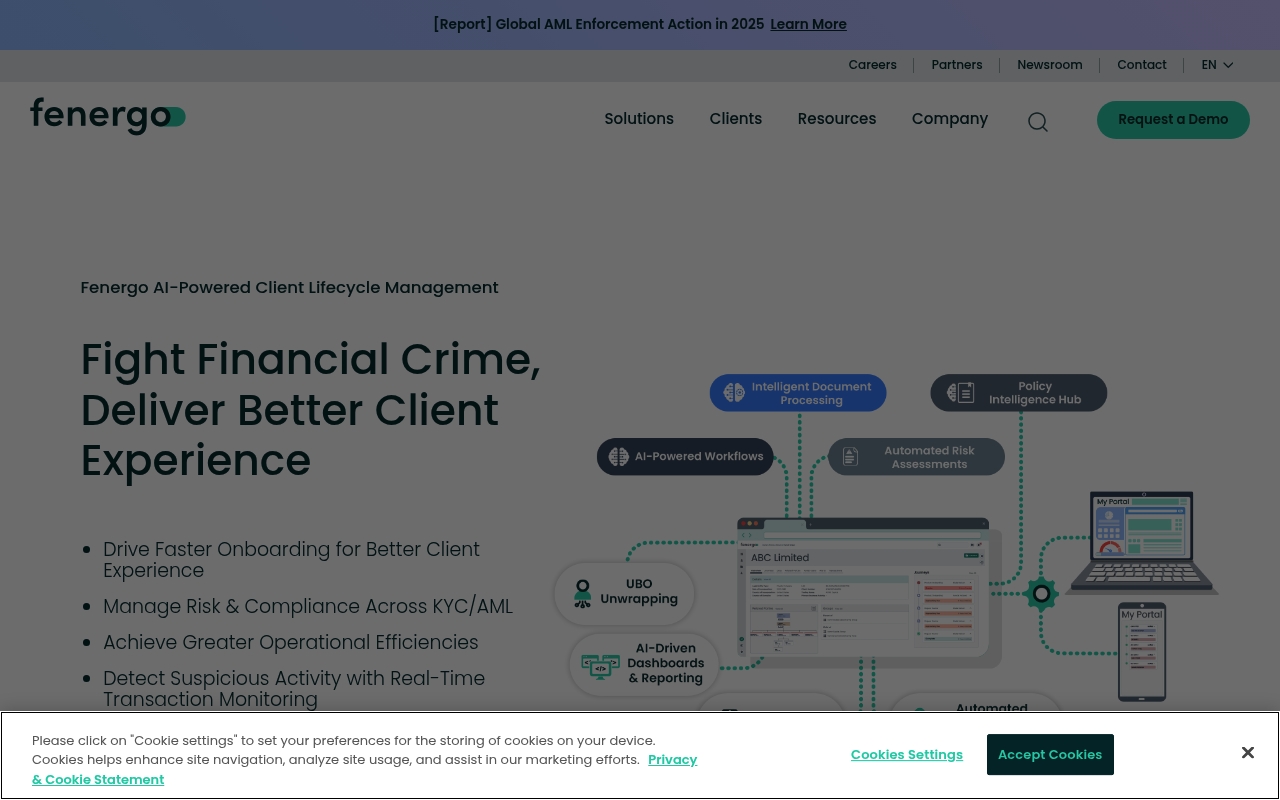
Compliance has long been the unglamorous backroom operation of financial services—heavy, expensive, and often painfully slow. Fenergo flips that script by turning regulatory friction into operational advantage. The Dublin-based software company automates the gruelling work of onboarding clients, managing their data, and staying compliant with an ever-shifting maze of regulations. What banks and investment firms once treated as a cost center, Fenergo repositions as competitive edge. At its core, Fenergo is a digital client lifecycle management platform. It consolidates onboarding, KYC, AML screening, sanctions checks, and ongoing regulatory monitoring into a single, integrated workflow. Rather than legacy institutions juggling multiple point solutions and manual spreadsheet cultures, Fenergo orchestrates the entire client journey—from first interaction through renewal—in a single intelligent system. The software ingests regulatory data, flags anomalies, and automates approvals where rules allow, freeing compliance teams to focus on judgment calls that actually require human expertise. What sets Fenergo apart in a crowded RegTech space is its disciplined focus on the regulated financial institution as customer, not the consumer. While plenty of fintechs chase sexy consumer-facing applications, Fenergo has built deep, sticky relationships with banks, asset managers, and brokers who need sophisticated, audit-proof compliance infrastructure. It operates at institutional scale—handling millions of client records, complex entity hierarchies, and regulatory jurisdictions spanning continents. In an era when regulatory fines have become nine-figure line items and reputational damage from compliance failures can tank a bank's stock price, Fenergo sits at the nerve center of institutional risk management. It's not the flashy side of fintech, but it's arguably the most essential.
Charles Delingpole had already built two companies before this one — The Student Room, the UK's largest student community, started when he was sixteen, and MarketInvoice, the invoice finance platform he co-founded after Cambridge. It was at MarketInvoice that he met the problem that became ComplyAdvantage: every regulated financial business is legally required to screen its customers against sanctions lists, politically exposed persons registers, and adverse media — and the databases everyone relied on for this were built by armies of analysts manually copying names into lists. The data was stale, the false-positive rates were punishing, and compliance teams spent their days clearing alerts on people who shared a name with someone on a watchlist. In 2014 he founded ComplyAdvantage in London on a simple inversion: instead of selling software that queries someone else's manually curated lists, build the risk database itself — with machine learning, from primary sources, updating in real time. That database is the product. ComplyAdvantage continuously processes millions of structured and unstructured data points a day — sanctions updates, regulatory notices, court records, news in dozens of languages — into risk profiles on more than 150 million entities, surfacing tens of thousands of new risk events daily. On top of the data layer sit the tools regulated firms actually deploy: customer screening at onboarding, ongoing monitoring as risk profiles change, payment and transaction screening, and — since 2023 — a fraud detection product that extends the platform from "who is this customer" to "what is this customer doing." The strategic position is precise: this is the data layer of financial crime compliance, sold as an API, competing directly with Dow Jones Risk & Compliance, LSEG's World-Check, and LexisNexis — incumbents whose core asset is exactly the manual process ComplyAdvantage was built to obsolete. The customer base is over 500 enterprises across 75 countries, weighted toward the businesses that grew up alongside it: fintechs, payment companies, crypto platforms, and digital banks that needed compliance infrastructure as programmable as the rest of their stack. Named clients have included Gemini and TransferMate, with partnerships spanning blockchain analytics (Elliptic) and Banking-as-a-Service (Raisin Bank). The company was selected as a World Economic Forum Technology Pioneer, employs around 480 people, and has raised over $150 million from Balderton Capital, Index Ventures, Ontario Teachers' Pension Plan, and Goldman Sachs. In December 2023 it acquired Golden, the a16z-backed knowledge-graph startup, folding structured entity data and its engineering team into the core database. Leadership formalised the company's second act in early 2023: Delingpole moved to executive chairman and Vatsa Narasimha — previously CEO of the trading platform OANDA, and ComplyAdvantage's COO through its scaling years — took over as chief executive. The regulatory backdrop since has run entirely in the company's favour. AMLD6 and the EU's new AML Authority raise screening and monitoring obligations across the continent from 2027, and every expansion of the compliance perimeter — crypto under MiCA, instant payments with sanctions screening at ten-second settlement speeds — enlarges the addressable market for exactly what ComplyAdvantage sells. The honest read is about the market's direction. Financial crime and identity infrastructure is consolidating fast — Featurespace went to Visa, Fourthline is merging with Veridas, World-Check sits inside LSEG — which leaves ComplyAdvantage as one of the few independent, at-scale data players left standing. That independence is a genuine selling point for customers wary of buying compliance data from a card network or an exchange group, and it simultaneously makes the company one of the most obvious acquisition targets in European regtech. The other open question is the arms race it chose: the same generative AI that makes screening sharper is making the launderers' synthetic identities and shell structures cheaper to produce. ComplyAdvantage's bet since 2014 has been that the detection side compounds faster. So far, the market has agreed.
Pliant is a compliance automation platform built for financial services firms that are tired of drowning in spreadsheets and manual processes. Rather than layering another point solution onto an already fragmented tech stack, Pliant unifies risk, compliance, and audit workflows into a single operating system. The platform handles the tedious work—continuous monitoring, policy enforcement, evidence collection, regulatory reporting—that currently consumes entire compliance teams and slows down growth.
Three brothers — Andrey Sever and his twins Jacob and Peter — founded Sumsub in 2015 to solve a problem that regulated digital businesses had been solving badly: verifying who a customer is, fast enough that they don't abandon signup, and rigorously enough that a regulator accepts it. What began as a document verification vendor has become an onboarding orchestration platform covering the full compliance lifecycle: identity verification, business verification (KYB) including ownership-structure analysis, AML screening, transaction monitoring, fraud prevention, and case management, delivered through API and SDKs. The scale claims are aggressive and specific: over 6,500 document types across 220 countries and regions, verification in under a minute on average, and conversion rates published per market — the kind of numbers a company only publishes when conversion is its main selling point against competitors. The methodology follows FATF recommendations and is built against FINMA, FCA, CySEC, MAS and BaFin requirements, which tells you the customer profile: crypto exchanges, trading platforms, fintechs, marketplaces and gaming operators, in that rough order of historical concentration. Two things distinguish Sumsub in this directory's context. First is what happened in March 2022: following the invasion of Ukraine, the company ceased its Russian operations, chartering flights to relocate team members out of Russia, Ukraine and Belarus — an unusually consequential decision for a company that had built engineering capacity there, and one that reset its corporate footprint toward London and Limassol. Second is where it is going: reusable identity, so a verified user can onboard elsewhere in a few clicks, and — launched January 2026 — AI agent verification, binding automated agents to verified human identities. That second product is a direct answer to the agentic commerce thesis Checkout.com and Adyen have both been building toward. If AI agents start transacting on people's behalf, someone has to establish which human is accountable, and Sumsub is betting that becomes an identity product.