Reporting automation Companies in Europe
Reporting automation platforms streamline the production of internal management reports, regulatory submissions, and external financial disclosures. Manual reporting processes are slow, error-prone, and resource-intensive — particularly for institutions with complex multi-entity structures or extensive regulatory reporting obligations. Automated reporting platforms connect to source systems, apply reporting logic, validate outputs, and distribute final reports — reducing both the time and error rate of the reporting cycle.
European Reporting automation companies in our database
Notable reporting automation companies include Pliant, Blockpit, Tax Free, Skribble and Fonoa.
Pliant is a compliance automation platform built for financial services firms that are tired of drowning in spreadsheets and manual processes. Rather than layering another point solution onto an already fragmented tech stack, Pliant unifies risk, compliance, and audit workflows into a single operating system. The platform handles the tedious work—continuous monitoring, policy enforcement, evidence collection, regulatory reporting—that currently consumes entire compliance teams and slows down growth.

Crypto turned millions of Europeans into accidental tax risks. Every trade, swap, staking reward, and NFT sale is potentially a taxable event, scattered across exchanges, wallets, and chains that were never designed to produce anything a tax office would accept — and for years the gap between what the law required and what anyone could practically compute was where most crypto investors quietly lived. Blockpit was founded in Linz in 2017, by CEO Florian Wimmer and his co-founders, on the bet that this gap would close and that someone European should build the software for it. The compliance-first DNA was there from the start: a cooperation with KPMG to validate the tax logic, and TÜV Austria certification of the calculation engine in 2020 — credentials aimed at tax advisors and auditors, not just crypto Twitter. The product is a portfolio tracker that ends in a tax report a local authority will actually accept. Users connect exchanges, wallets, and blockchains; Blockpit reconstructs the transaction history, classifies every event, and generates ready-to-file, country-specific reports across more than 100 jurisdictions. The differentiation is legal precision rather than chart polish: Germany's one-year holding-period exemption, Austria's 27.5% capital-income regime, France's specific rules — encoded per country, where the big US-born competitors historically produced generic exports and left the local law to the user. That focus made Blockpit the reference tool in the German-speaking world, voted best crypto tax calculator by the BTC-Echo community three years running from 2023 to 2025. It also consolidated the European field with unusual decisiveness for a company its size. In 2020 Blockpit merged with CryptoTax, its German rival. In November 2023 it acquired Accointing — the Swiss competitor that Glassnode had bought only a year earlier — in an all-cash, multi-million deal financed through shareholder debt, shutting the Accointing platform within months and migrating its users. Wimmer was explicit about the reasoning: the deal was preparation for DAC8, the EU directive that changes what this entire category is for. Since 1 January 2026, crypto-asset service providers across the EU must report their customers' transaction data to tax authorities under DAC8 and the OECD's CARF framework. The era in which crypto taxes were a voluntary-compliance problem is over — tax offices now receive the data automatically, and the reconciliation burden lands on the individual. Blockpit spent five years positioning to be the consumer side of that equation. The company profile behind this is strikingly lean: roughly 30 employees, profitability reached in 2024, and a $10 million Series A from 2021 led by MiddleGame Ventures — until March 2025, when Raiffeisen Bank International invested millions through its venture arm Elevator Ventures, the fund's first crypto investment. A major Austrian banking group buying into crypto tax compliance is itself a market signal: the institutional world expects enforced crypto transparency to be permanent infrastructure, not a cycle product. Blockpit has since been publicly flagged among Austrian startups exploring an eventual IPO. It sits within an Austrian crypto cluster that punches far above the country's size, alongside Bitpanda's licensed brokerage a train ride away in Vienna. The honest read cuts both ways. The risks are real: demand breathes with the crypto cycle, exchanges could bundle good-enough tax reporting natively, and global competitors like Koinly fight for the same users. But the structural driver is a ratchet — regulation like DAC8 does not un-happen, every new reporting regime adds jurisdictions to the addressable market, and the moat in this category is the unglamorous one of encoding a hundred countries' tax law correctly and keeping it current. A profitable, thirty-person company that owns the DACH market, absorbed its two nearest rivals, and has a systemically important bank on its cap table is about as well-positioned for enforced transparency as a startup can be. Blockpit's founding bet was that crypto would eventually have to grow up and file its taxes. As of January 2026, that's no longer a bet.

Tax Free is a B2B SaaS platform that simplifies VAT reclamation for international businesses. Most companies lose thousands annually to complex VAT compliance across borders—Tax Free automates the entire process, from documentation to submission, turning compliance overhead into recovered cash. Built for e-commerce merchants, SaaS platforms, and service providers operating across multiple European jurisdictions, it handles the messy work of tracking eligible expenses, calculating VAT positions, and filing claims with regional tax authorities. Rather than hiring tax consultants or wrestling with spreadsheets, customers connect their accounting systems and let Tax Free's intelligence layer handle jurisdiction-specific rules, deadlines, and documentation requirements. The platform sits quietly in the financial backend but unlocks material capital recovery that most businesses simply abandon. It's part infrastructure, part compliance, part cash management—solving a problem that affects every company doing cross-border business in Europe. In a landscape where VAT complexity remains one of the last major inefficiencies in SME finance, Tax Free turns hidden liabilities into automated revenue recovery.
Skribble is a Swiss-based digital signature platform that strips away the bureaucratic friction from document workflows. It's built for a Europe that still drowns in paperwork—contracts, agreements, approvals—but increasingly wants them signed without printing or scanning. Rather than positioning itself as just another e-signature tool, Skribble emphasizes compliance and trust, offering legally binding digital signatures that work across EU and Swiss law without requiring special infrastructure from users. The platform integrates into existing business processes, letting companies move from wet ink to verified digital identity in seconds. What separates Skribble from competitors is its focus on the European regulatory landscape, particularly the eIDAS regulation that governs electronic identification. It's not chasing the global market with a one-size-fits-all product; it's building trust infrastructure for markets where legal certainty matters. The company targets enterprises and SMEs drowning in document logistics, positioning digital signatures as a compliance win rather than just a convenience feature. Skribble represents a maturing phase of fintech where the real value lies not in disruption but in making legacy systems actually work in a digital-first world.
Tax compliance has long been the tedious, error-prone side of fintech—the regulatory checkbox that slows down growth. Fonoa automates indirect tax (VAT, GST, sales tax) for digital businesses operating across multiple jurisdictions, turning what used to be a spreadsheet nightmare into API-driven accuracy. The platform handles tax calculation, compliance reporting, and filing across more than 200 territories, meaning a SaaS company or marketplace doesn't need a dedicated tax accountant just to stay legal. Fonoa integrates directly with billing systems and payment processors, capturing transaction data and determining tax obligations in real time. What sets Fonoa apart is its focus on the messy reality of cross-border digital commerce. While traditional tax software still assumes you're filing locally, Fonoa was built for companies that sell globally by default—the kind of businesses that would otherwise need to hire lawyers and accountants in every market they touch. In the broader European fintech stack, Fonoa occupies the unsexy-but-critical layer between payment platforms and accounting systems. It's the kind of infrastructure that enables other fintechs to scale without regulatory friction, making it essential backbone software for anyone processing payments across borders.
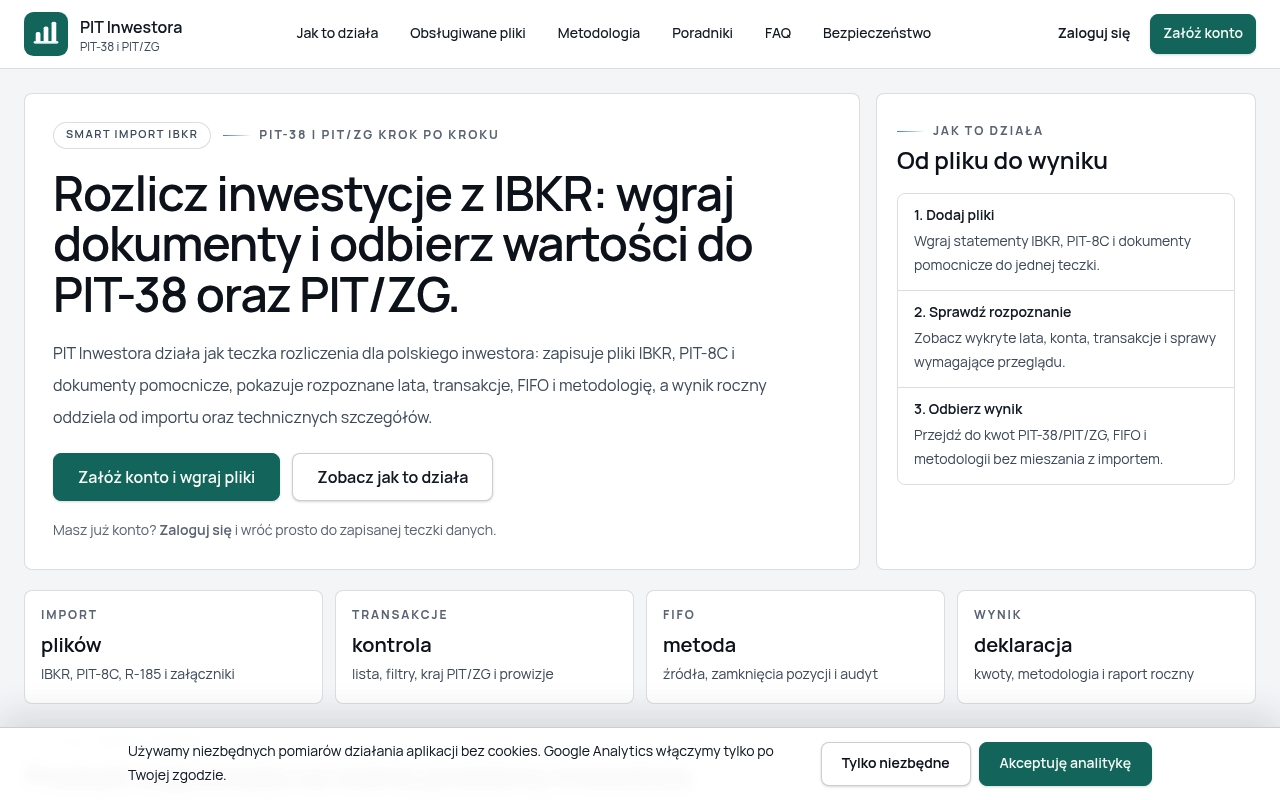
PIT Inwestora is a Polish tax reporting application for retail investors who hold accounts with foreign brokers — and it exists because of a specific gap in the Polish system. A domestic brokerage issues its clients a PIT-8C form each year, listing their capital gains and deductible costs, which makes filing the annual PIT-38 return relatively painless. Interactive Brokers issues nothing of the sort. Every Polish investor with a foreign brokerage account is left to reconstruct the whole calculation themselves. That reconstruction is heavier than it sounds. Each transaction must be converted into złoty at the National Bank of Poland rate from the day before it settled. Cost basis has to be established under FIFO. Dividends and interest need separating and attributing to the country they came from, in order to complete the PIT/ZG foreign income attachment. Any withholding tax already paid abroad has to be evidenced. Get any of it wrong and you either overpay or file an incorrect return. PIT Inwestora automates that chain. A user uploads their IBKR activity statements — alongside any PIT-8C from a Polish broker, R-185 withholding documents, and supporting files — into a single case folder. The application identifies the tax years, accounts, and transactions it finds, applies FIFO and NBP conversion, flags discrepancies that need human review, and produces the figures required for PIT-38 and PIT/ZG. Crucially, it shows the methodology and evidence beside each number rather than burying them under a total, and it can combine a Polish PIT-8C with a foreign IBKR statement in the same annual result — which is the position most Polish investors with international exposure actually find themselves in. The product is paired with a library of guides covering PIT-38 filing step by step, IBKR-specific reporting, when PIT/ZG becomes relevant, and the two most common sources of error: FIFO and the NBP exchange rate. It occupies a niche the large European tax platforms have largely left alone — not tax filing in general, but the particular mechanics of reporting a foreign brokerage account under Polish law. Most Poles still navigate PIT filing through complex government portals or hire accountants to handle the bureaucracy. Pit in Westora inverts that equation, giving users control over their own returns with guided workflows that walk through each deduction, income source, and credit without requiring specialist knowledge. The platform connects directly to bank data and accounting records, pulling information automatically to pre-populate forms. For a market where tax compliance remains largely analog despite digital infrastructure, Pit in Westora represents a quiet but meaningful shift toward consumer financial empowerment. It positions itself as the bridge between personal finance tools and formal regulatory requirements—neither a bank nor a full accounting suite, but the missing piece that connects them. The company operates in Poland's growing personal finance tech segment, where digitization of tax services remains incomplete compared to Western European counterparts. By focusing on one clear pain point rather than attempting to be an all-in-one financial platform, Pit in Westora demonstrates the European fintech pattern of hyper-specialization around regulatory compliance.