Accounting integrations Companies in Europe
Accounting integrations connect financial platforms — banks, payment processors, expense management tools, and lending products — directly to accounting software like Xero, QuickBooks, and Sage. These integrations automatically sync transaction data, invoices, and reconciliation records, eliminating manual data entry and reducing the bookkeeping burden for small businesses. For fintechs, deep accounting integrations are a key driver of SME adoption and retention.
European Accounting integrations companies in our database
Notable accounting integrations companies include Indy, Tiime, Tax Free, ANNA Money and Countingup.
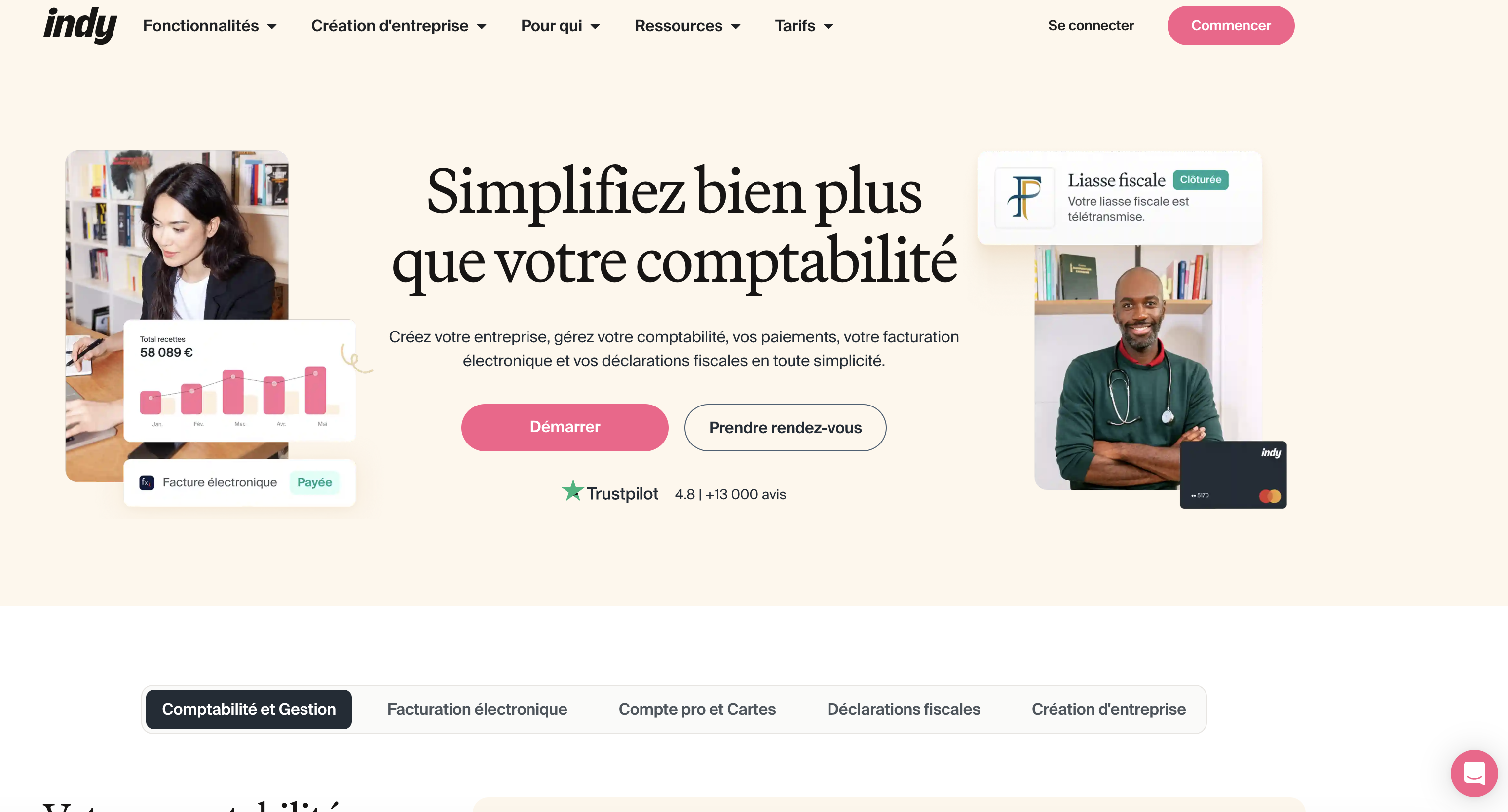
Indy is a French fintech built for freelancers and self-employed workers who are tired of juggling accounting software, invoicing tools, and bank dashboards across a dozen different apps. The platform consolidates business banking, invoicing, expense tracking, and tax compliance into a single workspace designed specifically for French independent professionals and micro-entrepreneurs. Unlike traditional accounting software that feels built for accountants, Indy puts the solopreneur first—automating routine tasks like categorizing expenses and calculating quarterly tax estimates while keeping the interface clean and approachable. The company has become a go-to solution across France for freelancers managing both the creative and administrative sides of their business, from photographers to consultants to digital agencies. It's one of Europe's clearest examples of how fintech can solve a specific, underserved market by building exactly what that market actually needs rather than trying to be everything to everyone. In a landscape crowded with generic SME finance platforms, Indy's laser focus on French self-employed workers—and their particular regulatory requirements and pain points—has established it as a cultural fixture in the French freelance community.
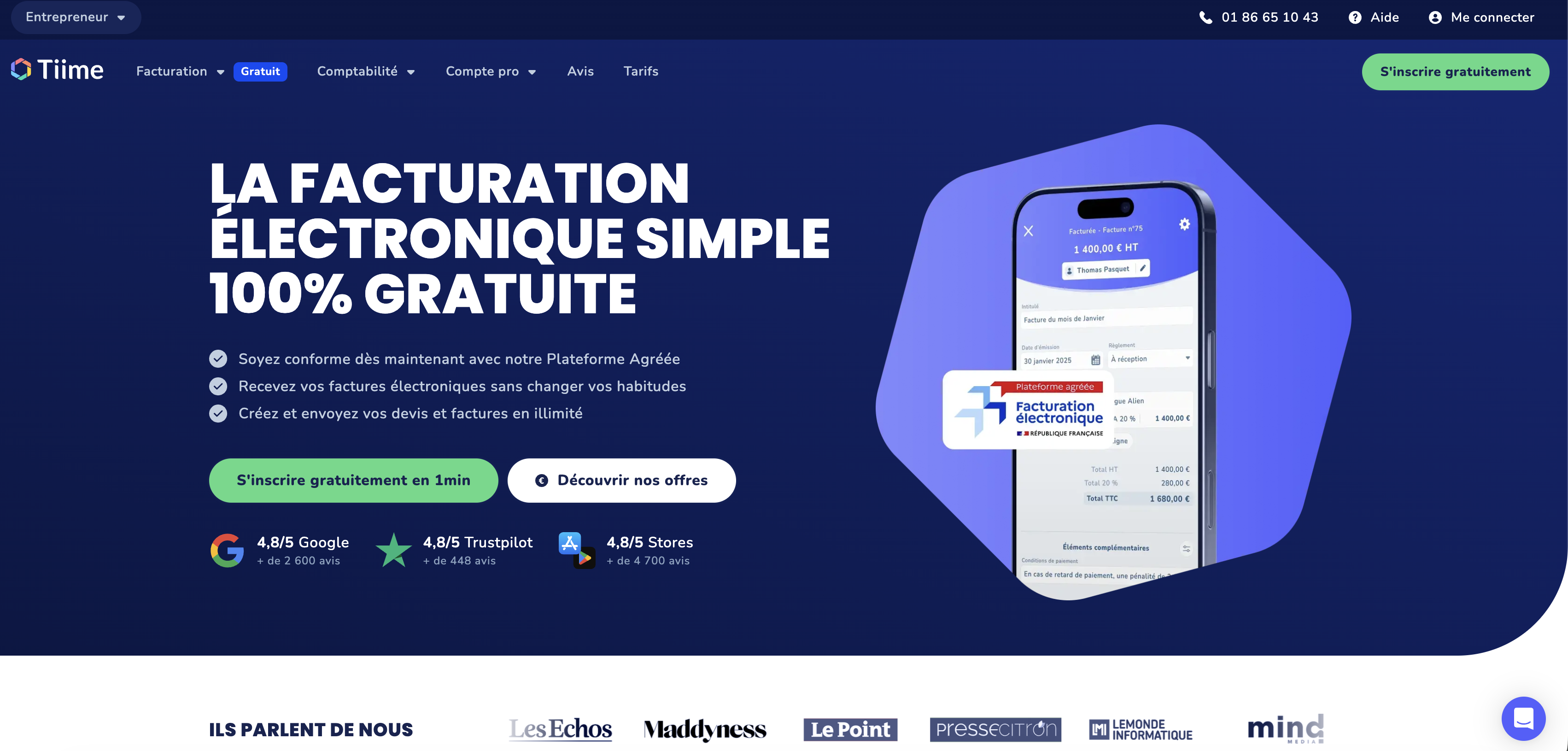
Tiime sits at the intersection of accounting software and financial management for small businesses, offering a streamlined alternative to the traditional bookkeeping grind. Rather than forcing entrepreneurs to juggle spreadsheets and endless paperwork, Tiime automates the heavy lifting—invoice generation, expense tracking, and financial reporting—directly within a unified platform designed for French SMEs. The software integrates with major accounting systems and banking partners, pulling transactions automatically and categorizing them without manual intervention. What separates Tiime from legacy accounting tools is its focus on simplicity and real-time visibility. Founders understood that most small business owners aren't accountants and don't want to be; they want clarity on their cash position and fewer admin headaches. The platform surfaces key financial metrics at a glance, enabling better decision-making without requiring a finance degree. In the crowded SME finance software market, Tiime positions itself as the bridge between basic invoicing apps and expensive enterprise accounting suites—accessible enough for solopreneurs, sophisticated enough for growing teams. It represents the modernization of accounting infrastructure across French and broader European SME finance, where digital transformation still lags behind consumer fintech.
Tax Free is a B2B SaaS platform that simplifies VAT reclamation for international businesses. Most companies lose thousands annually to complex VAT compliance across borders—Tax Free automates the entire process, from documentation to submission, turning compliance overhead into recovered cash. Built for e-commerce merchants, SaaS platforms, and service providers operating across multiple European jurisdictions, it handles the messy work of tracking eligible expenses, calculating VAT positions, and filing claims with regional tax authorities. Rather than hiring tax consultants or wrestling with spreadsheets, customers connect their accounting systems and let Tax Free's intelligence layer handle jurisdiction-specific rules, deadlines, and documentation requirements. The platform sits quietly in the financial backend but unlocks material capital recovery that most businesses simply abandon. It's part infrastructure, part compliance, part cash management—solving a problem that affects every company doing cross-border business in Europe. In a landscape where VAT complexity remains one of the last major inefficiencies in SME finance, Tax Free turns hidden liabilities into automated revenue recovery.
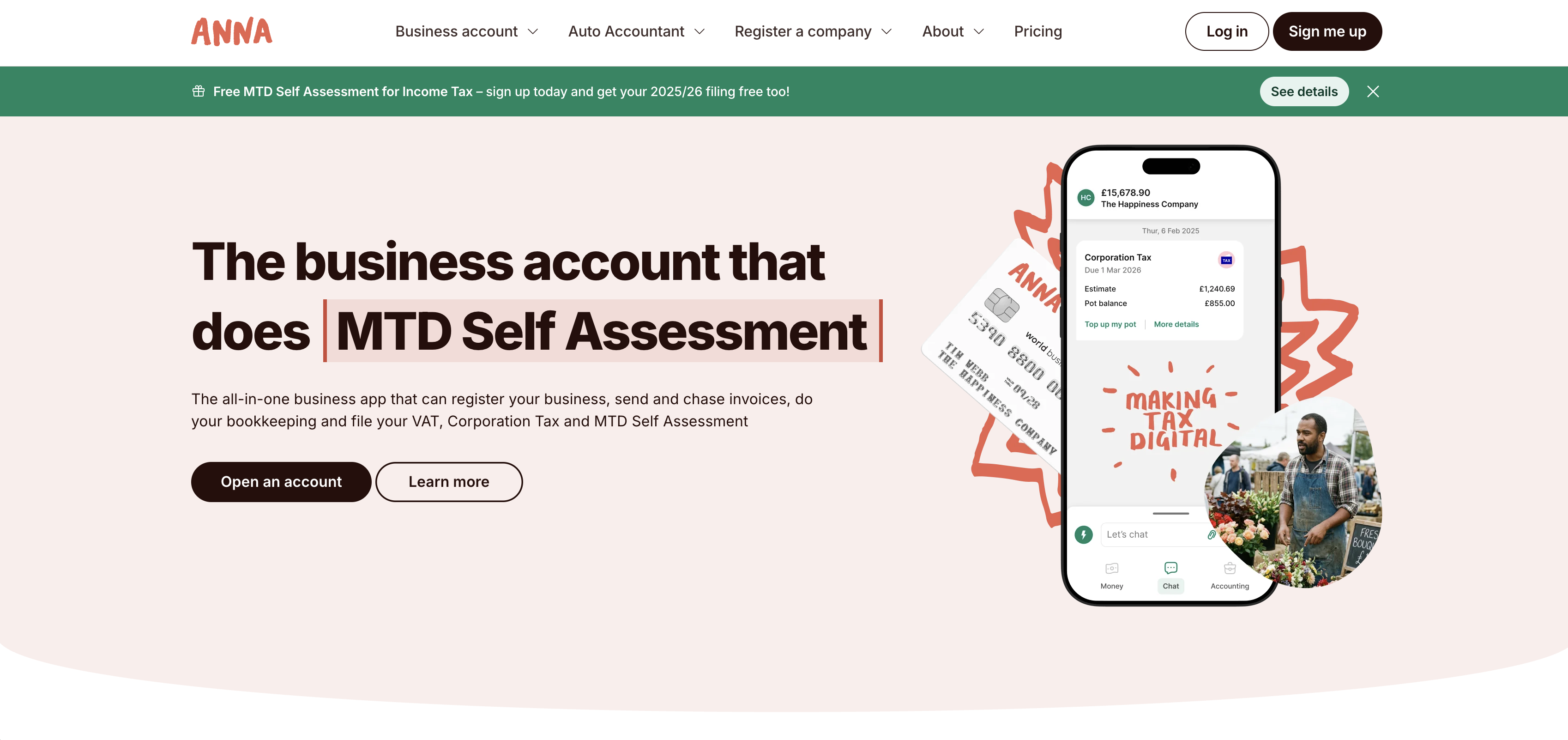
Business admin is the part of running a company that nobody starts a business to do. Invoicing, tax filing, expense management, and the general administrative overhead of being a legitimate business entity in the UK are simultaneously essential and relentlessly time-consuming for the freelancers and small business owners who have to deal with them. ANNA Money was founded in London in 2017 — the name stands for Absolutely No Nonsense Admin — with a direct mandate to automate as much of that overhead as possible. Its business account combines a Mastercard, invoicing tools, tax estimation, expense categorisation, and a smart assistant that handles routine admin tasks, targeting the sole traders and micro-businesses who are the most underserved segment of the UK business banking market. The tone is deliberately irreverent — the brand uses a cat as its mascot and communicates in a register that is the opposite of corporate banking language. That positioning is not just aesthetic; it reflects a genuine product philosophy that the administrative burden on small businesses should be reduced, not monetised. In the UK business banking market, where Monzo Business, Tide, and Revolut Business compete for the same customers, ANNA has carved out a distinctive position through product depth in the admin automation layer.
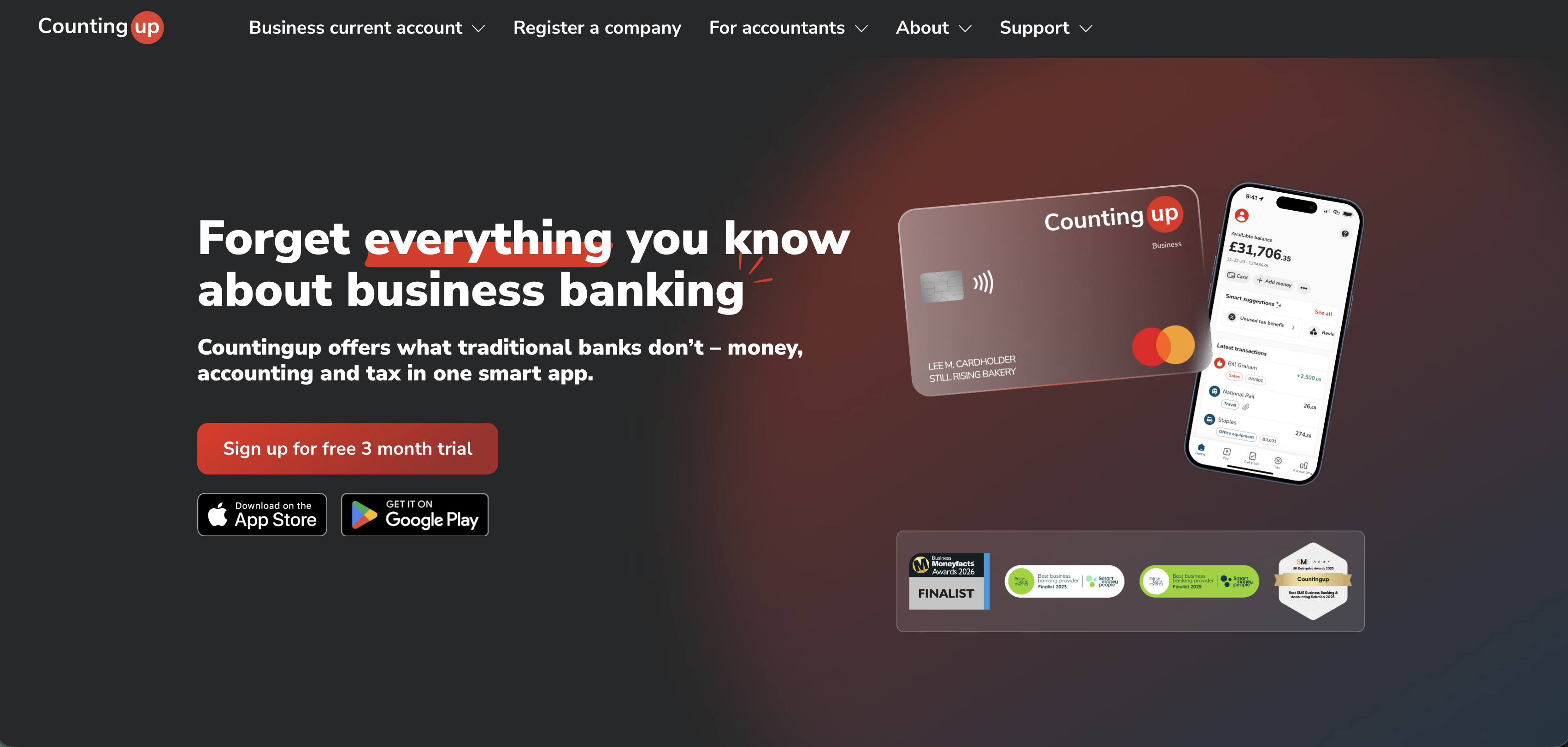
Sole traders and micro-businesses in the UK spend a disproportionate share of their working time on financial administration — bookkeeping, invoicing, VAT returns, self-assessment — tasks that add no value to the business but carry real consequences if done incorrectly. Countingup was founded in London in 2017 to eliminate that administrative burden with a business current account that has bookkeeping built directly into the product. Rather than connecting a bank account to a separate accounting app, Countingup combines them from the start — transactions are automatically categorised, VAT is tracked in real time, and tax estimates are updated continuously based on actual income and expenses. The integration removes the synchronisation problems, subscription costs, and manual reconciliation that define the experience of running a separate bank account and accounting product. Countingup targets the UK's five million sole traders and micro-businesses — a segment that has been chronically underserved by both traditional banks and accounting software companies that design for businesses larger than they are. In the UK SME fintech landscape, where Tide, ANNA, and Starling Business compete for the same customers, Countingup's vertical integration of banking and accounting is a product differentiator that is difficult to replicate without rebuilding both layers simultaneously.
Qonto is a French business banking platform for freelancers and SMEs — though, strictly speaking, it isn't a bank. It has operated since 2018 under a payment institution licence from France's ACPR, with customer funds safeguarded at Crédit Mutuel Arkéa, and only filed for a full French banking licence in July 2025. The distinction matters more than it sounds: that licence is the thing standing between Qonto and the lending, savings, and investment products it wants to sell directly. Founded in 2016 by Alexandre Prot and Steve Anavi — Prot the son of Baudouin Prot, former chairman of BNP Paribas, which gives the challenger story a certain symmetry — the company set out to build the business account the founders wished they'd had. The product wraps a business account around the admin that surrounds it: invoicing, expense management, bookkeeping automation, cash flow forecasting, sub-accounts, and accounting integrations. Prot's own pitch is that customers save roughly two hours a week on paperwork. That has scaled into the leading position in European B2B banking. Qonto passed 600,000 customers across eight markets — France, Germany, Italy, Spain, Austria, Belgium, the Netherlands, and Portugal — employs around 1,600 people, and has been profitable since 2023. It raised a $552 million Series D in 2022 at a $5 billion valuation and hasn't needed to raise since; profitability means even the banking licence push can be funded from what it already holds. Two acquisitions shaped it: German rival Penta in 2022, which brought 50,000 customers and a real German footprint, and accounting automation platform Regate in 2024, which opened up accountants and accounting firms as a new customer segment. The direction of travel is credit. Qonto has launched a Pay Later product, financing from €150 to €50,000, and added its first business credit card and overdraft facilities in January 2026 — all currently dependent on partnerships. A full banking licence would let it do that lending on its own account, which is the entire point of the application and the foundation of its stated goal of two million customers by 2030. Its competitive set is the European business banking cohort: Revolut Business, Tide, Holvi, Pennylane, and the incumbent banks it was built to route around.