Bank connectivity Companies in Europe
Bank connectivity platforms provide the technical infrastructure that allows businesses and fintechs to connect to multiple banks simultaneously — accessing account data, initiating payments, and managing cash positions across different banking relationships through a single integration. Open banking and SWIFT connectivity are both important mechanisms. Bank connectivity is the foundation of treasury management, cash flow forecasting, and multi-bank payment operations for mid-market and enterprise companies.
European Bank connectivity companies in our database
Notable bank connectivity companies include Enable Banking, Powens, Bridge, Ebury and Salt Edge.
Most open banking aggregators want your data. That is the business model: connect to the banks, pull the transactions, store them, enrich them, and sell the enriched product back. Enable Banking built the opposite. The company describes itself as the postman of your data — it moves financial information from the bank to the customer's application and does not retain, process, or build models on what passes through. For a fintech that considers its transaction data a competitive asset, or a customer with strict data residency requirements, that neutrality is the entire pitch. Joonas Tomperi and Fedor Tyurin founded the company in Espoo in 2019, at the point where PSD2 had legally opened European bank APIs but had not made them usable. Each bank interpreted the standard differently, each shipped its own authentication quirks, and each updated on its own schedule. The regulation created the right; someone still had to build the plumbing. Enable Banking started with Finland and the Nordics and expanded outward, and now connects to more than 2,700 banks across 30 European countries through a single PSD2-compliant API — account information from all of them, and payment initiation from over 1,500. What makes the company genuinely unusual is its scale relative to that coverage. Enable Banking has raised roughly €600,000 in total, in a single seed round in 2022 led by Wellstreet and Forward VC, and employs somewhere between fourteen and seventeen people distributed across seven countries. Tink sold to Visa for €1.8 billion with 500 employees. TrueLayer has raised hundreds of millions. Enable Banking is covering comparable European ground with a team that would fit around one table, which says something about how much of open banking infrastructure is disciplined engineering rather than capital. The company holds its own Account Information Service Provider registration, supervised by Finland's FIN-FSA — which means other companies can build on top of its licence rather than obtaining their own. That is the model behind open-banking.io, the Danish developer tool that resells Enable Banking access at €3 per month without customers needing eIDAS certificates. It is also why Enable Banking's no-data-retention architecture matters structurally: because the platform never holds readable customer data, the companies building on it can make stronger privacy guarantees than they otherwise could. Two smaller details are revealing about who this is built for. Enable Banking runs a balanced split between business and consumer accounts — roughly half of its ten million monthly API calls come from each, where most early open banking providers targeted consumer accounts only and treated corporate banking as an afterthought. And it offers a live production environment for testing without requiring a contract, which is a small thing that tells you the company expects developers to evaluate it by using it rather than by booking a call. Tomperi now chairs the board of Fintech Finland, the national industry association.
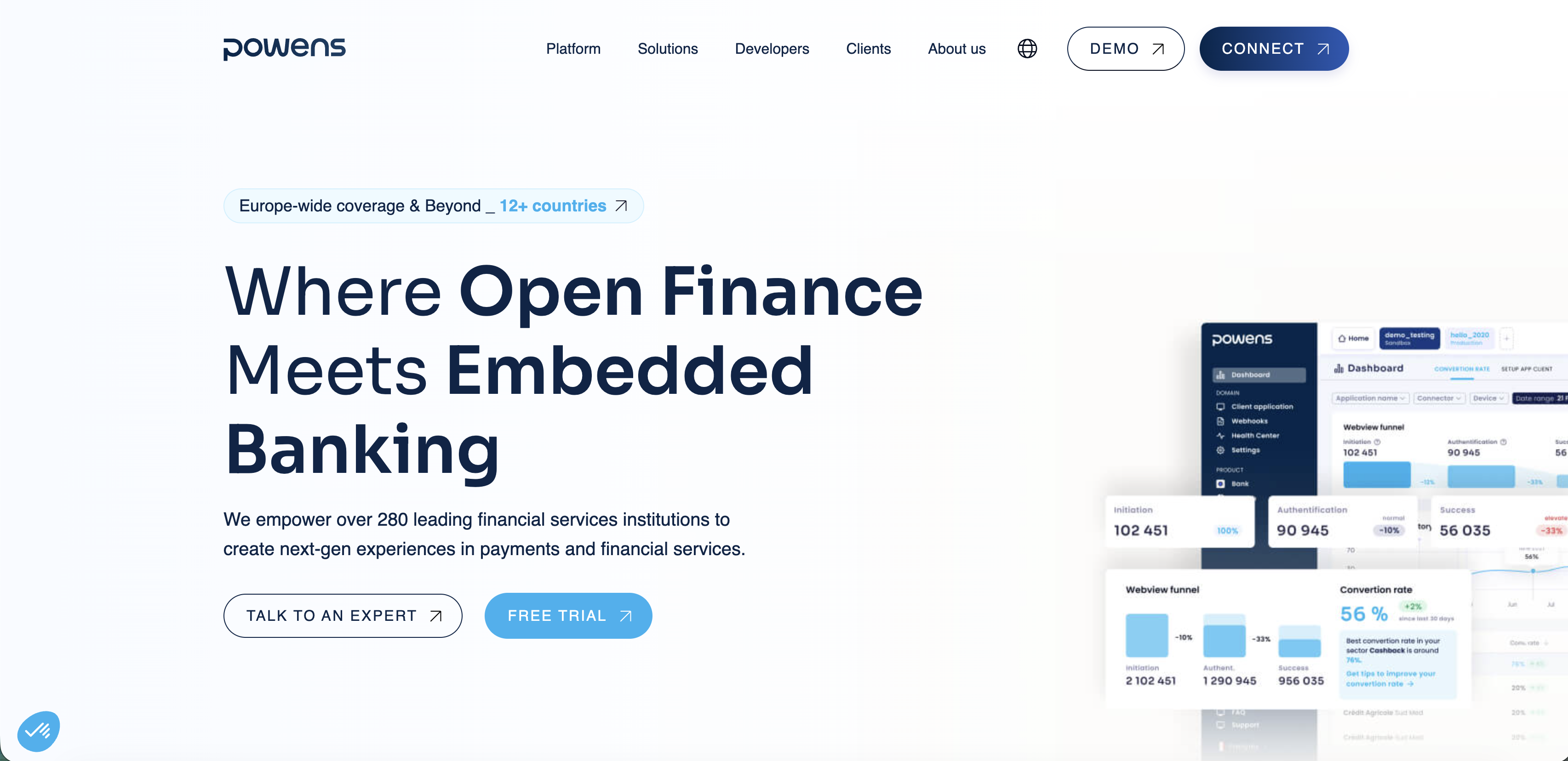
Powens sits at the intersection of open banking and financial data aggregation, helping European fintechs and traditional banks make sense of the fragmented payment and account landscape. Rather than building another me-too aggregator, the company positions itself as the connective tissue between institutions and the data they need to move capital efficiently and securely. Their platform ingests transaction data, payment initiation flows, and account information from thousands of financial institutions across Europe, surfacing clean, standardized intelligence to power lending decisions, fraud detection, and embedded finance experiences. What sets Powens apart is its focus on the continental European market—where open banking adoption is uneven and legacy banking infrastructure still dominates. While UK and US aggregators have enjoyed first-mover advantage, Powens saw an opportunity to build native expertise in Germany, France, Spain, and Benelux, where regulatory tailwinds and fragmented banking systems created genuine demand. The company works with both consumer-facing fintechs and institutional clients, meaning they've learned to navigate the messy reality of building infrastructure that talks to both sleek fintech apps and stuffy corporate banking platforms. This dual-sided approach has become their competitive moat—they understand both the user experience expectations of modern fintech and the compliance complexity of traditional finance. In the broader European fintech stack, Powens functions as a critical middleware layer, solving the unglamorous but essential problem of data connectivity that powers everything downstream—from embedded lending to fraud prevention to wealth management.
Bridge is an open banking API platform that sits between applications and financial institutions, making it trivially easy to connect customers' bank accounts and move money around. Rather than building direct integrations with hundreds of banks across Europe, developers plug into Bridge once and gain instant access to account aggregation, payment initiation, and transaction data across the continent's fragmented banking landscape. The company emerged at the intersection of open banking regulation and developer frustration. PSD2 mandated that banks expose customer data via APIs, but the reality was messy—each bank implemented things differently, with varying speed and quality. Bridge standardized that chaos, translating dozens of regional banking protocols into a single, clean REST interface that developers actually want to use. In the European fintech stack, Bridge occupies a crucial middle layer. While some competitors focus narrowly on payments or data, Bridge built a horizontal platform that covers the full spectrum: reading account balances, initiating payments, categorizing transactions, and handling the compliance overhead that comes with touching banking data. The company competes against both specialized point solutions and infrastructure players, but its strength lies in treating open banking as a genuine developer experience problem, not just a regulatory checkbox. As fintech adoption accelerates across Europe and regulations like PSD2 spread globally, Bridge's role as a translator between app developers and banking infrastructure has become increasingly central to how modern financial services get built.
Ebury is a London-based fintech that's quietly become one of Europe's most ambitious cross-border payment platforms for small and mid-sized businesses. Built for founders and finance teams who spend too much time juggling currency conversions, hedging risk, and waiting days for international transfers, Ebury strips away the friction that traditional banks left behind. The platform handles the full spectrum of what mid-market companies actually need: sending money across borders at better rates, managing foreign exchange exposure without needing a treasury team, collecting payments in dozens of currencies, and—increasingly—accessing working capital tied to those flows. It's not a flashy consumer app; it's infrastructure that makes international growth less exhausting. Unlike the volume-chasing payment processors or the idealistic startups that oversimplified cross-border payments, Ebury positioned itself as the pragmatic middle ground. It embedded deep relationships with regional banks while building technology that works at scale. The company has expanded beyond its British roots into major European markets, growing a client base that ranges from e-commerce sellers to manufacturing firms that actually need sophisticated FX management, not just cheaper wires. Ebury represents a maturing fintech category: the infrastructure play that's neither a bank nor a simple API, but rather a new kind of financial operating system for companies doing serious international business.
Salt Edge is the open banking aggregator that sells to both sides of the same regulation. Its Open Banking Gateway is the familiar product: one API giving lenders, accounting software, personal finance apps and banks access to customer account data and — in the EU — payment initiation, with enrichment tools for transaction categorisation and merchant identification layered on top. Its second product is the mirror image: a PSD2 and open banking compliance solution sold to banks and EMIs that need to expose compliant APIs, including TPP verification, mobile SCA and consent management. That dual position is genuinely unusual and commercially clever. Every regulation that forces banks to open up creates two customers — the institution that must comply and the fintech that wants access — and Salt Edge sells to both. It also explains the distribution strategy: partnerships with core banking and engagement platforms including Finastra and Backbase, which put the compliance product inside the stack banks already run. On coverage, Salt Edge is at the broad end of the market — connections to over 5,000 financial institutions across 50-plus countries spanning Europe, APAC and the Americas, though payment initiation is EU-only. It was named a Strong Performer in Forrester's Open Banking Intermediaries Wave. The comparison worth drawing for this directory is with Enable Banking: both are aggregators, but Enable Banking is a fifteen-person Finnish company competing on a privacy-first, no-data-retention architecture with its own FIN-FSA registration, while Salt Edge competes on global breadth and the bank-side compliance product. One verification note before publishing: Salt Edge's corporate structure spans a Latvian presence and a registered entity in Ottawa, Canada, and different sources give different primary locations — worth confirming which entity you want in the country field.
Open banking infrastructure across Central and Eastern European markets has been built more slowly than in Western Europe, partly because of the smaller size of individual national markets and partly because the major pan-European open banking infrastructure providers have prioritised the larger Western markets in their integration work. Finqware was founded in Bucharest in 2018 to address that gap with an open banking platform focused specifically on the CEE region. Its API connectivity covers banks across Romania and the broader CEE markets, providing the account aggregation and payment initiation capabilities that fintechs and financial institutions in the region need to build digital products. The regional focus is deliberate — building genuine connectivity to the long tail of Central European banks requires the kind of operational depth in each market that platforms with broader ambitions struggle to maintain. Finqware's positioning as the CEE specialist gives it integrations and partnerships in markets where the larger Western European open banking platforms have less coverage. In the broader European open banking landscape, the regional specialist model has proven more durable than expected — the technical and regulatory complexity of bank connectivity in each country gives genuine local depth a competitive advantage that larger but shallower platforms cannot easily replicate.