FX management Companies in Europe
FX management platforms help businesses that operate across currencies understand, hedge, and reduce their foreign exchange exposure — providing exposure tracking, hedging analytics, and the ability to execute forward contracts and options to lock in exchange rates for future currency requirements.
European FX management companies in our database
Notable fx management companies include Kyriba, Salv, Kantox, Ebury and Ophen Technologies.
Kyriba is a cloud-native treasury and finance platform that sits at the intersection of corporate finance operations and intelligent automation. Rather than patching together spreadsheets and legacy systems, Kyriba consolidates cash management, liquidity forecasting, and working capital visibility into a single operating system for finance teams. Think of it as the command center for CFOs who are tired of fragmented data and manual workflows. The platform handles everything from multi-currency cash positioning to FX hedging and supply chain financing, all orchestrated through APIs that plug into banks and accounting systems. It's built for mid-market to enterprise companies that move serious money across borders and need to know exactly where every dollar sits at any given moment. Kyriba doesn't try to be a banker or a startup darling—it's an industrial-grade tool that speaks the language of corporate treasurers. In the European treasury space, Kyriba competes with legacy software vendors but with a modern cloud architecture that actually scales. It's the kind of platform that gets adopted quietly but becomes mission-critical once companies realize how much time their finance teams get back. The market for treasury automation remains sticky and consolidating, but Kyriba has built a defensible position by solving the unglamorous but essential work of helping large corporations optimize their balance sheets and reduce financial risk.
Salv is a European treasury and payments platform designed for the modern finance team. Rather than juggling spreadsheets and legacy banking interfaces, Salv consolidates cash visibility, liquidity forecasting, and cross-border payments into a single, intuitive interface. The platform connects directly to a company's bank accounts—whether across Europe or globally—and gives CFOs and controllers real-time insight into cash positions, pending transactions, and upcoming obligations. What sets Salv apart is its focus on simplicity without sacrificing depth. While enterprise treasury software often demands armies of consultants and months of implementation, Salv gets finance teams operational in days. The platform handles multi-currency cash management, automates reconciliation, and streamlines payment execution—all critical functions that most midmarket companies currently manage through error-prone manual processes or expensive legacy systems. In a market dominated by entrenched enterprise players like Kyriba and Treasurit, Salv targets the overlooked middle: growth companies and mid-sized enterprises that have outgrown basic banking but don't need Fortune 500-grade complexity. It's positioned as the cash management tool for teams that want control without the headache, and it reflects a broader European fintech trend toward pragmatic, cloud-native alternatives to traditional treasury solutions. For finance leaders tired of workarounds, Salv represents the kind of infrastructure redesign that turns scattered processes into streamlined workflow.
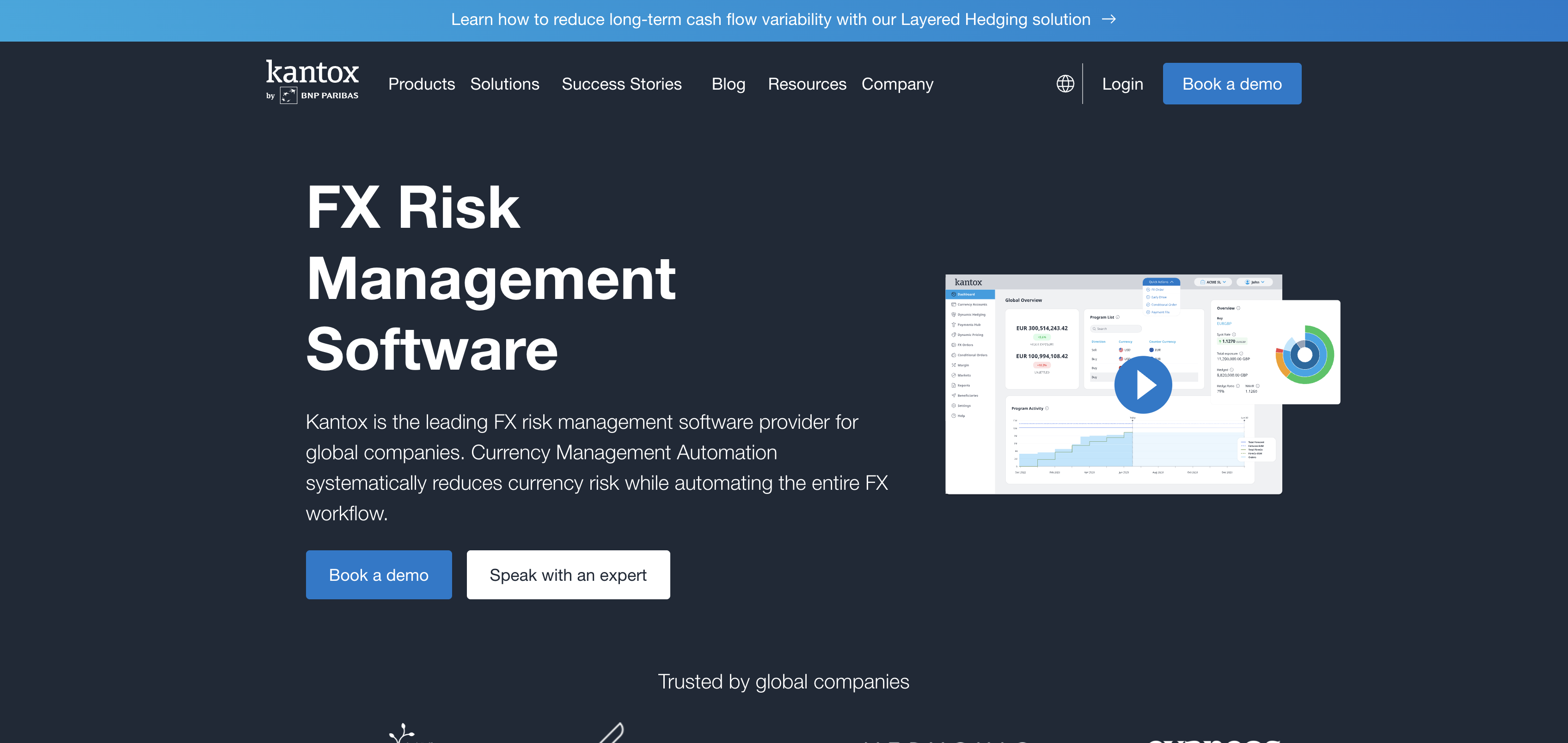
Kantox sits at the intersection of corporate finance and fintech, solving a problem that has plagued treasurers and CFOs for decades: the cost and complexity of managing foreign exchange. Rather than forcing companies through the byzantine world of traditional banks or crude hedging tools, Kantox built a platform that lets businesses buy and sell currency with transparency, speed, and intelligence. The platform aggregates liquidity from multiple sources—banks, non-bank liquidity providers, and peer matching—and surfaces the best rates in real time. No more vendor lock-in, no more opaque spreads, no more waiting. A mid-market company can execute a multi-million euro FX trade in minutes, seeing exactly what they're paying and why. What sets Kantox apart in a crowded treasury tech space is its refusal to abstract away the mechanics. The platform shows you the market, then lets you trade. It's designed for finance professionals who know what they're doing and want control back from intermediaries. The company has built serious depth in emerging markets and supply chain currencies, which most legacy providers still treat as afterthoughts. Kantox represents a broader shift in European fintech: the recognition that some of the most valuable problems live in the unglamorous corners of corporate finance, where even small improvements in execution cost save companies millions annually. In that sense, it's doing for FX what more visible fintechs have done for payments—stripping away friction and opacity from a process that should have been digital decades ago.

Ebury is a London-based fintech that's quietly become one of Europe's most ambitious cross-border payment platforms for small and mid-sized businesses. Built for founders and finance teams who spend too much time juggling currency conversions, hedging risk, and waiting days for international transfers, Ebury strips away the friction that traditional banks left behind. The platform handles the full spectrum of what mid-market companies actually need: sending money across borders at better rates, managing foreign exchange exposure without needing a treasury team, collecting payments in dozens of currencies, and—increasingly—accessing working capital tied to those flows. It's not a flashy consumer app; it's infrastructure that makes international growth less exhausting. Unlike the volume-chasing payment processors or the idealistic startups that oversimplified cross-border payments, Ebury positioned itself as the pragmatic middle ground. It embedded deep relationships with regional banks while building technology that works at scale. The company has expanded beyond its British roots into major European markets, growing a client base that ranges from e-commerce sellers to manufacturing firms that actually need sophisticated FX management, not just cheaper wires. Ebury represents a maturing fintech category: the infrastructure play that's neither a bank nor a simple API, but rather a new kind of financial operating system for companies doing serious international business.
Most corporate treasuries are still wrestling with spreadsheets and manual workflows when it comes to managing liquidity and FX exposure. Ophen Technologies reimagines treasury management for mid-market companies by building a unified platform that turns fragmented banking relationships into a single source of truth. The platform aggregates real-time cash positions across multiple banks, surfaces FX exposure, and automates the mechanics of moving money and hedging risk. It sits between a company's existing bank accounts and ERP systems, orchestrating what should be simple but somehow remains chaotic. What sets Ophen apart is its refusal to force clients into rip-and-replace dynamics. Instead, it works with existing infrastructure, meaning finance teams get immediate value without betting the company on a migration. The platform speaks the language of CFOs and controllers, not engineers, which matters when the problem you're solving is as mission-critical as knowing where your cash actually is. In a market where treasury tech tends toward either complexity or oversimplification, Ophen occupies a pragmatic middle ground. For European mid-market companies managing multi-currency operations and the complexity that comes with it, the platform addresses a genuine pain point that traditional banking and generic ERP modules have consistently underserved.
Additiv is a treasury and cash management platform built for the modern corporate finance team. It sits at the intersection of spreadsheets and enterprise software—companies spend billions managing liquidity across multiple banks, currencies, and counterparties, yet most still rely on fragmented manual processes. Additiv replaces that chaos with a unified workspace where teams can forecast cash flows, manage payments, and monitor FX exposure in real time. The platform connects directly to a company's banking infrastructure, pulling live transaction data and balances across all their accounts. From there, teams can model scenarios, automate routine reconciliation, and execute payments without context-switching between tools. It's designed for finance managers and treasurers who've outgrown spreadsheets but don't want the bloat of legacy treasury systems. In a market dominated by legacy players like Kyriba and FIS, Additiv positions itself as the cloud-native alternative—faster to implement, easier to use, and built for companies that actually want to control their cash position rather than just report on it. The company sits squarely in the corporate finance modernization wave that's reshaping how mid-market and enterprise companies think about liquidity. Unlike niche point solutions, Additiv attempts to be comprehensive enough to replace multiple tools while remaining nimble and intuitive.