Portfolio management Companies in Europe
Portfolio management tools help both retail investors and professional wealth managers construct, monitor, and optimise investment portfolios. For professionals, these platforms provide client reporting, performance attribution, compliance documentation, and multi-asset class management across client portfolios. For retail investors, they provide transparency into holdings, performance tracking against benchmarks, and automatic rebalancing. The shift to ETF-based investing has driven demand for tools that manage diversified, low-cost portfolios efficiently.
European Portfolio management companies in our database
Notable portfolio management companies include DEGIRO, Scalable Capital, Portu, Crealogix and Nordnet.
DEGIRO is a Dutch discount broker built on a single observation: the marginal cost of executing a stock trade is software and settlement, not human labour — so the fees European retail investors were paying bore little relation to what a trade actually cost. Founded in Amsterdam in 2008 by former BinckBank employees, it started as an institutional broker, opened to retail investors in 2013, and undercut the incumbents by a wide enough margin to expand across the continent within a few years. The product is deliberately unglamorous. No gamification, no social feed, no notification congratulating you on a €5 deposit. DEGIRO offers direct access to dozens of exchanges across Europe and the US, real market data, and low per-trade pricing, and it assumes you already know what you want to buy. That utilitarian positioning has aged well as the novelty of investing apps has faded and European retail investors have matured past the onboarding experience into simply wanting to invest efficiently. DEGIRO is no longer independent. German broker flatex AG agreed to acquire it for around €250 million in December 2019, with the legal merger into flatexDEGIRO Bank completing in May 2021. The combined group trades on the Frankfurt Stock Exchange, joined the MDAX in March 2025, and converted from an AG to a European Company (SE) at the end of 2025. It now runs three brands — DEGIRO for international European markets, flatex for Germany and Austria, and ViTrade for active traders — together serving more than 3.5 million customers across 16 countries, with over €95 billion in assets under custody and more than 75 million transactions a year. Group revenue reached €559.8 million in 2025 with net income of €160.4 million, up from €71.9 million in 2023. The regulatory record is less tidy than the pricing story. The Dutch AFM fined the bank €2 million in 2022 over late and inaccurate reporting of unusual transactions, reduced to €797,500 on appeal in 2025. BaFin has issued a series of penalties: €1.05 million in 2023 for breaches of banking supervisory rules, accompanied by additional capital requirements and a special representative appointed to oversee remediation; €560,000 in December 2025 for advertising free investment services without clearly disclosing that a processing fee applied; and €1 million in April 2026 for failing to publish inside information promptly. Leadership has churned alongside it — CEO Frank Niehage resigned in 2024 after a public dispute with founder and major shareholder Bernd Förtsch, and former Morgan Stanley Europe CEO Oliver Behrens took over that October.
Scalable Capital was founded in Munich in 2014 by an unusually complementary quartet: Erik Podzuweit, a former Goldman Sachs banker; Florian Prucker, his co-CEO to this day; Adam French, who built the UK business; and Stefan Mittnik, an econometrics professor who gave the company its quantitative risk-management backbone. The product they launched in 2016 was a robo-advisor — algorithmically managed ETF portfolios for German savers who had money in zero-interest accounts and no relationship with the stock market. The early growth hack was distribution rather than marketing: a 2017 partnership put Scalable's digital wealth management inside ING Germany's retail bank, and BlackRock joined the cap table the same year. By 2018 it was managing €1 billion and ranked among the fastest-growing robo-advisors anywhere. The decision that transformed the company came in 2020: the launch of Scalable Broker, a flat-fee trading platform built around a subscription model — the PRIME tiers — rather than per-trade commissions. It arrived at exactly the moment a generation of Germans discovered investing, and it made recurring ETF savings plans, the culturally German path into the market, effectively free at scale. Scalable became one of continental Europe's two dominant neobrokers, locked in a now decade-defining duel with Berlin's Trade Republic, with the low-cost incumbent DEGIRO fighting the same war from the Netherlands. What distinguishes Scalable strategically is how far it has pushed vertical integration. When the EU banned payment for order flow — the revenue model most neobrokers were built on — Scalable's answer was to co-found its own trading venue, the European Investor Exchange, with Börse Hannover in 2023, keeping headline trading costs low by bringing execution in-house. It launched its own World ETF with DWS and MSCI in 2024, and opened private equity access to retail investors through a BlackRock partnership in 2025. Independent reviewers note the obvious tension in this design: when a broker routes client orders to its own exchange, execution quality and spreads deserve as much scrutiny as the visible fees — a fair caveat about a structure that is otherwise a genuine competitive moat. The capstone came in September 2025, when the European Central Bank granted Scalable Capital a full banking licence, making it a CRR credit institution supervised by BaFin and the Bundesbank. The licence collapsed the remaining dependency on partner banks: Scalable now handles custody, clearing, settlement, deposits, and lending itself. Interest-bearing deposits launched within weeks, spread across Scalable's own bank and partner institutions with the distribution visible in-app, and a flexible credit product followed — loans from €1,000 to €250,000 with no fixed term. Podzuweit's framing of the ambition is lifelong: everything a customer and their family need for investing, saving, and financing, from the first savings-plan euro to retirement. It's the same full-stack endgame Trade Republic reached via its own licence — the two German rivals have independently concluded that the neobroker business ends in becoming a bank. The scale now backs the ambition. Scalable Capital manages more than €30 billion for over one million customers across Germany, Austria, France, Italy, Spain, and the Netherlands, with around 845 employees across Munich, Berlin, London, Vienna, and Milan. A $175 million round led by Sofina and Noteus Partners in June 2025 — joined by Balderton, Tencent, and HV Capital — took total funding past half a billion dollars, three months before the banking licence landed. A decade in, the company that started by automating ETF portfolios for cautious German savers has become one of Europe's few vertically integrated investment banks for retail: its own exchange, its own ETF, its own banking licence, and a product that now touches every stage of a customer's financial life.
Czech investment culture has shifted noticeably over the past decade — from a population that primarily held cash savings to one increasingly comfortable with regulated investment products, particularly among the generation that came of age financially after 2010. Portu was founded in Prague in 2018 to serve that emerging investor base with a digital wealth management platform offering diversified ETF portfolios, retirement planning products, and child savings accounts under a single mobile-first interface. The product was deliberately designed for first-time investors — clear language, low minimum investments, transparent fees, and educational content that helps users understand what they are actually buying rather than the opaque advice models of traditional Czech wealth management. Portu is part of the WOOD Group ecosystem, giving it the institutional backing of one of Central Europe's significant investment firms while maintaining the digital-native product experience that its target users expect. In the Czech wealth tech landscape, Portu has built one of the more successful examples of a Central European robo-advisor reaching genuine consumer scale — proof that the broader European thesis about digital wealth management for first-time investors translates well into markets where investment culture is still being formed.
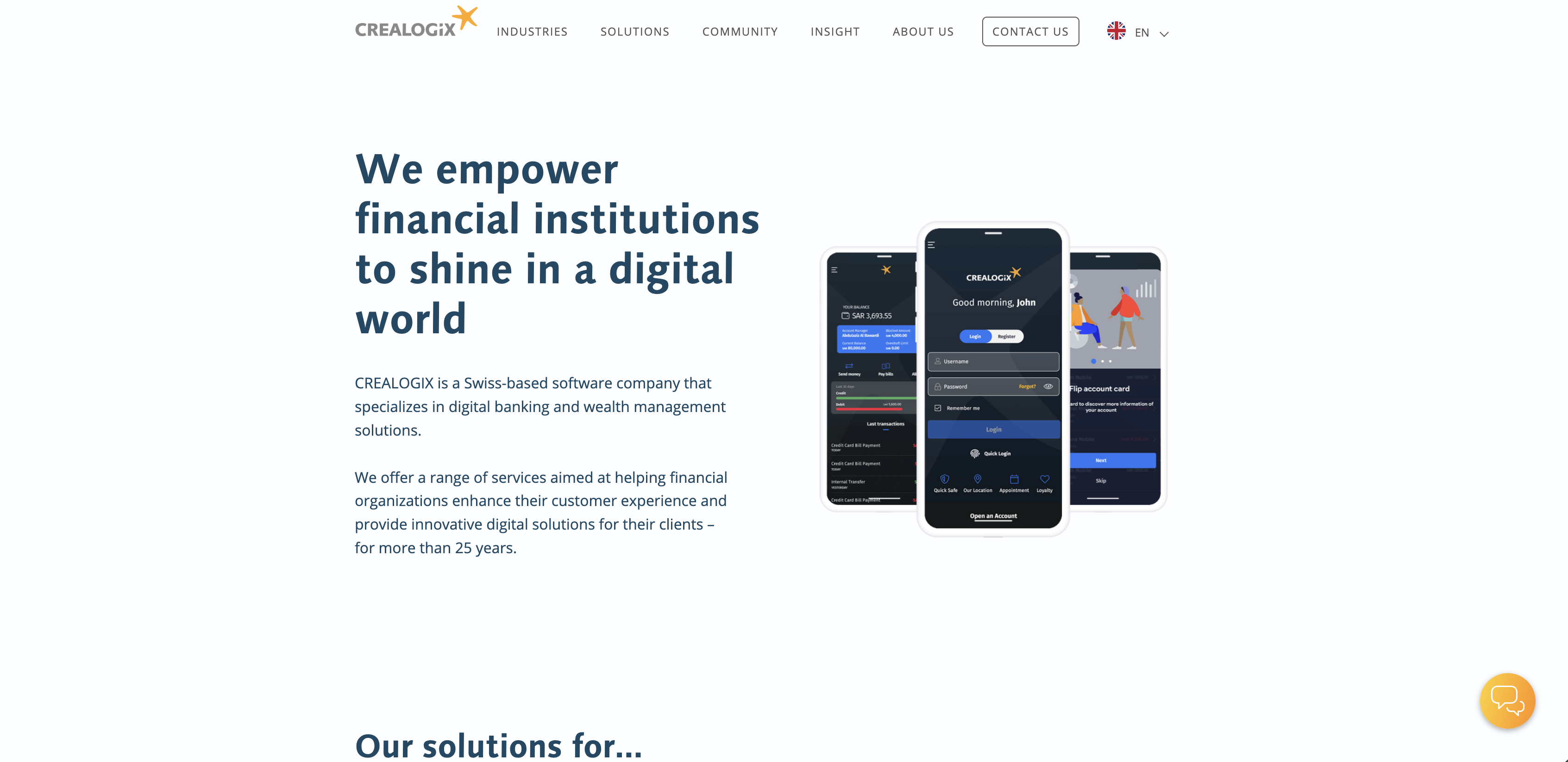
Crealogix is a Swiss fintech company that builds digital banking platforms for financial institutions across Europe. Rather than starting from scratch, banks and wealth managers plug into Crealogix's modular software suite to modernize their customer experience—covering everything from retail and corporate banking interfaces to wealth management portals and mobile apps. The company operates as an infrastructure play in the digital transformation space. Its platforms run on a microservices architecture, letting financial institutions pick and choose the components they need rather than ripping out legacy systems entirely. This approach has gained traction with mid-market and enterprise banks looking to compete with neobanks without the cost of a complete rebuild. Crealogix sits in a pragmatic middle ground between traditional banking software vendors and modern fintech disruptors. It's not trying to be a bank itself; instead, it partners with incumbents and increasingly with smaller financial institutions across German-speaking Europe and beyond. The company's strength lies in understanding both the technical demands of modern digital banking and the regulatory complexity that traditional banks navigate daily. In the evolving European fintech landscape, Crealogix represents the infrastructure generation—the companies enabling the banking industry's digital transition rather than replacing it entirely.
Pan-Nordic retail investing requires more than translating a Swedish product into Norwegian, Danish, and Finnish. Each Nordic market has its own pension system, tax-advantaged investment accounts, regulatory framework, and consumer expectations — complexity that has kept many investment platforms confined to a single national market. Nordnet was founded in Stockholm in 1996 with the explicit ambition to build a genuinely Pan-Nordic investment platform, and has spent nearly three decades doing it. Its platform serves customers across Sweden, Norway, Denmark, and Finland, offering stocks, funds, ETFs, pensions, and savings products tailored to each market's specific tax-advantaged account structures. The cross-border depth is genuinely unusual — most Nordic financial services companies that operate internationally do so through separate national entities with separate products, rather than the integrated platform approach that Nordnet has built. The company is publicly listed on the Stockholm Stock Exchange and competes directly with Avanza in the Swedish market while occupying dominant positions in several other Nordic countries. In the European retail investment landscape, Nordnet's combination of cross-border integration and decades of operational depth makes it one of the most credible regional brokers in any European market — a model that the rest of Europe has been slower to replicate.
Robo-advisory in Central and Eastern Europe faces a market where investment culture is still developing, financial literacy varies enormously, and the major Western European platforms have shown limited interest in localising their products for markets they consider too small to prioritise. Finax was founded in Bratislava in 2017 to fill that gap with a robo-advisory platform built specifically for the CEE region — Slovakia, Czech Republic, Hungary, Poland, Croatia, Romania, and beyond. Its product offers diversified ETF portfolios with localisation that includes pension account integration where local regulation allows, currency hedging strategies relevant to CEE investors, and content designed to build investment knowledge among first-time investors. Finax holds a Slovak investment firm licence with EU passporting rights, allowing it to operate across the European Economic Area. The company has grown rapidly in Slovakia and the Czech Republic, building from a base in markets that international robo-advisors have largely ignored. In the European wealth tech landscape, Finax represents the model that builds for an underserved regional market rather than following the larger platforms into the most competitive Western European geographies — a strategy that has produced sustainable growth in markets where being the credible local option matters more than being the cheapest international one.