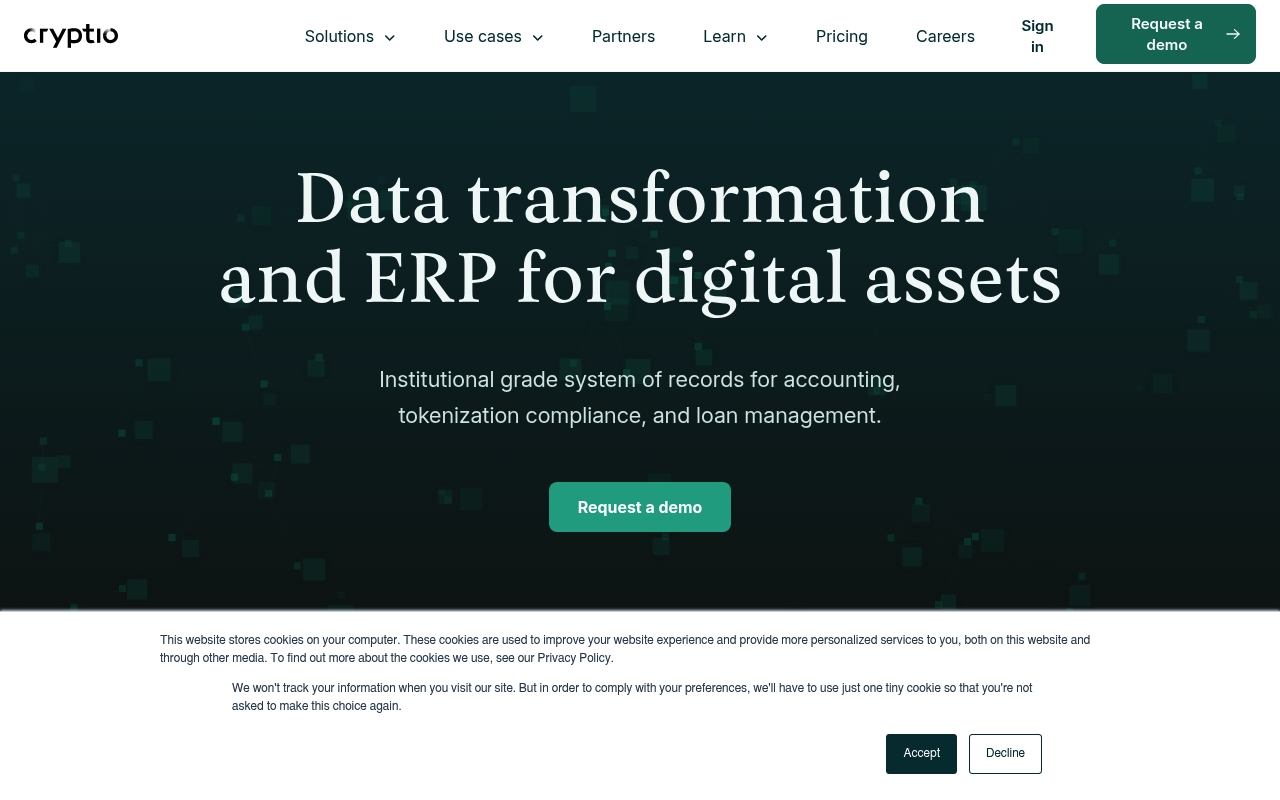
Antoine Scalia founded Cryptio in Paris straight out of business school around 2018, on a bet that looked premature for most of its life: that large institutions would eventually hold digital assets and would then discover their accounting systems couldn't cope. A bank transfer leaves a line on a statement; a blockchain transaction is scattered across wallets, custodians, exchanges and protocols, in a form no ERP was designed to reconcile. Cryptio transforms that data — DeFi, custody, OTC, exchange — into auditable records for accounting, treasury and tax filing.
The bet paid off in 2025–2026. FASB rules requiring fair-value reporting of crypto assets took effect in 2025, the SEC replaced SAB 121 with SAB 122 easing bank custody, and institutional adoption accelerated — turning a niche product into infrastructure. Cryptio now has over 400 clients across more than 30 countries, including Circle, Gemini, SG Forge (Société Générale's blockchain arm), Securitize and Nomura's digital assets subsidiary, and all four of Deloitte, EY, KPMG and PwC rely on its data in audit procedures. Over $3 trillion in transaction volume has passed through the platform.
In March 2026 Cryptio raised a $45 million Series B led by BlackFin Capital Partners and Sentinel Global, with 1kx, BlueYard and Ledger Cathay Capital participating — a substantial round for a company that had raised around $26 million previously, and one closed on institutional traction rather than crypto-cycle enthusiasm. Cryptio completes a natural cluster in your database with Blockpit and Koinly: all three turn blockchain data into tax and accounting output, but Blockpit and Koinly serve individuals while Cryptio serves the institutions and their auditors — the same problem at opposite ends of the market.