DatabaseServicesArticlesCountriesGlossaryNewsletterRequest listing
← All countries
🇲🇹

Fintech in Malta

5 companies·View all in directory →
About the Malta fintech ecosystem

Malta has developed a reputation as a crypto and blockchain regulation pioneer within the EU, having passed a comprehensive legal framework for digital assets — the Virtual Financial Assets Act — ahead of most European jurisdictions. This early regulatory clarity attracted a significant number of crypto companies to Malta in the late 2010s, and the country has maintained an active engagement with digital asset innovation through the Malta Financial Services Authority (MFSA).

Malta's EU membership and eurozone participation give Maltese-licensed financial companies access to the full EU single market, making it an attractive licensing jurisdiction for companies seeking EU regulatory standing. The country has a developed financial services sector focused on gaming, insurance, and fund administration alongside its digital asset activity.

Malta's small size — population under 600,000 — limits the domestic financial services market, but its proactive approach to digital asset regulation and EU single market access give it a specific niche in the European fintech licensing landscape.

Fintech companies based in Malta

Finaro
Finaro
Payments
Finaro is a cross-border payment platform built for the modern freelancer and remote worker. It strips away the bureaucracy of international money transfers, turning what used to be a two-day affair with heavy fees into something that works in minutes. The platform handles multi-currency accounts, instant payouts, and the compliance overhead that typically requires a lawyer and a spreadsheet. What sets Finaro apart is its focus on the self-employed and contractor economy rather than chasing enterprise clients. While traditional banks still treat freelancers like second-class citizens—demanding minimum balances, charging brutal spreads, and treating a basic currency conversion like brain surgery—Finaro built directly for people who earn in dollars but spend in euros, or vice versa. The platform sits somewhere between a neobank and a specialized payments rail. You get a genuine multi-currency account, not just a prepaid card masquerading as one. Settlement is fast, transparent pricing is non-negotiable, and there's no pretense of being your primary bank. It's a specialist tool for a specific problem: making cross-border work financially frictionless. In the crowded European fintech landscape, Finaro represents a counterpoint to the feature-bloated generalists. It does one thing—international payments for freelancers—and does it with the kind of obsessive focus that makes category-specific fintechs genuinely useful rather than just another app on your phone.
Founded 2020
RS2
RS2
Financial Infrastructure
RS2 sits at the infrastructure layer of European fintech, operating as a silent but essential backbone for digital banking. The company builds payment and banking systems that power everything from challenger banks to traditional financial institutions, handling the plumbing that most customers never see but every modern bank needs. Rather than competing for end-user attention, RS2 focuses on solving the unglamorous but critical problem: how do you move money, verify identities, and manage accounts at scale across multiple countries and currencies. Their platform approach means banks and fintechs can launch new services faster without rebuilding core systems from scratch. In a landscape crowded with consumer-facing apps and robo-advisors, RS2 represents the infrastructure play—the company that enables others to be innovative. They've built particular strength in payments orchestration and acquiring, areas where fragmentation across European markets creates real complexity. The company's positioning is fundamentally B2B, serving financial institutions that need to modernize their tech stacks rather than competing directly for customer wallets. For European fintech, RS2 is part of the connective tissue that allows the entire ecosystem to function more efficiently and move faster.
Founded 2005
Fyorin
Fyorin
Financial Infrastructure
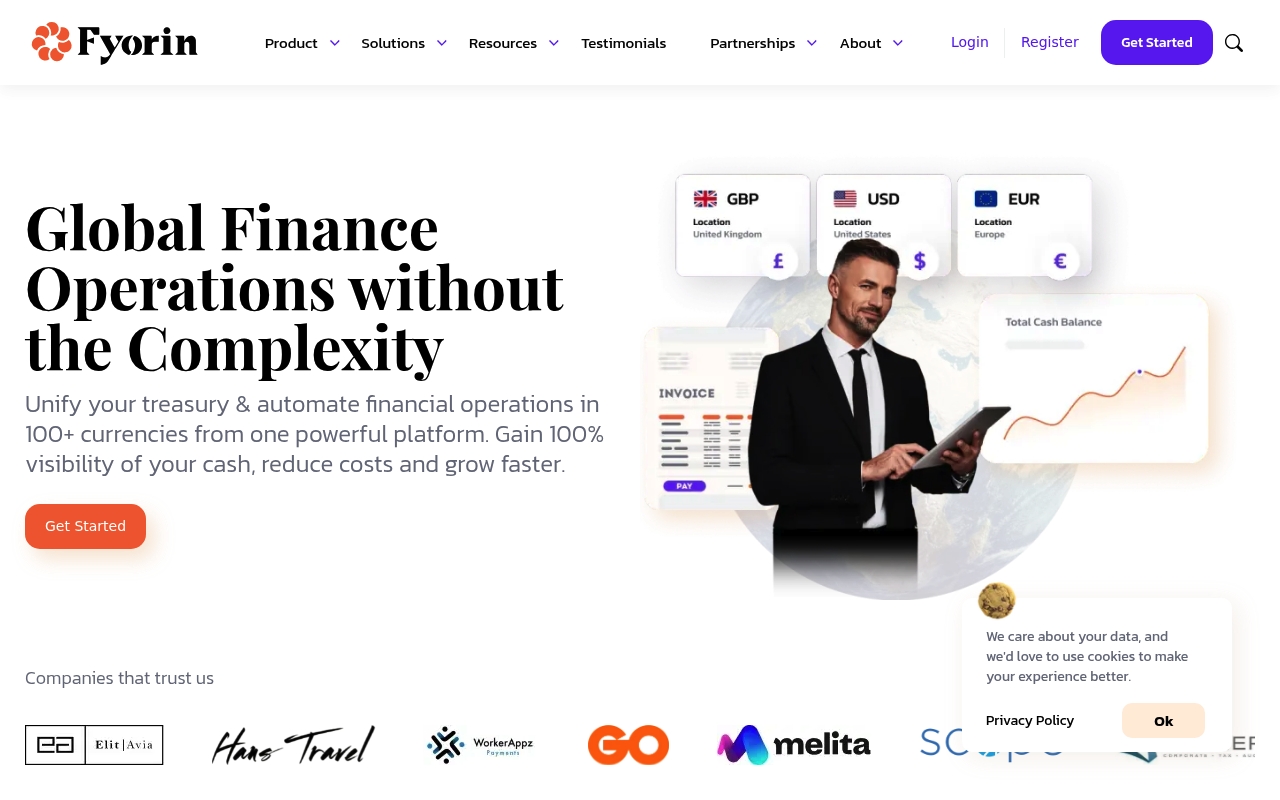
Fyorin is a European treasury and payments platform built for the modern corporate finance team. It bundles cash management, FX execution, and liquidity forecasting into a single interface—stripping away the complexity that haunts traditional treasury software. The platform connects directly to your banks and accounting systems, giving finance teams real-time visibility into cash positions across multiple accounts and currencies. Unlike legacy solutions that require armies of integrators and months of implementation, Fyorin is designed for immediate deployment, letting companies start optimizing cash flow within weeks rather than years. It appeals to mid-market and enterprise finance teams tired of spreadsheet-driven processes and fragmented point solutions. Fyorin sits squarely in the gap between enterprise banking software and modern fintech: it's professional enough for serious corporate finance, but built with the simplicity and speed that modern teams expect. The platform is particularly valuable for companies with multi-currency exposure or complex banking relationships, where manual cash management becomes a real drag on working capital efficiency. In a market crowded with legacy treasury vendors, Fyorin represents a cleaner, faster alternative that doesn't ask you to overhaul your entire finance stack.
Shift4
Shift4
Embedded Finance
Shift4 is a payments infrastructure company that processes transactions for some of the world's largest businesses—hotels, travel agencies, e-commerce platforms, and entertainment venues. Rather than building from scratch, Shift4 operates as the backbone that other payment systems rely on, handling everything from card processing to alternative payment methods across multiple continents and currencies. The company processes over $200 billion annually, quietly powering payment flows for thousands of merchants who may never see its name but absolutely depend on its reliability. What sets Shift4 apart in a crowded payment ecosystem is its operational focus. While many fintech companies obsess over consumer-facing innovation, Shift4 builds enterprise-grade infrastructure designed for resilience, speed, and compliance at scale. Its platform handles the complexity that makes most companies cringe: high-volume verticals like hospitality and gaming, multi-currency settlements, regulatory variance across jurisdictions, and the kind of uptime demands that simply cannot tolerate failure. The company has grown through both organic expansion and acquisitions—notably bringing PayMaker into its fold to expand its European footprint and capabilities. For businesses that process millions of transactions daily, Shift4 isn't sexy. It's indispensable. It represents the unglamorous but critical layer of fintech infrastructure that enables everyone else to function.
Founded 1999
OKX
OKX
Crypto & Blockchain
OKX is a cryptocurrency exchange and Web3 infrastructure platform that has become one of Europe's most active crypto trading destinations. The platform combines spot and derivatives trading with a growing suite of Web3 tools, positioning itself as more than just an exchange—it's a gateway to decentralized finance and digital assets for European traders and institutions alike. The exchange operates with institutional-grade infrastructure, offering sophisticated order types, leverage trading, and options markets that rival traditional capital markets platforms. What sets OKX apart is its commitment to European regulatory compliance and its investment in Web3 ecosystem tools, including an integrated wallet and support for blockchain exploration across multiple networks. While most traditional exchanges struggle to navigate crypto's regulatory complexity, OKX has built operational depth in multiple European jurisdictions. It serves everyone from retail traders seeking exposure to digital assets to institutions building Web3 strategies, making it a central hub in Europe's growing crypto infrastructure layer. In the broader fintech landscape, OKX represents the convergence of trading sophistication and Web3 accessibility—a platform built for the next generation of financial infrastructure rather than merely replicating legacy models.
Founded 2017