← All services
23 European companies
Consumer Credit Apps Providers in Europe
Consumer credit apps provide individuals with personal credit products — credit lines, personal loans, or instalment plans — through mobile-first interfaces outside traditional bank relationships. Digital consumer credit apps offer pre-approved limits, faster decisions, clearer terms, and better user experiences than traditional credit cards, often using open banking transaction data for more accurate underwriting.
Typically offered by
European fintech companies offering consumer credit apps
Klarna
Embedded Finance🇸🇪 Sweden
Three Stockholm School of Economics students pitched an idea at a university entrepreneurship competition in 2005: let shoppers receive goods before they pay, and put the credit risk on the merchant side. The pitch finished last. They built it anyway.
Sebastian Siemiatkowski, Niklas Adalberth, and Victor Jacobsson launched what was originally called Kreditor, later renamed Klarna, and spent the next two decades turning that rejected idea into one of Europe's most recognised fintech brands. The core insight held up: millions of people would rather split a purchase into three instalments than reach for a credit card, and merchants would pay for the privilege of offering that option because it reduces cart abandonment and increases average order values.
Klarna grew from a Swedish checkout button into something considerably more complex. It now holds a banking licence in Sweden, offers savings accounts, issues its own card, and operates across more than 45 markets with around 93 million active consumers and 675,000 merchant partners at the end of 2024. The US, which Klarna entered in 2015, has become its largest market by revenue, a fact the company underlined by listing on the New York Stock Exchange in September 2025 under the ticker KLAR, raising $1.37 billion at IPO.
The financial trajectory has been bumpy. Klarna reported net income of $21 million in 2024, a return to profitability after a bruising 2022 that included an 85% valuation cut and significant layoffs that reduced headcount from over 7,000 to around 3,400. What survived the restructuring was a leaner company with $2.81 billion in revenue and a clearer strategic direction: AI. Klarna's partnership with OpenAI produced a customer service assistant it claims handles the equivalent of 700 full-time agents, and generative AI now manages roughly two-thirds of customer chats.
The honest assessment of where Klarna sits today: it's no longer purely a BNPL provider and it's not quite a bank. It's somewhere in between, a consumer finance platform that knows more about your shopping behaviour than your bank does, and is betting that's worth a lot.
Founded 2005
Abound
Open Banking🇬🇧 United Kingdom
Gerald Chappell ran digital lending globally at McKinsey; Dr Michelle He was a director at EY advising banks on credit analytics, with a PhD in computer science. Both spent years building credit products for large financial institutions, and both reached the same conclusion about the machinery they were working inside: it was wrong at the individual level. A credit score is a statistical average applied to a person — it captures how someone has borrowed before, not what they can actually afford now. In 2020 they founded Fintern in London to replace that inference with observation, using the bank transaction data PSD2 had just made accessible. Chappell's description of what open banking gives a lender is the sharpest summary of the thesis: financial X-rays.
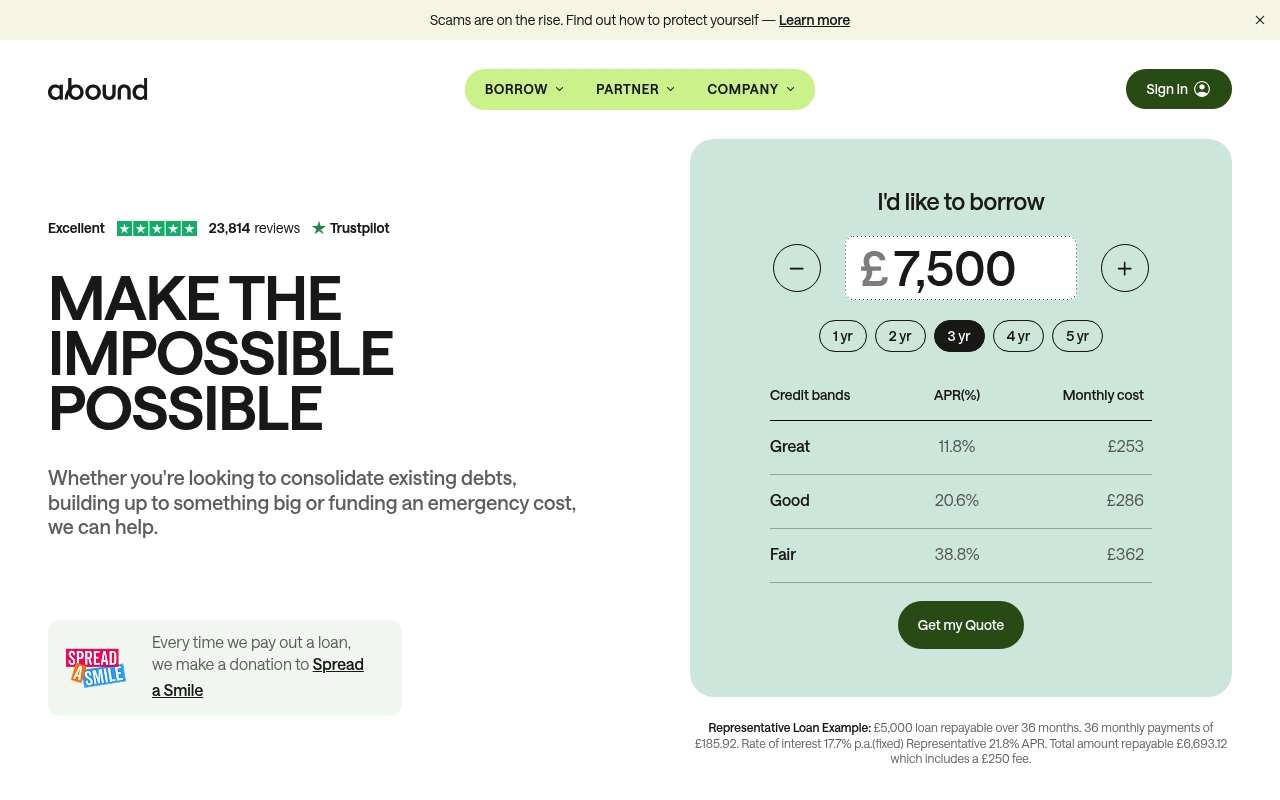
The consumer product, rebranded from Fintern to Abound, is a UK personal loan of a few thousand pounds up to around £20,000, repayable over one to five years, applied for entirely online with funds arriving within hours of approval. What happens underneath is the actual product. Applicants connect their bank accounts through open banking; Abound's proprietary platform, Render, reads real income and real spending — the rent, the subscriptions, the irregular gig income, the seasonal dip — and calculates affordability from what is there rather than from a bureau file. A soft credit check runs alongside it, so quoted rates carry no credit-score impact. The practical consequence is that people with thin files or a couple of historic blemishes can be approved on evidence a scorecard would never see, and that the company claims default rates roughly 75% below industry standard. That figure is Abound's own and unaudited — but the direction is corroborated by the funding it has been able to raise against the loan book.
That funding is the second thing to understand precisely. Abound has announced facilities totalling more than £1.6 billion since launch — £500 million in 2023, up to £800 million in 2024, a further £250 million from Deutsche Bank in 2025 — from Citi, Deutsche Bank, Waterfall Asset Management, LuminArx, Salica, Informed Ventures, and West Coast Capital. The overwhelming majority is debt to fund lending, not equity in the company; before the 2023 round Abound had raised only around $11 million in equity, and no valuation has ever been disclosed. This is the standard structure for a balance-sheet lender and it says something real — institutional lenders underwrite the underwriter, and £1.6 billion of credit facilities is a market verdict on Render's models — but it is not a $1.6 billion company. The genuinely notable milestone is quieter: Abound reached profitability three years after launch, and has now lent over £1 billion, from a team of roughly 130 in London.
The strategic shape now mirrors what several European fintechs have converged on: run the consumer brand, and rent the machinery. Render is being licensed to other lenders — GAIA Family and LemFi are named clients — as cashflow underwriting infrastructure for companies that want to launch credit products or improve their decisioning without building affordability models themselves. Alongside it sit partner products in retail finance and premium finance. It is the same dual model that made Klarna infrastructure for Apple: the consumer business proves the technology, and the technology business scales beyond what the consumer brand could reach alone. International expansion has been signalled repeatedly but Abound remains UK-only, regulated by the FCA under Fintern Ltd (FRN 929244).
The honest read requires looking at the rate card. Abound markets fairness, and relative to what its customers' alternatives are, the case is strong: representative APR is 21.8%, debt consolidation customers save around £1,000 over a loan's life on the company's numbers, and 25,000-plus Trustpilot reviews average 4.9 — unusually good for consumer credit, a category where people rarely leave happy reviews. But the published bands run from 11.8% for the strongest applicants to 38.8% for the "fair" band, and the sample £5,000 loan carries a £250 fee. This is near-prime and non-prime lending: much cheaper than payday or doorstep credit, considerably more expensive than a high-street personal loan, and priced for a customer the high street declines. The structural question is the one facing every lender that has only grown — Abound's models have been profitable through a rate shock but not yet through a genuine consumer credit downturn, and affordability underwriting is precisely the discipline that either proves itself or doesn't when unemployment moves. What it has already demonstrated is narrower but not trivial: open banking data, six years after PSD2 made it available, can underwrite people the credit bureaus get wrong.
Founded 2020
ESTO
Lending🇪🇪 Estonia
Estonian consumer credit at the point of online purchase has been transformed by the combination of digital infrastructure that lets credit decisions happen in real time and consumer expectations of completing purchases without leaving the merchant checkout. ESTO was founded in Tallinn in 2016 to serve that specific moment — providing buy now pay later and instalment financing options integrated into Estonian and Baltic merchant checkouts. The platform connects merchants with consumers seeking flexible payment options at purchase, handling underwriting, settlement, and ongoing customer relationship management for the credit products it originates. ESTO has expanded across the Baltic markets and into broader Central European territories, building a position in the BNPL category as one of the regional specialists that competes alongside the larger European platforms by virtue of its local market depth. In the Baltic BNPL landscape, where international platforms have made selective entries but have generally not built the merchant integration depth that domestic operators have, ESTO represents the local champion category. The competitive question for that category is whether local depth in a single regional market can sustain a competitive position as international BNPL platforms continue to expand and as the underlying economics of the category continue to evolve through cycles of growth and regulatory tightening.
Founded 2016
Inbank
Digital Banking🇪🇪 Estonia
Specialised banking for consumer credit — focused on lending products distributed through merchant partnerships rather than building general-purpose retail banking — is a model with deeper European roots than the venture-backed BNPL conversation suggests. Inbank was founded in Tallinn in 2011 as a specialist lender focused on point-of-sale consumer credit, partnering with retailers across Estonia and the broader Baltic and Central European region to offer instalment finance at the moment of purchase. The company received a full Estonian banking licence and has built operations across Estonia, Latvia, Lithuania, Poland, and the Czech Republic, expanding from a domestic specialist into a Pan-European consumer finance bank. Inbank is publicly listed on the Nasdaq Tallinn exchange — one of the few publicly traded Baltic fintechs — giving it both the regulatory standing of a licensed bank and the funding access of a public company. Its product range covers point-of-sale finance, BNPL, and consumer deposit products, with merchant partnerships across automotive, electronics, home improvement, and other categories where consumers commonly finance purchases. In the European specialist consumer banking landscape, Inbank represents one of the more successful examples of a focused operator scaling across borders while maintaining the operational discipline of a regulated bank.
Founded 2011
4finance
Lending🇱🇻 Latvia
Consumer credit at scale across emerging European markets has been one of the more controversial and one of the larger businesses in European fintech. 4finance was founded in Riga in 2008 and grew into one of the largest digital consumer lenders in Europe, operating in over a dozen markets including Latvia, Lithuania, Poland, Spain, Czech Republic, Slovakia, Romania, Bulgaria, Denmark, Sweden, and beyond. Its product range includes short-term loans, instalment loans, and credit lines, distributed entirely through digital channels. The company's scale — billions in loans originated, millions of customers served — has made it both a significant financial institution and a frequent subject of regulatory and consumer protection scrutiny. The business has navigated the tightening regulation of consumer credit across multiple European jurisdictions, repositioning its product range and pricing as different markets have implemented caps on short-term lending costs. 4finance is owned by funds and operates with the operational scale of a substantial bank without holding traditional banking licences in most of its markets. In the broader European consumer fintech landscape, 4finance represents a category that exists outside the venture-backed startup conversation but processes meaningful credit volume across markets where formal banking remains less accessible than digital alternatives.
Founded 2008
Ferratum
Digital Banking🇫🇮 Finland
Mobile-first consumer lending was a genuinely novel concept in 2005, the year that Ferratum was founded in Helsinki. The company built one of Europe's earliest digital consumer credit businesses, offering small short-term loans through SMS and later through mobile apps — long before smartphone banking became universal. Its initial product targeted the gap between bank credit and informal lending, providing small loans quickly to consumers who needed flexibility that banks didn't offer. Ferratum expanded across more than 20 markets, received a Maltese banking licence, and rebranded to Multitude as it broadened from short-term consumer lending into a more diversified consumer banking business including a digital mobile bank. The transition from short-term lender to licensed bank reflects the broader maturation of European consumer fintech — companies that started with specific lending products evolving toward fuller-service banks as their licences and customer relationships justified the broader product range. Multitude is publicly listed on the Frankfurt Stock Exchange, making it one of the few publicly traded pan-European consumer fintechs. In the European consumer credit landscape, the company's two-decade trajectory illustrates both the original opportunity in mobile-first lending and the strategic logic of evolving toward a licensed banking model as the regulatory environment for short-term credit has tightened.
Founded 2005
Kreditech
Lending🇩🇪 Germany
Algorithmic underwriting for consumer credit using non-traditional data was one of the most ambitious bets in European fintech a decade ago. Kreditech was founded in Hamburg in 2012 with the thesis that machine learning models trained on thousands of data points — far beyond traditional credit scoring inputs — could underwrite consumers in markets where conventional credit bureau coverage was thin. The company expanded across emerging markets, particularly in Latin America, Eastern Europe, and Asia, lending to consumers who were credit-invisible to traditional underwriters. The technology was genuinely advanced for its time, the addressable market was enormous, and the funding it attracted reflected the ambition — over $300 million across multiple rounds, including investments from PayU and other major institutional backers. The execution proved harder than the technology. Operating in multiple emerging markets simultaneously, navigating diverse regulatory regimes, and managing the credit performance of underbanked borrower populations created complexity that challenged the company's ability to scale profitably. Kreditech rebranded to Monedo and entered insolvency proceedings in 2020. Its story is one of the more instructive in European fintech — a technology-led approach to a real market opportunity that ultimately demonstrated the gap between algorithmic possibility and operational sustainability in consumer lending across emerging markets.
Founded 2012
Credissimo
Lending🇧🇬 Bulgaria
Bulgaria's consumer credit market evolved through a different trajectory than Western European countries, with the digital alternatives developing alongside rather than after the traditional banking sector. Credissimo was founded in Sofia in 2007 as one of the country's first digital consumer lenders, providing short-term and instalment loans through online channels at a time when most Bulgarian consumers were still receiving credit through bank branches and informal networks. The company has expanded across multiple European markets and built a substantial digital lending operation, with technology infrastructure that supports underwriting, servicing, and customer management across borders. Credissimo operates in a regulatory environment that has tightened significantly over the past decade — the Bulgarian and EU consumer credit frameworks have evolved to set clearer standards for short-term lending, and operators that survived the regulatory consolidation are those that adapted their products to the new requirements. In the broader European consumer credit landscape, Credissimo represents the kind of operator that has been quietly building scale across Central and Eastern European markets while the venture-backed fintechs of Western Europe have captured the headlines — a different model with different economics, but one that has demonstrated genuine durability across nearly two decades of operation.
Founded 2007
NEO Finance
Lending🇱🇹 Lithuania
NEO Finance operates a European peer-to-peer lending platform.
Founded 2014
Yonder
Digital Banking🇬🇧 United Kingdom
Credit card fintech offering rewards and flexible spending tools.
Founded 2021
Monefit
Lending🇪🇪 Estonia
Consumer credit in Europe is in the middle of a slow renegotiation between flexibility and responsibility. Borrowers want access to credit without the formality of a personal loan application; lenders need underwriting models that work for revolving products without producing the kind of debt traps that have damaged the broader sector. Monefit was founded in Tallinn in 2020 as part of the Creditstar Group, building a digital revolving credit product for European consumers who want a flexible credit line they can draw on as needed rather than a fixed-term loan. Its model gives users access to credit up to a personalised limit, with interest charged only on the amount drawn, repayable on terms that flex with the borrower's circumstances. The Estonian base reflects both Creditstar Group's origins and the operational advantages of running a pan-European consumer credit business from a country whose digital infrastructure makes it possible. Monefit operates across multiple European markets, building a position in the segment of consumer credit that sits between traditional personal loans and credit card debt — a space that has been growing steadily as consumers become more comfortable with digital credit products and lenders find ways to underwrite them sustainably.
Founded 2020
Lendico
Lending🇩🇪 Germany
Marketplace lending in Germany was supposed to disrupt the conservative German banking system by connecting borrowers directly to investors at better rates than the banks offered. Lendico was founded in Berlin in 2013 by Rocket Internet to do exactly that, launching as a peer-to-peer lending platform offering personal and business loans across multiple European markets. The company expanded aggressively in its early years, operating in Germany, Austria, Spain, Poland, the Netherlands, and South Africa, with the kind of scale-first ambition that defined Rocket Internet's portfolio approach. The marketplace lending thesis proved harder than the platform builders anticipated. Lendico repositioned its business model multiple times, eventually being acquired by ING in 2018 — turning a P2P platform into a digital SME lending arm of one of Europe's largest banks. The acquisition reflects a pattern that has played out repeatedly in European P2P lending: the platforms that proved the demand for alternative credit ultimately become acquired by the incumbents whose customers they were originally trying to win over. Lendico's trajectory from independent marketplace to bank-owned lending platform is one of the most explicit examples of that pattern in DACH fintech.
Founded 2013
Showing 12 of 23 companies. View all in the directory →