← All services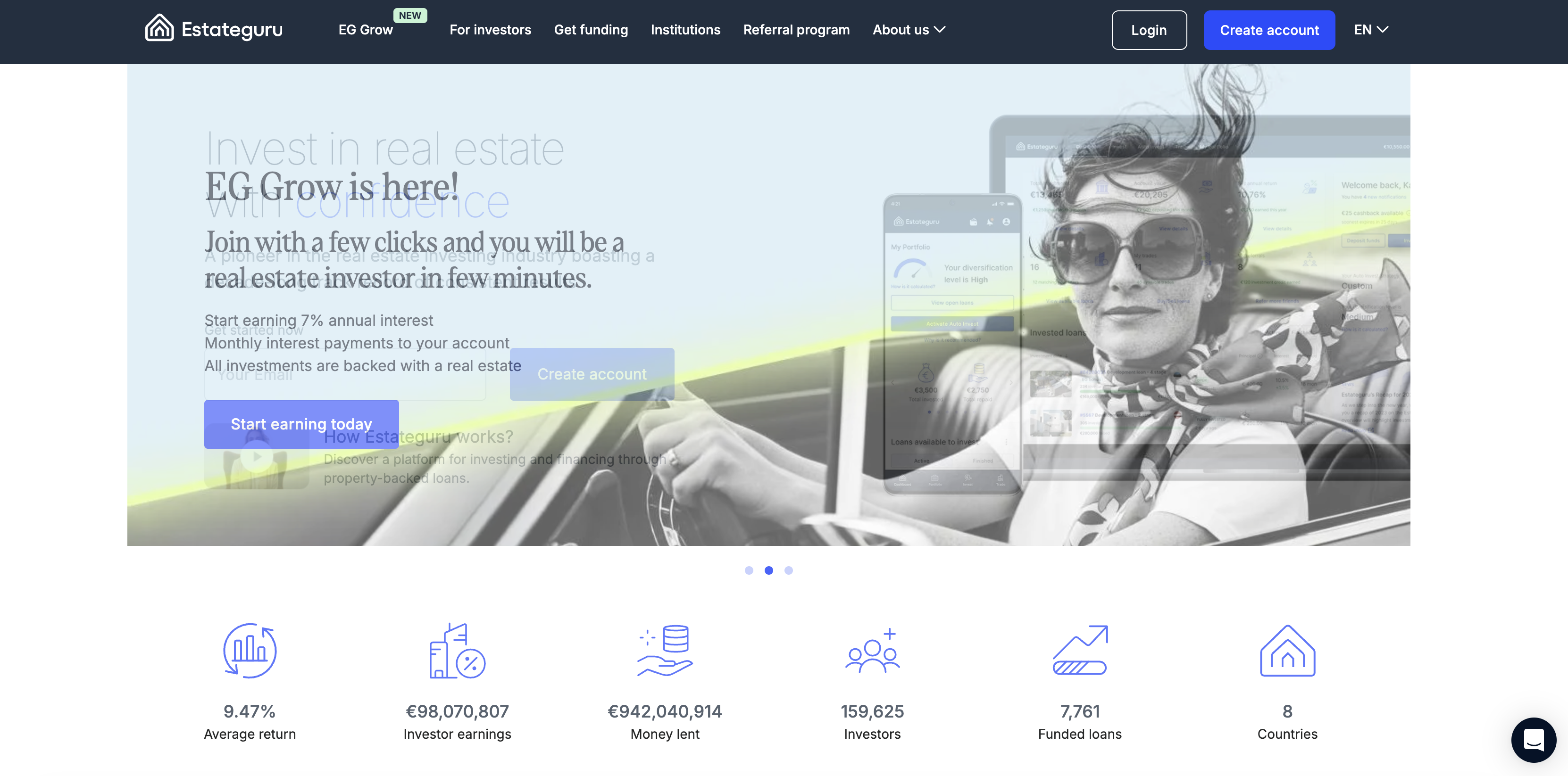

21 European companies
P2P Lending Providers in Europe
Peer-to-peer lending platforms match investors directly with borrowers, with the platform facilitating the loan rather than acting as the lender itself. P2P lending bypasses bank intermediaries, potentially offering better rates for borrowers and better returns for investors. The European P2P market has consolidated significantly following regulatory tightening and defaults during economic stress, with remaining platforms operating under stricter investor protection requirements.
Typically offered by
European fintech companies offering P2P lending
EstateGuru
Real Estate Finance🇪🇪 Estonia
EstateGuru was founded in Tallinn in 2014 by Marek Pärtel and co-founders, and for most of a decade it was the reference platform for property-backed lending in Europe. The model is debt, not equity — the structural opposite of Reinvest24. Investors fund short-term loans to small property developers and businesses, each loan secured by a first-rank mortgage on real estate, starting from €50. If the borrower repays, investors collect interest of roughly 8–11%. If the borrower defaults, the platform enforces the mortgage and sells the collateral. That security model — boring, bank-like, collateralised — is what let EstateGuru scale to more than €700 million in funded loans across eight European markets, and it is also what the platform's crisis would ultimately stress-test.
The crisis came from Germany. EstateGuru expanded aggressively there in 2020 and 2021, originating a large loan book at speed just before the German property market entered its sharpest correction in decades. In January 2023 the company announced an internal investigation into its German team over violations of internal lending guidelines during those origination years; new German lending was paused shortly after, then Finland, then the platform retreated to its Baltic core. The damage was substantial: over €78 million of the German book alone ended up in recovery, defaults across the affected markets drew widespread criticism — one community tracker puts non-performing rates above 50% for the legacy portfolio and voted EstateGuru its worst crowdlending platform of the year — and individual investors with German exposure have publicly reported negative annual returns on their portfolios.
What distinguishes EstateGuru from the platforms that didn't survive this cycle is what happened next. The company holds the ECSP authorisation that became mandatory for European crowdfunding in November 2023 — the licence Reinvest24 never obtained — and kept originating in Estonia, Latvia, and Lithuania throughout the workout. It hired the German debt-servicing specialist Steinberg to run enforcement, and puts roughly €100,000 a month of its own capital into recovery efforts, over €1.1 million in 2024 alone. Spain and Sweden have been fully wound down with all loans repaid; Portugal is being closed the same way. Leadership turned over twice: Pärtel moved to chairman, Mihkel Stamm ran the restructuring for two and a half years, and in September 2025 long-time insider Daniil Aal, previously COO, took over as CEO. Along the way the platform introduced fees investors of the growth era never paid — a monthly management fee on performing principal and a €3 withdrawal charge — a decision that funded the recovery machinery and permanently annoyed a portion of the investor base.
The mid-2026 picture is a company running two businesses at once. The active Baltic business has €101.9 million outstanding, roughly two-thirds performing, and continues to fund new mortgage-secured loans under tightened risk policies. The legacy business is a slow-motion workout: €97.7 million still outstanding in the inactive markets, nearly all of it in active recovery, with the company estimating three to five years to resolve. Against that, EstateGuru has recovered around €70 million in principal for investors to date — €7.5 million in 2025, €6.3 million in the first half of 2026, and a further €5.3 million under signed agreements. All figures are self-reported; the platform publishes monthly repayment and recovery updates, which is more transparency than the category average, if less than burned investors would like.
Founded 2014
RateSetter
Lending🇬🇧 United Kingdom
RateSetter is a peer-to-peer lending platform that cuts out the traditional bank middleman, connecting borrowers directly with retail investors seeking better returns. The London-based marketplace launched in 2010 and has processed billions in loans, operating on the principle that both sides deserve fairer terms than the high street offers. Rather than the opacity of conventional lending, RateSetter's model puts investors in control—they decide which loans to fund and at what rates, while borrowers get transparent pricing without the gatekeeping of legacy institutions. The platform has evolved beyond pure peer-to-peer lending into a more sophisticated investment marketplace, handling everything from personal loans to business finance. RateSetter positions itself as the thinking investor's alternative to savings accounts and bonds, offering yields that reflect real credit risk rather than central bank rates that punish savers. In the fragmented European lending landscape, where fintech platforms compete on transparency and speed, RateSetter remains one of the oldest and most credible players, having weathered multiple regulatory cycles and maintained investor confidence through market volatility. It represents a foundational model in the fintech revolution—the idea that technology and data can democratize finance better than institutional gatekeeping ever could.
Founded 2010
Lendosphere
Lending🇫🇷 France
Lendosphere is a European marketplace lending platform that connects small businesses with institutional investors hungry for alternative returns. Founded on the conviction that traditional banks systematically underserve SMEs, the platform has built a dual-sided network where vetted borrowers access capital at competitive rates while investors diversify beyond bonds and equities. What makes Lendosphere distinct isn't just the marketplace mechanics—it's the emphasis on data-driven credit assessment and a commitment to transparency that appeals to both cautious CFOs and yield-conscious institutional money. The company operates across multiple European markets, handling everything from loan origination through servicing, which means they've had to navigate fragmented regulatory environments while maintaining operational efficiency. In a lending landscape crowded with point solutions and pure-play platforms, Lendosphere positions itself as the connective tissue between supply and demand, enabling capital that would otherwise stay idle or be allocated inefficiently. For SMEs tired of bank gatekeeping, and for institutions seeking uncorrelated returns with human oversight, Lendosphere represents a pragmatic alternative—not utopian blockchain dreams, but boring-boring-good marketplace infrastructure that actually works across borders.
Founded 2014
Assetz Capital
Lending🇬🇧 United Kingdom
Assetz Capital runs a peer-to-peer lending platform that connects individual investors with small and medium-sized businesses seeking growth capital. Rather than routing deals through traditional bank gatekeepers, the platform lets investors browse vetted SME borrowers, assess risk directly, and earn returns by funding loans. It's a middle ground between passive savings accounts and active equity investing, appealing to investors tired of rock-bottom deposit rates and businesses frustrated by bank credit committees.
The platform handles the heavy lifting: borrower vetting, loan servicing, and portfolio management. Investors can diversify across dozens of loans, while businesses get faster access to capital than traditional lenders typically offer. Returns vary by loan grade, giving investors choices between conservative and aggressive lending strategies.
Assetz Capital occupies a distinct niche in the UK fintech landscape. While equity crowdfunding platforms democratize startup investment and traditional banks control the SME lending market, P2P sits in between—offering real asset backing, regulatory oversight, and returns that reflect genuine credit risk rather than venture speculation. It's become a proving ground for how alternative finance can scale without abandoning prudence.
Founded 2013
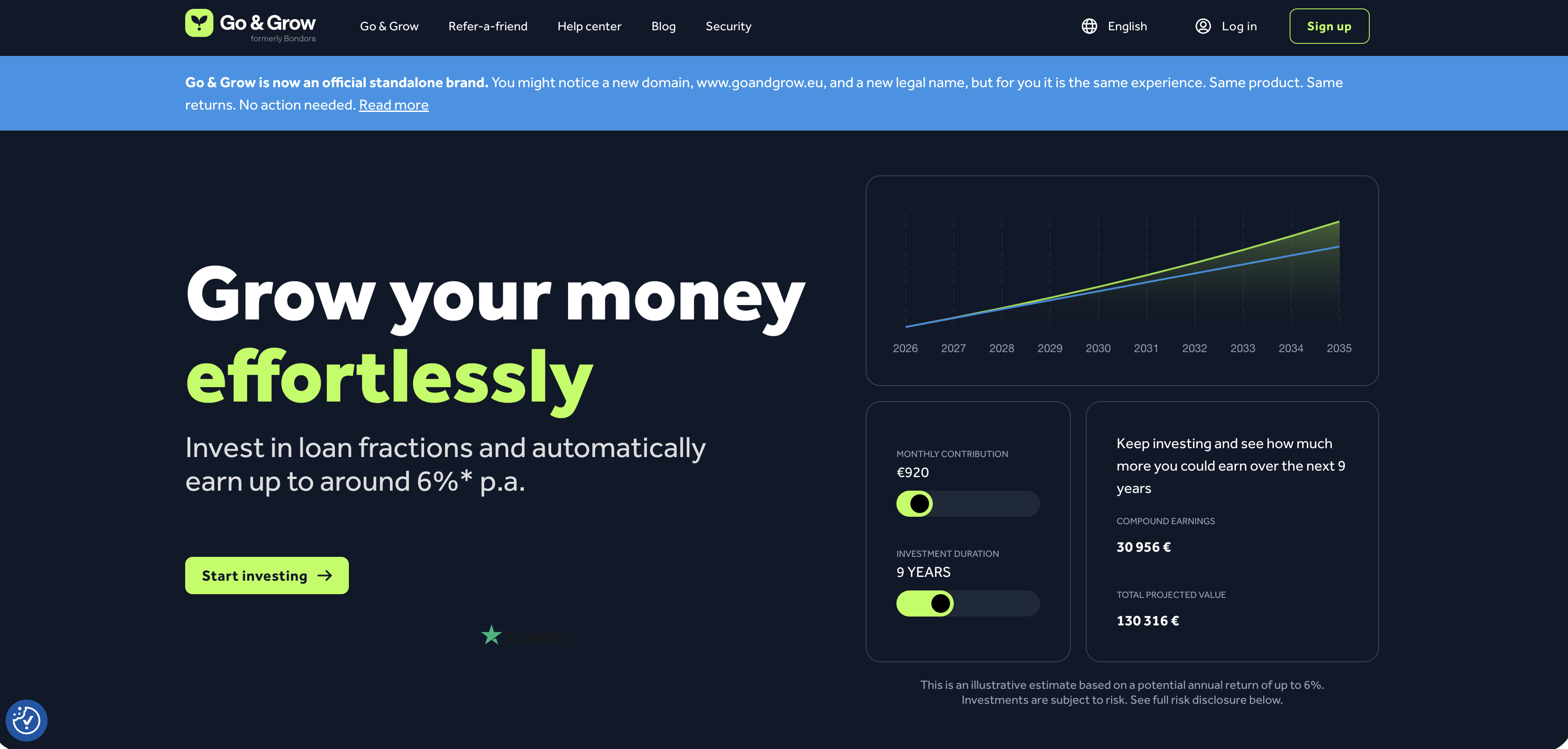
GoAndGrow
Lending🇪🇪 Estonia
GoAndGrow strips away the complexity of peer-to-peer lending by connecting retail investors directly with vetted borrowers across Europe. The platform democratizes alternative finance in a region where traditional banks still gatekeep access to capital, offering returns that actually reflect market conditions rather than the near-zero rates savers have endured for over a decade.
Founded 2015
Robo.cash
Lending🇭🇷 Croatia
Robo.cash operates in the intersection of peer-to-peer lending and alternative finance, offering investors access to curated loan portfolios across emerging markets. The platform automates investment selection and portfolio management through algorithmic underwriting, letting retail investors diversify across geographies without the friction of traditional private lending networks. Unlike conventional P2P platforms that focus on domestic markets, Robo.cash targets cross-border lending opportunities, primarily in Central and Eastern Europe and Latin America. The company positions itself as a fintech bridge between individual capital and underserved borrowing markets, using data-driven credit assessment to reduce default risk. It appeals to yield-seeking European investors looking for alternatives to negative real returns in traditional savings. Robo.cash's automation removes the manual effort from international lending, a category typically locked behind institutional gatekeeping. The platform operates as a regulated marketplace in multiple jurisdictions, handling currency conversion and cross-border settlement automatically. Its role in the broader landscape is part of the democratization wave that challenges traditional banking's monopoly on international capital allocation, though with higher risk profiles than conventional banking products.
Founded 2015
PeerBerry
Lending🇱🇻 Latvia
PeerBerry is a peer-to-peer lending marketplace that connects individual investors with borrowers across Central and Eastern Europe, creating a direct lending alternative to traditional bank loans. The platform operates as an open marketplace where retail investors can fund loans to small businesses and personal borrowers, earning returns through interest payments while borrowers access capital outside conventional banking channels. Unlike traditional peer-to-peer lending platforms that focus primarily on consumer loans, PeerBerry emphasizes business lending and has built a significant presence across multiple CEE markets. The platform functions as a secondary market facilitator, allowing investors to buy and sell loan portions after origination, adding liquidity to what would otherwise be illiquid investments. PeerBerry targets experienced retail investors seeking portfolio diversification through alternative assets, positioning itself as a bridge between European savers and credit-worthy borrowers in emerging markets where traditional lending often remains restrictive. In the broader fintech landscape, PeerBerry represents the maturation of European peer-to-peer lending, moving beyond novelty into established alternative finance infrastructure that now competes directly with institutional capital sources.
Founded 2015
Swaper
Lending🇱🇹 Lithuania
Swaper is a peer-to-peer lending platform that connects individual borrowers with investors across Europe, operating since 2014. The platform cuts out traditional banks from the equation, letting regular people lend to and borrow from each other directly—think of it as crowdsourcing credit. It's a refreshingly transparent approach to lending where returns aren't hidden behind opaque fee structures, and borrowers get access to capital without the gatekeeping that conventional banks impose.
The platform operates across multiple European markets, offering investors the chance to diversify their portfolios by backing loans at varying risk levels, while borrowers get competitive rates without the bureaucratic friction. Swaper essentially democratizes what was once a monopoly: the decision about who deserves credit and at what price. For investors looking beyond traditional savings accounts, it's a way to put capital to work. For borrowers, it's an alternative when bank doors close.
In a market still dominated by legacy banking, Swaper represents a more distributed model of credit allocation. It hasn't disrupted traditional lending in the way some fintechs have, but it's quietly built a genuine two-sided marketplace where humans fund humans—no algorithms pretending to be wisdom, just real supply meeting real demand. It's the kind of service that feels more honest than what you'll find at your local bank branch.
Founded 2014
NEO Finance
Lending🇱🇹 Lithuania
NEO Finance operates a European peer-to-peer lending platform.
Founded 2014
Lendico
Lending🇩🇪 Germany
Marketplace lending in Germany was supposed to disrupt the conservative German banking system by connecting borrowers directly to investors at better rates than the banks offered. Lendico was founded in Berlin in 2013 by Rocket Internet to do exactly that, launching as a peer-to-peer lending platform offering personal and business loans across multiple European markets. The company expanded aggressively in its early years, operating in Germany, Austria, Spain, Poland, the Netherlands, and South Africa, with the kind of scale-first ambition that defined Rocket Internet's portfolio approach. The marketplace lending thesis proved harder than the platform builders anticipated. Lendico repositioned its business model multiple times, eventually being acquired by ING in 2018 — turning a P2P platform into a digital SME lending arm of one of Europe's largest banks. The acquisition reflects a pattern that has played out repeatedly in European P2P lending: the platforms that proved the demand for alternative credit ultimately become acquired by the incumbents whose customers they were originally trying to win over. Lendico's trajectory from independent marketplace to bank-owned lending platform is one of the most explicit examples of that pattern in DACH fintech.
Founded 2013
Bondora
Lending🇪🇪 Estonia
Bondora sits at the intersection of consumer finance and investment, letting everyday Europeans lend money directly to borrowers across a handful of European markets. Founded in the early days of the crowdlending boom, the platform has matured into a regulated player that treats itself as seriously as a real bank—because in many ways, it is one now.
The core proposition is straightforward: retail investors deposit capital, Bondora matches them with vetted borrowers seeking personal loans, and the platform takes a cut. But the company has evolved beyond that simple formula. It's built out a secondary market where investors can trade their loans, added an automated investment tool for hands-off allocation, and obtained a banking license in Estonia, which gives it the infrastructure and credibility that early crowdlenders lacked.
In a European lending market dominated by fintech disruptors chasing speed and banks chasing yields, Bondora occupies a distinctly hybrid space. It's not trying to undercut banks on origination margins or move at light-speed like a mobile-first lender. Instead, it's positioning itself as a yield engine for retail investors who want exposure to credit risk without managing a portfolio of individual borrowers.
The platform operates across multiple markets—Estonia, Finland, Spain, and others—which gives it scale and diversification but also regulatory complexity. That's partly why the banking license matters: it's proof that Bondora can operate at a level of rigor that regulators expect, not just startup agility.
Within the broader fintech ecosystem, Bondora represents a durable but perhaps less glamorous category: the regulated alternative lending platform that treats credit underwriting and risk as its core competency rather than a feature. It's the kind of company that tends to persist through downturns and skepticism because the underlying mechanics—matching savers with borrowers at scale—remains fundamentally useful.
Founded 2009
Savy
Lending🇱🇹 Lithuania
Lithuanian P2P lending in its 2014 vintage represented an ambitious attempt to build marketplace lending infrastructure in a Baltic market that was small in absolute terms but had high digital adoption and a regulatory framework that was unusually supportive of fintech experimentation. Savy was founded in Vilnius in 2014 as part of that early wave, building a P2P platform offering consumer loans funded by retail investors. The model has evolved over the decade since launch as the European P2P landscape has matured, regulations have tightened, and the operational complexity of managing both borrower underwriting and investor relationships at scale has become clearer. Savy has continued operating as one of the Lithuanian platforms that survived the consolidation of the broader European P2P sector, maintaining a Lithuanian borrower focus alongside a Pan-European investor base. In the Baltic marketplace lending ecosystem, where dozens of platforms launched and many subsequently closed or merged, the platforms that have remained operational represent a smaller, more disciplined category than the early enthusiasm suggested. Savy is part of that category — not one of the largest by funded volume but operationally durable across more than a decade of European P2P market evolution.
Founded 2014
Showing 12 of 21 companies. View all in the directory →