← All services

11 European companies
Invoice Finance Providers in Europe
Invoice finance allows businesses to receive early payment on outstanding invoices rather than waiting for customers to pay on standard terms. The lender advances 80-90% of the invoice value immediately, with the remainder paid when the customer settles minus a fee. Invoice finance addresses the working capital gap created by long payment cycles without requiring businesses to take on traditional term debt.
Typically offered by
European fintech companies offering invoice finance
Bid Finance
Lending🇵🇱 Poland
Bid Finance is a European platform that streamlines how small and mid-sized businesses access working capital finance. Rather than the traditional dance of chasing multiple lenders and dealing with weeks of paperwork, the platform lets SMEs connect with a curated network of funding providers—banks, alternative lenders, and institutional investors—through a single application. The process is built around speed and transparency: once a business posts its financing need, multiple lenders can compete for the deal, which typically means better terms and faster decisions.
What sets Bid Finance apart is its marketplace model. Instead of being another loan originator or broker that simply refers you somewhere else, it facilitates genuine competition between funders. SMEs see real-time offers and can compare pricing and terms side by side. It's the B2B equivalent of price transparency in consumer finance, but applied to the murky world of business lending where information asymmetry has long been the norm.
The platform operates across multiple European markets, positioning itself as a pan-European solution for working capital, invoice financing, and asset-based lending. It targets businesses that don't fit neatly into the big bank's playbooks—growing firms that need flexible, responsive funding without the bureaucracy. For lenders, it reduces sourcing costs and lets them plug into deal flow they'd otherwise struggle to access.
Bid Finance represents a broader shift in how European SMEs access capital: moving away from relationship banking and towards digital-first, competitive marketplaces where multiple parties bid on deals in near real-time.
Founded 2015
Defacto
Embedded Finance🇫🇷 France
Defacto is a supply chain financing platform built for the digital age, targeting the gap between small suppliers and the large enterprises that depend on them. Rather than waiting 30, 60, or 90 days for payment, suppliers can access capital immediately based on their invoices and purchase orders—turning cash flow from a bottleneck into a competitive advantage. The platform connects directly to procurement systems, automating the approval and funding process with minimal friction. What sets Defacto apart is its focus on transparency and speed. Traditional supply chain finance has always been opaque, expensive, and slow. Defacto strips that away, offering suppliers a straightforward alternative to bank loans or factoring arrangements that drain margins. For corporates, it becomes a working capital tool that improves supplier relationships while unlocking liquidity across the supply chain. The company operates in an increasingly crowded space, but its emphasis on automation and real-time data integration—pulling directly from ERP and procurement systems—gives it operational efficiency competitors struggle to match. In the broader fintech landscape, Defacto represents a shift toward embedded finance solutions that solve real business problems rather than chasing consumer attention. It's helping reshape how money flows through global supply chains, one invoice at a time.
Founded 2018
OneFor
Lending🇬🇧 United Kingdom
OneFor is a European fintech platform that reimagines how SMEs access and manage working capital. Rather than treating finance as a transactional afterthought, OneFor embeds cash flow tools, invoice financing, and dynamic credit solutions directly into the workflows where small business owners actually work. The platform pulls together accounts data, payment history, and real-time transaction flows to offer instant access to capital without the friction of traditional bank applications.
What sets OneFor apart is its positioning as a cash flow operating system rather than just another lending product. It serves companies that traditional banks have largely abandoned—the messy middle of European small business—by automating the visibility and accessibility of working capital. While legacy banks still demand spreadsheets and weeks of underwriting, OneFor delivers decisions in hours using behavioral data and API connections to accounting software.
The company operates across Western Europe with particular traction in the UK and Nordics, building a loyal following among founders who've grown tired of juggling multiple finance tools. Its integration-first approach means OneFor sits comfortably alongside existing business software stacks, making it feel less like switching banks and more like upgrading your CFO's toolkit. In a crowded SME finance space, OneFor's bet is that speed, transparency, and embedded simplicity will ultimately win over traditional lending relationships.
Founded 2020
iwoca
Lending🇬🇧 United Kingdom
iwoca is a British fintech that turns the SME lending game upside down. Instead of sitting in a bank branch explaining cashflow statements to a skeptical manager, small business owners can get funded in days—sometimes hours—through a slick online platform. The company uses AI and open banking data to assess creditworthiness, stripping away the gatekeeping that's long defined traditional lending. Founded in 2012, iwoca has become one of the few alternative lenders that actually feels like it was built in the 21st century, not retrofitted from a 1995 spreadsheet.
The core pitch is deceptively simple: connect your business bank account, let the algorithm run, and get a decision without the theater. Most UK banks still treat SMEs like supplicants; iwoca treats them like customers. Loans range from a few thousand pounds to over £100,000, flexibly structured to match actual business needs rather than the lender's comfort zone. The speed is the real differentiator—traditional invoice financing can take weeks; iwoca's paperless approach cuts that to days. The algorithm isn't a black box either; transparency around how decisions are made matters when you're asking entrepreneurs to trust a machine over a handshake.
In the crowded European alternative lending space, iwoca has managed to feel both established and scrappy, which is rare. The company works with institutional capital partners (including the British Business Bank, which treats it almost like a quasi-public utility at this point), so you're not betting your growth on a startup's runway. That institutional backing combined with actual product design separates iwoca from the dozens of me-too players that launched in its wake and either pivoted or died. It's become a fixture in the UK's alternative lending ecosystem—the rare fintech that solved a real problem without needing a TikTok audience to prove it.
Founded 2012
Thincats
Lending🇬🇧 United Kingdom
Thincats operates in a corner of fintech that most ignore: connecting small businesses with alternative lenders through a streamlined platform. Rather than chasing venture capital headlines or consumer wallet share, Thincats has built infrastructure that lets SMEs access non-bank funding—invoice financing, merchant cash advances, and working capital lines—without the eight-week application gauntlet traditional banks impose. The platform acts as a marketplace, matching borrowers with lenders who actually want to move fast. For businesses stuck between outgrowing their bank line and being too risky for institutional capital, Thincats solves a real problem. Most fintech either targets individuals drowning in consumer debt or targets enterprises with nine-figure balance sheets. Thincats sits in the profitable, often overlooked middle. The company has quietly built meaningful scale in the UK and Australian markets, processing billions in lending volume. Its real innovation isn't technological flash—it's operational: turning SME lending from a six-month negotiation into a process that works at the speed business actually moves. In a landscape dominated by robo-advisors and app-based checking accounts, Thincats represents a different breed of fintech: unglamorous, profitable, and deeply embedded in how actual businesses access capital.
Founded 2012
illimity
Digital Banking🇮🇹 Italy
illimity is an Italian digital bank built from scratch for the modern era, refusing the bloat of legacy banking while maintaining the credibility of a proper banking license. The Milan-based lender makes its money by funding SMEs, distressed companies, and consumer credit—markets where traditional banks have largely checked out or moved at glacial speed. Unlike neobanks chasing retail deposits with app aesthetics, illimity operates as a genuine credit institution, meaning it takes deposits and extends loans at scale.
The bank's core insight is straightforward: the best businesses and borrowers often get rejected by automated systems or stuck in months-long approval queues. illimity cuts through that friction with data-driven underwriting and a willingness to look beyond standard credit scores. For SMEs, it offers working capital facilities, invoice finance, and acquisition financing. For consumers, it provides personal loans and mortgages. It also runs a dedicated division for acquired distressed loans and restructured credits—a niche most retail-focused fintechs have no interest in.
In the crowded Italian banking landscape, illimity stands apart by combining tech-first operations with genuine lending expertise. It's not pretending to be a bank; it actually is one. Where most European digital lenders hit a ceiling—they can't take deposits or originate real credit—illimity has built the full stack. Its positioning sits somewhere between a next-gen retail bank and a specialized credit platform, serving customers ignored or underserved by the incumbents.
Founded 2018
finleap
Embedded Finance🇩🇪 Germany
finleap is Berlin's answer to a question the European fintech scene keeps asking: how do you build world-class financial companies at scale? Rather than chase unicorn valuations, finleap builds them. The holding company operates as a fintech factory, incubating and scaling financial startups from day one with institutional backing, operational expertise, and a network that spans regulators, banks, and investors across the continent.
What sets finleap apart is the architecture itself. It's not an accelerator or a VC fund—it's a purpose-built engine for creating and nurturing fintech companies. Each portfolio company gets access to finleap's infrastructure, compliance playbooks, and go-to-market templates, which compresses timelines and eliminates the friction that typically derails early-stage fintechs. The model works: companies like Wayfair-backed Finn, B2B payments platform Foxpay, and lending marketplace Evala have all emerged from the finleap stable.
Internally, finleap operates across payments, lending, wealth, and embedded finance—categories where the European market remains genuinely underpenetrated compared to the US. The company's thesis is straightforward: identify white space in financial services, build products faster than traditional banks can move, and create defensible market positions through technology and user experience. It's less about disruption theater and more about pragmatic value creation.
Finleap sits at an interesting intersection in the European fintech landscape: large enough to command resources and regulatory relationships, independent enough to move quickly, and structured in a way that lets founders maintain autonomy while tapping institutional muscle. For a continent that produces good fintech companies but struggles with scaling, finleap represents a new playbook.
Founded 2014
Banca AideXa
Digital Banking🇮🇹 Italy
Banca AideXa is a digital bank focused on fast credit for Italian SMEs.
Founded 2020
Factris
Lending🇳🇱 Netherlands
Fintech providing invoice financing solutions for SMEs.
Founded 2017
Billie
Lending🇩🇪 Germany
Billie is a B2B payments platform built for small businesses and freelancers who are tired of chasing invoices. Instead of waiting 30, 60, or 90 days to get paid, users can access their outstanding invoices instantly through Billie's platform, converting them into immediate working capital without the traditional loan machinery.
The service works like this: businesses upload their invoices, Billie validates them, and funds arrive within hours. It's not a loan in the conventional sense—there's no credit scoring, no months of approval waiting, just a straightforward advance against money that's already owed. The economics are transparent: a small fee on the advance, nothing else.
Billie positions itself against the backdrop of Europe's slow payment culture, where SMEs are routinely starved of cash flow by larger clients who take their time settling bills. While traditional banks offer supply chain financing to enterprises, Billie democratizes this for the mid-market and smaller players who have real invoices but zero patience for bureaucracy.
In the broader fintech landscape, Billie sits at the intersection of lending, payments, and working capital—essentially making invoice financing frictionless for businesses that actually need it.
Founded 2018
Mondu
Embedded Finance🇩🇪 Germany
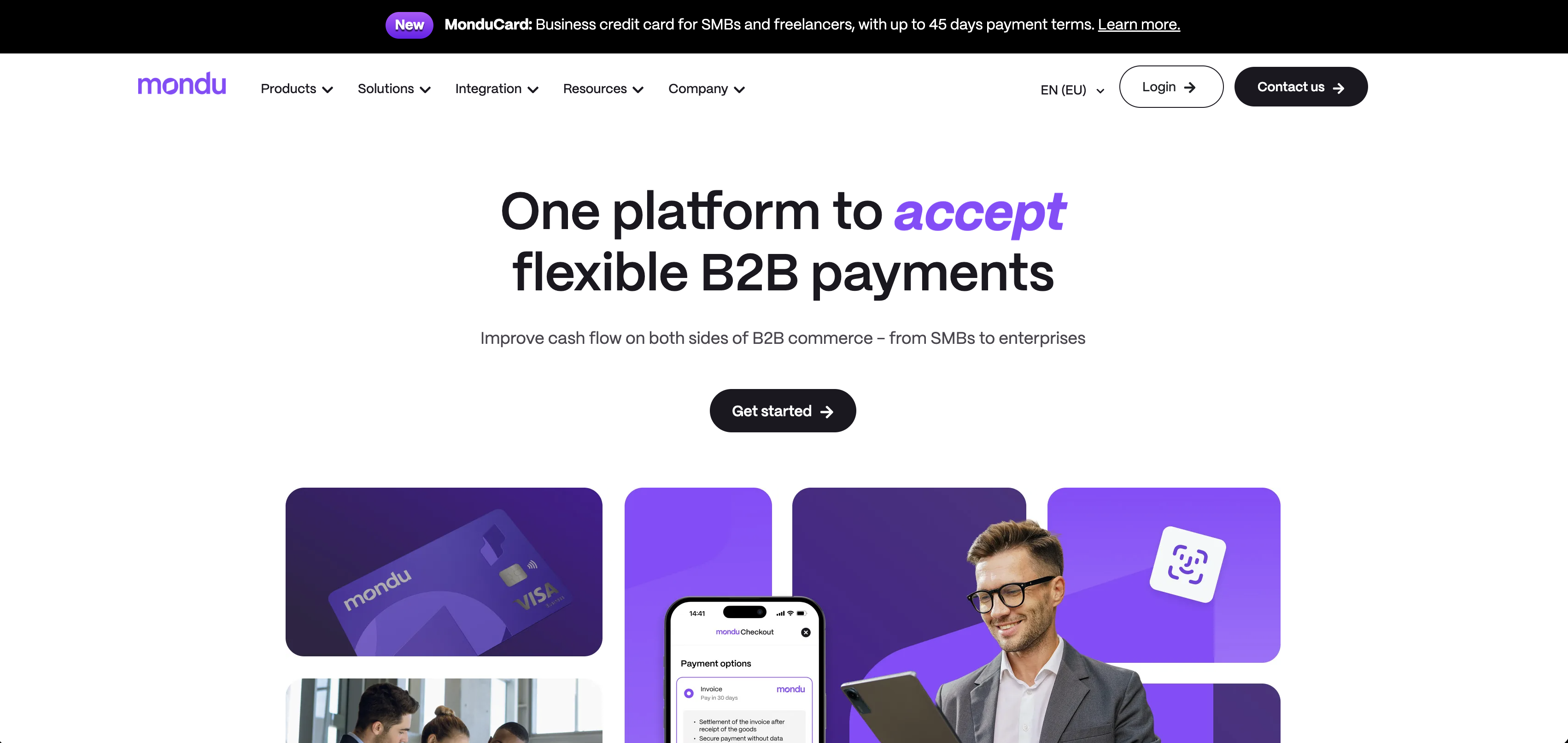
Mondu is a Berlin-based B2B payments platform that lets European SMEs buy from suppliers on flexible terms without traditional credit checks. Rather than forcing businesses to pay upfront or wait for invoice financing, Mondu lets them settle invoices later through a frictionless checkout experience embedded directly into supplier websites. The company targets a structural gap in European commerce: most SMEs still exchange paper invoices and rely on bank transfers, while payment terms remain a brutal negotiating point between unequal partners. Mondu flips this by making deferred payment the default, not the exception. For suppliers, it's a checkout option that doesn't cannibalize cash—Mondu covers the risk. For buyers, it's working capital on demand without the application grind. The platform integrates with accounting software, so late payments become a solved problem, not a cash flow crisis. In a market where alternatives still require days of underwriting, Mondu's instant approval for repeat buyers feels almost radical. It's part of a broader European shift toward embedded finance and instant credit, but Mondu has positioned itself squarely at the invoice level—where the friction actually matters. The company has raised significant backing from investors betting on a future where B2B payments look less like banking and more like consumer fintech.
Founded 2021