← All services
32 European companies
Robo-Advisory Providers in Europe
Robo-advisory services provide automated investment portfolio management using algorithms rather than human advisers. Customers complete a risk assessment, the platform constructs a diversified ETF portfolio matched to their profile, and the portfolio is automatically rebalanced over time. At fees typically well below traditional wealth managers, robo-advisors have democratised access to systematic, diversified investing across Europe.
Typically offered by
European fintech companies offering robo-advisory
Scalable Capital
Wealth🇩🇪 Germany
Scalable Capital was founded in Munich in 2014 by an unusually complementary quartet: Erik Podzuweit, a former Goldman Sachs banker; Florian Prucker, his co-CEO to this day; Adam French, who built the UK business; and Stefan Mittnik, an econometrics professor who gave the company its quantitative risk-management backbone. The product they launched in 2016 was a robo-advisor — algorithmically managed ETF portfolios for German savers who had money in zero-interest accounts and no relationship with the stock market. The early growth hack was distribution rather than marketing: a 2017 partnership put Scalable's digital wealth management inside ING Germany's retail bank, and BlackRock joined the cap table the same year. By 2018 it was managing €1 billion and ranked among the fastest-growing robo-advisors anywhere.
The decision that transformed the company came in 2020: the launch of Scalable Broker, a flat-fee trading platform built around a subscription model — the PRIME tiers — rather than per-trade commissions. It arrived at exactly the moment a generation of Germans discovered investing, and it made recurring ETF savings plans, the culturally German path into the market, effectively free at scale. Scalable became one of continental Europe's two dominant neobrokers, locked in a now decade-defining duel with Berlin's Trade Republic, with the low-cost incumbent DEGIRO fighting the same war from the Netherlands.
What distinguishes Scalable strategically is how far it has pushed vertical integration. When the EU banned payment for order flow — the revenue model most neobrokers were built on — Scalable's answer was to co-found its own trading venue, the European Investor Exchange, with Börse Hannover in 2023, keeping headline trading costs low by bringing execution in-house. It launched its own World ETF with DWS and MSCI in 2024, and opened private equity access to retail investors through a BlackRock partnership in 2025. Independent reviewers note the obvious tension in this design: when a broker routes client orders to its own exchange, execution quality and spreads deserve as much scrutiny as the visible fees — a fair caveat about a structure that is otherwise a genuine competitive moat.
The capstone came in September 2025, when the European Central Bank granted Scalable Capital a full banking licence, making it a CRR credit institution supervised by BaFin and the Bundesbank. The licence collapsed the remaining dependency on partner banks: Scalable now handles custody, clearing, settlement, deposits, and lending itself. Interest-bearing deposits launched within weeks, spread across Scalable's own bank and partner institutions with the distribution visible in-app, and a flexible credit product followed — loans from €1,000 to €250,000 with no fixed term. Podzuweit's framing of the ambition is lifelong: everything a customer and their family need for investing, saving, and financing, from the first savings-plan euro to retirement. It's the same full-stack endgame Trade Republic reached via its own licence — the two German rivals have independently concluded that the neobroker business ends in becoming a bank.
The scale now backs the ambition. Scalable Capital manages more than €30 billion for over one million customers across Germany, Austria, France, Italy, Spain, and the Netherlands, with around 845 employees across Munich, Berlin, London, Vienna, and Milan. A $175 million round led by Sofina and Noteus Partners in June 2025 — joined by Balderton, Tencent, and HV Capital — took total funding past half a billion dollars, three months before the banking licence landed. A decade in, the company that started by automating ETF portfolios for cautious German savers has become one of Europe's few vertically integrated investment banks for retail: its own exchange, its own ETF, its own banking licence, and a product that now touches every stage of a customer's financial life.
Founded 2014
Avanza
Wealth🇸🇪 Sweden
Avanza is Sweden's largest independent online brokerage, a no-frills investment platform that democratized stock trading for Swedish retail investors two decades ago. What started as a scrappy alternative to traditional banks has become the go-to app for millennials and Gen Z who want to trade, invest, and save without paying legacy banking fees. The platform strips away unnecessary complexity—no advisors, no jargon, just direct market access at transparent prices. Avanza operates in that interesting middle ground between a neobank and a pure trading platform. It offers savings accounts, pension accounts, and investment accounts with a sharp focus on user experience and low costs. The company has built a cultural following in Sweden, becoming almost synonymous with retail investing for a generation that views traditional brokers as relics. Beyond just equities and funds, Avanza has expanded into savings products, retirement planning, and financial education—positioning itself as a genuine financial companion rather than just a transaction layer. Its dominance in the Nordic market reflects a broader European shift toward direct-to-consumer investment platforms that compete on transparency, speed, and mobile-first design. Avanza exemplifies how fintech can win by doing one thing exceptionally well and then expanding thoughtfully into adjacent categories. The company's influence extends beyond Sweden into a broader shift in how younger Europeans think about investing: without gatekeepers, without unnecessary fees, and entirely on their own terms.
Founded 1999
Portu
Wealth🇨🇿 Czech Republic
Czech investment culture has shifted noticeably over the past decade — from a population that primarily held cash savings to one increasingly comfortable with regulated investment products, particularly among the generation that came of age financially after 2010. Portu was founded in Prague in 2018 to serve that emerging investor base with a digital wealth management platform offering diversified ETF portfolios, retirement planning products, and child savings accounts under a single mobile-first interface. The product was deliberately designed for first-time investors — clear language, low minimum investments, transparent fees, and educational content that helps users understand what they are actually buying rather than the opaque advice models of traditional Czech wealth management. Portu is part of the WOOD Group ecosystem, giving it the institutional backing of one of Central Europe's significant investment firms while maintaining the digital-native product experience that its target users expect. In the Czech wealth tech landscape, Portu has built one of the more successful examples of a Central European robo-advisor reaching genuine consumer scale — proof that the broader European thesis about digital wealth management for first-time investors translates well into markets where investment culture is still being formed.
Founded 2018
Wealthify
Wealth🇬🇧 United Kingdom
Investing in the UK has historically required either enough money to interest a private bank or enough financial confidence to navigate a self-directed brokerage account — neither of which describes the typical UK saver with a few thousand pounds set aside who would benefit from being invested rather than holding cash in a low-interest savings account. Wealthify was founded in Cardiff in 2015 to serve that customer with a robo-advisory platform that accepted investments from £1, used a short questionnaire to determine risk profile, and managed diversified portfolios automatically. The proposition was deliberately accessible: no minimum investment, transparent fees, no jargon, and an interface designed to make investing feel approachable rather than intimidating. Wealthify was acquired by Aviva in 2017 — one of the UK's largest insurance companies — providing it with both distribution and the institutional credibility that helps newer investment platforms attract conservative savers. The Cardiff-based team has continued operating with significant autonomy as part of Aviva's wealth offering. In the UK robo-advisory landscape — which has been smaller and more fragmented than the US equivalent — Wealthify built a particularly accessible position for first-time investors, and its acquisition by Aviva represents one of the cleaner examples of a robo-advisor finding a strategic home with a major financial services group rather than struggling to build sustainable scale independently.
Founded 2015
Enerfip
Wealth🇫🇷 France
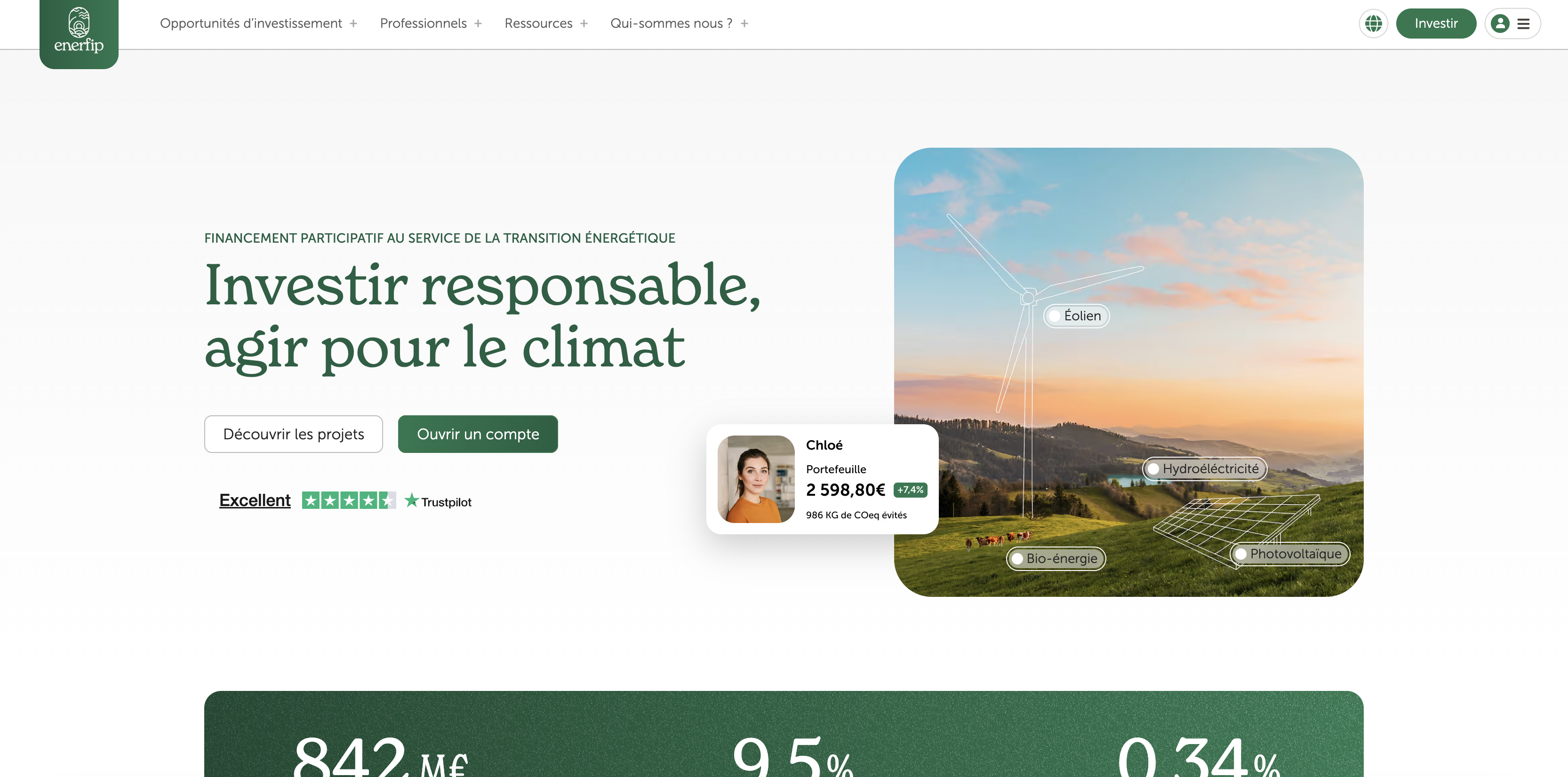
Enerfip is a French renewable energy crowdfunding platform that lets retail investors back solar, wind, and biomass projects with minimal friction. Rather than requiring the traditional wealth checks and gatekeeping that institutional investors face, Enerfip democratizes green energy financing—you can start investing from as little as €100 in projects across Europe. The platform has financed over €100 million in renewable capacity since 2014, positioning itself as a serious player in the intersection of climate finance and retail investment. What sets Enerfip apart is its focus on operational projects with real yields, not speculative green ventures. Its model works because the renewable energy sector desperately needs capital, and Enerfip sits comfortably between the retail investor appetite for impact and the genuine need for project-level funding. The platform doesn't just move money; it acts as a curator and risk manager, vetting projects to ensure investors understand what they're buying into. In a European fintech landscape crowded with robo-advisors and crypto platforms, Enerfip remains distinctly mission-driven—proving that profitable finance and environmental impact aren't mutually exclusive. The company reflects a broader European shift toward sustainable investing, where returns and responsibility are expected to move in tandem.
Founded 2014
Liqid
Wealth🇩🇪 Germany
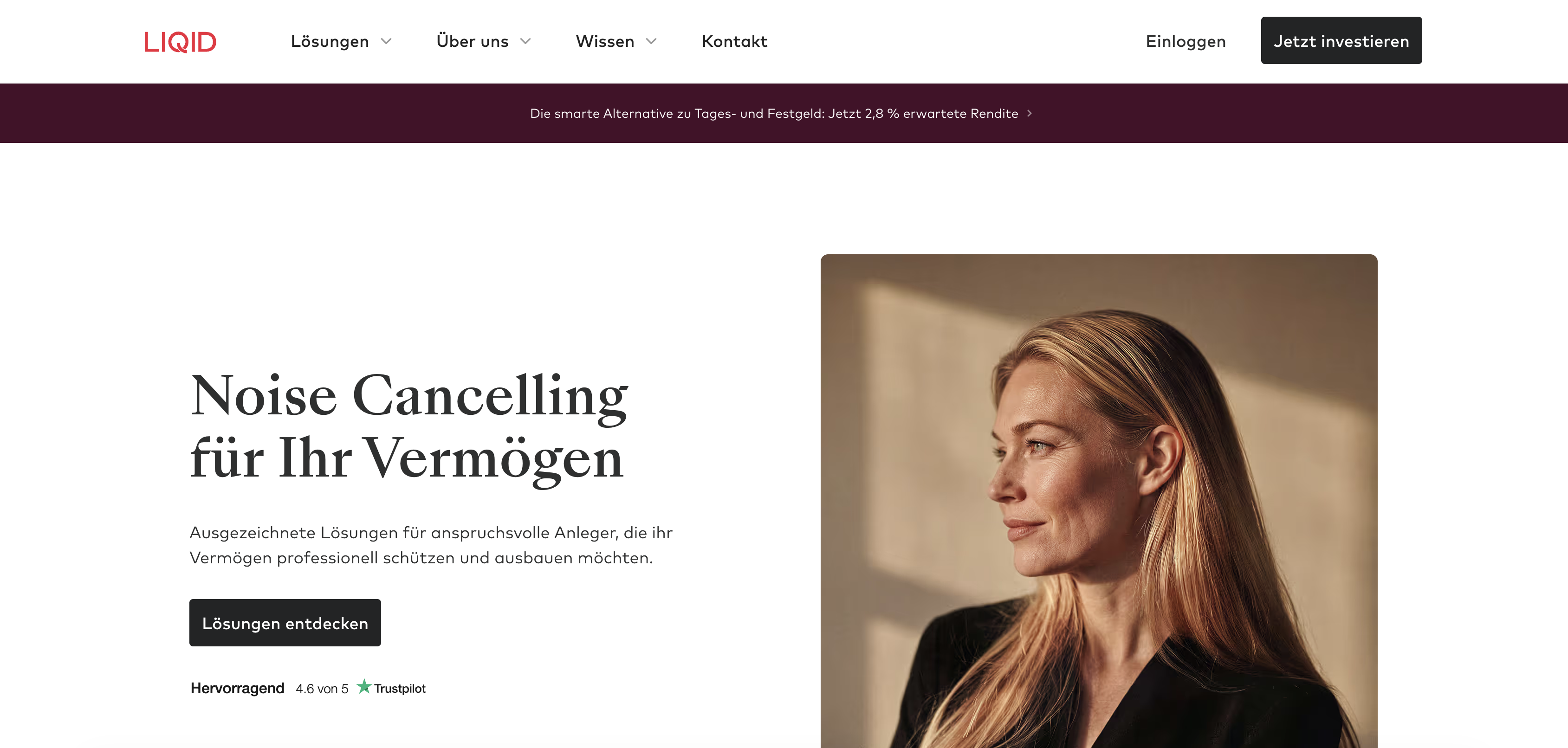
Liqid sits at the intersection of wealth management and digital-first banking, targeting European high-net-worth individuals who've outgrown traditional wealth advisors but cringe at the thought of a faceless robo-advisor. The platform bundles a private banking account with curated investment options and automated portfolio rebalancing, all wrapped in a sleek, mobile-native interface that feels more fintech than dusty wealth management.
Unlike the gatekeeping of legacy private banks—where "advisor relationships" still mean lengthy phone calls with suits—Liqid lets you move money, adjust allocations, and access wealth tools on your own terms. It's pitched toward entrepreneurs, professionals, and inheritors who want sophistication without the theatrical relationship management.
In the crowded European wealth tech space, Liqid differentiates through a combination of low account minimums relative to traditional private banking and a genuine focus on seamless digital experience. The platform also emphasizes transparency on fees and performance, a direct rebuke to the opaque commission structures that have defined wealth management for decades.
Liqid represents a broader shift: the erosion of the exclusivity moat that private banking once enjoyed, replaced by meritocratic access and algorithmic precision.
Founded 2013
B2 Impact
Wealth🇳🇴 Norway
B2 Impact is an investment platform built for a generation that cares where their money goes. The startup combines wealth management with values-driven investing, letting users build portfolios aligned with their beliefs—whether that's climate action, social justice, or gender equality. Unlike traditional advisors who treat ESG as an afterthought, B2 puts impact at the center from day one.
The platform offers curated investment strategies from environmental sustainability to financial inclusion, alongside real-time tracking of how your investments actually perform on social and environmental metrics. You're not just buying index funds; you're seeing the measurable impact your capital creates. It's democratizing impact investing, which traditionally lived in the private wealth world, and making it accessible to younger investors who reject the false choice between returns and values.
B2 operates in a crowded space of robo-advisors and ESG platforms, but distinguishes itself through genuine integration—your impact metrics aren't bolted on, they're woven into the algorithm. The European fintech landscape has embraced ESG quickly, but B2 has positioned itself as the activist layer that older wealth managers lack. For a generation of investors skeptical of traditional finance, it offers permission to invest without moral compromise.
Founded 2020
Argenta
Wealth🇧🇪 Belgium
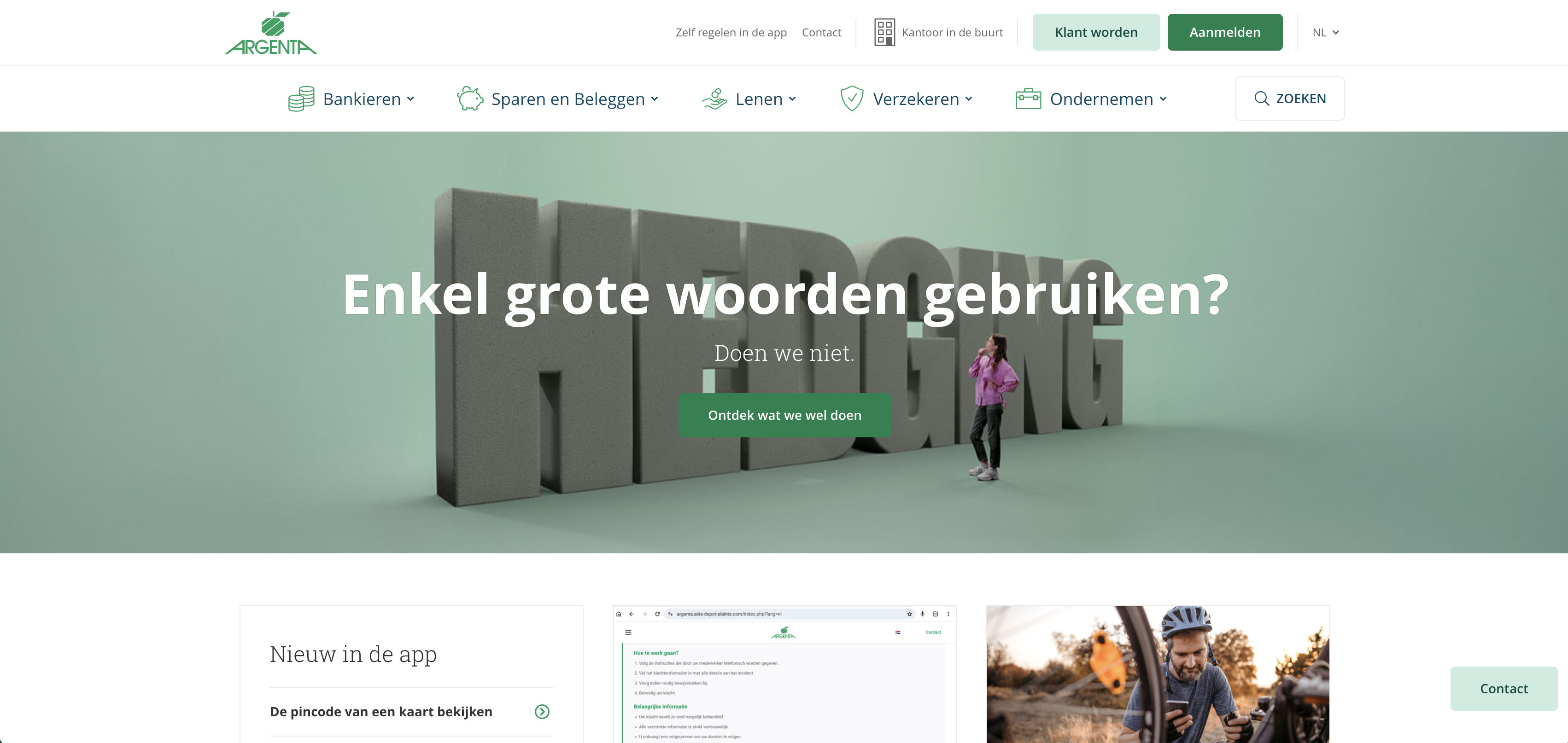
Argenta is a Belgian bank built for everyday people who want straightforward, no-nonsense banking without the corporate theatre. Founded in the early 1990s, it operates as a lean, customer-owned cooperative—a structure that shapes everything from its fee philosophy to its digital experience. Rather than chasing fintech disruption points, Argenta focuses on doing traditional banking services well: savings accounts, mortgages, personal loans, and investments, all accessible through a solid mobile app and online platform.
The bank has carved out a distinctive position by staying independent and member-focused in a market dominated by larger European players. It doesn't compete on cryptocurrency or embedded finance; instead, it emphasizes fair pricing, transparency, and a digital experience that actually works for the average Belgian. Its customer base skews practical—people who want a bank that handles their money competently without asking them to adopt a persona as a "retail investor" or "digital native."
Argenta occupies a middle ground between traditional retail banking and the pure-play neobank movement. It's relevant to the broader fintech conversation not as an innovator, but as a proof point that in mature European markets, there's durable demand for a bank that simply executes the fundamentals well and keeps customer interests aligned with its own. For Belgium specifically, it remains a credible alternative to the multinational banking incumbents.
Founded 1989
Relio
Wealth🇨🇭 Switzerland
Relio is a Swiss digital wealth platform built for the generation that grew up with smartphones but inherited a banking system designed for their parents. It combines automated portfolio management with a clean, modern interface that makes investing feel less like a chore and more like a natural part of daily financial life. Rather than the gatekeeping traditional advisors impose, Relio opens institutional-grade investing to anyone with a modest sum to start—no minimums, no pretense, just straightforward asset management.
The platform sits at the intersection of robo-advisory and accessibility. You link your account, answer a few questions about your risk tolerance, and Relio handles the rest: portfolio construction, rebalancing, tax optimization. It's the algorithmic approach that's become standard elsewhere, but executed with the clarity and design sensibility that Swiss fintech does well. Most competitors either dumb down the interface or overwhelm users with data; Relio finds the middle ground.
In a market flooded with trading apps and crypto speculation, Relio takes a fundamentally different stance: long-term, diversified, automated wealth-building. It competes less with brokerages and more with traditional private banks and advisors, but at a fraction of the cost and without the relationship theatre. The company represents a quiet but persistent shift in how younger Europeans want to manage money—efficiently, transparently, and on their own terms.
Founded 2017
Kvika
Wealth🇮🇸 Iceland
Kvika is an Icelandic investment bank and fintech firm that has quietly built something rarely seen in Europe's crowded fintech space: a full-service wealth and capital markets platform designed for serious investors, not casual traders. Founded in the early 2000s, the company operates as a licensed bank rather than a scrappy startup, which gives it something most fintechs lack—direct access to markets, custody capabilities, and institutional credibility.
The platform combines retail investment tools with professional-grade execution and advisory services. You can trade equities, bonds, funds, and derivatives across multiple exchanges, but Kvika doesn't compete on flashiness. Instead, it positions itself as the thinking investor's choice in a market saturated with gamified trading apps and commission-free broker clones.
What sets Kvika apart in the Nordic and European context is its hybrid model. It serves both individual investors seeking serious portfolio management and corporate clients needing capital markets access. The company operates with the regulatory infrastructure and market relationships that pure fintechs spend years trying to replicate, yet it maintains the technology-first approach that defines modern finance.
Kvika represents a different kind of European fintech success—one built on institutional foundations rather than disruption narratives. It's the kind of player that rarely makes headlines but quietly captures the investor who wants depth over hype.
Founded 2002
Finax
Wealth🇸🇰 Slovakia
Robo-advisory in Central and Eastern Europe faces a market where investment culture is still developing, financial literacy varies enormously, and the major Western European platforms have shown limited interest in localising their products for markets they consider too small to prioritise. Finax was founded in Bratislava in 2017 to fill that gap with a robo-advisory platform built specifically for the CEE region — Slovakia, Czech Republic, Hungary, Poland, Croatia, Romania, and beyond. Its product offers diversified ETF portfolios with localisation that includes pension account integration where local regulation allows, currency hedging strategies relevant to CEE investors, and content designed to build investment knowledge among first-time investors. Finax holds a Slovak investment firm licence with EU passporting rights, allowing it to operate across the European Economic Area. The company has grown rapidly in Slovakia and the Czech Republic, building from a base in markets that international robo-advisors have largely ignored. In the European wealth tech landscape, Finax represents the model that builds for an underserved regional market rather than following the larger platforms into the most competitive Western European geographies — a strategy that has produced sustainable growth in markets where being the credible local option matters more than being the cheapest international one.
Founded 2017
Yomoni
Wealth🇫🇷 France
Yomoni is a robo-advisor built for French investors who want algorithmic portfolio management without the premium price tag or institutional gatekeeping. The Paris-based platform automates investment decisions through a algorithm that rebalances your portfolio, manages tax efficiency, and removes the emotional friction most retail investors wrestle with. Unlike traditional wealth managers charging a fortune for mediocre returns, Yomoni targets the mass-affluent segment with transparent, low-cost index-based investing. The company has carved a meaningful presence in the French fintech landscape by proving that algorithmic wealth management doesn't require either a massive bankroll or a white-glove service model. Yomoni sits at the intersection of accessibility and sophistication: it democratizes portfolio construction for middle-class savers while maintaining the rigor of quantitative finance. In a market saturated with commission-hungry advisors and bloated wealth platforms, Yomoni represents a cleaner alternative, one where costs are visible, advice is systematic, and your money does the work instead of enriching intermediaries.
Founded 2014
Showing 12 of 32 companies. View all in the directory →