Liudas Kanapienis and Andrej Vistorskij met working on fintech projects in Lithuania and kept running into the same obstacle: the KYC methods available to regulated businesses were slow, manual and badly suited to companies operating across borders. They founded Ondato in Vilnius to fix it, and built what is now one of the Baltics' most successful compliance exports.
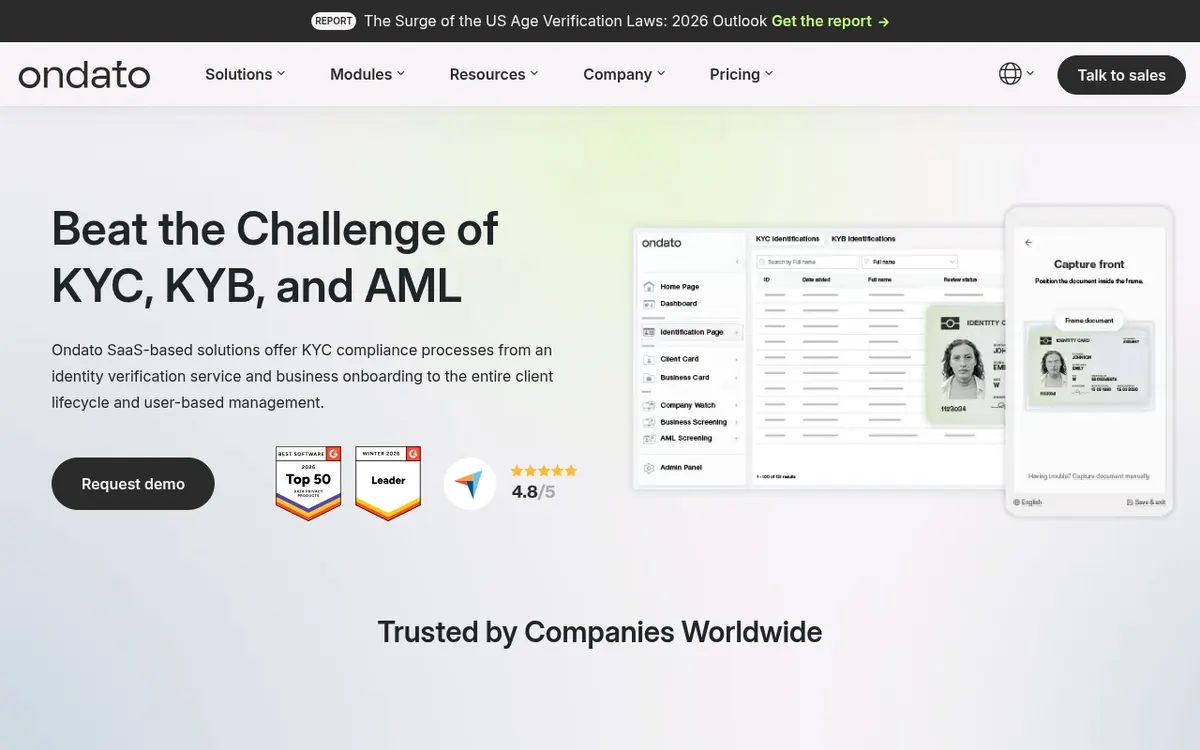
The product has expanded well past its original remit. What began as remote identity verification — photo and video identification, biometric checks, liveness detection — now spans business onboarding (KYB) with ownership-structure analysis, AML screening across sanctions lists, politically exposed persons and adverse media, age verification, authentication for returning users, and e-signature. In 2022 Ondato consolidated these modules into Ondato OS, which the company describes as a compliance CRM: onboarding, screening, ongoing monitoring and case management for the entire client lifecycle in a single environment. The platform supports identity documents from 192 countries and holds ISO 27001 certification.
The company's trajectory reflects the Baltic pattern of building for export from a small domestic market. Ondato was named fintech company of the year at the German-Lithuanian Business Awards in 2019, ranked among the top ten scale-ups in Eastern Europe, and has appeared in the Financial Times ranking of Europe's fastest-growing companies. Funding has been modest by the standards of the category — a pre-seed from Startup Wise Guys, followed by seed rounds with OTB Ventures and LitCapital totalling several million euros. The company has since moved its headquarters to London while keeping research and development in Vilnius.
Strategically, Ondato competes in one of Europe's most crowded categories, against Fourthline's regulatory depth, Veriff's scale, IDnow's DACH position and Sumsub's breadth. Its differentiation is consolidation: rather than selling identity verification as a point solution, it sells the whole compliance file in one system, which is genuinely valuable for mid-sized regulated firms that would otherwise stitch together three or four vendors. The counter-argument, which competitors make and which buyers should weigh, is that consolidating the full customer file creates a single large store of regulated identity data — and both GDPR data minimisation and the incoming EU Anti-Money Laundering Regulation reward architectures that hold less of it by design. The EU's AML framework arriving in 2027 expands the market for everyone in this category; how much of that growth accrues to suite providers versus specialists is the open question.