← All services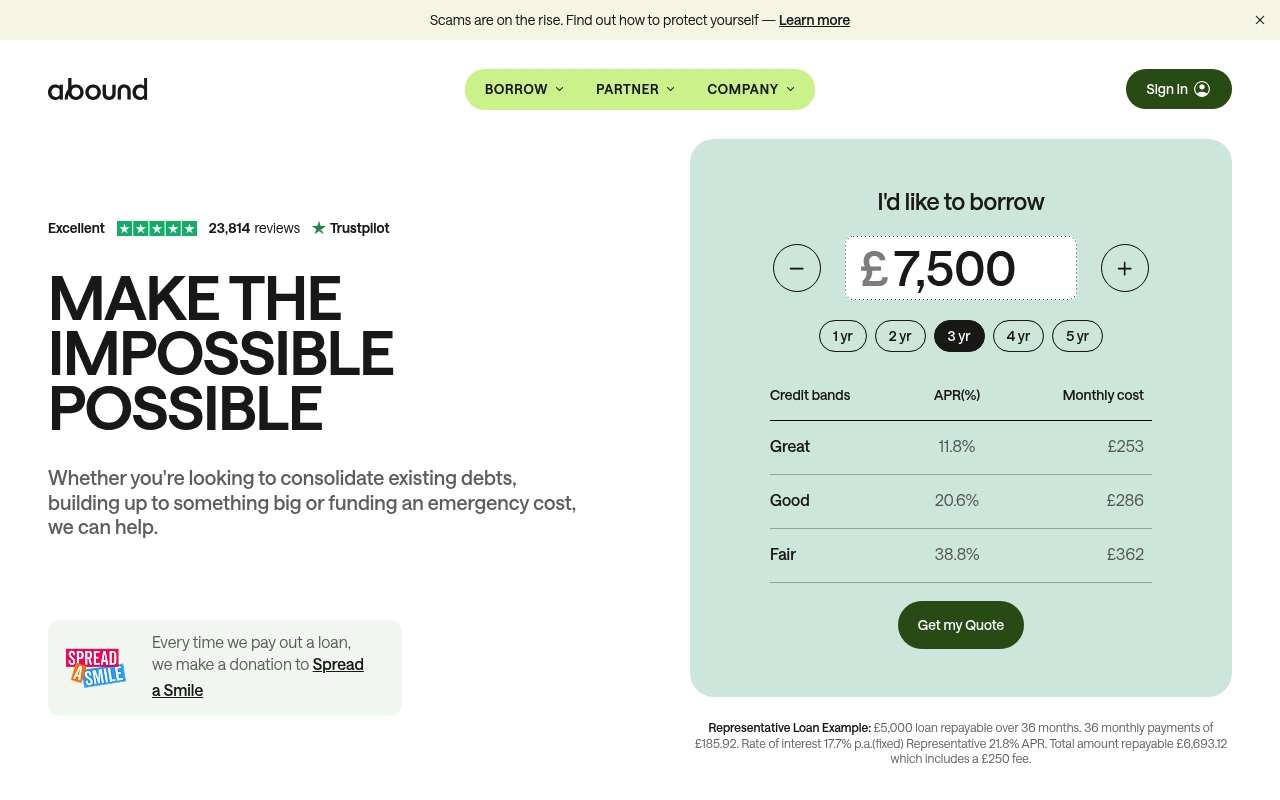


62 European companies
Credit Scoring Providers in Europe
Credit scoring assesses the creditworthiness of individuals and businesses using data models that predict repayment likelihood. Alternative credit scoring expands on bureau data by incorporating open banking transaction history, accounting records, and behavioural signals — enabling lenders to serve borrowers who lack traditional credit histories and to underwrite existing borrowers more accurately.
Typically offered by
European fintech companies offering credit scoring
Abound
Open Banking🇬🇧 United Kingdom
Gerald Chappell ran digital lending globally at McKinsey; Dr Michelle He was a director at EY advising banks on credit analytics, with a PhD in computer science. Both spent years building credit products for large financial institutions, and both reached the same conclusion about the machinery they were working inside: it was wrong at the individual level. A credit score is a statistical average applied to a person — it captures how someone has borrowed before, not what they can actually afford now. In 2020 they founded Fintern in London to replace that inference with observation, using the bank transaction data PSD2 had just made accessible. Chappell's description of what open banking gives a lender is the sharpest summary of the thesis: financial X-rays.
The consumer product, rebranded from Fintern to Abound, is a UK personal loan of a few thousand pounds up to around £20,000, repayable over one to five years, applied for entirely online with funds arriving within hours of approval. What happens underneath is the actual product. Applicants connect their bank accounts through open banking; Abound's proprietary platform, Render, reads real income and real spending — the rent, the subscriptions, the irregular gig income, the seasonal dip — and calculates affordability from what is there rather than from a bureau file. A soft credit check runs alongside it, so quoted rates carry no credit-score impact. The practical consequence is that people with thin files or a couple of historic blemishes can be approved on evidence a scorecard would never see, and that the company claims default rates roughly 75% below industry standard. That figure is Abound's own and unaudited — but the direction is corroborated by the funding it has been able to raise against the loan book.
That funding is the second thing to understand precisely. Abound has announced facilities totalling more than £1.6 billion since launch — £500 million in 2023, up to £800 million in 2024, a further £250 million from Deutsche Bank in 2025 — from Citi, Deutsche Bank, Waterfall Asset Management, LuminArx, Salica, Informed Ventures, and West Coast Capital. The overwhelming majority is debt to fund lending, not equity in the company; before the 2023 round Abound had raised only around $11 million in equity, and no valuation has ever been disclosed. This is the standard structure for a balance-sheet lender and it says something real — institutional lenders underwrite the underwriter, and £1.6 billion of credit facilities is a market verdict on Render's models — but it is not a $1.6 billion company. The genuinely notable milestone is quieter: Abound reached profitability three years after launch, and has now lent over £1 billion, from a team of roughly 130 in London.
The strategic shape now mirrors what several European fintechs have converged on: run the consumer brand, and rent the machinery. Render is being licensed to other lenders — GAIA Family and LemFi are named clients — as cashflow underwriting infrastructure for companies that want to launch credit products or improve their decisioning without building affordability models themselves. Alongside it sit partner products in retail finance and premium finance. It is the same dual model that made Klarna infrastructure for Apple: the consumer business proves the technology, and the technology business scales beyond what the consumer brand could reach alone. International expansion has been signalled repeatedly but Abound remains UK-only, regulated by the FCA under Fintern Ltd (FRN 929244).
The honest read requires looking at the rate card. Abound markets fairness, and relative to what its customers' alternatives are, the case is strong: representative APR is 21.8%, debt consolidation customers save around £1,000 over a loan's life on the company's numbers, and 25,000-plus Trustpilot reviews average 4.9 — unusually good for consumer credit, a category where people rarely leave happy reviews. But the published bands run from 11.8% for the strongest applicants to 38.8% for the "fair" band, and the sample £5,000 loan carries a £250 fee. This is near-prime and non-prime lending: much cheaper than payday or doorstep credit, considerably more expensive than a high-street personal loan, and priced for a customer the high street declines. The structural question is the one facing every lender that has only grown — Abound's models have been profitable through a rate shock but not yet through a genuine consumer credit downturn, and affordability underwriting is precisely the discipline that either proves itself or doesn't when unemployment moves. What it has already demonstrated is narrower but not trivial: open banking data, six years after PSD2 made it available, can underwrite people the credit bureaus get wrong.
Founded 2020
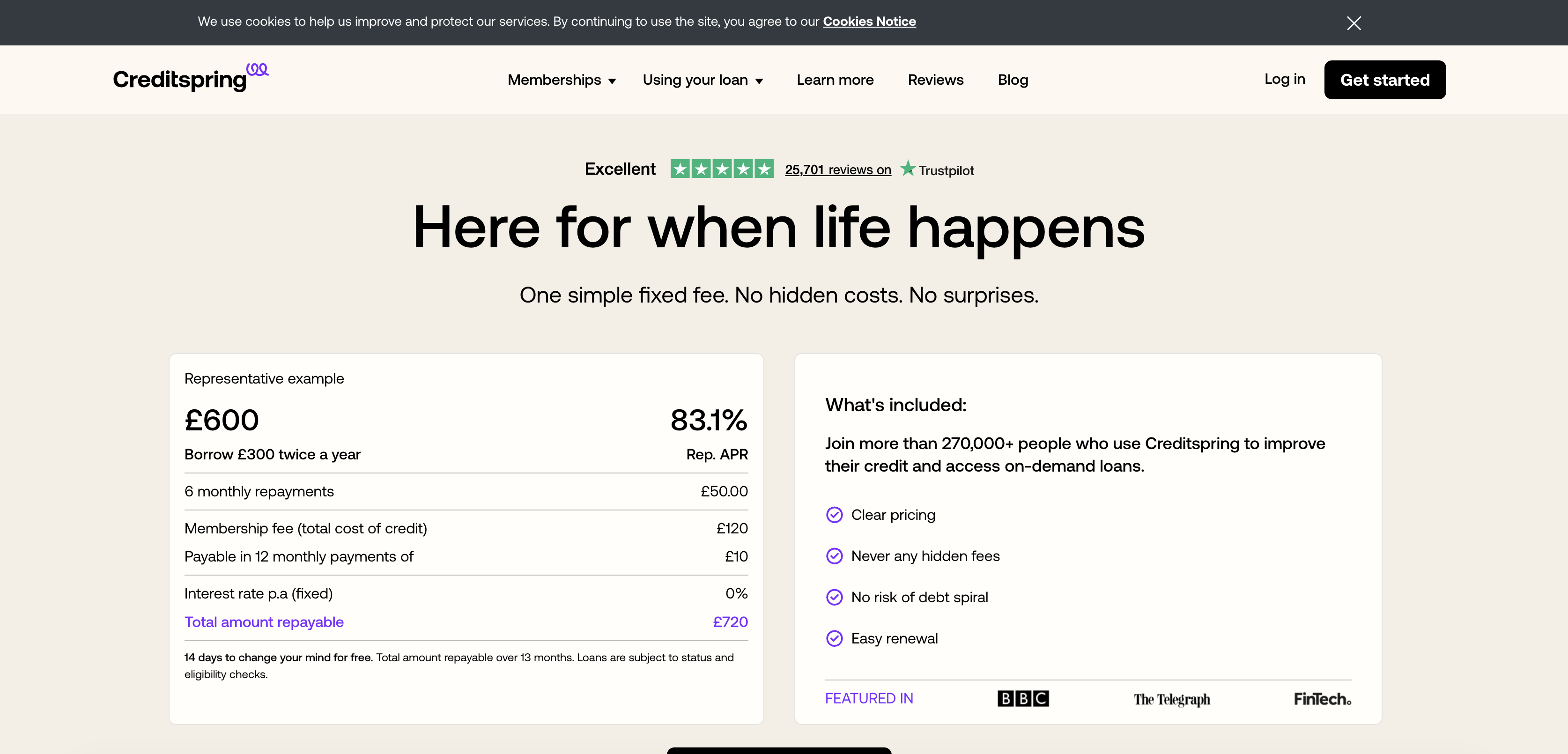
Credit Spring
Lending🇬🇧 United Kingdom
Credit Spring is a UK-based fintech that treats financial distress like a health problem—one that deserves diagnosis and treatment, not judgment. Rather than simply offering credit, the company combines short-term loans with financial coaching and debt management tools, recognizing that a quick cash injection without context is often a band-aid on a bigger problem. The platform helps borrowers understand their spending patterns and rebuild their financial foundation, not just patch a temporary shortfall. It's a provocative stance in a market crowded with BNPL and payday lenders that rarely ask why someone needs money in the first place. Credit Spring targets people in the credit-vulnerable segment—those with poor or limited credit histories who'd normally be shut out of mainstream lending. Instead of algorithmic rejection, the company uses alternative data and behavioral insights to assess creditworthiness beyond traditional scoring. For users, this means faster access to reasonable credit at transparent rates. For the market, it signals a shift toward lending that acknowledges financial fragility as a temporary state, not a permanent condition. The company represents a broader move within fintech to attach financial wellness services to credit products, treating lending as an entry point to deeper financial health rather than a transaction.
Founded 2016
Inbank
Digital Banking🇪🇪 Estonia
Specialised banking for consumer credit — focused on lending products distributed through merchant partnerships rather than building general-purpose retail banking — is a model with deeper European roots than the venture-backed BNPL conversation suggests. Inbank was founded in Tallinn in 2011 as a specialist lender focused on point-of-sale consumer credit, partnering with retailers across Estonia and the broader Baltic and Central European region to offer instalment finance at the moment of purchase. The company received a full Estonian banking licence and has built operations across Estonia, Latvia, Lithuania, Poland, and the Czech Republic, expanding from a domestic specialist into a Pan-European consumer finance bank. Inbank is publicly listed on the Nasdaq Tallinn exchange — one of the few publicly traded Baltic fintechs — giving it both the regulatory standing of a licensed bank and the funding access of a public company. Its product range covers point-of-sale finance, BNPL, and consumer deposit products, with merchant partnerships across automotive, electronics, home improvement, and other categories where consumers commonly finance purchases. In the European specialist consumer banking landscape, Inbank represents one of the more successful examples of a focused operator scaling across borders while maintaining the operational discipline of a regulated bank.
Founded 2011
OpenWrks
Open Banking🇬🇧 United Kingdom
OpenWrks was the UK's first FCA regulated AIS Open Banking platform. In 2020 OpenWrks was acquired by Tink.
Credit decisions have historically been made on backward-looking data — credit files that reflect what happened years ago rather than what a person's financial life looks like today. OpenWrks was founded in London in 2017 to change that with open banking data. Its platform uses transaction data from bank accounts to generate real-time financial insights — income verification, affordability assessments, and cash flow analytics — that lenders, debt advisors, and financial services companies can use to make better decisions about the people they serve. The focus on affordability and debt support is deliberate — OpenWrks has built particular depth in the debt advice sector, providing tools that help debt charities and money guidance services understand their clients' financial situations with precision and speed that paper-based assessments cannot match. Its work with the Money and Pensions Service and other UK debt support organisations reflects a commitment to using open banking data for financial inclusion rather than purely commercial lending optimisation. In the open banking ecosystem, where most data applications focus on acquisition and credit origination, OpenWrks' orientation toward debt support and financial wellbeing is a distinctive positioning that has built genuine trust with the organisations that serve financially vulnerable people.
Founded 2017
Narvi
Embedded Finance🇫🇮 Finland
Narvi is a European fintech that simplifies embedded lending for e-commerce and marketplace platforms. Rather than forcing merchants to build lending infrastructure from scratch, Narvi handles the entire loan lifecycle—from origination through servicing—as a white-label API that integrates directly into checkout flows.
The company targets online retailers and marketplace operators who want to offer buy-now-pay-later and installment credit without the operational overhead of underwriting, collections, or compliance. Narvi handles credit decisions using proprietary scoring models and manages all regulatory requirements, while merchants simply embed a widget and capture incremental revenue.
In a market crowded with point-solution BNPL providers, Narvi positions itself as a full-stack lending partner rather than a payment mode. The company serves merchants across Europe and has built integrations with major e-commerce platforms, making it simpler for smaller retailers to compete with well-funded rivals on financing offerings.
Narvi represents a growing class of embedded finance infrastructure plays—companies enabling non-financial businesses to offer financial products without becoming financial institutions themselves. Its role is to abstract complexity and regulatory burden, letting merchants focus on customer experience and growth.
Founded 2020
EstateGuru
Real Estate Finance🇪🇪 Estonia
EstateGuru was founded in Tallinn in 2014 by Marek Pärtel and co-founders, and for most of a decade it was the reference platform for property-backed lending in Europe. The model is debt, not equity — the structural opposite of Reinvest24. Investors fund short-term loans to small property developers and businesses, each loan secured by a first-rank mortgage on real estate, starting from €50. If the borrower repays, investors collect interest of roughly 8–11%. If the borrower defaults, the platform enforces the mortgage and sells the collateral. That security model — boring, bank-like, collateralised — is what let EstateGuru scale to more than €700 million in funded loans across eight European markets, and it is also what the platform's crisis would ultimately stress-test.
The crisis came from Germany. EstateGuru expanded aggressively there in 2020 and 2021, originating a large loan book at speed just before the German property market entered its sharpest correction in decades. In January 2023 the company announced an internal investigation into its German team over violations of internal lending guidelines during those origination years; new German lending was paused shortly after, then Finland, then the platform retreated to its Baltic core. The damage was substantial: over €78 million of the German book alone ended up in recovery, defaults across the affected markets drew widespread criticism — one community tracker puts non-performing rates above 50% for the legacy portfolio and voted EstateGuru its worst crowdlending platform of the year — and individual investors with German exposure have publicly reported negative annual returns on their portfolios.
What distinguishes EstateGuru from the platforms that didn't survive this cycle is what happened next. The company holds the ECSP authorisation that became mandatory for European crowdfunding in November 2023 — the licence Reinvest24 never obtained — and kept originating in Estonia, Latvia, and Lithuania throughout the workout. It hired the German debt-servicing specialist Steinberg to run enforcement, and puts roughly €100,000 a month of its own capital into recovery efforts, over €1.1 million in 2024 alone. Spain and Sweden have been fully wound down with all loans repaid; Portugal is being closed the same way. Leadership turned over twice: Pärtel moved to chairman, Mihkel Stamm ran the restructuring for two and a half years, and in September 2025 long-time insider Daniil Aal, previously COO, took over as CEO. Along the way the platform introduced fees investors of the growth era never paid — a monthly management fee on performing principal and a €3 withdrawal charge — a decision that funded the recovery machinery and permanently annoyed a portion of the investor base.
The mid-2026 picture is a company running two businesses at once. The active Baltic business has €101.9 million outstanding, roughly two-thirds performing, and continues to fund new mortgage-secured loans under tightened risk policies. The legacy business is a slow-motion workout: €97.7 million still outstanding in the inactive markets, nearly all of it in active recovery, with the company estimating three to five years to resolve. Against that, EstateGuru has recovered around €70 million in principal for investors to date — €7.5 million in 2025, €6.3 million in the first half of 2026, and a further €5.3 million under signed agreements. All figures are self-reported; the platform publishes monthly repayment and recovery updates, which is more transparency than the category average, if less than burned investors would like.
Founded 2014
Credolab
Lending🇳🇱 Netherlands
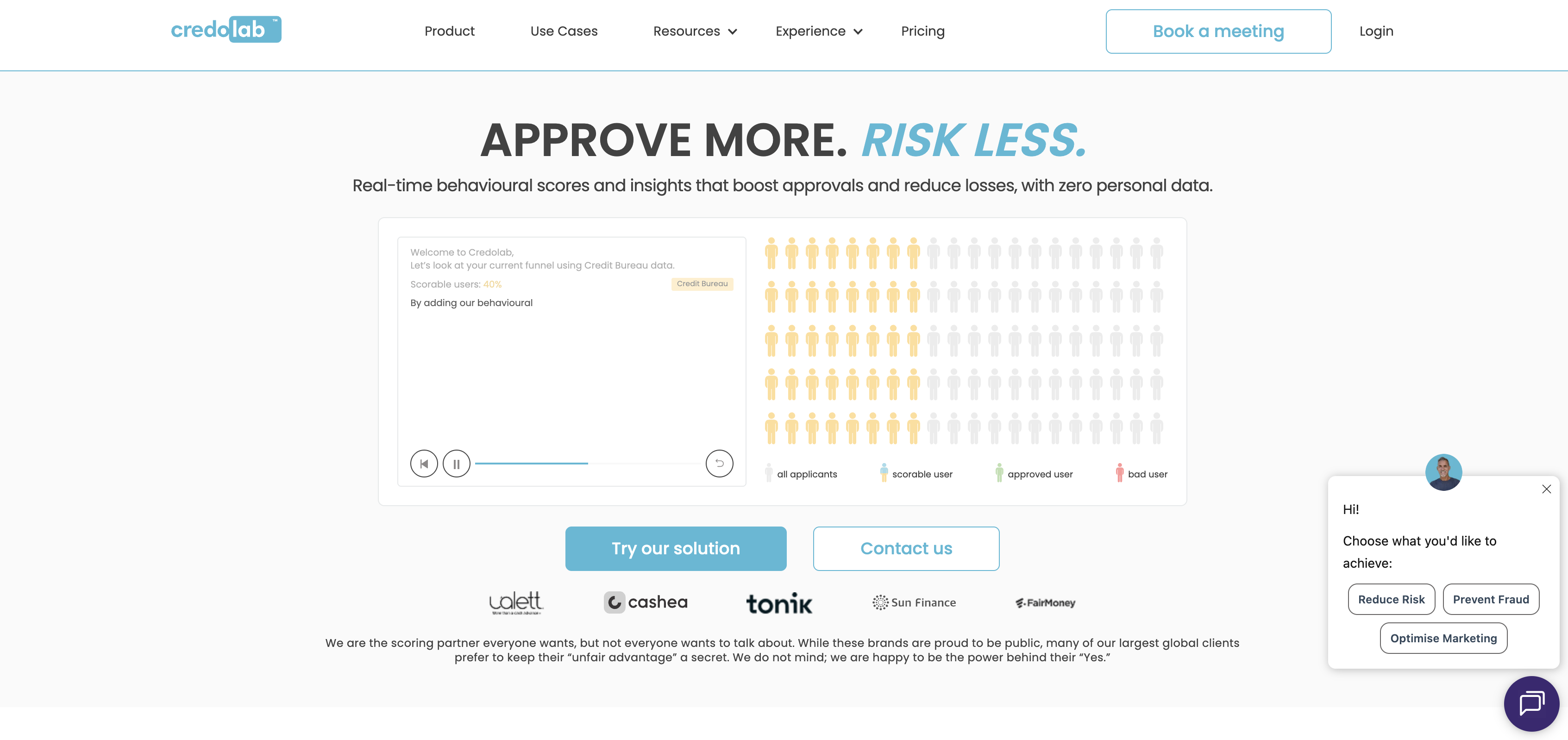
Credit decisions in markets without comprehensive credit bureau coverage have always been hard. The traditional underwriting model relies on credit history, income verification, and identity documents that significant portions of the global population either don't have or can't easily produce. Credolab was founded in 2016 with operations across Asia and Europe to address that gap with an unconventional data source — smartphone metadata. Its platform analyses behavioural patterns from a mobile device — without accessing personal content — to generate credit scores for consumers who have no traditional credit history. The data points are surprisingly predictive: how someone manages their phone storage, the pattern of their app usage, the regularity of their device behaviour all correlate with credit risk in ways that traditional underwriting misses. Credolab serves lenders, telcos, and digital platforms across emerging markets where credit bureau coverage is thin and the demand for digital credit is growing rapidly. In the alternative credit data landscape, where companies are competing to find the data sources that will define the next generation of underwriting, Credolab's behavioural smartphone approach is one of the more distinctive — and one that addresses a genuinely large unmet need in markets where billions of people remain credit-invisible to traditional financial systems.
Founded 2016
RateSetter
Lending🇬🇧 United Kingdom
RateSetter is a peer-to-peer lending platform that cuts out the traditional bank middleman, connecting borrowers directly with retail investors seeking better returns. The London-based marketplace launched in 2010 and has processed billions in loans, operating on the principle that both sides deserve fairer terms than the high street offers. Rather than the opacity of conventional lending, RateSetter's model puts investors in control—they decide which loans to fund and at what rates, while borrowers get transparent pricing without the gatekeeping of legacy institutions. The platform has evolved beyond pure peer-to-peer lending into a more sophisticated investment marketplace, handling everything from personal loans to business finance. RateSetter positions itself as the thinking investor's alternative to savings accounts and bonds, offering yields that reflect real credit risk rather than central bank rates that punish savers. In the fragmented European lending landscape, where fintech platforms compete on transparency and speed, RateSetter remains one of the oldest and most credible players, having weathered multiple regulatory cycles and maintained investor confidence through market volatility. It represents a foundational model in the fintech revolution—the idea that technology and data can democratize finance better than institutional gatekeeping ever could.
Founded 2010
OneFor
Lending🇬🇧 United Kingdom
OneFor is a European fintech platform that reimagines how SMEs access and manage working capital. Rather than treating finance as a transactional afterthought, OneFor embeds cash flow tools, invoice financing, and dynamic credit solutions directly into the workflows where small business owners actually work. The platform pulls together accounts data, payment history, and real-time transaction flows to offer instant access to capital without the friction of traditional bank applications.
What sets OneFor apart is its positioning as a cash flow operating system rather than just another lending product. It serves companies that traditional banks have largely abandoned—the messy middle of European small business—by automating the visibility and accessibility of working capital. While legacy banks still demand spreadsheets and weeks of underwriting, OneFor delivers decisions in hours using behavioral data and API connections to accounting software.
The company operates across Western Europe with particular traction in the UK and Nordics, building a loyal following among founders who've grown tired of juggling multiple finance tools. Its integration-first approach means OneFor sits comfortably alongside existing business software stacks, making it feel less like switching banks and more like upgrading your CFO's toolkit. In a crowded SME finance space, OneFor's bet is that speed, transparency, and embedded simplicity will ultimately win over traditional lending relationships.
Founded 2020
Zopa
Lending🇬🇧 United Kingdom
Zopa rewrote the lending playbook by putting people before profit margins. Founded in 2005, it was the original peer-to-peer lending platform in the UK—a marketplace where ordinary people could lend to one another, bypassing the bank middleman entirely. That ethos still runs through everything it does, though the model has evolved considerably.
Today, Zopa operates as a digital lender offering personal loans and credit products directly to consumers, backed by institutional funding rather than peer capital. It's stripped away the complexity traditional lenders love and built something genuinely transparent: you get a real interest rate upfront, no hidden fees, and a lending decision in minutes rather than days. The platform targets people with thin credit histories or subprime scores—segments that banks treat with suspicion and expensive rates.
What separates Zopa from the noise is its refusal to play the conventional credit game. Most lenders obscure terms or rely on manipulative affordability checks. Zopa's approach feels almost quaint by comparison: fair pricing, straightforward underwriting, and a genuine attempt to lend responsibly. It's positioned itself as the anti-bank lender in a market cluttered with me-too fintechs chasing the same high-income borrowers.
In Europe's competitive lending landscape, Zopa represents a maturing fintech that's learned to balance mission with sustainability—proof that there's still room for players who refuse to compromise on transparency.
Founded 2005
iwoca
Lending🇬🇧 United Kingdom
iwoca is a British fintech that turns the SME lending game upside down. Instead of sitting in a bank branch explaining cashflow statements to a skeptical manager, small business owners can get funded in days—sometimes hours—through a slick online platform. The company uses AI and open banking data to assess creditworthiness, stripping away the gatekeeping that's long defined traditional lending. Founded in 2012, iwoca has become one of the few alternative lenders that actually feels like it was built in the 21st century, not retrofitted from a 1995 spreadsheet.
The core pitch is deceptively simple: connect your business bank account, let the algorithm run, and get a decision without the theater. Most UK banks still treat SMEs like supplicants; iwoca treats them like customers. Loans range from a few thousand pounds to over £100,000, flexibly structured to match actual business needs rather than the lender's comfort zone. The speed is the real differentiator—traditional invoice financing can take weeks; iwoca's paperless approach cuts that to days. The algorithm isn't a black box either; transparency around how decisions are made matters when you're asking entrepreneurs to trust a machine over a handshake.
In the crowded European alternative lending space, iwoca has managed to feel both established and scrappy, which is rare. The company works with institutional capital partners (including the British Business Bank, which treats it almost like a quasi-public utility at this point), so you're not betting your growth on a startup's runway. That institutional backing combined with actual product design separates iwoca from the dozens of me-too players that launched in its wake and either pivoted or died. It's become a fixture in the UK's alternative lending ecosystem—the rare fintech that solved a real problem without needing a TikTok audience to prove it.
Founded 2012
Powens
Fraud & Security🇫🇷 France
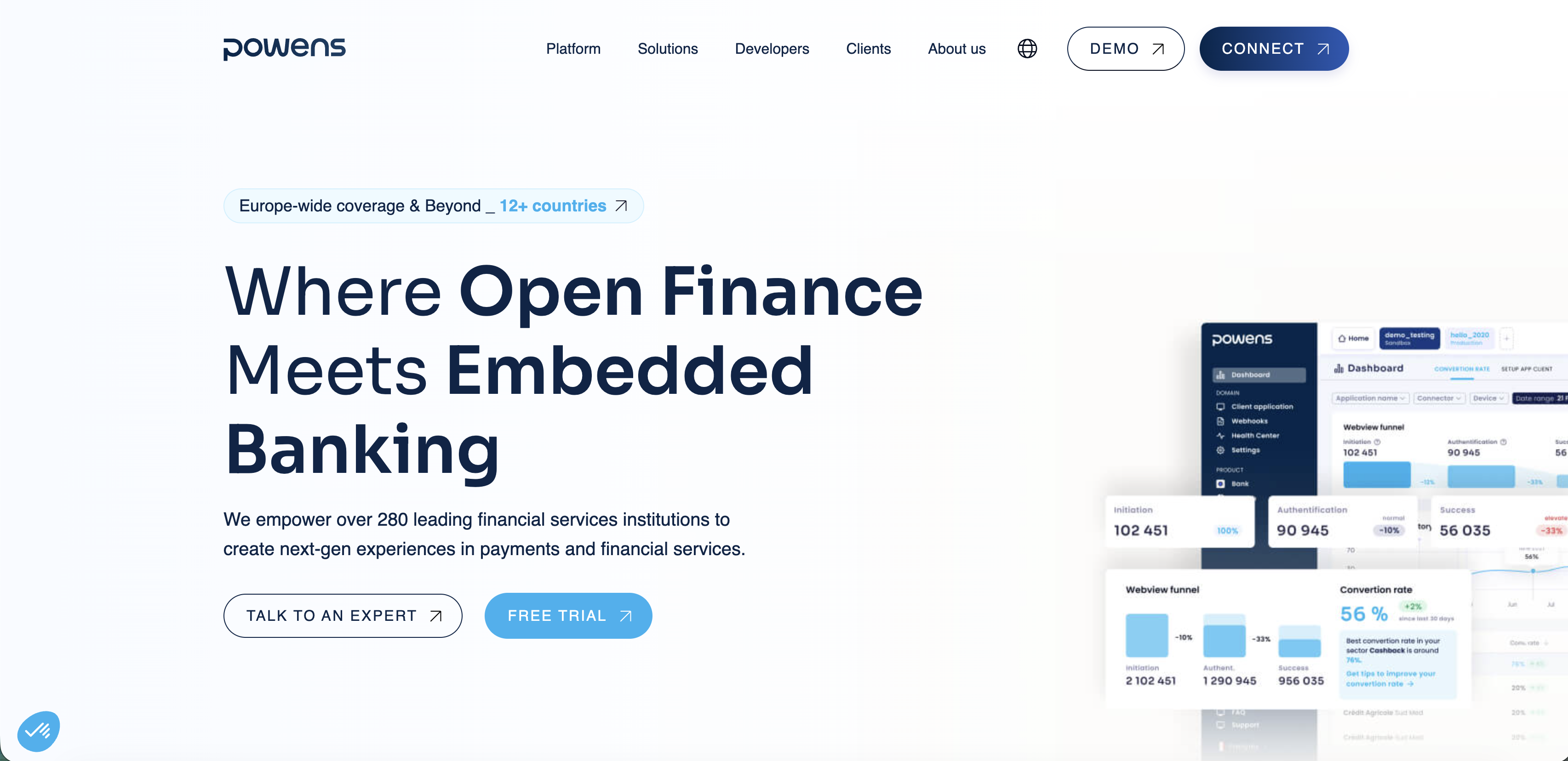
Powens sits at the intersection of open banking and financial data aggregation, helping European fintechs and traditional banks make sense of the fragmented payment and account landscape. Rather than building another me-too aggregator, the company positions itself as the connective tissue between institutions and the data they need to move capital efficiently and securely. Their platform ingests transaction data, payment initiation flows, and account information from thousands of financial institutions across Europe, surfacing clean, standardized intelligence to power lending decisions, fraud detection, and embedded finance experiences. What sets Powens apart is its focus on the continental European market—where open banking adoption is uneven and legacy banking infrastructure still dominates. While UK and US aggregators have enjoyed first-mover advantage, Powens saw an opportunity to build native expertise in Germany, France, Spain, and Benelux, where regulatory tailwinds and fragmented banking systems created genuine demand. The company works with both consumer-facing fintechs and institutional clients, meaning they've learned to navigate the messy reality of building infrastructure that talks to both sleek fintech apps and stuffy corporate banking platforms. This dual-sided approach has become their competitive moat—they understand both the user experience expectations of modern fintech and the compliance complexity of traditional finance. In the broader European fintech stack, Powens functions as a critical middleware layer, solving the unglamorous but essential problem of data connectivity that powers everything downstream—from embedded lending to fraud prevention to wealth management.
Founded 2015
Showing 12 of 62 companies. View all in the directory →